
Unit testing — Classical vs. London Approaches
Most, if not all, software projects suffer from the same problem. When starting the project it’s very easy to include new features. One feature might take one day to implement, but as the code base grows, implementing something new will take a week, a month, or half a year until it’s impossible to implement something without breaking something else. Different parts of the code depend on each other and this can create a cascading effect where a small change propagates throughout the entire codebase breaking a lot of stuff.
Unit tests are safeguards that help the developer in writing code that does not break the existing code, making it easier to make progress when working on the codebase.
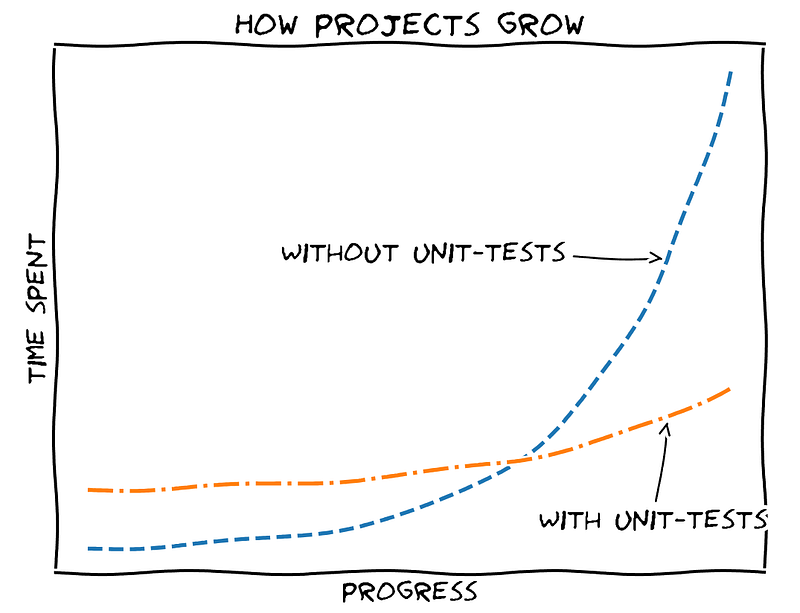
In the early stages of a project, it is probably easier and faster to implement new features than it is to write unit tests for them. For smaller projects implementing unit tests might even hinder the progress of the project, but in the long run, it is worthwhile.
What is a unit test?
def test_is_hungry():
    cat = Cat("funnywhiskers")
    assert cat.is_hungry is True

def test_meow():
    cat = Cat("funnywhiskers")
    assert cat.meow() == "Meow!"

def test_eat():
    cat = Cat("funnywhiskers")
    assert cat.eat() == "Yum!"
    assert cat.is_hungry() is False
    assert cat.eat() == "I'm not hungry."
In this example, we see that even though we have one Cat class, the tests are split into smaller pieces, each testing a small aspect of that class. This is where the name “unit” comes from. Furthermore, each test is small, to the point, and fast. And lastly, each test is isolated from each other. What isolation means exactly, we will explain shortly.
A unit test has the following properties:
- it verifies a piece of code.
- it is fast.
- it is isolated.
The requirement that a unit test is isolated is something that many people have strong opinions about, so strong even, that we broadly have two schools of thought: The London (mockist) and the Detroit (classical) school.
The classic view of isolation
Let us examine the classical school first. Imagine that our cat codebase has grown quite a bit and now we also have an Owner class that is responsible for getting the food for the cat. Again, a simple test to test this functionality would be
def test_classical_eat():
    cat = Cat("funnywhiskers")
    owner = Owner("Robert")
    food = owner.get_food("fish")

    assert cat.eat(food) == "Yum! Ate fish."
    assert cat.is_hungry is False
There is a small issue with this test, however. We are testing whether the .eat method and .is_hungry method are working as intended, but what if we introduce a change in the codebase corresponding to the Owner.get_food method in such a way that cat.eat(food) != "Yum! Ate fish.". The test will fail, but not because anything is wrong with our cat, but because we changed the behavior elsewhere. This is the classic example of touching one part of the code and it breaks something else. This cascading effect of a bug that propagates throughout the code base and fails a lot of tests, is not necessarily wrong. If many tests fail because we made a change to .get_food it means that the codebase heavily depends on it and we discovered that it’s quite an essential piece of code.
The downside, however, is that when a lot of tests fail it becomes difficult to isolate where the problem exactly is. As mentioned, in this case, we’re testing the eating behavior of the cat, but the problem lies in the .get_food method of Owner. And according to the Londonists, this is due to isolation.
The London view of isolation
When testing a piece of code that depends on other parts of the codebase, the Londonists say we should replace those dependencies with dummies (also called doubles or mocks). The above test then becomes
def test_london_eat(pytest_mock):
    mock_owner = pytest_mock.Mock(spec=Owner)
    mock_owner.get_food.return_value = "fake fish"

    cat = Cat("funnywhiskers")
    food = mock_owner.get_food("fake fish")
    assert cat.eat(food) = "Yum! Ate fake fish."
    assert cat.is_hungry is False
where we used the mocking capability of pytest to create a fake version of Owner. The line mock_owner.get_food.return_value sets the return value of get_food regardless of how get_food is implemented in the code base.
A note on dependencies
In the classical style of testing, it is still important that unit tests do not depend on each other. Certain dependencies that are shared, should still be mocked even in the classical style. For example, updating a shared database might cause issues with other tests that operate on the same database. Imagine a hundred tests that all add the same cat named funnywhiskers to the database. This can cause many problems while testing, either because the database requires unique cat names or maybe because there is a test that adds and removes Funnywhiskers from the database and asserts that no there is no Funnywhiskers in the database anymore.
Comparisons
As mentioned above, isolation in the London school attempts to isolate dependencies and as such test small “units” of code. This has a few side effects though (some positive, some negative). These tests tend to be more focussed on the implementation of code, rather than the behavior of code. In the get_food example, if we refactor the code so that get_food returns an instance of a Food object, and .eat accepts this food instance the classical test will pass, whereas the London test will fail because get_food is mocked in a way to return a str object, rather than a Food object. Consequently, classical tests generally protect better against code refactors.
One benefit of London-style testing is that if you have a large code base with a lot of tests, if you introduce a bug in an important piece of code it will only cause relevant tests to fail and allow you to quickly figure out where you introduced the bug. In the classical style of unit testing, you will see many more tests that fail because of the dependency issue. If you run all the unit tests frequently however, (e.g. with every commit or even more often) you should be able to quickly figure out what went wrong anyway because you haven’t made many changes yet. So in practice, this shouldn’t be too big of a problem for developers.
+====================+=======================================================+
|       Aspect       |  Classical (Detroit) School | London (Mockist) School |
+====================+=======================================================+
| Isolation          | Units are not isolated from | Units under test are    |
|                    | each other; only the tests  | isolated from each      |
|                    | are isolated.               | other.                  |
+--------------------+-----------------------------+-------------------------+
| Unit Under Test    | A unit of behavior.         | A unit of code, usually |
|                    |                             | a class.                |
+--------------------+-----------------------------+-------------------------+
| Dependencies       | Only shared dependencies    | All dependencies except |
|                    | are replaced with test      | immutable ones are      |
|                    | doubles.                    | replaced with test      |
|                    |                             | doubles.                |
+--------------------+-----------------------------+-------------------------+
| Granularity        | May not provide as fine-    | Provides better         |
|                    | grained control as the      | granularity.            |
|                    | London School.              |                         |
+--------------------+-----------------------------+-------------------------+
| Ease of Testing    | Less focused on ease of     | Makes it easier to test |
|                    | testing large graphs of     | large graphs of         |
|                    | interconnected classes.     | interconnected classes. |
+--------------------+-----------------------------+-------------------------+
| Debugging          | Doesn't make it particularly| Easier to find which    |
|                    | easy or hard to find which  | functionality contains  |
|                    | functionality contains a    | a bug.                  |
|                    | bug.                        |                         |
+--------------------+-----------------------------+-------------------------+
| Issues             | Does not hide issues with   | May hide issues with    |
|                    | code design.                | code design due to      |
|                    |                             | focus on units of code  |
|                    |                             | rather than units of    |
|                    |                             | behavior.               |
+--------------------+-----------------------------+-------------------------+
| Over-Specification | Less likely to couple tests | Higher risk of over-    |
|                    | to the system under test's  | specification; tests    |
|                    | (SUT's) implementation      | could become coupled to |
|                    | details.                    | the SUT's implementation|
|                    |                             | details.                |
+--------------------+-----------------------------+-------------------------+


