
The Weaponization of Telegram and Internet Blackouts in Gaza
It is time to speak out: Israel’s systematic genocide over Palestine
Here in Patagonia, the dark web is more a sci-fi concept than a reality. If you want to get some off-grid, forbidden, shady stuff, the place you visit is Telegram and its local groups. Once there, you have one of two possible outcomes: get what you are looking for — drugs, sex, and rock’n roll — or someone trying to scam you (don’t fall, my friend).
What I wasn’t aware of is that, amid the Israel-Hamas war, Telegram would emerge as a mind-bending weapon. Yes, like Patagonians, the Israelis also reach out to the unconventional market of cannabis (especially after the government officially decriminalized it) through the app. But Telegram witnessed a surge in users propelled by sustained government pressure on traditional news sources. And Hamas, the oppressed Palestinian Resistance, took notice of it. And, once again, it caught the Israelis off-guard.
Telegram’s Surge Amidst Conflict
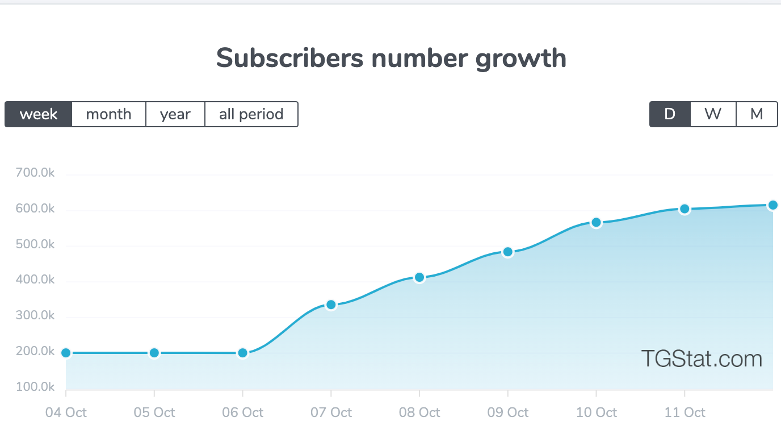
In the past, when violence escalated, there was usually an increase in Telegram activity. On October 8, Pavel Durov, Telegram’s Russian founder, acknowledged this surge, noting that “hundreds of thousands are signing up for Telegram from Israel and the Palestinian Territories” were signing up from Israel and the Palestinian Territories, emphasizing the need for reliable news and private communication during these dire times. This phenomenon during the Israel-Hamas conflict exemplifies how Telegram has served as a powerful tool for the dissemination of propaganda. The ability to easily share content, coupled with the platform’s lax content moderation, allows extremist messages and graphic imagery to reach a global audience, all while conspiracy theories flourish in the absence of credible information.
Because Hamas, a group long banned from major social media platforms, found refuge on Telegram. When it launched its attack on Israel on October 7, Hamas had a significant presence on the platform, and a dissemination strategy with specifically-designed-for-2023-virality type of content made it a vital weapon, playing a crucial role in amplifying the impact of Hamas’ actions. And also in misrepresenting it.
The real-time broadcasting of Hamas’ attacks on Israel was termed “psychological warfare.” And all the most extreme content can all be traced back to Telegram.
The surge in content on Telegram, particularly violent and graphic videos, found an eager audience. In particular, the Qassam Brigades channel, dedicated to Hamas’ military wing, experienced exponential growth in subscribers and views. The channel strategically utilized techniques inspired by the Islamic State’s playbook to spread its actions and gain support. The content initially uploaded to the Qassam Brigades Telegram channel was subsequently reshared by supporters, news outlets, and other social platforms, leading to further distortion and amplification of events.
Another source is AryJeay, whose Telegram is frequently updated.
Durov’s Historical Stance and Dilemmas
The leader of a leading social media platform is often damned if they do, damned if they don’t. Many believe Instagram has been censoring and shadow-banning pro-Palestinian accounts, some of which had resorted to burying the #IStandWithIsrael hashtag in posts to get seen. Meta, which owns Instagram, said it had fixed several bugs that may have been causing such issues.
Telegram’s stance during this crisis has been a subject of debate. Despite mounting (and effective) pressure to ban Hamas’ channels, Telegram resisted calls to block other channels, citing the complexity of regulating speech during a conflict. This has raised concerns about the platform’s role in facilitating the rapid spread of extremist content and its impact on shaping global events.
In a post on October 13, Durov cited a Hamas warning before a strike on the Israeli city of Ashkelon as a reason not to act: “Would shutting down their channel help save lives — or would it endanger more lives?”
As the Israel-Hamas conflict continues, Telegram emerges as a primary platform for witnessing the conflict in real-time, unfiltered and unmoderated. Its unique features, such as public channels with unlimited subscribers and private groups accommodating up to 200,000 people, provide a space for skeptical individuals to access alternative narratives. However, this stance, reminiscent of the app’s role during Russia’s invasion of Ukraine, entrenches the platform in another geopolitical and humanitarian crisis.
Durov’s reluctance to interfere in political and international crises, based on pragmatism, ignited a broader debate about the responsibilities of major social media platforms. But he’s all business.
This debate brings to mind past instances where Telegram faced criticism for its stance during the rise of the Islamic State. In 2015, when questioned about Telegram being the preferred app for Islamic State and other jihadist groups, Durov defended the platform, refusing to compromise user privacy, which drew widespread criticism. Following the terrorist attacks in Paris, Telegram took action by banning 78 IS channels, deploying a bot to track and eliminate new channels, and cooperating with Europol.
On October 13, Durov mentioned that Telegram’s moderators and AI tools are working to remove millions of obviously harmful content. However, he acknowledged that tackling war-related coverage is complex and requires careful consideration, considering the differences between social platforms. Durov argued that Telegram users only receive the content they have subscribed to, unlike other apps that algorithmically promote shocking content. Therefore, he concluded that it is unlikely for Telegram channels to amplify propaganda significantly.
The truth is that people who wish to bypass restrictions and access blocked Hamas channels can purchase anonymous Telegram numbers using the Telegram-approved cryptocurrency called Toncoin. They can then download the messenger via Telegram’s website and log in using these unidentified numbers. And even if Hamas is removed from Telegram, the group will find alternative ways to share its message. They are currently testing a rudimentary app to update people on the latest news and announcements from the Qassam Brigades, showcasing their expanded technical capabilities.
The bigger problems for Palestinians, though, are much more pressing than divulging content or getting tangled in conspiracy theories — the scarcity of food and water and the continuous targeting of civilian buildings by Israel. In a straightforward compensation for their weak online strategy, Israel has reportedly initiated a complete internet shutdown in the region since October 27. And once again, it is the innocent Palestinians who suffer the most from this damaging action.
Gaza Off From the World
Since October 7, Israel’s response in Gaza has purportedly caused over 10,000 deaths, including more than 3,000 children, as per Ashraf al-Qidra, a spokesman from the Gazan Health Ministry. The widespread destruction has severely impacted the community’s essential utilities and infrastructure, including internet and communication systems, leaving approximately 2.2 million Gazans with limited connectivity to the outside world.
Shutdowns in the region, lasting between 15 and 34 hours, coincidentally took place forcefully as Israeli troops entered the Gaza Strip intending to isolate Gaza City from southern Gaza. While researchers cannot definitively attribute the blackouts to Israel or determine whether they resulted from technical controls or physical infrastructure destruction, the rapid restoration of some connectivity suggests intentional shutdowns rather than incidental damage. Because Gaza has around a dozen internet service providers and cell phone companies, primarily relying on Israeli infrastructure for global internet access.
On October 17, ahead of the total blackouts, the Israeli communications ministry published an update on the war that appeared to detail its plans. “There is an ongoing examination and preparation for the shutting down of cellular communications and internet services to Gaza,” the update said.
The destruction of mobile and internet providers’ offices, cables, and cell towers has left many completely offline. Despite partial restoration, data indicates that connectivity is around 15% or less than the usual capacity, with reports estimating that 65 percent of households and businesses in Gaza have lost internet access. Paltel, the largest internet provider in Palestinian territories, alleges that Israel intentionally disconnected its services during the blackouts. The Ministry of Communications and Information Technology of the State of Palestine has also claimed that there has been systematic targeting of networks and called on countries to put pressure on the Israeli government to restore connections.
“This is a terrifying development,” Marwa Fatafta, a policy manager focusing on the Middle East and North Africa at the digital rights group Access Now. “Taking Gaza completely off the grid while launching an unprecedented bombardment campaign only means something atrocious is about to happen.”
Internet as a Formidable War Weapon
In recent years, internet shutdowns have become a frequent dystopian reality for millions of people living under authoritarian regimes in attempts to suppress protests and curtail free speech. Last year, there were 187 internet shutdowns in 35 countries, according to Access Now, a digital rights nonprofit. And targeting the communications networks is common during conflicts. Because internet shutdowns can damage a country’s economy and people’s ability to communicate with friends and loved ones and access medical care and other essential information. During Russia’s war in Ukraine, its forces have decimated communications networks, tried to take over the internet, and set up new mobile companies to control information flows. Even when Hamas first attacked Israel on October 7, it used drones to bomb communications equipment at surveillance posts along the borders of the Gaza Strip.
These deliberate actions to disrupt internet access have had devastating consequences for the people of Gaza, exacerbating an already dire humanitarian situation. The international community must condemn these actions and work towards ensuring that all individuals have access to essential services and communication channels, regardless of their geopolitical circumstances.
Israel has taken things to a whole different level: it’s explicit genocide.
The kinetic warfare, the starving, targeting hospitals, solar panels, water tanks, people running out of electricity, clean water, food, medical supplies, and safe shelter. But losing communications turned out to be critical: they could not contact relatives and friends and reach out for water and bread.
The words of Dr. Ghassan Abu-Sittah, a volunteer in a Gaza hospital, shed light on the motif:
Gazans, isolated from the outside world and each other, faced scenes straight out of an apocalyptic movie. Rescue crews struggled to locate airstrike sites by observing the direction of explosions. Injured individuals were transported to hospitals by volunteers who provided the location of the airstrike to assist in saving others. The voice of the Gazans felt insignificant as if they were dying alone.
In their own words, “We expected to die every second. We just hope to stay alive.”
How can anybody live like this?!
It’s Not Me, It’s Israelis Who Say It: This Is Deliberate Genocide of Palestine
On one side, we can see that the Palestinian Resistance has a strategy. In contrast, Israel is applying the oxymoron of ‘strategic bombing’ (killing everyone is the absolute lack of strategy). Israel is murdering babies in hospitals while the Resistance is blowing up tanks at point-blank range. Israel is waging genocide while the Resistance is waging war, which are different things altogether. And Israel has been saying it loud and clear.
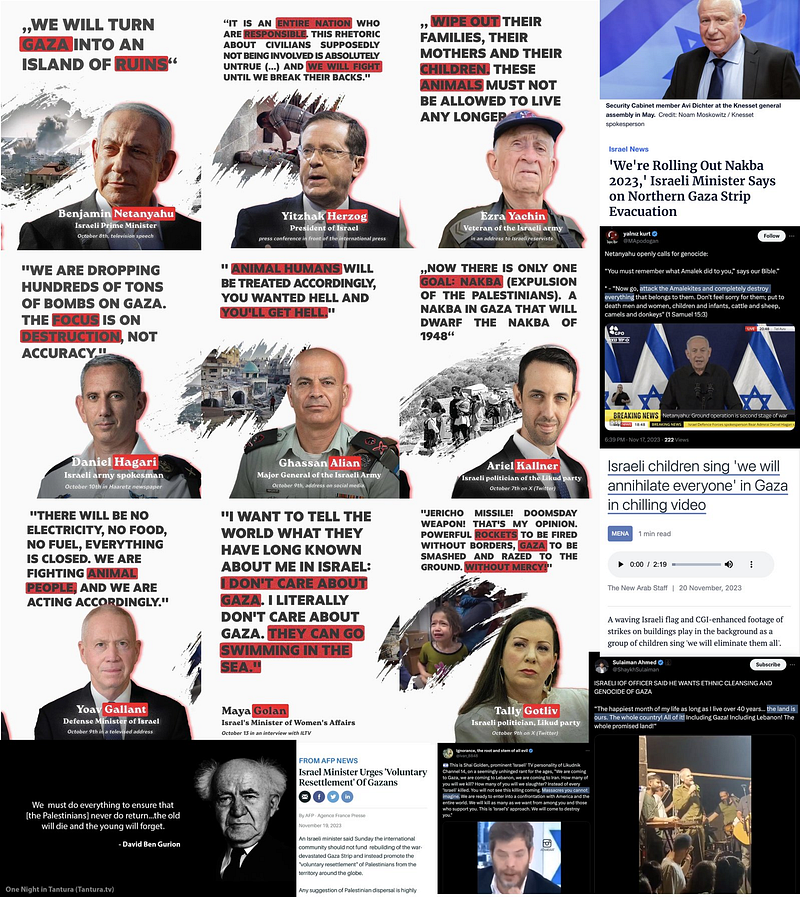
Just go ahead and read the following compilation of genocidal quotes:
‘We will turn Gaza into an island of ruins,’ — Netanyahu, Israeli Prime Minister
‘We are dropping hundreds of tons of bombs on Gaza. The focus is on destruction, not accuracy,’ — Daniel Hagari, Israeli Army Spokesman
‘Wipe out their families, their mothers, and their children,’ — Ezra Yachin, veteran of the Israeli Army
‘Animal humans will be treated accordingly: you wanted hell and hell you’ll get,’ — Ghassan Alian, Major General of the Israeli Army
I don’t care about Gaza: they can go swimming in the sea,’ — Maya Golan, Israel’s Minister of Women’s Affairs
‘There is only one goal: Nakba (the mass displacement and dispossession of Palestinians),’ — Ariel Kallner, Israeli politician
The plan is pretty straightforward: bomb everything and everybody and try to break the will of an entire nation, not just their military.
Ask yourself now, who are the terrorists? Who is a force, and who is a farce?
Contrary to the Western claims that Hamas is trying to ‘kill everyone’ or even Jews, the Resistance does not seek to kill and, even less, based on religion. As stated in the Hamas charter, their conflict is with the Zionist project, not with Jews because of their faith. Hamas recognizes that the persecution of any individual based on nationality, religion, or sect is unjust. The Jewish problem and anti-Semitism are historical phenomena tied to European history, not to the Arab or Muslim heritage. This is propaganda from the actual antisemites in the West. Hamas fights against the Zionist occupation of Palestine. It aims to reclaim their land in a region that opposes such an invasion.
The stories of rape and beheaded babies on October 7 are baseless and disproven by evidence and common sense. The Al Aqsa Flood was a targeted military operation, taking hostages for potential exchanges. In their panic and incompetence, Israel caused friendly fire incidents resulting in the deaths of their own civilians. Instead, they spread lies to incite further violence in their genocidal campaign. While they deceive the gullible Western media, in Hebrew, they reveal the truth.
So, while the world watches, the Israeli government keeps cutting off essential resources to the two million people trapped in the world’s biggest open-air prison, a.k.a. Gaza, inflicting collective punishment for the actions of Hamas. The international community, led by President Biden and his European allies, turns a blind eye and questions the validity of the Palestinian Health Authority’s reports on the number of casualties.
Meanwhile, as bombs continue to rain down on Gaza, Israel prioritizes its own economic interests. Just recently, Israel granted 12 licenses to six companies to explore natural gas reserves off its Mediterranean coast. These gas fields hold immense value, estimated at $524 billion. However, the legality of Israel’s entitlement to these resources is questionable. A UN report states that some of these reserves are sourced from within the Occupied Territory of Palestine, and the rest lies outside national borders. It is unjust for Israel to claim exclusive rights to these resources, considering the historical occupation of Palestinian territory and the fact that these reserves took millions of years to form.
The situation in Israel and Palestine is dire. This brutal campaign aims to crush the Palestinian spirit and eliminate any hope of future Resistance. The backing of the United States and Europe further enables Israel’s war crimes and genocide.
I don’t support violence by any means. But it is time for the international community to acknowledge the truth: Israel is not just committing war crimes; Israel is a war crime.


