
Unfashionable choices
There is an urgent need to assess and address the largely untold and untethered environmental impacts of your daily wardrobe.
The oil, coal and gas industries have taken the brunt of the blame for the global climate crisis. This blame is both understandable and well-placed; these industries have literally fueled the crisis and there is more than enough available evidence to show that their in-house scientists knew of the adverse consequences of burning fossil fuels, yet the companies kept the secret while funding political denial. This should not excuse a lack of scrutiny into the role that other sources and industries have played, and are continuing to play, in setting the stage for and perpetuating man-made climate change. Which brings us to the clothes on your back.

Estimates place the fashion industry as a trillions of dollars per year business. The fashion world has been pegged as the second most polluting industry following oil and the second largest user of water. Although the exact numbers may be unconfirmed, the fashion world ranks near the top of the list of dirty and wasteful business sectors. It is difficult to hammer out the exact scope of pollution and carbon emissions from fashion due to the extensive and complicated supply network involved in the production of apparel and textiles. The impacts of the fossil fuel industry are better understood because of its simpler web of extraction, processing, and end-use consumption. One study published in 2010 identified the fashion industry as an emitter of 10% of global greenhouse gas emissions. And yet most consumers don’t see the fashion industry as a climate culprit; most scientists haven’t tackled the scope of the pollution created from the industry; and, most of the suppliers, manufacturers, and retailers of fashion have felt little pressure to face and tackle their complicity in the industry’s carbon footprint. Unethical labor practices and the highly visible use and discharge of toxic chemicals has largely held the public’s critical eye.
“Fashion’s true environmental scope is astounding. It touches agriculture (cotton, flax, hemp), animal agriculture (leather, fur, wool, cashmere), petroleum (polyester and other synthetics), forestry (rayon), mining (metal and stones), construction (retail stores), shipping, and, of course, manufacturing. And this complex and multilayered supply chain provides both a challenge and an opportunity for climate advocates.” Racked.com, March 2017.
Let me backpedal for a second here. There is an unhealthy lack of public knowledge regarding what climate change is, and the consequences of inaction. Increased human activity since the advent of the Industrial Age has altered the composition of the atmosphere: most importantly, we have increased the amount of certain gases (e.g., carbon dioxide and methane) that hold in heat like a blanket around the planet. There is now an imbalance in the carbon cycle within the natural world: the forests, soils and oceans, once serving as sinks for these gases, are now overtaxed. The results are increasing temperatures, magnified extreme weather events, rising sea levels, and species extinctions. This climate crisis will come to roost on your doorstep eventually, if it hasn’t already. Climate change also has direct ramifications on the fashion industry, in terms of impacts to agriculture and material resources, water shortages, and disruptions to suppliers, transporters and retailers. Just as with the oceans and the forests, the corporate world is large, but not large enough to evade imbalance in the long-term.
Greenhouse gas emissions that are produced by the fashion industry are largely due to fiber production, spinning, and consumer care. It is estimated that 60 billion kilograms of fabric are produced globally each year, requiring approximately one trillion kilowatt hours of electricity. Every kilowatt hour of electricity produced by burning coal produces 900 grams (or about 2 pounds) of CO₂. It adds up, in this case to more than 900,000 metric tons of CO₂ emitted by the fashion industry each year. This number pertains to direct energy usage and does not reflect the emissions generated from the sourcing and growing of raw materials and the transportation of materials and goods. Also, it doesn’t account for use by consumers. According to the Athenas project at Kansas State University, the carbon footprint associated with the spinning, knitting, dyeing, finishing, cutting and sewing required to manufacture just one kilogram (2.2 pounds) of fabric can emit over 27 pounds of CO₂. This is more than 6 times as much emissions as is produced from the manufacture of the same quantity of steel.
The fashion industry uses vast amounts of water and resources; approximately seven trillion liters of water are consumed per year for textiles, and the production of a single shirt and jeans outfit can consume 5,000 gallons of water. The industry is resource-intensive in terms of both labor and raw materials, utilizing pesticides and herbicides, dyes and other chemicals, fossil-powered machinery and transportation, and direct production with fossil fuels (polyester and nylon). Transportation provides an outline of the complicated network between sources, suppliers, manufacturers and retailers: the materials for any one garment are generally not sourced from or manufactured in any central location. It is estimated that 22 billion new clothing items are bought by Americans per year, with only 2% being manufactured within the country. Instead, raw materials, garment and packaging components, and final products are driven, flown and shipped from locations around the world before making the final trip to be burned or to be buried in methane-producing landfills.
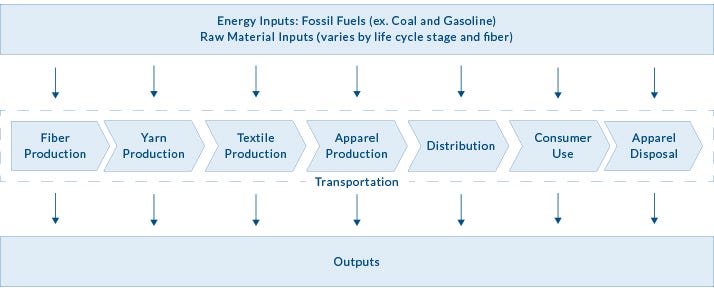
If we are to avoid the critical increase in global surface warming of 2 degrees Celsius above pre-industrial levels, industries and individuals need to take a closer look at their own carbon footprint. Humanity has already swept past an increase of 1 degree, and is likely to hit a 1.5 degree increase before 2050. According to the Ellen MacArthur Foundation, emissions from textile production will rise by more than 60% by 2030 if the industry stays on its current trajectory. The world of “fast fashion” has a heavy hand in this upward trend, no pun intended, where clothing is considered as disposable as last night’s takeout containers.
The fashion industry can begin with a life-cycle analysis of their products to get a better understanding of where materials are extracted or grown and how these materials and goods move from cradle to grave, including farming and resource extraction, manufacturing, transportation, real estate and waste management. The Sustainable Apparel Coalition has created a set of tools called the Higg Facility Modules to help fashion brands, facilities and retailers track not only environmental impacts, but social impacts as well. Use of tools such as these can ease the effort of the fashion industry in calculating their overall environmental and social footprint, perhaps providing a level of standardized assessment and transparency that consumers would appreciate. It should be noted that “sustainability” is not just an environmental term, but includes social and economic aspects as well. A related organization, the Global Fashion Agenda, provides a partnership and platform for cooperation on sustainability in fashion, hosting the annual Copenhagen Fashion Summit and including notables such as Target, Nike and H&M. If you look across the groups of sustainable fashion participants among these organizations, you will sadly see the same brand and retailer names repeated.
“Our profound wish is to create change in our industry. Creating real change in the fashion system takes a collaborative effort. We’re proud to take leadership on sustainability along with some of the world’s foremost companies, our Strategic Partners and Associate Partners. Through our initiatives we guide fashion leaders around the world to make sustainability a strategic priority, because sustainability is no longer just a trend — it’s a business imperative.” Eva Kruse, CEO of Global Fashion Agenda.
The Global Fashion Agenda has set forward eight sustainability priorities for the fashion industry, including the environmentally-minded development goals of supply chain traceability, combating climate change, use of sustainable materials, and efficient use of water, energy and chemicals. In 2018, fashion stakeholders, with the guidance of the UN Climate Change group, have worked to identify climate action commitments for the textile, clothing and fashion industry, including the creation of the Fashion Industry Charter for Climate Action with an eye on achieving net-zero emissions by 2050.
There are many solutions to be offered for reducing the environmental footprint of the fashion world. There are notable sustainable brands that use recycled materials or organic sources, such as switching to organic cotton, or have made moves to replace polyester with a recyclable alternative or use synthetic materials that do not shed micro-plastics when washed. The industry can focus on reducing water consumption at every point in their production chain, as well as minimize the use and discharge of dyes and other chemicals. Some forward-thinking brands have considered the use of regenerative agriculture, where proper land management can lead to more carbon being pulled out of the air than emitted. Sourcing and production of materials and garments can be consolidated to avoid additional transport. Packaging can be reduced, facilities can switch to renewable energy sources, energy efficiency of lighting and machines can be improved, and the amount of discarded textiles can be reduced and reused. Technological innovation and savvy design can utilize sustainably grown crops (e.g., hemp), up-cycled materials (e.g., everyday objects no longer in use) and improvised sources (e.g., slime mold). Much of the current apparel and textiles are produced in China and India where inroads have been made to increase use of renewable energy sources and abate pollution, however, there is still much left to be done. Some of these measures are a win-win for the industry: better land and resource management, decreased reliance on or improved efficiency of transportation, and a reduction in water, chemical and energy usage boost the bottom line.
Consumer usage includes washing, drying, dry-cleaning and final disposal. What YOU do, from the decision to purchase to how you use and take care of clothes to how you dispose of them, is a significant part of the overall carbon fashion footprint. You can make more informed decisions on the brands and textiles that you buy, and you can reduce your own overall water, chemical and energy usage involved in the care of your clothes. Avoid quick-turnaround disposable fashion trends and be wary of brands touting use of recycled products as they might be buying virgin material to make up at least part of the product. We know more about where our food comes from than where our clothing is sourced and manufactured. Oftentimes, the change at the level of the individual is relatively minor, however, the combined impact of those individual changes can have incredible force and influence.
The fashion industry is only starting to embark on a long look at their own activities in regards to climate change. Without the spotlight of consumer pressure on the fashion industry, it may be business-as-usual into the future and that’s not good for anyone in the long run. The answer for industry executives is to save money and get a return on profits, and the answer for consumers might just be to make sustainability a new and lasting fashion trend. The carbon cycle is a circular system, with inputs, outputs, sources and sinks: what goes around, comes around. The production, sale and use of consumer goods should also be viewed as a circular model with finite inputs and outputs that have impacts on the whole. Your clothes have made a mark on the world from the start, but there is no finish line for the items that you buy — throwing them away does not make them go away, and some effects will be around for generations.