
Understanding Why Apple Makes The iPhone SE So God Damn Boring Will Help You Land High-Income Clients
Get so smart at building pricing ladders that clients leave with the forbidden fruit.
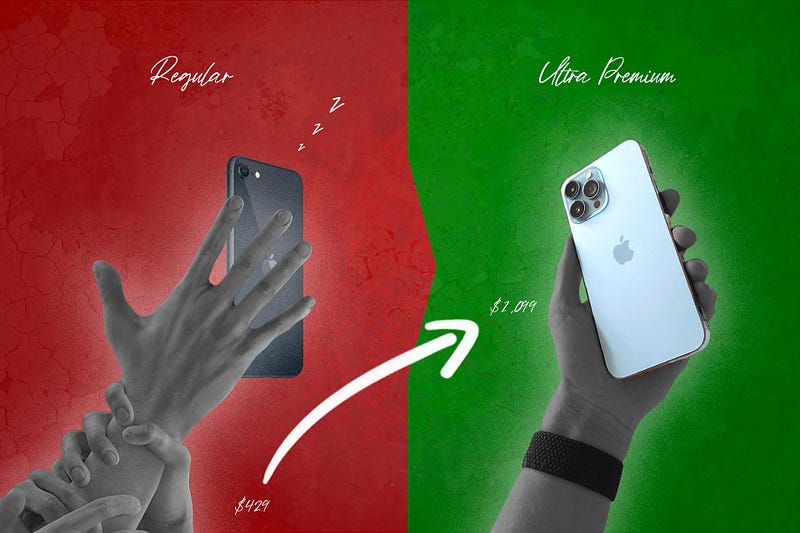
Everyone wants an iPhone.
The Samsung employee who stealthily browses Apple’s website on the toilet during a lunch break. The hater who makes Apple memes for a living. The seasoned Android power user who secretly wants a naughty littl’ bite of the forbidden fruit.
And then there’s me.
The Apple fanboy who curls his toes in excitement under a furry blanky, ready to enjoy a stash of specially prepared emergency Keynote snacks for the moment Uncle Tim cues the live stream and utters the three most jubilant words every Apple fanatic wants to hear:
One more thing…
But there is always one boring duckling in the iPhone lineup.
The iPhone nobody wants.
The one that your brain tells you is a dependable investment. The one that your heart tells you is so unglamorous that it is probably better to invest a little more to get an iPhone with a double digit behind its name. The one your kids hide in the top drawer when their friends come over. The one you got your grandma on her 80th birthday.
The iPhone SE.
Probably Apple’s most profitable iPhone.
Not because of its sales.
Because of its ability to make you want more.
Something better. Something faster. Something sleeker.
Apple has perfected its pricing strategy so we don’t have to.
A wise entrepreneur once told me:
“If you ride on the giant’s shoulder, you see what the giant sees.”
Perhaps you’re scared that lowering your price will make you cheap. Perhaps you’re tired of lying in bed at night thinking of how competitors are snatching all your honey. Perhaps you’re just tired of cheap clients who send you manipulative messages to get more work out of you. Perhaps you’re just curious about what Apple has figured out about pricing that you haven’t quite learned.
Perhaps you feel like it's your time to peek over the giant’s shoulder and upgrade your pricing strategy.
Top takeaways:
- Make it painful to downgrade.
- Use good-better-best pricing tiers.
- When the market gets tough, add an affordable product instead of a sales discount on your premium option.
- Take clients from a binary buy/don’t buy mentality to a which option mentality.
Let me show you — exactly — how Apple does it.
Apple’s forbidden fruit pricing ladder in action
I was recently due for a long-awaited iPhone upgrade.
I had an iPhone XR.
It was a good phone.
But it just started to feel a little slow in a world where phones were getting “Oh. So. Pro.”
My humble journey started on a $450 budget.
Starting out, I had only 2 requirements:
- It had to be a new generation iPhone.
- It had to have good battery life.
That is perfect iPhone SE territory. But I just couldn’t see myself going back to the boring rectangular display and the infamous homescreen button.
Besides, if I add just $270 more, I can get an iPhone 13 mini.
Hmmmm...
But it’s too small.
Nope, definitely not enough battery life for me.
An Apple store visit confirms my suspicions.
My hands are too big.
Besides, if I add only $100 more, I have a much bigger size.
But are two cameras really enough?
I am, after all, a professional.
Maybe I deserve a Pro?
That Sierra Blue is just so fucking beautiful.
But then I might as well get the best of the best since I’m so close.
The cameras. The massive display. The massive, massive 120 Hz display.
Done.
I am now the proud owner of an iPhone 13 Pro Max.
I took a bite out of the forbidden fruit. I took a bite out of the forbidden Apple.
Or did Apple take a bite out of this hardened marketer’s soul?
Understanding Apple’s Good-Better-Best pricing model
For years, companies believed consumers were incredibly price sensitive.
They believed the best way to price their consumer products was to provide the highest quality at the lowest price.
In the early 2000s, it all changed.
Again and again, pricing experiments showed that a much more profitable way to price products was to create a 3-tier system.
In his book, Priceless: The Myth of Fair Value, William Poundstone goes over a purchasing pattern study offering customers different drink options.
Pricing Test 1:
- $1.80 — Regular drink
- $2.50 — Premium drink
80% of customers picked the premium drink while 20% picked the regular product.
Pricing Test 2:
- $1.60 — Cheap drink
- $1.80 — Regular drink
- $2.50 — Premium drink
Customers ignored the cheap drink. But the ratio between the other two products totally flipped around. 80% wanted a regular drink and only 20% opted for a premium drink in this case.
Pricing Test 3:
- $1.80 — Regular drink
- $2.50 — Premium drink
- $3.40 — Ultra-Premium drink
This ended up being the most profitable option.
5% chose the regular drink. 85% picked the premium drink. 10% picked the ultra-premium option.
Apple’s smartphone tier looks like this:
- Regular: iPhone SE
- Premium: iPhone 13
- Ultra-Premium: iPhone 13 Pro
Although the iPhone SE might at first glance come across as the cheap option, it actually falls into the regular section considering the overall smartphone market.
And that right there is what makes Apple so fucking smart at pricing.
Most consumers think Apple is using the pricing structure done in Pricing Test 2 while they are actually playing the game of Pricing Test 3 using the iPhone SE as a ladder to make the premium iPhone 13 more attractive.
And for the few consumers that chose to go with the iPhone SE, Apple has one final weapon in its toolkit to ensure profit gains.
On-device services.
When other companies put new smartphones on sale, Apple doesn’t mark down the iPhone 13. They just released a lower-tier iPhone SE.
When the price stays steady, 10% of sales, might be lost to a lower-cost rival. But Apple knows that 90% of buyers are still paying full price — whereas if there is a price cut, 100% of buyers will be paying less.
How to build your own pricing model that attracts high-income clients
Pricing other people’s work is easy.
Pricing your own work can be tricky.
You don’t want to come across as cheap. You don’t want to scare away potential customers. You don’t want to punish yourself for being good at your job.
Let’s be straightforward:
- Discounts cheapen your brand.
- Value-based pricing can often scare away smaller clients.
- Charging by the hour punishes you for being good at your job and can often piss off clients.
All of these options are binary.
Should I as a client buy this or not.
Take clients from ‘if’ to ‘which’
By learning how Apple perfected its pricing game, we can switch from an ‘if I should pick’ binary narrative to a ‘which one should I pick’ narrative by introducing options.
Yes.
Humans love picking things.
Stick with 3 options or less — at a time
But we know from researchers like Barry Schwartz that too many options can leave consumers so paralyzed that they’d rather walk away than buy anything.
I like to group my marketing packages into 3 tiers just like Apple.
- Regular — $5,550
- Premium — $10,550
- Ultra-Premium — $15,550
Notice that I used the words “at a time” in the title.
Always give clients an option upgrade certain aspects of the product.
A good option I like to give clients is to add further options within each category like Apple does with its size, and storage capacity options.
Use your premium prices to market you as premium
Your premium and ultra-premium products boost your brand image simply by being there.
Think about it.
Would you rather buy a $100 shoe from a brand that sells their most expensive shoes for $100, or a $100 shoe from a luxury brand that sells their most expensive shoes for $800.
The second option. Now we are buying into a bespoke luxury brand.
Clients buy the feeling of the solution being fixed.
Not the solution.
Just imagine how clients will brag about using your services on the golf course when you knock it out of the park.
Make it painful not to go for premium
The harder part is designing fence attributes that make it painful for customers to downgrade to the regular option.
This is the real reason the iPhone SE is so God damn unsexy.
Apple needs to make it painful for premium iPhone customers to downgrade.
Even the mugger who snatched grandma’s phone is disappointed to look at that cursed Touch ID button.
Although it may be incredibly intriguing, it is important not to make the regular package too nice. Leave the magic sauce that people think about before they fall asleep late at night for the more premium packages.
Let’s be honest.
Hate Apple. Love Apple.
Sliding that forbidden fruit out of your pocket feels fucking good.
You know what feeling I’m talking about.
Let your clients feel that same feeling and you’re set.


