
Understanding The Sources of Japanese Buddhism
The modern mix of Zen, Jodo Shin, and Tendai that is international
This article assumes some knowledge of both Asian history and Buddhist tradition. The Wikipedia links at the end are useful for background information. Post questions in comments, and I will attempt to answer or direct you to the best sources for detail.
The migration of Buddhism from the verbal tradition of northern India to Southeast Asia and then to China, Korea, and Japan shows a fantastic evolution of a very original spiritual system that, in many ways, seems designed for the problems of our world. One particular aspect is the movement from India to China and Japan.
The emphasis in the Japanese Jodo Shin tradition is very different from the early Buddhist monastic tradition of the Sangha as the center of Buddhism. But how did that evolve and retain the essential forms of Siddartha Gautama’s message?
A brief look at this history helps us understand the foundation on which the most successful form of Buddhism was built.
The history of any religion is difficult to assess. Religious beliefs define a cultural group’s origins, social roles, characteristics, and ideals. These are sacred to that cultural group.
Any effort to redefine, confirm, deny, or historically adjust elements of that religious story directly attacks how a cultural group defines itself. As history is the story of a people, the components of that story are not lightly changed or even questioned.
The scientific revolution heavily influences modern accounts and attempts to be accurate by dating original documents and events and attempting to understand the development of a religion based on shifting cultures over time.
Buddhism is unique among major religions in not defining itself as an origin story of a particular people but as a spiritual system to solve a specific human problem. That problem is the universal problem of existential pain. Yet, it became the cultural center for the cultures of most of Asia and beyond.
Buddhism gained two roles as the cultural defining story and, simultaneously, a more abstract spiritual philosophy not closely linked to a specific cultural record. For this reason, Buddhism has gained influence in the modern world. It has been adopted and adapted by individuals in different cultures over time with less conflict than more traditional religions.
While it has competed with other belief systems over millennia, it can be either a culturally defining religion or a personal spiritual philosophy.
The original teachings of Siddartha Gautama are abstract enough to stand on their own as a practical guide to living without directly challenging the folk traditions of a cultural group. Buddhism in the modern world is increasingly free from ties to fixed cultural histories.
Specifically, I find the evolution of Buddhism from its earliest forms in Theravada to the spirituality of the Mahayana tradition fascinating. It is also one unique way of understanding the power and brilliance of the Buddhist path defined twenty-five hundred years ago. This brilliance is vital for the planetary challenges that we face today.
While Buddhism developed from the teachings of one monk in northern India, within two hundred years, it spread to the Hellenic world of Alexander the Great but more significantly to China of the Han dynasty.
We have little information on the missionary monks who first spread these ideas to China. Still, they took root there as elements of the Buddhist quest for knowledge echoed many similarities in Taoism. As a result, there were many years of confusion as Buddhist principles were not clearly stated in Chinese.
The first surviving translations of Buddhist texts into Chinese were those of the 2nd-century Parthian An Shigao (Ch. 安世高), who worked in the capital of Luoyang. His work was followed by the extensive Mahāyāna translations of the Kushan monk Lokakṣema (Ch. 支婁迦讖, active c. 164–186 CE), as well as the work of Dharmaraksa (3rd century).
The second and third centuries CE led to the first Chinese schools of Buddhism. These schools became increasingly more sophisticated and distinct from the Chinese Confucian system, the Chinese rulers’ official philosophy.
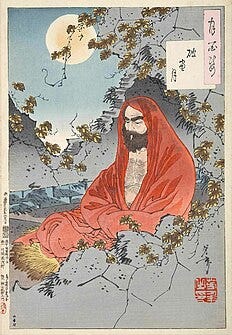
Bodhidharma was a significant individual in this era for China and later Japan. He was a semi-legendary Buddhist monk who lived during the 5th or 6th century CE, traditionally credited as the transmitter of Chan Buddhism to China, and is regarded as its first Chinese patriarch. Chan became Zen in Japan.
The 6th and 7th centuries saw a flowering of new and unique Chinese Buddhist traditions, including:
- The Tiantai school was mainly founded by the efforts of master Zhiyi (538–597 CE) and was based on the Lotus Sutra and the works of Zhiyi.
- The Pure Land tradition is based on the veneration of Amitabha and the works of Pure Land masters like Tanluan (476–542), Daochuo (562–645), and Shandao (613–81).
- Chan Buddhism is based on the teachings of various Chan masters such as Bodhidharma, Dazu Huike (487–593), Sengcan (?–606), Dayi Daoxin (580–651), and Hongren (601–674).
As you can see, the primary sources of Buddhism in 8th century Japan are part of this flowering.
Tientai (Tendai in Japan) and Chan (Zen) were closely tied to the Pure Land tradition that Shinran brought to a new level of influence in a changing Buddhist world.
Additional information and sources:
https://en.wikipedia.org/wiki/Chinese_Buddhism
https://en.wikipedia.org/wiki/Bodhidharma
Mike Meyer ~ Honolulu ~ September 21, 2023
Also, on Future Search/Black Bamboo


