
Understanding the Proxy design Pattern in Kotlin

The Proxy design pattern is a structural design pattern that acts as an intermediary between a client and an actual object. This pattern is particularly useful when direct access to an object is undesirable or suboptimal for various reasons. A proxy can filter, forward, or even delay the requests of the client before passing them to the target object. This intermediate layer can fulfill different functions, such as access control, lazy initialization, logging, or caching of requests to enhance performance.
A significant advantage of the Proxy pattern lies in its ability to promote the principles of separation of concerns and single responsibility. By managing the operations on an object, it allows for a clean separation between the complexity of interactions with an object and its core business logic.
The Proxy design pattern is often employed in situations where:
- Resource-intensive operations need to be delayed until their results are truly required (Lazy Initialization).
- Access to an object must be controlled or monitored, whether for security reasons, performance monitoring, or logging.
- A simplified interface to complex systems or network resources is needed, such as when working with remote servers or large datasets.
In practice, the Proxy pattern is used in many areas of software development, including web services, database access, file systems, and interaction with external services or APIs. Its ability to delay or control operations as needed makes it a valuable tool for the development of efficient and secure applications.
Scenario

Imagine you are developing an application for a library that allows users to browse, reserve, and borrow books online. The library has a large collection of physical books as well as a growing collection of digital books that can be read online. Due to the vast number of books and the varied locations of physical copies across different branches of the library, accessing information about the availability of books is a resource-intensive operation. It requires network requests to various internal systems to determine the current status of a book (e.g., checked out, available, reserved).
Problem: Every time a user retrieves the details of a book, the system performs extensive network requests to deliver the most up-to-date information. This results in slow performance, especially during peak times when many users access the application simultaneously. Additionally, it unnecessarily strains network resources and the servers providing the book data.
Expected Outcome: Users should be able to quickly and efficiently obtain information about books without the application needing to perform extensive network requests for every query. If a user retrieves the details of a book that has already been queried recently by another user, the result should be delivered instantly from the cache, without initiating repeat network requests. This would significantly improve the application’s performance and reduce the load on servers and network resources.
Why Consider the Proxy Design Pattern? The Proxy pattern can be used in this scenario to introduce an intermediary layer (Proxy) between the client (the application’s user interface) and the servers providing the book data. This proxy could be responsible for managing a cache where recently retrieved book information is stored. Upon a request for book details, the proxy first checks if this information is already in the cache. If so, the proxy delivers the data directly from the cache, without sending a network request to the backend systems. Only if the data is not present in the cache or is outdated does the proxy initiate a request to the backend systems to fetch the latest information.
This scenario helps understand when and why the Proxy design pattern can be beneficial: It offers an efficient solution for managing resource-intensive operations and enhances the performance and scalability of applications by introducing a smart caching mechanism.
First Implementation
To illustrate the scenario of the library application without using the Proxy design pattern, let’s consider a simple implementation in Kotlin that directly accesses data sources to fetch book details. This approach leads to the issues discussed earlier, such as inefficient use of resources and poor performance under high load.
class LibraryService {
    fun getBookDetails(bookId: String): BookDetails {
        // Represents a network request to get book details from a remote server
        println("Fetching book details for book ID: $bookId from the server...")
        // Simulates a network request with Thread.sleep
        Thread.sleep(1000) // 1-second delay to simulate the network request
        return BookDetails(bookId, "Some Book Title", "Some Author", "Available")
    }
}

data class BookDetails(val id: String, val title: String, val author: String, val status: String)

fun main() {
    val libraryService = LibraryService()
    // Represents multiple requests for the same book details
    println(libraryService.getBookDetails("book123"))
    println(libraryService.getBookDetails("book123"))
}
In this example, the getBookDetails method of the LibraryService class retrieves the details of a book through a simulated network request. Each request incurs a delay, slowing down the application's response time. This implementation shows no form of caching or intelligent data retrieval strategy, leading to inefficient network traffic and poor user experience.
UML Diagram for the Simple Implementation
The following UML diagram represents the relationship between the client application and the LibraryService without using a proxy.
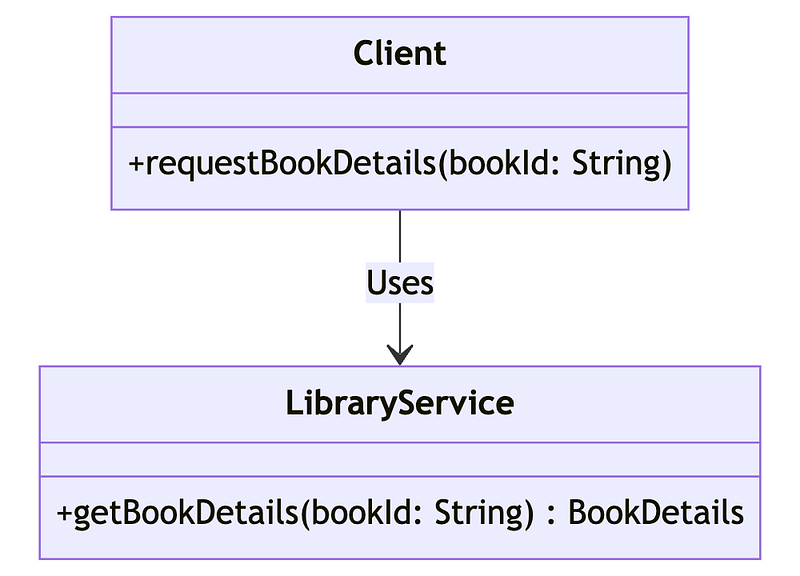
In this diagram, the Client directly interacts with the LibraryService to fetch book details. There is no intermediate layer that could filter, delay, or cache requests, leading to the disadvantages described above.
This implementation illustrates typical problems that can arise when design patterns like the Proxy pattern are not used to efficiently manage requests and conserve resources.
Improved Implementation
To address the challenges of the previous implementation and to fully leverage the benefits of the Proxy design pattern, we present an improved implementation for our library application scenario. In this implementation, we utilize the Proxy pattern to integrate an efficient caching solution that avoids unnecessary network requests. We also employ specific Kotlin features such as by lazy for delayed initialization, enhancing the performance and resource utilization of our application.
class LibraryServiceProxy(private val realLibraryService: LibraryService) {
    private val bookDetailsCache: MutableMap<String, Lazy<BookDetails>> = mutableMapOf()

    fun getBookDetails(bookId: String): BookDetails {
        // Uses the 'by lazy' Kotlin feature to lazily load book details
        return bookDetailsCache.getOrPut(bookId) {
            lazy { realLibraryService.fetchBookDetails(bookId) }
        }.value
    }
}

class LibraryService {
    fun fetchBookDetails(bookId: String): BookDetails {
        // Simulates a network request with a delay to fetch book details
        Thread.sleep(1000) // 1-second delay to simulate the network request
        println("Fetching book details for book ID: $bookId from the server...")
        return BookDetails(bookId, "Some Book Title", "Some Author", "Available")
    }
}

data class BookDetails(val id: String, val title: String, val author: String, val status: String)

fun main() {
    val realLibraryService = LibraryService()
    val libraryServiceProxy = LibraryServiceProxy(realLibraryService)

    // The first call for 'book123' will initialize and fetch the data from the real service
    println(libraryServiceProxy.getBookDetails("book123"))
    // The second call for 'book123' uses the cached, already initialized data
    println(libraryServiceProxy.getBookDetails("book123"))
}
In this implementation, LibraryServiceProxy acts as a mediator between the client and LibraryService, efficiently storing and managing book details in a cache. By employing by lazy, it ensures that data is loaded only when needed, thereby improving the performance and efficiency of the application.
UML Diagram for the Improved Implementation
The following UML diagram illustrates the structure and relationships between components in the improved implementation that uses the Proxy design pattern:
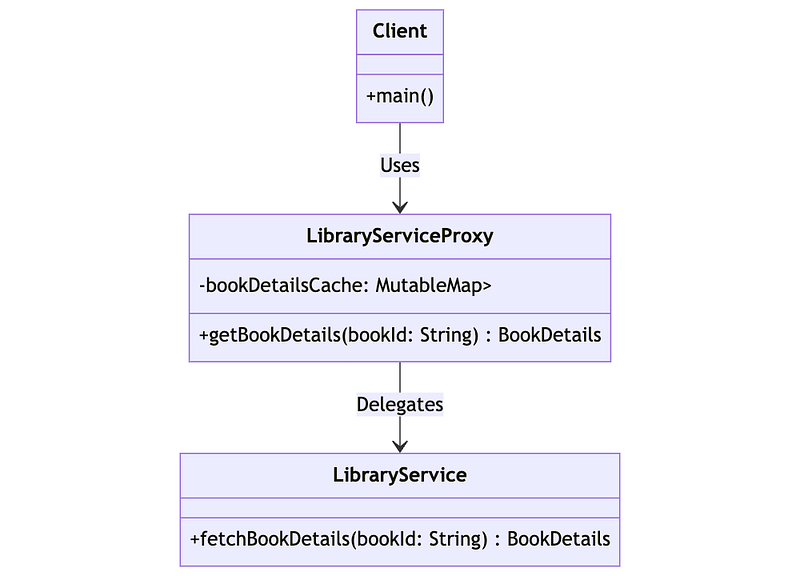
In this diagram, LibraryServiceProxy acts as a proxy between the Client and LibraryService, containing the logic for caching book details. This reduces the need for repeated network requests and enhances the overall performance of the application. The client interacts solely with the proxy, which transparently provides book details, either by loading the data from the original service or by delivering the data from the cache.
Proxy Design Pattern: Pros and Cons

Pros
- Separation of Concerns: The Proxy pattern allows for the separation of the primary business logic from the auxiliary responsibilities (like caching, access control, or lazy initialization). This enhances code maintainability and clarity.
- Improved Performance and Efficiency: By using techniques like lazy initialization and caching, the Proxy pattern can significantly reduce the cost of resource-intensive operations, leading to better performance and lower resource consumption.
- Access Control: Proxies can control the access to an object, which is particularly useful in scenarios where certain conditions must be met before the access is granted (e.g., checking permissions or authenticating a user).
- Transparent to the Client: The use of a proxy does not change the way the client interacts with the actual object. This transparency ensures that existing codebases can adopt proxies without extensive modifications.
Cons
- Additional Complexity: Introducing proxies into your system can add an extra layer of complexity, potentially making the system harder to understand and maintain. This complexity might not always be justified, especially for simple scenarios.
- Potential Performance Overhead: While proxies can improve performance by caching or lazy loading, they also introduce an extra layer of indirection which might slightly impact performance in scenarios where direct access would have been more efficient.
- Design Complexity: Properly implementing the Proxy pattern requires a good understanding of the system’s design and the specific use case it aims to solve. Incorrectly implemented proxies can lead to issues like memory leaks (in the case of improper caching) or unnecessary delays (in the case of mismanaged lazy loading).
- Testing Overhead: Testing an application that makes extensive use of proxies can be more challenging, as unit tests might need to account for the behavior of the proxy as well as the actual object. This can lead to more complex test setups and potentially longer testing cycles.
In conclusion, while the Proxy design pattern offers a robust solution for managing access to objects, caching, lazy initialization, and access control, it is essential to weigh its benefits against the added complexity and overhead it introduces. It’s most beneficial in scenarios where its advantages clearly outweigh the potential drawbacks, such as in distributed systems, large-scale applications, or when working with resource-intensive operations.
Now then… 👋

If you found this essay helpful, don’t forget to clap, subscribe, like, and share it with your peers on social media! Your support helps spread knowledge and fosters a vibrant community of developers.