
Understanding the Internal Architecture of the Catalyst Optimizer in Apache Spark SQL
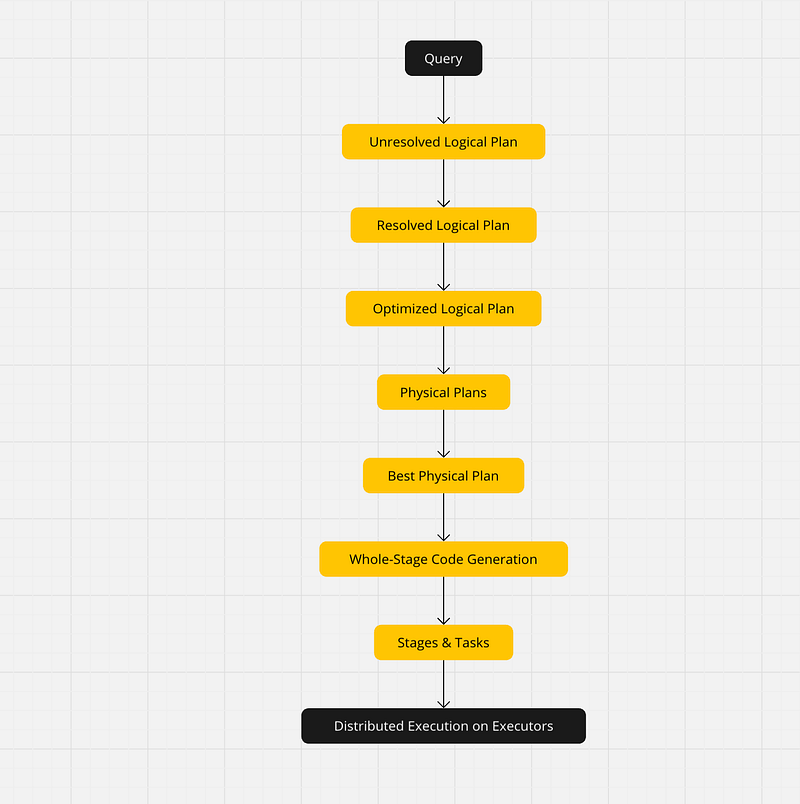
The Catalyst Optimizer is one of the core components of Apache Spark SQL that makes Spark highly

performant when it comes to SQL queries and DataFrame operations.
Catalyst is responsible for optimizing query plans and is the reason behind Spark’s ability to scale and execute queries efficiently across large datasets.
1. What is the Catalyst Optimizer?
The Catalyst Optimizer is an extensible query optimization framework in Spark SQL that transforms logical query plans into optimized physical plans. It provides optimizations like predicate pushdown, projection pruning, and many others to improve the execution efficiency of SQL queries and DataFrame transformations.
It is a rule-based optimizer that uses rules to modify and optimize query plans. Catalyst consists of four phases:

- Analysis
- Logical Optimization
- Physical Planning for optimisation
- Code Generation (Tungsten Engine)
2. Why Does Catalyst Exist?

Catalyst Optimizer was designed to overcome some key challenges:
- Performance: With growing data volumes, efficiently optimizing queries is crucial. Catalyst allows Spark to execute SQL queries on distributed data with high performance.
- Extensibility: Catalyst is extensible, which means we can add new optimization rules or even support new data sources and execution engines.
- Unification of APIs: It supports both SQL queries and DataFrame operations. Spark SQL and DataFrames share the same optimization engine, making it easy to switch between the two.
3. When to Use the Catalyst Optimizer?

- When working with SQL queries or DataFrame APIs in Spark: Every time a query is written in SQL or operations are performed on DataFrames, Catalyst Optimizer is automatically invoked to improve the performance of query execution.
- For complex queries: When queries involve joins, filters, aggregations, etc., Catalyst Optimizer ensures that the best execution plan is chosen, making these operations more efficient.
- When we need to process large datasets efficiently: The Catalyst Optimizer is crucial when dealing with large-scale data, as it ensures that query plans are optimized for distributed data processing.
4. How Does the Catalyst Optimizer Work?
The Catalyst Optimizer works in four main phases:
Phase 1: Analysis
- In this phase, the logical query plan is parsed and checked for validity.
- It resolves columns and tables and verifies that the query refers to valid attributes.
Phase 2: Logical Optimization
- Once the logical plan is analyzed, it is optimized using various rule-based optimizations.
- Examples of optimizations include:
- Predicate Pushdown: Filters are pushed down closer to the data source, reducing the amount of data read.
- Projection Pruning: Only necessary columns are selected instead of scanning the entire dataset.
- Constant Folding: Constant expressions are evaluated during the optimization phase.
Phase 3: Physical Planning
- After the logical optimizations, Spark converts the logical plan into a physical plan.
- It selects the most efficient algorithms to execute the query, such as choosing between Hash Join or Sort Merge Join based on the query.
Phase 4: Code Generation (Tungsten):
- This is where Spark generates low-level bytecode to execute the query plan efficiently.
- It uses the Tungsten execution engine, which directly manages memory and CPU, optimizing for performance.
5. Example: SQL Query Optimization in Spark
Let’s walk through a simple SQL query and explain how the Catalyst Optimizer works on it.
SELECT name, age FROM employees WHERE age > 30;

df.filter(df.age > 30).select(df.name, df.age).show()
Optimization Process:
Analysis:
- Spark checks the schema of the
employeestable to validate thatageandnameexist.
Logical Optimization:
- Predicate Pushdown: Spark pushes the
WHERE age > 30filter closer to the data source so that only relevant rows are read. - Projection Pruning: Since we only need the
nameandagecolumns, Spark avoids reading other columns from the dataset.
Physical Planning:
- Spark chooses the best physical plan. For example, if
employeesis a large dataset, it might choose a parallel scan to distribute the workload across multiple nodes.
Code Generation (Tungsten):
- Spark compiles this optimized plan into bytecode, ensuring efficient CPU and memory usage.
- What is the Catalyst Optimizer in Spark?
- The Catalyst Optimizer is Spark SQL’s query optimizer that transforms logical query plans into optimized physical plans using a rule-based approach.
Explain the different phases of the Catalyst Optimizer.
- The phases are Analysis, Logical Optimization, Physical Planning, and Code Generation. Each phase improves query efficiency by applying different rules and optimizations.
What is predicate pushdown in Spark SQL?
- Predicate pushdown is an optimization where filter conditions are pushed closer to the data source, reducing the amount of data that needs to be loaded and processed.
How does the Catalyst Optimizer improve the performance of SQL queries in Spark?
- By applying rule-based optimizations like predicate pushdown, projection pruning, constant folding, and selecting efficient execution strategies, the Catalyst Optimizer minimizes data processing overhead and improves query performance.
What is the role of Tungsten in the Catalyst Optimizer?
- Tungsten is the execution engine used by Spark that manages memory and CPU directly, improving performance by generating optimized bytecode for execution.
What are some optimizations performed by the Catalyst Optimizer?
- Examples include predicate pushdown, constant folding, projection pruning, and reordering joins.


