
Understanding the Essence of a Photograph
Barthes’ Studium and Punctum
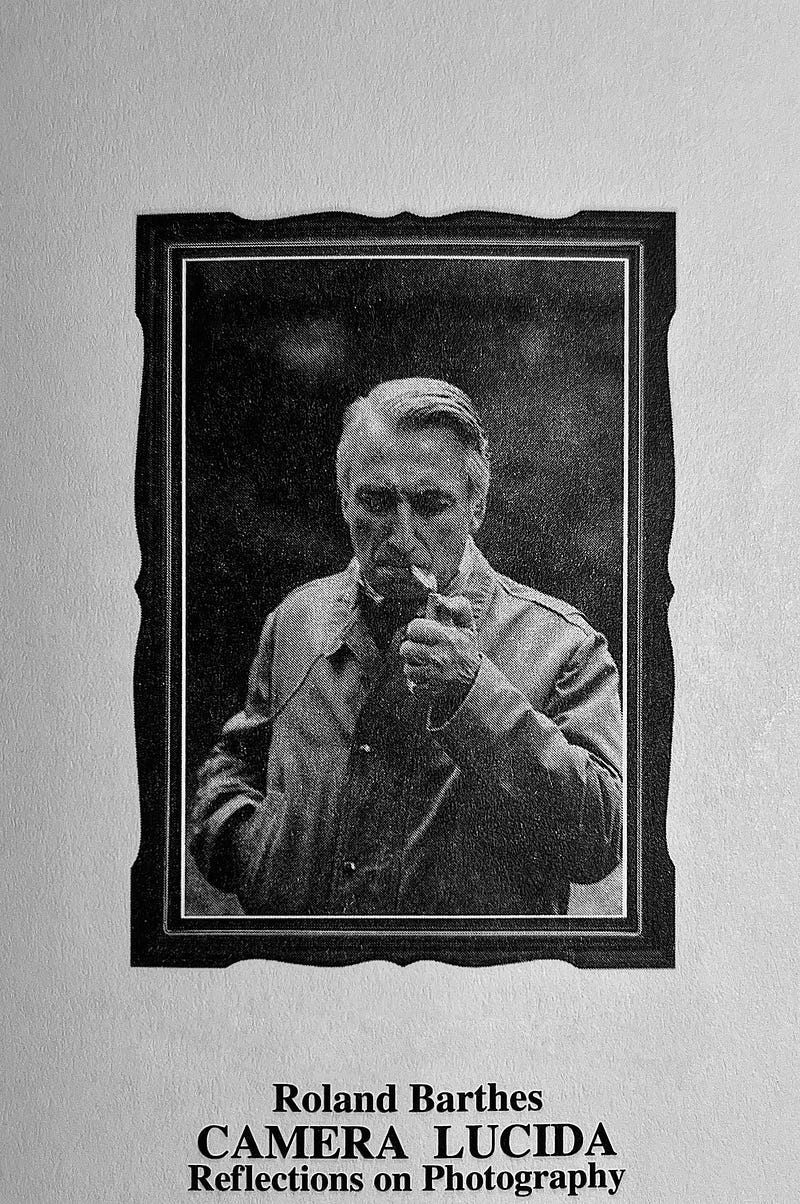
Reflect on the viewer’s role and the evolving interpretation of images.
Introduction
My focus on Punctum drove me to capture the emotional essence in photos. This personal journey underscores Barthes’ view of photography as a multifaceted medium, highlighting the viewer’s role in interpretation.
In this essay, we explore Roland Barthes’ significant contributions to the field of photography, focusing on two key concepts, Studium and Punctum, as outlined in his work Camera Lucida.
Published in 1980, Camera Lucida stands as a seminal work in the annals of both photography and literary theory. This book not only transformed our understanding of photography but also redefined the way we connect emotionally and aesthetically with the visual medium. Its lasting impact on the realms of photography and visual culture firmly establishes it as a pivotal milestone in this domain.
The Three Levels of Meaning
Barthes’ essay “The Third Meaning” serves as the basis for our exploration. In this essay, he analyzes a scene from Sergei Eisenstein’s film “Ivan the Terrible” and identifies three levels of meaning. The first level corresponds to explicit or direct signification, representing the straightforward presentation of information. The second level encompasses implicit signification, symbolizing a connotative or symbolic meaning.
The Foundation for Punctum
The third and most intriguing level is the “slow meaning” or “obtuse meaning”, which Barthes introduces as the foundation for Punctum. This level involves the viewer’s interpretation of inconspicuous yet profoundly impactful details that hold a highly personal dimension, adding a unique layer of meaning to the image.
Studium: The Surface of Engagement
What is Studium? Studium is a Latin word meaning “study”, “zeal”, “dedication”, etc. Studium indicates the factor that initially draws the viewer to a photograph. Barthes defines Studium as a form of interest, inclination, and attachment without acute sensitivity. It embodies a broad field of inclination, featuring a range of interests and preferences, akin to a form of special indifference. Studium provides a shared visual language between photographer and viewer, enabling the meaning of a photograph to be understood. It encompasses the more general aspects of a photograph that engage viewers based on societal conventions and preferences.
The Role of Studium
Barthes suggests that in the context of Studium, news photographs and pornography often re-represent subject matter continuously, making an impact within Studium without significantly changing the viewer’s perspective. Studium includes elements that initially draw viewers in, presenting knowledge that is logical, rational, and influenced by societal conventions. However, the attraction within Studium tends to fade into obscurity over time.
The Emotional Connection
Punctum is defined as “a small, distinct point”. It represents a deeper and more emotional connection with a photograph. It defies easy categorization and emerges as an element within the image that pierces the viewer, often causing an emotional response akin to a wound. Punctum is highly personal and specific to each viewer, varying with individual interests and aesthetic sensibilities.
The Intriguing Nature of Punctum
Punctum transcends the photographer’s deliberate intentions and does not stem from technique or design. It is an intrinsic feature discovered independently by the viewer, adding an extra layer of meaning to the image. It creates an attraction that pricks the reader, resulting in a distinctive and individual response.
Punctum and Its Subtle Signification
Barthes emphasizes that Punctum represents that which defies codification, embodying a transcendence that evokes a personal and subtle signification. This supplementary meaning is deeply emotional, adding vitality to the image and engaging the viewer on a profound level. Punctum is not confined by conventions and is an essential element of a photograph that cannot be deliberately produced or reconstructed by the photographer.
The Dynamic Punctum
A photograph truly comes to life and evokes love and desire when Punctum emerges. It represents a characteristic within the photograph that either highlights a point in Studium or creates a gap within it. Punctum is an intrinsic feature discovered by the viewer, emerging randomly and unexpectedly within the image, resulting in an immediate and intense response. It disrupts the conventional understanding of the photograph and engages the viewer on a personal and individual level.
The Ever-Evolving Punctum
The interplay between Studium and Punctum varies from viewer to viewer, as Punctum is deeply affected by individual sensibilities, values, habits, and tastes, particularly within their own era. The Punctum found in a photograph can differ with each revisit, making it a dynamic and ever-evolving element.
The Significance of Punctum
Punctum represents a pivotal moment when the viewer forges a unique emotional connection with the image. It captures the viewer’s emotions in a way that transcends straightforward interpretation, often eluding easy explanation. This element deeply resonates with the viewer, making photography a rich and multifaceted medium for personal interpretation and emotional connection.
Conclusion
In conclusion, Studium and Punctum represent two distinct aspects of photography, each operating at different levels and evoking different forms of pleasure. Studium offers a shared, surface-level pleasure, while Punctum provides a deeply personal and emotional response that goes beyond the photographer’s deliberate intentions, making photography a medium of rich and multifaceted meaning. Barthes’ concepts emphasize the vital role of the viewer in adding meaning to a photograph and the dynamic nature of interpretation and engagement with images.


