
Understanding the Crucial Role of Cardiovascular Fitness and How to Improve It
A guide to two primary strategies to improve your VO2 max
What is the most important metric to know how physically healthy you are?
If you ask a room full of physicians, personal trainers, physical therapists, exercise physiologists, dieticians, and coaches, you will receive a wide variety of answers.
We have strong research to support strength and muscle mass. While BMI and body fat are associated with many chronic diseases, they are complicated and the relationship is not clear. More strength and muscle mass are nearly universally better but BMI and body fat are a U curve, with low and high numbers being problematic. Muscle and bone mass also muddy the waters for some individuals.
There is one metric that has a clear relationship with health and wellness it the associations are stronger than strength and muscle mass: cardiorespiratory fitness.
What is cardiorespiratory fitness and how do you measure it?
Improving your cardiorespiratory fitness is one of the best ways to improve your health and wellness. As I have progressed in my career as an orthopedic physical therapist, I have come to appreciate the value of focusing on the area of health and wellness
Cardiorespiratory fitness, also known as aerobic fitness, refers to the efficiency and effectiveness of the cardiovascular (heart and blood vessels) and respiratory (lungs and airways) systems in delivering oxygen to the muscles during prolonged physical activity. It is a key component of overall physical fitness and is closely related to VO2 max, which measures the maximum amount of oxygen the body can use during exercise.
During exercise, muscles require oxygen to produce energy. VO2 max reflects the maximum rate at which oxygen can be transported from the air to the muscles and used by the body’s tissues. Higher VO2 max values typically indicate better cardiovascular fitness and endurance, as the body can efficiently deliver oxygen to working muscles, allowing for sustained physical activity.
Check out the following list of the first 20 sub-4-minute milers in history.
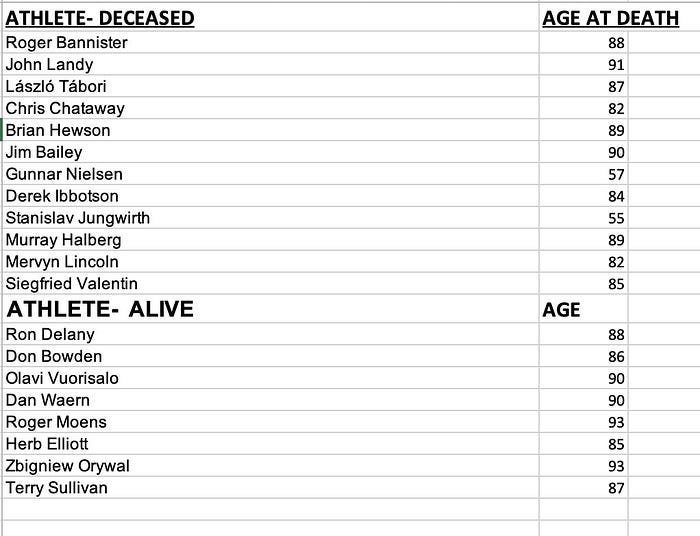
These figures surpass the average life expectancy of any nation. However, this information doesn’t imply that running a 4-minute mile is necessary for a long life, nor does it guarantee reaching 80 years old by incorporating 400m repeats into your training regimen. Rather, it emphasizes that individuals who prioritize aerobic fitness, even without indulging in the various biohacking trends often seen on social media, can enjoy a lengthy lifespan.
VO2 max can be measured through various methods, including laboratory-based tests such as the graded exercise test (commonly performed on a treadmill or stationary bike) where oxygen consumption is monitored while the intensity of exercise increases progressively until exhaustion.
Most people don’t have their VO2 max tested in a lab, but they can track improvements in aerobic fitness through testing regular exercise performance, such as mile time.
It’s important to note that this estimation is not as accurate as direct measurement in a laboratory setting. Here’s a website that you can use to quickly calculate your VO2 max estimate. For a more accurate assessment, consider undergoing a graded exercise test in a laboratory setting under the supervision of trained professionals.
That website also contains a chart showing roughly which metrics are considered good or poor. If you want to improve your numbers, what should you do?
Training to improve VO2 max
Aerobic training is largely broken down into high-intensity interval training (HIIT) and moderate-intensity continuous training (MICT). Here is how they differ:
- HIIT: alternating between short bursts of intense exercise and periods of rest or low-intensity exercise. A typical HIIT session may last anywhere from 5 to 30 minutes. During the high-intensity intervals, individuals push themselves to work at or close to their maximum effort level (e.g., sprinting, cycling at a high resistance).
- MICT: maintaining a steady, moderate level of exercise intensity for at least 30 minutes. The exercise should sustain around 50–70% of an individual’s maximum heart rate or 5–6 out of 10 perceived exertion level.
Both types of training are effective, improve VO2 max, and lower all-cause mortality. It doesn’t matter if you prefer running, cycling, swimming, or any other type of cardiovascular training. The key is you are elevating your heart rate. Walking is a great form of physical activity but it won’t improve your VO2 max.
Several studies have explored specific protocols to get a better idea of how hard and long to train. A 2019 review in the Journal of Science and Medicine in Sport assessed 53 studies focused on HIIT. They concluded that short-interval (≤ 30s), low-volume (≤5 min), and short-term (≤4 weeks) HIIT represent effective and time-efficient strategies for developing VO2max, especially for the general population. To maximize the training effects on VO2 max, long-interval (≥2 min), high-volume (≥15 min), and moderate to long-term (≥4–12 weeks) HIIT are recommended.
MCIT is largely a volume game. As VO2 max and exercise efficiency improve, exercise pace needs to improve to maintain the same intensity. For example, a 10-minute mile pace for 30 minutes may sustain HR at 60% of HR max for a couple of months but then become too easy failing to increase HR above 50%. In this case, either the pace or volume needs to increase.
How fast and how long you train depends on your goals.
Which approach should you take?
It depends on several factors including available time, preference, and goals. Time is the first consideration to work through.
How much time do you have to exercise?
If you don’t have several hours a week to dedicate to endurance training, then continuous moderate-intensity exercise is a poor option. If you are starting from the ground level with no aerobic training experience, then you will see improvements in your cardiovascular capacity with low volumes.
For some, two 20-minute runs or bike rides a week may be enough to experience improvements. They will plateau quickly, however. The volume needs to be substantially higher to see additional improvements.
So, if time is limited, you should choose high-intensity interval training. For example, a Tabata (20-second max effort, 10-second rest, repeat 8 times) is an effective 4-minute program. If time is of no consequence, you can move on to your goals.
What are your fitness and performance goals?
If you want to run a marathon or any event that requires a long duration of aerobic activity, then target continuous moderate-intensity exercise. Yes, you can complete a marathon if you only perform HIIT training, but your results will suffer. Every elite marathoner puts in a substantial volume of miles. The key is varying your intensity.
Polarized training, favored by many elite athletes, emphasizes extensive aerobic training in low-intensity zones (1 and 2) to build a robust aerobic foundation. Determining your zone 2 range can be done through various methods. While using a lactate meter offers precise measurements, relying on subjective feel, although less accurate, can still give a rough estimate.
Subjective ways to determine Zone 2 training include the “talk but sing” method, where you aim to maintain a conversation comfortably without gasping for air, indicating an appropriate intensity. Additionally, assessing your perceived exertion on a scale of 1 to 10, with Zone 2 corresponding to a moderate effort level (around 4 to 6), can guide your training intensity.
If you play a specific sport, train for that sport. You may need to mix your training. For example, basketball and soccer involve a lot of running but require explosive movements and sprinting. You need the endurance to sustain activity for a full game and power. Conversely, baseball and softball do not require high levels of cardiovascular endurance. Time spent on long runs and bike rides can be better used elsewhere.
If you don’t have a specific goal (other than improving your overall health and fitness) and you don’t have any time constraints, move to the final consideration — enjoyment.
Which exercises and programs do you enjoy (or dislike least)?
You are more likely to stick with activities that you enjoy. Even if you don’t like to exercise, choosing the one you dislike least will help. If you can embrace the suck for brief intervals, that may be a better option than long, slow runs. If you hate the feeling of extreme fatigue, muscle burning, and being out of breath, a long bike ride while listening to an audiobook or watching a TV show may be your speed.
You can also gamify your exercise. Examples include tracking personal records, competing with a workout partner, integrating cardiovascular training into pickup basketball or soccer games, or working towards a new challenging movement (such as a muscle up).
Regardless of your method, remain consistent
Consistency is key for any adaptations. It is hard to sustain exercise motivation when you dread each workout. You don’t have to stick with the same protocol in perpetuity.
You can alternate between intervals, tempo runs, and long and slow runs. You can establish a rotation of cycling, running, swimming, and hiking. Or you can build blocks of exercise, focusing on one type until you achieve a specific goal then moving on to a new intensity and volume.
If you have big fitness aspirations, it may help to work with a coach to fine-tune and personalize your programming. As long as you remain consistent, push your body appropriately, and adhere to good recovery habits, you will see improvements.


