
Understanding Taxes: 3 Strategies to Lower Taxes and Maximize Wealth
Starting your own business, being financially free, having millions of dollars, such is the dream of every single person in the world.
Money is an important asset to have in these times. Everything you wish to do requires money. From food, health, and housing to giving back and helping others in their tough journey.
The only problem is that people are focused on making money, but not on eliminating things that make them spend money. And taxes are one of them.
Indeed, taxes are one of the most overlooked topics when it comes to finance. They don’t only make you spend money, but if you take a closer look at the percentage you have to pay, it is as if the government is your business partner. You have almost to do fifty-fifty and split your income together. Yes, this same income you earned through hard work and sweat, the government obtains half of it without similar effort.
There are many misconceptions about taxes and how they work. Some think that only rich people don’t pay taxes, while others believe that this topic affects only the wealthy.
So let’s see if this is true, and most importantly how rich people avoid paying taxes legally.
1)- The 4 Types Of Taxes Paid
In life, there are 4 categories through which you can earn money. Either you are:
- An employee
- A small business
- A big Business
- An investor
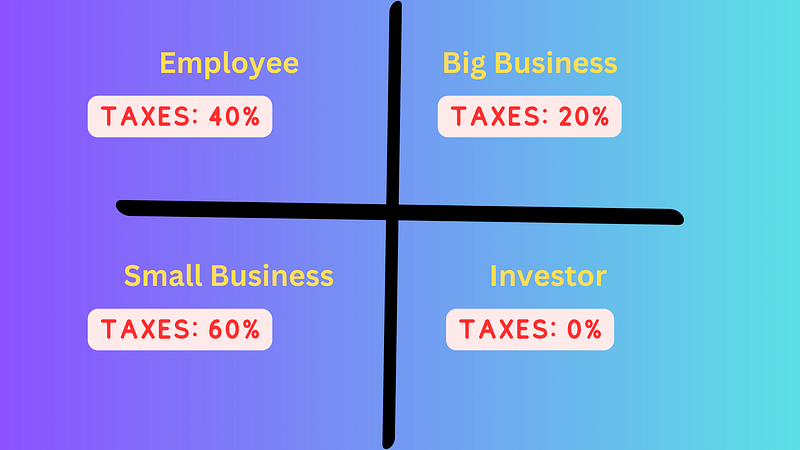
If you are an employee and you have a good salary, the amount of taxes you pay on average around the world is around 40%, taking into account various taxes like federal income tax, state income tax, and social security taxes.
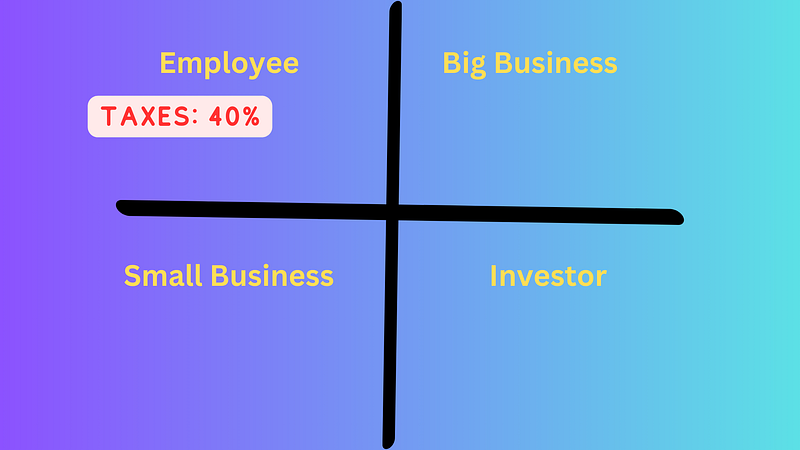
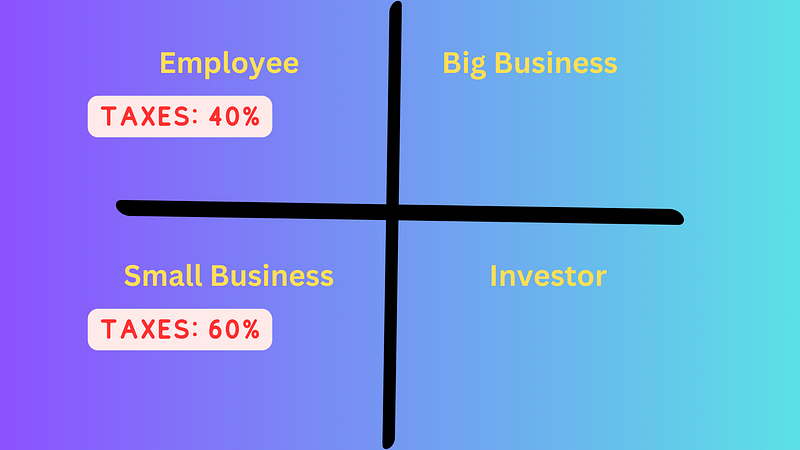
If you are thrilled with the idea of starting your own business like a small burger restaurant then the amount of taxes to pay is around 60%. It is higher because you are your own boss now.
When you were an employee you had to pay 40% because your employer paid the rest. But now as you are the employee and the employer at the same time you have to pay all of the amount, which is 60%.
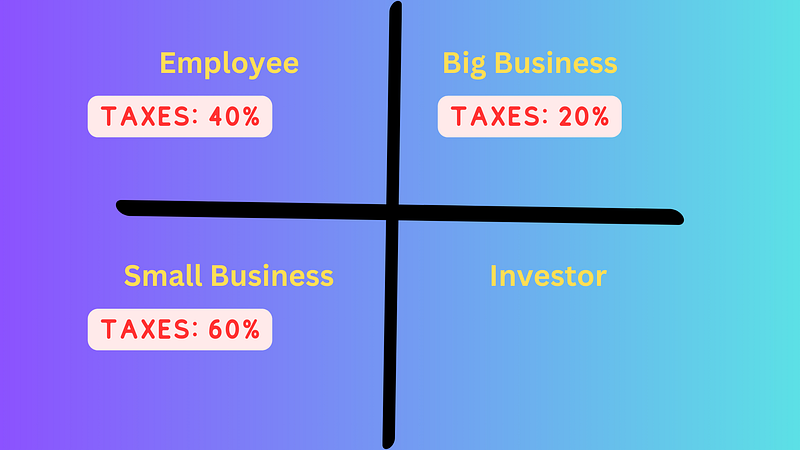
If you are a big business however the average amount of taxes around the world is set to 20%.
Surprising isn’t it? A big business normally should pay more taxes you would say! But here is why it doesn’t work this way: One of the reasons why big businesses pay less taxes is because the government wants to have less unemployment and create more jobs to create more stability in the country. And as big businesses do just that, the more jobs they create the more tax benefits they get.
There are a lot of other government benefits that big businesses like Amazon benefit from at federal, state, and city levels to lower their taxes.
If you are an investor you can pay as much as 0% taxes.
2)- The Rich vs The Poor: How Each One Uses Taxes
Here is where most people get trapped. Tax discussions are thought to be reserved for the wealthy only. No, not at all! Everyone can escape paying taxes legally or reduce them.
Tax benefits are not given only to the wealthy, because you can be wealthy from your 9 to 5 job. If you are the CEO of a company then you are wealthy but you will still have to pay taxes if you don’t understand the game.
One of the reasons big businesses don’t pay taxes is because they create jobs for people, but what about investors? Why can they pay as much as 0% tax?
Well, again because they do what the government wants. And what the government wants is housing, projects built, energy, technology, agriculture… And investors invest in all of that, they put their money in all these places.
If you are an employee or a small business you are considered much as a consumer and the government doesn’t want that, what they want instead is all the producers like big businesses and investors.
Rich people understand that the tax system is built for the ones who do what the government encourages.
By contributing to employment and economic development, you can receive tax benefits as well.
For example in countries like France, if you buy a property, especially in crowded cities like Paris, and you rent it for a certain period (typically between 6 and 12 years), you will benefit from a tax reduction on your income because the purpose of the law is to encourage investment in housing and participate in economic development in areas with housing shortage.
And you don’t have to be a big business or a big investor to receive this benefit, you only have to do what the government wants. So if your goal is to invest in real estate, why not buy properties in crowded areas and benefit from tax reduction?
Every country in the world has its laws and rules, and you should just understand them to play the game.
3)- 3 Ways To Legally Lower Or Avoid Paying Taxes
1- Turn Your Sole Proprietorship Into A Corporation
Sole Proprietorship and corporation business are taxed differently. If you have a sole proprietorship then you are combining personal finances with business finances and so your business income will be taxed like an earned income which can go to 37% just for federal taxes alone.
However, if you set up a corporation business type you will have to pay only 21% of taxes in federal taxes.
Many people start using corporations to run their businesses because this not only allows the owner to take advantage of the corporate tax rate but also claims any expenses related to the business as a corporate loss.
You can buy a house or a nice car and still claim it as a business expense, which lowers the taxable income of the company.

2- Tax Havens
The advantage of tax havens or offshore companies is that you pay no taxes. Offshore companies are set up in countries where taxes are reduced to 0.
Some well-known countries are the Bahamas, Bermuda, Jersey, and the Cayman Islands.
The process is not straightforward though, meaning it is not about just depositing the money in a foreign bank, but rather employing a team with expertise in tax laws to legitimately reduce the taxable income.
For example, if your company generates $100 million in profits, you will have to pay 21% of corporation tax. However, if you have an offshore company you can strategically allocate the ownership of the patent, trademarks, and intellectual property of your company in the USA to the offshore company in the Bahamas for example, or Bermuda.
When it is time to pay taxes, you can say that the company generated most of its profits offshore. This way the company will be required to pay as little as the original tax liability, and in some cases no taxes at all.
However, it is important to bear in mind that if you want to use this method you cannot repatriate the fund to the USA, if you do so then the funds will be subject to taxation once repatriated.
So in short, when companies use this method they do not do it to access their offshore fund immediately, but rather wait for favorable tax opportunities to arise such as changes in corporate tax rates, and then repatriate their offshore funds to the USA.
3)- Print Your Own Money
Another way to reduce taxes after you have a corporation is to print your own money.
Today many companies pay their executives or reward them by giving them shares of the company’s stock as part of their compensation instead of paying them cash.
This creates a lot of benefits. On one hand, the executive or employee will not pay any taxes until they sell their shares which puts them in control when they’re taxed. On the other hand, the company can report losses in the form of salaries without losing cash.
For the company to issue new shares it doesn’t require it to spend any money.
But if your company gives its employees shares of stock, you can claim these shares as an expense on the company’s financial statement.
Basically, it is like if your company is saying: “We gave our employees these shares, and these shares cost X amount of money, so we spent money by giving these shares to our employees, so we should be able to deduct that expense from our taxable income.”
But since the company didn’t spend any money to create these shares, it is essentially reporting a “paper loss” on its financial statements. Which allows the company to reduce its taxable income without actually reducing its cash reserves.

Final Thoughts
Taxes are such a big topic that is completely overlooked by the majority of people. Understanding how they work is essential for a better financial planning though.
There are many legal methods to reduce or avoid paying taxes completely and by exploring them people and businesses can optimize their financial strategies while staying compliant with the law.