
Understanding Repository Pattern with Implementation: A Step-by-Step Guide
Unlock the Power of Abstraction, Testability, and Maintainability with Real-world Examples
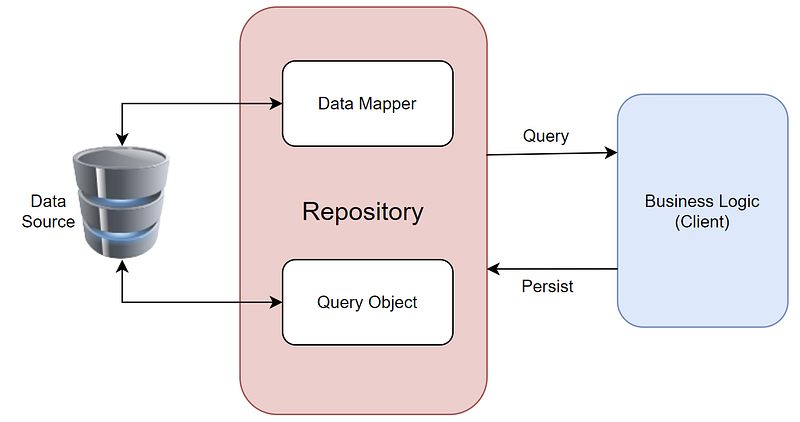
The Repository Pattern is a fundamental design pattern in software development that provides an abstraction layer between the application’s data access logic and the underlying data source. It promotes separation of concerns and enhances code maintainability, testability, and scalability. In this article, we’ll delve into the Repository Pattern, its benefits, and how to implement it with complete code examples in C#.
What is the Repository Pattern?
At its core, the Repository Pattern acts as a bridge between your application’s business logic and data storage. It encapsulates the data access logic within repositories, which are responsible for querying and manipulating data from the underlying data source, such as a database or a web service. By doing so, it shields your application from the intricacies of data storage, making it easier to switch between data sources or make changes to the database schema without affecting your application’s code.
Key Components of the Repository Pattern
- Entities: These are your data objects, representing the core data structures of your application. In our previous example,
Useris an entity. - Repository Interface (
IRepository): This interface defines the contract for interacting with data entities. It typically includes methods likeGetById,GetAll,Add,Update, andDelete. The interface abstracts the underlying data storage details, making your code agnostic to where and how data is stored. - Concrete Repositories: These are classes that implement the
IRepositoryinterface for specific entities. In our example,UserRepositoryis a concrete repository for theUserentity. It contains the actual logic for retrieving, adding, updating, and deleting users. - Data Source: This is where your data is stored, which could be a database, a web service, or any other data store. The repository hides the complexity of working with the data source.
- Client Code: Your application code that interacts with repositories. It calls methods on the repository interfaces without worrying about how data is retrieved or stored.
Benefits of Using the Repository Pattern
- Abstraction: The Repository Pattern provides an abstract interface for data access, enabling you to change the data source without modifying your business logic.
- Separation of Concerns: It promotes a clear separation between data access code and application logic, making the codebase more maintainable.
- Testability: By using interfaces and dependency injection, you can easily mock repositories for unit testing.
- Flexibility: You can create custom repositories for specific data entities and tailor their methods to meet your application’s needs.
- Consistency: The pattern enforces consistent data access patterns and conventions throughout your application.
Implementation of the Repository Pattern
Let’s walk through the implementation of the Repository Pattern using C#. We’ll create a simple example with a User entity and a UserRepository.
1. Define the User Entity
public class User
{
    public int Id { get; set; }
    public string Username { get; set; }
    public string Email { get; set; }
    // Other properties
}
2. Create the IRepository Interface
public interface IRepository<T>
{
    T GetById(int id);
    IEnumerable<T> GetAll();
    void Add(T entity);
    void Update(T entity);
    void Delete(T entity);
}
3. Implement the UserRepository
public class UserRepository : IRepository<User>
{
    private List<User> _users = new List<User>();

    public User GetById(int id)
    {
        return _users.FirstOrDefault(u => u.Id == id);
    }

    public IEnumerable<User> GetAll()
    {
        return _users;
    }

    public void Add(User entity)
    {
        _users.Add(entity);
    }

    public void Update(User entity)
    {
        // Implement update logic here
    }

    public void Delete(User entity)
    {
        _users.Remove(entity);
    }
}
4. Using the Repository in Your Application
Now that you’ve created the UserRepository, you can use it in your application.
class Program
{
    static void Main(string[] args)
    {
        var userRepository = new UserRepository();

        // Create a new user
        var newUser = new User { Id = 1, Username = "john_doe", Email = "[email protected]" };
        userRepository.Add(newUser);

        // Retrieve a user by ID
        var retrievedUser = userRepository.GetById(1);

        // Update the user
        retrievedUser.Username = "johndoe";
        userRepository.Update(retrievedUser);

        // Delete the user
        userRepository.Delete(retrievedUser);

        // Get all users
        var allUsers = userRepository.GetAll();
    }
}
Conclusion
The Repository Pattern is a powerful tool for managing data access in your applications. By encapsulating data access logic within repositories, you can achieve greater flexibility, maintainability, and testability. It’s a fundamental pattern to consider when designing software, and with the provided implementation examples, you can start using it effectively in your C# projects.


