avatarFarhad Malik

Free AI web copilot to create summaries, insights and extended knowledge, download it at here

2392

Abstract

tick With The Simple Definition For Now And We’ll Build On It As We Proceed</p><p id="d739">The artificial neural network shown above has 4 layers:</p><ol><li>One Input layer</li><li>One Output layer</li><li>Two Hidden Layers</li></ol><p id="b86c">There are in total 10 neurons:</p><ol><li>2 input neurons</li><li>6 hidden neurons — 3 neurons within each hidden layer</li><li>2 output neurons</li></ol><p id="ad58">This is an example of a feed-forward neural network as the data is flowing in one direction only; from the input layer to the output layer.</p><ul><li>Each neuron is connected with another neuron via synapses.</li><li>Each neuron takes in an input from one-or-more neurons along with the weights and a bias. An activation function is applied to convert the input into the required output.</li></ul><h1 id="9f04">Why Should We Use Neural Networks?</h1><p id="86ab">Neural networks can help us understand relationships between complex data structures. The neural networks can use the trained knowledge to make predictions on the behavior of the complex structures.</p><p id="7e5b">Neural networks can be utilised to predict linear and non-linear relationships in data.</p><p id="5fa9">Neural networks can process images and even make complex decisions such as on how to drive a car, or which financial trade to execute next.</p><h1 id="c4fb">What Are The Shortcomings?</h1><p id="768e">Although this is subjective but people have had hard time convincing business how neural networks have produced the answers. Hence the business users are slightly reluctant to trust its reasoning when compared to simple models like random forests and regression.</p><p id="8a48">Although, neural networks can be sophisticated and can solve complex problems, they are slower than most machine algorithms. They can also end up over-fitting the training data.</p><p id="9209">If you want to understand what weights and bias are then please read:</p><div id="b19f" class="link-block"> <a href="https://readmedium.com/neural-networks-bias-and-weights-10b53e6285da"> <div> <div> <h2>Neural Networks Bias And Weights</h2> <div><h3>Understanding The Two Most Important Components</h3></div> <div><p>medium.com</p></div> </div> <div> <div style="background-image: url(https:

Options

//miro.readmedium.com/v2/resize:fit:320/0*hrHGbUf92-CvgqB1)"></div> </div> </div> </a> </div><p id="2075">If you want to understand what activation functions are then please read:</p><div id="5903" class="link-block"> <a href="https://readmedium.com/neural-network-activation-function-types-a85963035196"> <div> <div> <h2>Neural Network Activation Function Types</h2> <div><h3>Understanding what really happens in a neural network</h3></div> <div><p>medium.com</p></div> </div> <div> <div style="background-image: url(https://miro.readmedium.com/v2/resize:fit:320/0*KxZHrfXwdtc8e_eC)"></div> </div> </div> </a> </div><p id="6012">If you want to understand what neural network layers are then please read:</p><div id="40b9" class="link-block"> <a href="https://readmedium.com/neural-network-layers-75e48d71f392"> <div> <div> <h2>Neural Network Layers</h2> <div><h3>Understanding How Neural Network Layers Work</h3></div> <div><p>medium.com</p></div> </div> <div> <div style="background-image: url(https://miro.readmedium.com/v2/resize:fit:320/)"></div> </div> </div> </a> </div><p id="9098">If you want to understand how neural network neurons work then please read:</p><div id="f337" class="link-block"> <a href="https://readmedium.com/understanding-neural-network-neurons-55e0ddfa87c6"> <div> <div> <h2>Understanding Neural Network Neurons</h2> <div><h3>Explaining What These Smart Components Doing?</h3></div> <div><p>medium.com</p></div> </div> <div> <div style="background-image: url(https://miro.readmedium.com/v2/resize:fit:320/1*lk7bbg9gbYKpDYSHABaDOg.png)"></div> </div> </div> </a> </div><h1 id="6feb">Summary</h1><p id="a61a">This article provided a brief overview of a neural network.</p><p id="dee0">Subsequent articles will present deeper understanding on each of the components of a neural network.</p></article></body>

Understanding Neural Networks

Let’s Understand The Revolutionary Concept

This article will highlight the basics of neural networks.

Why Am I Focusing On Neural Networks?

  • The number of neural network specific projects are growing at an exponential rate.
  • They are accurately predict heart attacks
  • How financial organisations utilise the networks to generate revenue and cut costs.
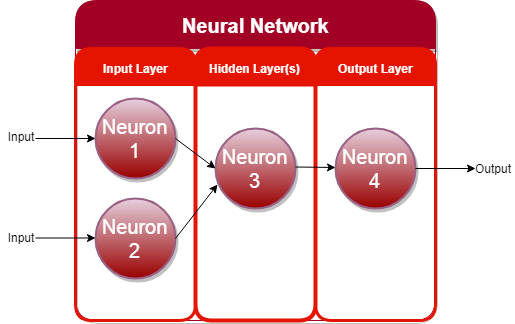
An example neural network

One thing is clear though; neural networks sit at the core of revolutionary machine learning projects. This article will set the foundations right.

Please read the Disclaimer.

Photo by Nicolas Picard on Unsplash

What Is A Neural Network?

The geniuses of Alexander Bain (1873) and William James (1890) proposed the concept of artificial neural network.

Artificial Neural Networks Are Inspired By Biological Neural Networks

Just like biological neural network, artificial neural network is constantly learning and updating its knowledge and understanding of the environment based on experiences that it encountered.

An artificial neural network is simply a set of mathematical algorithms that work together to perform operations on the input. These operations then produce an output.
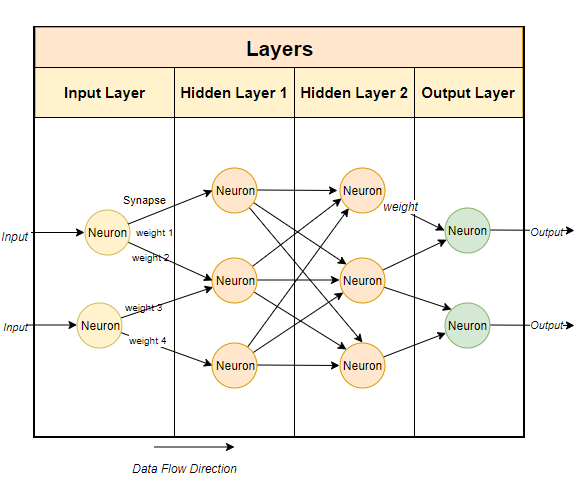
Therefore, these mathematically inter-connected formulae are known as artificial neural network (ANN).

Let’s Stick With The Simple Definition For Now And We’ll Build On It As We Proceed

The artificial neural network shown above has 4 layers:

  1. One Input layer
  2. One Output layer
  3. Two Hidden Layers

There are in total 10 neurons:

  1. 2 input neurons
  2. 6 hidden neurons — 3 neurons within each hidden layer
  3. 2 output neurons

This is an example of a feed-forward neural network as the data is flowing in one direction only; from the input layer to the output layer.

  • Each neuron is connected with another neuron via synapses.
  • Each neuron takes in an input from one-or-more neurons along with the weights and a bias. An activation function is applied to convert the input into the required output.

Why Should We Use Neural Networks?

Neural networks can help us understand relationships between complex data structures. The neural networks can use the trained knowledge to make predictions on the behavior of the complex structures.

Neural networks can be utilised to predict linear and non-linear relationships in data.

Neural networks can process images and even make complex decisions such as on how to drive a car, or which financial trade to execute next.

What Are The Shortcomings?

Although this is subjective but people have had hard time convincing business how neural networks have produced the answers. Hence the business users are slightly reluctant to trust its reasoning when compared to simple models like random forests and regression.

Although, neural networks can be sophisticated and can solve complex problems, they are slower than most machine algorithms. They can also end up over-fitting the training data.

If you want to understand what weights and bias are then please read:

If you want to understand what activation functions are then please read:

If you want to understand what neural network layers are then please read:

If you want to understand how neural network neurons work then please read:

Summary

This article provided a brief overview of a neural network.

Subsequent articles will present deeper understanding on each of the components of a neural network.

Artificial Intelligence
Machine Learning
Data Science
Fintech
Neural Networks
Recommended from ReadMedium