
Understanding Metaverse From a Developer’s Perspective
Three essential elements in metaverse: extended reality, avatars, and digital ownership

Meta means “beyond” and verse refers to the “universe.” The term, metaverse, was coined by Neal Stephenson in his science fiction novel, Snow Crash, in 1992. The book weaves virtual reality, Sumerian myth, and just about everything in between to bring a gigathriller of the information age.
Facebook, Inc. was renamed Meta Platforms, Inc. on October 28, 2021. Facebook, WhatsApp, and Instagram keep their names, but the company that produces and maintains them has since been called Meta.
What is metaverse?
Meta, the company, defines the metaverse to be 3D spaces that let everyone socialize, learn, collaborate, and play in ways that go beyond the imagination. In fact, the metaverse is a collective project that goes beyond a single company. It is created and shared by people all over the world and open to everyone.
Since metaverse is at its early stage, many definitions are still evolving. However, there are three essential elements in metaverse:
- Extended reality
- Avatars
- Digital ownership
Let’s take a look at these elements.
Extended Reality
Extended Reality (XR) is an umbrella term encapsulating Augmented Reality (AR), Virtual Reality (VR), Mixed Reality (MR), and everything in between. Here are definitions for AR, VR, and MR:
- AR: It overlays digital content in the real environment.
- VR: It replaces the real environment with the computerized space.
- MR: It blends elements of both AR and VR.
WebXR Device API is the specification for accessing VR and AR devices, including sensors and head-mounted displays, on the Web. It covers the following examples, but is not limited to:
- Head-mounted displays, whether they are opaque, transparent, or utilize video passthrough
- Mobile devices with positional tracking
- Fixed displays with head tracking capabilities
A 3DoF device, short for “Three Degrees of Freedom”, is one that can track rotational movement. A 6DoF device, short for “Six Degrees of Freedom”, is one that can track both rotation and translation, enabling precise 1:1 tracking in space.
A Navigator represents the identity and state of a User Agent (UA). It also serves as a generic global with various attributes and APIs.
The get method of the xr attribute (line 2 in above code) must return an XRSystem object that it is associated with.
Query navigator.xr.isSessionSupported() (line 3 in above code) to determine if the desired type of XR content is supported by the hardware and UA. If it is supported, it means that the XR content is ready. When a user clicks a button on the page, the window is activated. Within the user activation event, call navigator.xr.requestSession() (line 4) to retrieve an XRSession, which can be used to poll the user’s pose and to query information about the user’s environment. The active session presents imagery to the user on XR device. The session continues running until it is shut down by the UA or the user exits the XR content.
Here is the definition of XRSession:
Avatars
Mark Zuckerberg, the founder and CEO of Meta, said, “The defining quality of the metaverse is presence, which is this feeling that you’re really there with another person or in another place.”
For this feeling, avatars are needed in the metaverse. The term, avatar, is derived from Sanskrit in Hinduism, which means “descent”. It signifies the material appearance or incarnation of a deity on Earth. Avatar is an online representation of a user. It acts as a digital identity of a person. It can be 2D or 3D, static or animated.
Facebook mobile app is one of the ways to create an avatar. Open the app, and search for the word “avatars”. Click the menu item to create an avatar.
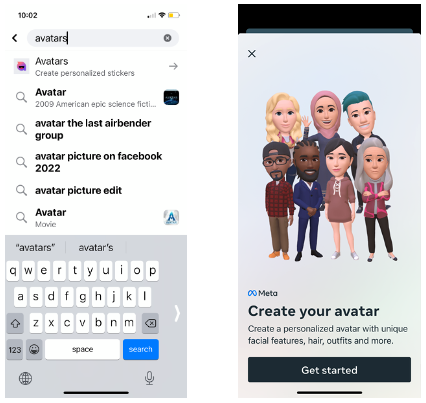
After Get started, create an avatar with specific skin tone, hairstyle, hair color, face shape, face markings, face lines, eye shape, eye color, eye makeup, eyebrows, eyebrow color, bindi, eyewear, eyewear color, nose, nose piercings, mouth, lip color, facial hair, facial hair color, body, outfit, headwear, headwear color, ear piercings, hearing devices, and hearing device color.
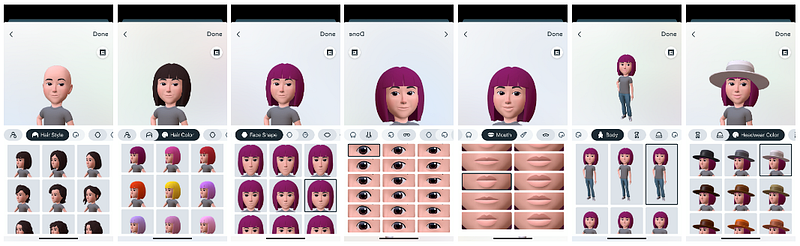
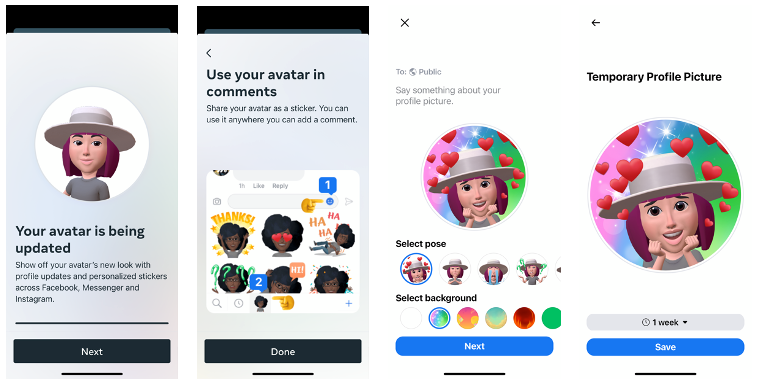
We create an avatar, which can be used as an identity, expression, and experience. In the metaverse, avatar looks realistic and acts animated, and presents through the entire universe.
There are a number of avatar providers that deliver more advanced avatars.
- Ready Player Me — It is a cross-game avatar platform for the metaverse. One avatar, many worlds to explore.
- VRoid Hub —It is a platform for uploading humanoid VRM avatars, where VRM is a file format designed for 3D characters and avatars in the modern VR landscape.
- Mixamo —It is a tool provided by Adobe to rig and animate characters.
- Cryptoavatars — It is a platform that allows avatar creators to mint single-edition Avatars. Each Avatar is tokenized as a unique Non Fungible Token (NFT) on the Ethereum blockchain.
Digital ownership
Metaverse is a virtual space, where we socialize, play, work, learn, and shop, just like in real life. In the metaverse, we also have ownership of virtual assets. Web3 is a new iteration of the World Wide Web that is based on blockchain technology, which incorporates concepts such as decentralization and token-based economics. Cryptocurrencies and NFTs have made it possible to build a fully functioning economy inside the virtual space where we can buy and sell any virtual assets.
Blockchain technology enables peer-to-peer transfer of digital assets without any intermediaries, and the metaverse benefits from the self-governing financial system. Decentralized Autonomous Organizations (DAOs) are parties that govern decisions and transactions. As of today, almost 200 DAOs supervise the cryptocurrency market, which removes the concerns pertaining to the manipulation of individual digital assets. The algorithms, or smart contracts, define the rules for participation and cooperation among different parties associated with the DAO.
Blockchain is the key technology for the metaverse, where there is trust, security, and interoperability in the decentralized world.
Conclusion
The metaverse is the revolution of internet. Although many definitions are still evolving, there are three essential elements in metaverse: extended reality, avatars, and digital ownership.
The metaverse may look utopian and naive. Believe it or not, some part of the metaverse will be a reality of tomorrow.
Thanks for reading. I hope this was helpful. If you are interested, check out my other Medium articles.


