
Understanding Kubernetes Security — A Beginner’s Guide
Authentication, Authorization, and Admission Control?
Find Complete mind map of A Beginner’s Guide to Kubernetes
Welcome to the next chapter of our journey into Kubernetes! Having covered the essential Networking concepts in our previous series, we now shift our focus to an equally crucial aspect: Security.
Ensuring the security of your Kubernetes cluster is paramount. That’s where authentication, authorization, and admission control come into play.
In this beginner’s guide, we will explore these fundamental concepts and how they work together to safeguard your cluster. Let’s delve into the world of Kubernetes security and unlock its secrets.
Check out “Understanding Kubernetes — A Beginner’s Guide” for the comprehensive series🚀
Overview of Authentication, Authorization, and Admission Control
To establish a secure environment within your Kubernetes cluster, it is essential to understand the concepts of authentication, authorization, and admission control.
Let’s take a closer look at each of these components:
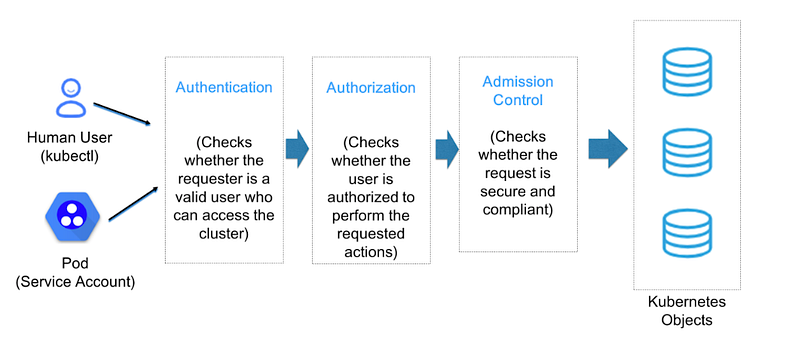
Authentication:
- Authentication is the process of verifying the identity of users or systems attempting to access your cluster.
- Kubernetes supports various authentication mechanisms, including client certificates, bearer tokens, and OpenID Connect.
- By enforcing authentication, you can ensure that only authenticated entities gain access to your cluster.
Authorization:
- Authorization determines what actions and resources a user or system can access within the cluster.
- It involves defining policies that grant or deny permissions based on a user’s role or group.
- Kubernetes implements Role-Based Access Control (RBAC) to manage authorization policies effectively.
Admission Control:
- Admission control governs the process of validating and mutating requests made to the Kubernetes API server before they are executed.
- It acts as a gatekeeper, intercepting and examining incoming requests and making decisions based on predefined rules and policies.
By implementing admission control, cluster administrators can enforce specific behaviors and ensure that incoming requests adhere to the desired configuration and security policies.
By combining authentication, authorization, and admission control, Kubernetes provides a robust security framework for your cluster.
Understanding how these components interact is crucial for maintaining a secure and controlled environment.
How does it work?
To better understand the connection between these concepts, let’s consider a scenario where a developer wants to update the configuration of a deployment in a Kubernetes cluster.
Authentication:
- The developer initiates the update request by interacting with the Kubernetes API server.
- The authentication mechanism, such as a username-password combination or a client certificate, verifies the developer’s identity before allowing access to the cluster.
- It ensures that the developer is a valid user with valid credentials.
Authorization:
- Once the developer’s identity is authenticated, the authorization process comes into play.
- The authorization mechanism, often implemented through role-based access control (RBAC), checks if the developer has the necessary permissions to perform the desired action.
- It verifies if the developer is authorized to update deployments in the specific namespace or if they hold a higher privilege that grants them the required access.
Admission Control:
- After passing authentication and authorization, the admission control process takes over.
- The admission controller intercepts the update request and evaluates it against a set of predefined rules and policies.
- For example, the admission controller might validate the configuration of the deployment, ensuring that it adheres to security standards, resource limits, or other specified criteria.
- If the update request meets the defined policies, it proceeds to the next step. Otherwise, the admission controller rejects the request or applies modifications to make it compliant.
Without proper access control measures, even authenticated users may have unauthorized access to sensitive resources, compromising the security of the cluster.
In this example, authentication verifies the developer’s identity, authorization checks their permissions, and admission control validates and enforces specific rules before allowing the update request to proceed. Together, these three components work in harmony to ensure that only authenticated, authorized, and compliant requests are accepted and processed within the Kubernetes cluster, maintaining the security and integrity of the system.
Key Takeaways
Here are the key takeaways from this guide:
- Authentication verifies the identity of users or systems accessing the Kubernetes cluster, ensuring they have valid credentials.
- Authorization checks if authenticated users or systems have the necessary permissions to perform specific actions within the cluster.
- Admission control enforces predefined rules and policies to validate and modify incoming requests, ensuring compliance and security.
- These three concepts work together to establish a secure environment, preventing unauthorized access and maintaining the integrity of the Kubernetes cluster.
In the upcoming articles, we will delve deeper into each concept, exploring the various authentication mechanisms, understanding how to define authorization policies, and implementing effective admission control in a Kubernetes cluster.
Stay tuned to gain a comprehensive understanding of how Kubernetes works with these security concepts and enhance the overall security posture of your containerized applications.
🔔 Stay tuned or subscribe to my series: “Understanding Kubernetes — A Beginner’s Guide” to explore everything about Kubernetes. 🚀
➕Join the Medium Membership Program to support my work and connect with other writers.
📝 Have questions or suggestions? Leave a comment or message me through Medium. Let’s connect!
Thank you for your support! 🌟