Understanding Blockchain

In the last years Blockchain has become a buzzword. Everyone talks about Blockchain, a new Internet, a foundation technology such as smartphones and probably Extended Reality (XR), basically the mix of VR, AR and MR. But when you ask someone, “what is Blockchain and how does it work?”, you will probably get an incorrect or incomplete answer. Just as it happened with the world of 3D Printers, I wanted to elaborate an article explaining in detail and at different levels what Blockchain is but there is so much content on the Internet that I have decided to take advantage of it :)
Before going into the details of Blockchain, I recommend to read this article by Chris Dixon on decentralization and why the new age of the Internet should be decentralized; and to watch this TED Talk about the real value of Blockchain: build trust.
BEGINNER
Let’s go with the introductions and key concepts. I’ve seen a million of videos that explain in a thousand ways Blockchain but one of them caught my attention because it uses real metaphors to introduce the concept, explaining complex concepts “with apples”.
Simple, right? To complete the explanation here is a video from Center for International Governance Innovation, another one from WIRED in which Bettina Warburg explains Blockchain to 5 types of people, from the most basic to the most advanced; and an article by MIT Technology Review that explains the history of Blockchain and the connection with Bitcoin (which we will discuss in depth in future articles)
The basic concept is perfectly understood, right? To finish this first block, take a look at the Blockchain Observatory of Sngular, one of the most complete documents I have seen about Blockchain that also has a specific focus in Spain. In addition to explaining the concept, it begins to introduce interesting terms such as DAO, DAS or dApps. It also explains concrete uses in several industries and the main players in the market.
ADVANCED
We’re going to take another step to talk about more technical terms. Let’s start with the Blockchain types. The Bitcoin White Paper was published by Satoshi Nakamoto in 2008 (if you want to know more about this enigmatic character, I recommend the Netflix documentary: Banking on Bitcoin) and as the Bitcoin protocol is open source, there are companies and initiatives that, based on the same principles, have created their own Blockchains.
In this article of BlockchainHub you can see the different types of Blockchain that there are right now. The fact is that there isn’t a specific way to list them but I personally like the public / private and based on the approach.
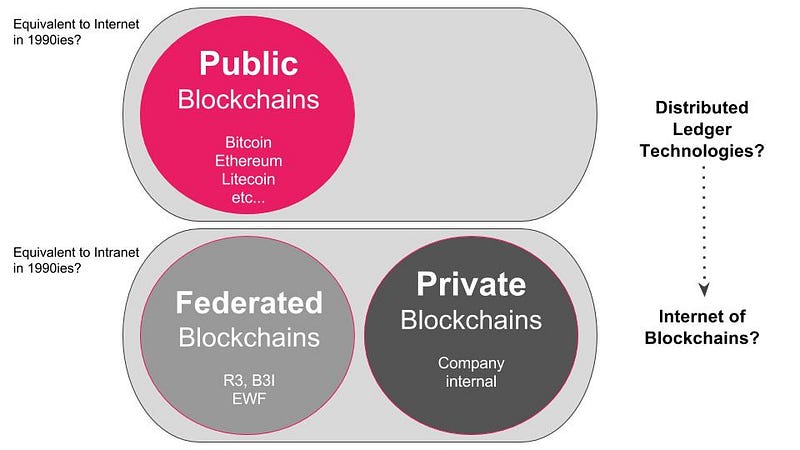
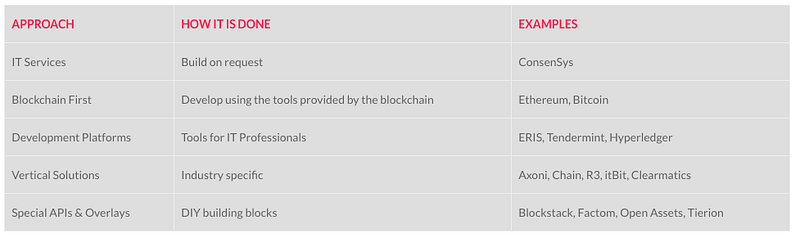
The most famous Blockchains to create projects are Ethereum (here you can know everything about it), which uses the tools that Blockchain offers in this case for smart contracts; and Hyperledger (on its website you can find many resources to learn how it works), which offers an application layer for the development of projects with Blockchain.
Another important concept is the token. A token is a unit of value that doesn’t have to be economic. For example, in currencies such as Bitcoin, the use is purely economic, but over Ethereum you can generate tokens that give another value, for example access permissions (utility tokens) or ownership of an asset (assey-backed tokens). The two best articles I’ve found about tokens are The Token Classification and Cryptographic Tokens. I have also found this video by George Levy particularly illustrative.
And to finish this block, I recommend a very interesting article from CNET focused on the generation of trust; this interactive website that describes from a very detailed (and technical) point of view how Blockchain works and a video simulation of the blockchain.
TECHNICAL
In this block I’m going to share some courses and resources for those who want to create your own Blockchain. In my case I funded the Kickstarter campaign Blockchain AZ ™ project: Learn How To Build Your First Blockchain and I’m doing the course. If you want to access it too, you can buy it at Udemy at a very low price.
Here is a list of interesting links for you to start developing in Ethereum and Hyperledger:
- Ethereum Development Walkthrough (Smart contracts, Truffle, Ganache, Geth and Mist) // Part I & Part II
- Working with Smart Contracts in Ethereum // Part I, II, III & IV
- Blockchain for Business — An Introduction to Hyperledger Technologies
- Hyperledger Fabric — Chain Code Develop in GO
- Building BLOCKCHAIN Apps With HYPERLEDGER COMPOSER
- Hyperledger Composer basics
I also recommend this Telegram group, very active and full of interesting tips and tools.
I hope this article helped you to understand Blockchain! If you want to add new resources, corrections or annotations … Please, comment!
#365daysof #blockchain #bitcoin #day112


