avatarBrenda Hali

Free AI web copilot to create summaries, insights and extended knowledge, download it at here

1342

Abstract

n the predictions</i></b> of a model and the <b><i>true values</i></b>. In this type of error, the model pays little attention to training data and <b><i>oversimplifies </i></b>the model and doesn't learn the patterns. The model <b>learns the wrong relations</b> by <b>not taking in account all the features</b></p><h2 id="1879">Errors due to Variance</h2><p id="eea1">Variability of model prediction for a given data point or a value that <b><i>tells us the spread of our data</i></b>. In this type of error, the model pays a l<b><i>ot of attention in training data</i></b>, to the point to memorize it instead of learning from it. A model with a high error of variance is not flexible to generalize on the data which it hasn’t seen before.</p><p id="6548" type="7">If Bias vs Variance was the act of reading, it could be like Skimming a Text vs Memorizing a Text</p><p id="e3e8">We want our machine model to learn from the data it is exposed to, not to <i>“have an idea of what it is about” </i>or “<i>memorize it word by word.”</i></p><h1 id="2a40">Bias — Variance Trade-Off</h1><p id="4680">Bias- Variance trade-off is about balancing and <b><i>about finding a sweet spot</i></b> between error due to bias and errors due to <i>variance</i>.</p><p id="1b3e" type="7">It is an Underfitting vs Overfitting dilemma</p><figure id="b6bf"><img s

Options

rc="https://cdn-images-1.readmedium.com/v2/resize:fit:800/0*Xs74WcSaotfNczXS"><figcaption>Plot by Jake VanderPla</figcaption></figure><p id="5427">If the model is indicated by the line in grey, we can see that a high bias model is a model that oversimplifies the data, while a high variance model is a model too complicated that overfits the data.</p><h2 id="8f9f">In short:</h2><ul><li><b>Bias </b>is the simplifying assumptions made by the model to make the target function easier to approximate.</li><li><b>Variance</b> is the amount that the estimate of the target function will change, given different training data.</li><li><b>Bias-variance trade-off </b>is the sweet spot where our machine model performs between the errors introduced by the bias and the variance.</li></ul><p id="3c77"><i>In this post, we discussed the c<b>onceptual meaning of Bias and Variance</b>. Next, we will explore the concept in <b>code.</b></i></p><p id="c89d"><b><i>Future reading:</i></b></p><p id="fb6c"><a href="http://scott.fortmann-roe.com/docs/BiasVariance.html"><i>Understanding the Bias-Variance Tradeoff</i><b></b></a><b> </b>by Scott Fortmann- Roe</p><p id="740b"><a href="https://web.stanford.edu/~hastie/ElemStatLearn/"><i>The Element of Statistical Learning</i></a> by Trevor Hastie, Robert Tibshirani, and Jerome Friedman</p></article></body>

Understanding Bias-Variance Trade-Off in 3 Minutes

Machine Learning Lighting Talk — October 11, 2019
Balancing them is like magic

Stuck behind the paywall? Click here to read the full story with my Friend Link.

Bias and Variance are the core parameters to tune while training a Machine Learning model.

When we discuss prediction models, prediction errors can be decomposed into two main subcomponents: error due to bias, and error due to variance.

Bias-variance trade-off is tension between the error introduced by the bias and the error produced by the variance. To understand how to make the most of this trade-off and avoid underfit or overfit our model, lets first learn that Bias an Variance.

Errors due to Bias

An error due to Bias is the distance between the predictions of a model and the true values. In this type of error, the model pays little attention to training data and oversimplifies the model and doesn't learn the patterns. The model learns the wrong relations by not taking in account all the features

Errors due to Variance

Variability of model prediction for a given data point or a value that tells us the spread of our data. In this type of error, the model pays a lot of attention in training data, to the point to memorize it instead of learning from it. A model with a high error of variance is not flexible to generalize on the data which it hasn’t seen before.

If Bias vs Variance was the act of reading, it could be like Skimming a Text vs Memorizing a Text

We want our machine model to learn from the data it is exposed to, not to “have an idea of what it is about” or “memorize it word by word.”

Bias — Variance Trade-Off

Bias- Variance trade-off is about balancing and about finding a sweet spot between error due to bias and errors due to variance.

It is an Underfitting vs Overfitting dilemma
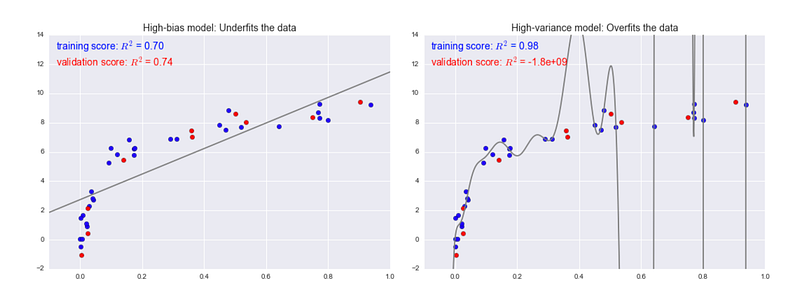
Plot by Jake VanderPla

If the model is indicated by the line in grey, we can see that a high bias model is a model that oversimplifies the data, while a high variance model is a model too complicated that overfits the data.

In short:

  • Bias is the simplifying assumptions made by the model to make the target function easier to approximate.
  • Variance is the amount that the estimate of the target function will change, given different training data.
  • Bias-variance trade-off is the sweet spot where our machine model performs between the errors introduced by the bias and the variance.

In this post, we discussed the conceptual meaning of Bias and Variance. Next, we will explore the concept in code.

Future reading:

Understanding the Bias-Variance Tradeoff by Scott Fortmann- Roe

The Element of Statistical Learning by Trevor Hastie, Robert Tibshirani, and Jerome Friedman

Machine Learning
Data Science
Algorithms
Tutorial
Latinas In Tech
Recommended from ReadMedium