Understanding and Normalizing the Creative Process
From universal experiences to intentional models
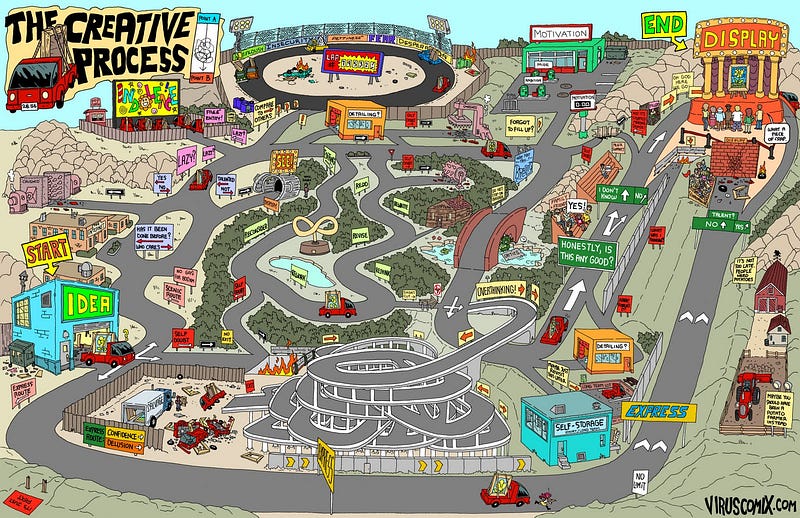

There are many processes in life — learning, growing, healing, and more. Understanding these processes can help guide us through them and normalize the challenging steps involved. It is no different when being creative, and the process is the most important part of creating.
We should focus on the process and not the product. This is because our understanding of the goal (product or outcome) changes as we discover new obstacles and opportunities. The end is unknown. We’ll likely experience failure and ambiguity. We’ll use divergent and convergent thinking. We’ll experience judgment from others, incubation and illumination, and many other characteristics of a nonlinear process.
This article will look at some of the actions involved in any creative process and several intentional processes we might use to be creative.
Wallace’s 4 Stages
A great place to begin exploring the creative process is by looking at Graham Wallace’s book The Art of Thought (1926), where he looked at several stages we all experience when creating. Wallace’s proposed four stages are preparation, incubation, illumination, and testing.
Preparation is when we gather information about our problem. We search for solutions and experiment with ideas.
Incubation happens when we aren’t focused on or thinking about the problem. Our subconscious is searching for connections between our past experiences, what we know, and the problems we face. We can help the incubation process by getting away from screens, walking in nature, taking a shower, or going for a drive.
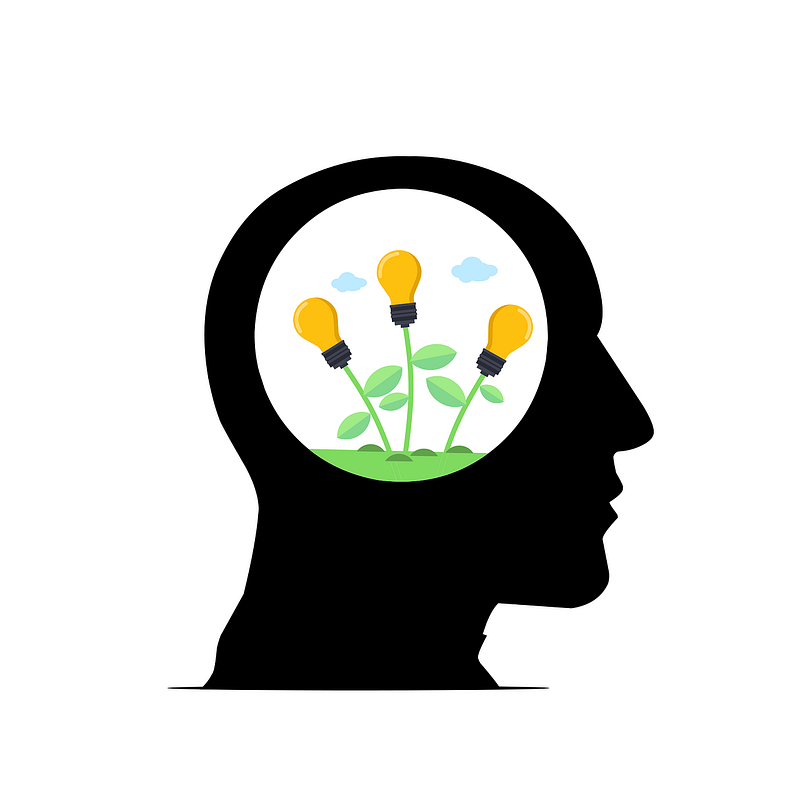
Illumination is when we suddenly have ideas or revelations about our problems. We may know these as lightbulb, ah ha, or Eureka moments. It’s like the answers just come out of nowhere — almost like a bubble that rises to the surface and pops when it reaches the air.
Testing is how we discover if our ideas work. This can involve feedback from others who apply the ideas or assess our work.
Remember that the creative process is not linear and that we’ll likely move back and forth between each of these until we find a solution or give up. Wallace’s four stages are very broad and general, so let’s take a deeper look at some of the specific tasks involved in being creative.
Divergent and Convergent Thinking
Divergent thinking is when we generate many ideas for solving problems. Convergent thinking is when we decide on the best ideas to use moving forward. School and society naturally condition us to be convergent thinkers while discouraging us from divergent thinking. Both are crucial, and both should be done independently of each other. Never mix the two. Let’s look more into divergent thinking since we generally know the least about it.
Divergent thinking has four guidelines to follow that will help us intentionally be more successful.
1. Don’t judge the ideas.
2. Think of wild, crazy, impossible, and ridiculous ideas.
3. Go for quantity over quality.
4. Build on the ideas of others.
Divergent thinking is the foundation of all creativity and cannot be avoided. Understanding it and how to apply the four guidelines provides direction and intentionality in our creative process. Divergent thinking comes first, then convergent thinking. Remember, never mix the two.
Failure and Mistakes
Failure and mistakes are inevitable in the creative process. To attempt to avoid them is to create even greater disappointment and failure. Instead, we should expect, embrace, and learn from them. Creativity involves doing something that has never been done before — either by the person/group or by any human. Not knowing the answer implies that experimentation will be involved until a solution has been found. Understand that failure and mistakes are part of the process.
Ambiguity and Uncertainty
When experimenting with creative solutions, we don’t always know what we’re searching for or what will happen. Creativity involves unique solutions that can’t exist without effort. As such, there is uncertainty about what will happen during the process. It can be challenging to commit to an unknown future that may be impossible. We should remain open to the unexpected and trust in the process. Embrace uncertainty.
Intentional Creative Processes
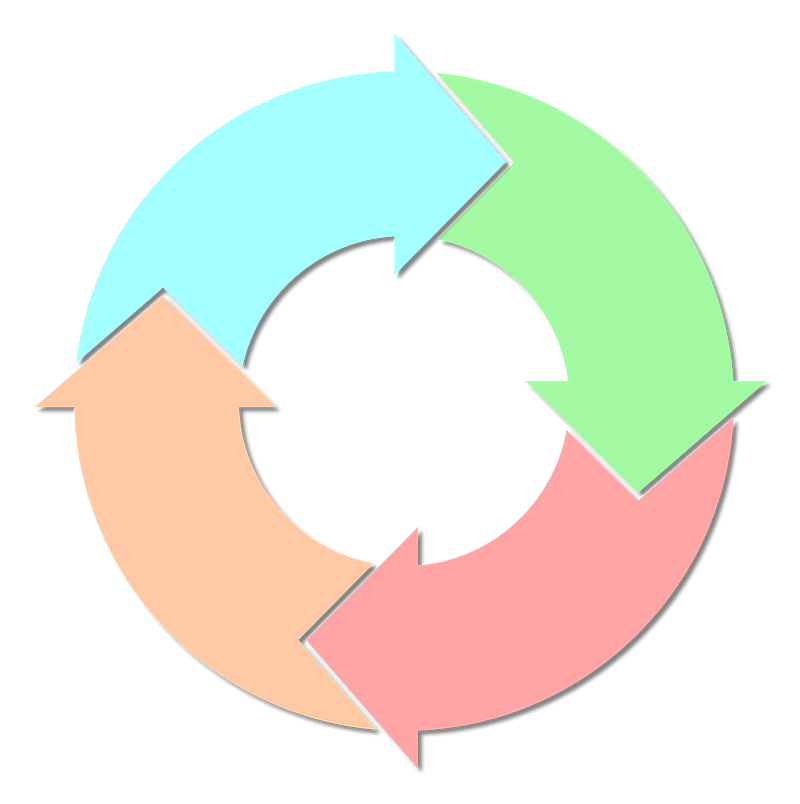
The attributes of our creative processes mentioned above can happen naturally without our conscious efforts. We looked at unavoidable aspects of the creative process that should be normalized. The final section will cite several creative processes with specific stages that can lead to intentionally creative outcomes.
Appreciative Inquiry — Appreciative inquiry focuses and builds on what is working. Rather than asking, “How might we fix this problem?” we ask, “What is working, and how might we build on it to discover a creative solution?” The four stages of appreciative inquiry are discovering what is working, dreaming about what might be, designing what should be, and putting the plan into action.
Creative Problem Solving — The creative problem-solving process (CPS) is another 4-step process that involves clarifying the problem that needs to be solved, ideating possible solutions, developing a plan, and then executing the plan. Each stage of CPS intentionally separates divergent and convergent thinking.
Design Thinking — One of the most popular processes is known as design thinking. Some of its unique characteristics are its use of empathy and prototyping. This process begins with empathizing with users to understand their needs, followed by defining the project’s focus or desired outcome. We move on to ideating next as we use divergent thinking to explore potential solutions. Then, we build prototypes and test them out.
Although each creative pursuit is unique, there are processes that we can intentionally follow to help us arrive at creative outcomes. Appreciative inquiry focuses on what is working, while creative problem-solving and design thinking aim to discover unique solutions to problems that can be based on nonexistent ideas. These nonlinear processes include divergent thinking (ideating) followed by convergent thinking.
Summary
While creative ideas and products are all unique, the processes we use to discover them have universal characteristics. These include exploring potential solutions using divergent thinking followed by convergent thinking, unavoidable failure and mistakes that provide valuable information for solving our problems, and uncertainty about what will happen or how to reach our goals. Still, there are specific processes we can use to intentionally arrive at creative solutions. These include appreciative inquiry, creative problem-solving, and the design thinking process. While the outcomes of our creative efforts may be unknown, we can be confident in our progress by understanding and committing to the creative process.
For a more in-depth look at divergent thinking and its four guidelines: