
Understand the types of cryptocurrency: A simple guide
There’s no doubt that Bitcoin is the dominant name. However, there are other types of cryptocurrencies with many use cases that are disrupting multiple industries.
Cryptocurrency is mainly divided into coins and tokens.
A coin runs on its own blockchain and is usually used solely for payments. A token runs on another blockchain and has various use cases.
Click here to understand tokenomics in more depth.
Crypto assets can be further subdivided based on how they are intended to be used.
- Payment currencies
- Blockchain economies
- Privacy coins
- Utility coins
- Security coins
- NFT(Non-fungible tokens)
- DeFi(Decentralised Finance)
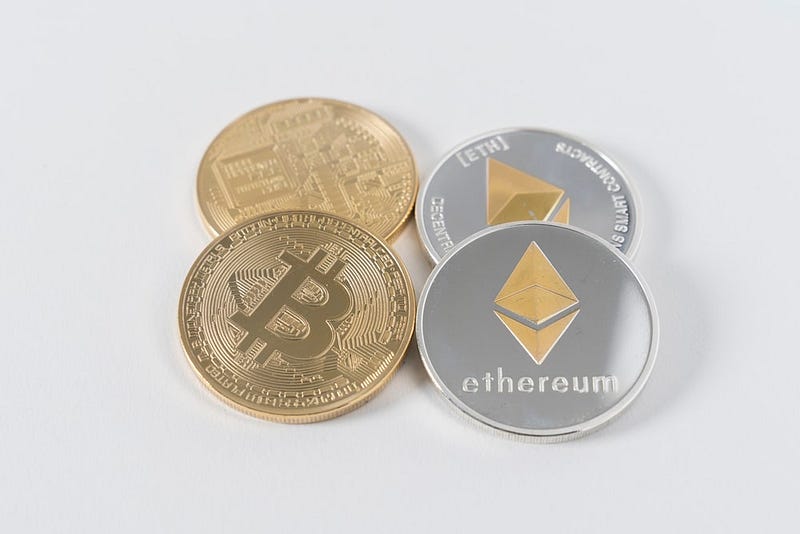
Payment currencies
- Used to pay for goods, services and bills.
- Value varies on the collective faith in the project or protocol
- Decentralised, anonymous, transparent, internet-based, irreversible and fungible.
Litecoin(LTC): Open source, decentralised, mathematics enabled P2P internet currency which enables instant, near-zero payments to anyone. At 56 transactions per second Litecoin is faster than bitcoin but is much slower than ripple and Visa. Another key difference between Bitcoin and Litecoin is the algorithms used. Bitcoin uses the SHA-256 algorithm while Litecoin uses a much newer algorithm called Scrypt.
Bitcoin Cash(BCH): BCH was created in August 2017, from a Bitcoin fork. BCH allowed more transactions by increasing the size of the blocks from 1MB to 8MB. A fork is simply a change in the protocol of a blockchain network. The main goal was to reduce the scalability problem of Bitcoin.
Bitcoin(BTC): Open-source and P2P technology that operates with no central authority. Issue of new coins and the management of transactions are carried out collectively by the network. Created by Satoshi Nakomoto in January 2009 at the wake of the global financial crisis and has been the best performing asset for the past decade with an annualized gain of over 360%. In 2020, with institutional adoption, money printing, cashless society and the internet, it is poised to continue its run. There will only ever be 21 million Bitcoin mined at a decelerating rate till 2140.
Read more on Bitcoin: An asset class made by a crisis, for a crisis
“Blockchain is the tech. Bitcoin is merely the first mainstream manifestation of its potential” — Marc Kenigsberg
Blockchain economies
- Platforms which takes the functionality of blockchain technology further than payments
- Allows the creation of digital assets(tokens), Decentralised applications(Dapps) on their respective platform.
- Build their own eco-system
Ethereum(ETH): Open-source, decentralised platform that enables smart contracts and distributed applications(Daaps) to be built and executed without any control or disruptions from third parties. Ethereum is built on Bitcoin’s innovation to adds the key feature of programmability which unlocks multiple use cases. Voting systems, banking systems, logistics, gaming, marketplaces and agreements can benefit from the use of Ethereum smart contracts. ETH uses a Proof of stake(PoS) consensus protocol.
Ethereum Classic(ETC): ETC is a split version from Ethereum blockchain and was created after a hack of $50 million USD on ethereum in June 2016. After the hack, a hard fork was agreed upon and retained the name Ethereum while the previous version was rebranded as Ethereum classic. Key differences between ETH include the proof of work(PoW) consensus protocol and a supply hard cap at 210 million
Cardano(ADA): Created by Charles Hoskinson, Cardano is the world’s first peer-reviewed blockchain after assembling over 300 top scientists and engineers to review its protocols. It is a third-generation cryptocurrency which aims to solve problems from the previous generations(i.e. Bitcoin and Ethereum). The 3 main problems Cardano wanted to solver were scalability, sustainability and interoperability(each individual blockchain can communicate with another blockchain and with external legacy financial systems).
Privacy Coins
- Focused on privacy(hence the name)
- Owners and the amounts are anonymous
- Extra layers of encryption
- Bitcoin is pseudo-anonymous as it protects some information but not all of it. Transactions can still be traced through connecting nodes, KYC verification and in the public ledger
Monero(XMR): Most popular and trusted privacy coin which makes transactions untraceable. Transactions hide the identities of both the sender and receiver. Current market cap of $2.3 Billion USD
Dash(DASH): A fork of the original bitcoin code. Dash stands for Digital Cash and is known to be the first privacy coin since its launch in 2014. Dash aims to protect the connection between the sender and receiver using a strategy called ‘PrivateSend’. Current market cap of $900 Million USD.
Zcash(ZEC): Zcash allows privacy through the concept called ‘Zero-knowledge proof’ which allow transactions to be verified without revealing the sender, receiver or transaction amount. Current market cap of $750 Million.
Utility Tokens
- Digital tokens used for a blockchain-based product or service
- Could be used to give users access to particular services or voting rights
- Howey Test created by the supreme court determines if a transaction represents an investment contract. If a crypto token doesn’t qualify according to the Howey test, it is deemed as a utility token.
- Part of a blockchain platform. The majority of the coins are ERC20 tokens running on the Ethereum blockchain.
Basic Attention Token (BAT): Reward creators and improve digital advertising through the Brave browser
Siacoin(SIA): Decentralized, peer-to-peer cloud storage solution, rewards in Siacoin to those who rent out extra space on their computers on the Sia network.
0x(ZRX): 0x is a decentralised exchange protocol that developers can use to build their own cryptocurrency exchanges. It enables the peer-to-peer exchange of assets on the ethereum blockchain. In the future, the entire stock market will be on the blockchain for optimum efficiency cutting out unnecessary middlemen and fees.
VeChain(VET): VeChain gives physical products a unique identity through RFID, QR codes or NFC where sensors read product information at each stage of the supply chain. Unlike Bitcoin which uses Proof of Work(POW) as consensus, VeChain uses proof of authority(POA) where validators agree on blocks. This consensus aims to achieve a balance between decentralisation and centralisation.
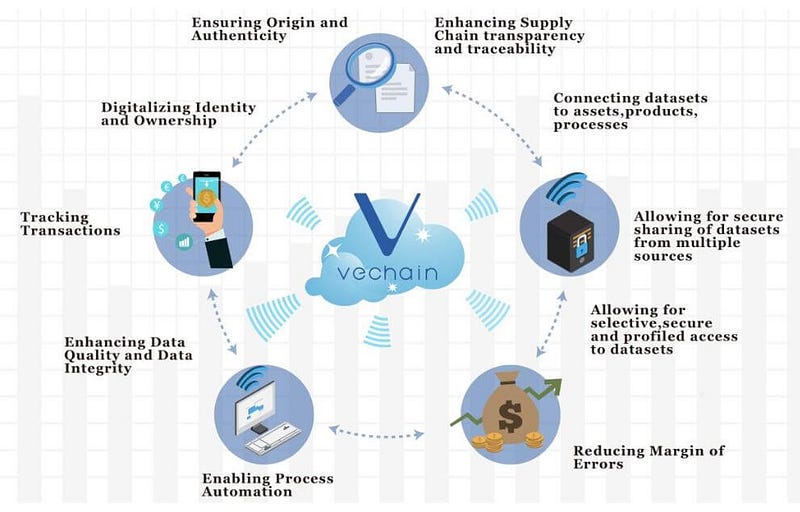
Read more on VeChain: Blockchain for supply chain resilience
Security tokens
- Used for the process of crowdfunding a new cryptocurrency or blockchain project
- A crypto token that passes the Howey test is deemed as a security token
- Derives their value from an external, tradable asset.
- Represents a stake in the project. Stakeholders expect a future profit and hold other benefits such as voting rights, shares of profits and rewards.
- Subjected to certain federal security regulations
- Important to cryptocurrencies as security tokens regain the credibility was in the ICO space back in 2017 and to improve traditional finance through the removal of excessive costs and middlemen.
SPiCE VC: One of the original security tokens that specialise in Venture capital(VC). It provides investors with exposure to the massive growth potential of blockchain in the coming years. VC investing has been exclusive to a particular set of investors thus far due to liquidity problems, and the high-risk nature of early business ventures. SPiCE VC aims to solve that by providing enough liquidity which will attract a new breed of investors. Not only does it help new investors, but it also provides capital to businesses at the most crucial stages.
Stablecoins
- Popular among traders as it protects them against volatility and enables trading pairs.
- As the name suggests, prices are kept stable, unlike other crypto assets.
There are 2 types of stablecoins, Fiat collateralized and crypto-collateralized. Fiat collateralized is backed by fiat currencies like the dollar and the Euro while crypto-collateralized coins are backed by cryptocurrencies.
Despite the stability in price, there are some inherent risks in stablecoins as well as they don’t always maintain their price peg. Furthermore, holders of the coin have to trust that there are sufficient reserves in the asset that’s backed by a stable coin which is known as counterparty risk.
However, the biggest risks for stablecoins are regulatory risks and the risk of government-backed digital assets which could minimize the necessity of stablecoins in the first place.
Paxos (PAX): ERC20 token issued on Ethereum blockchain that is collateralized by the U.S dollar and brings the twin benefits of blockchain technology efficiency and stability of fiat currencies.
Tether (USDT): Aims to provide a simple interface for people to access a blockchain-based cryptocurrency which is always valued at a 1-to-1 ratio with the U.S Dollar. It aims to maintain this ratio by backing the circulating supply of USDT with assets in reserve.
Dai (DAI): Decentralised stablecoin created by MakerDAO(MKR) that runs on the ethereum network and aims to maintain a soft peg with the U.S dollar. Unlike other stable coins, Dai is backed by crypto collaterals instead of U.S Dollars. It provides stability through a concept known as Collateralized debt position(CDP).
NFT /Collectibles
- Non-fungible token(NFT) is a cryptographic token that represents something unique and is not mutually interchangeable
- Fungibility is a basic characteristic of money. It is the ability to be interchanged for a similar unit. Bitcoin and U.S dollar is fungible.
- Non-divisible, rare, cannot be inflated and cannot be counterfeited.
- Used to create verifiable digital scarcity and the information is stored in smart contracts.
- Used for applications that require unique digital items such as in-game purchases, collectibles, virtual land and digital art
- Massive potential with VR, AR and gaming.
Enjin(ENJ): Enjin created the ERC-1155 token improved upon the ERC-20 and the ERC-721 tokens. ERC-1155 is both fungible and non-fungible on top of being secure and tradable. Enjin facilitates easy creation and management of virtual assets while allowing game developers to use the platform to integrate crypto assets into games and apps with limited coding knowledge
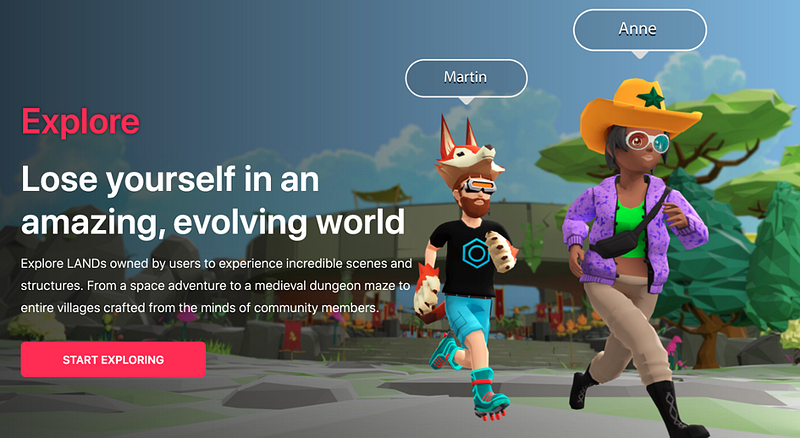
Decentraland(MANA): It is a decentralised virtual world powered by Ethereum blockchain which lets users create and monetize their content and applications. The digital land on the platform is called “LAND” and is finite in supply. Users can customize their avatar, build their own neighbourhoods and buy rare digital assets. If you want to know its true potential, watch ‘Ready player one’ by Steven Spielberg.
DeFi
- Decentralised financial services that use smart contracts
- Allows cryptocurrency trading on decentralized exchanges, betting, borrowing and lending cryptocurrencies to earn interest, exchange derivatives and participate in pooled lotteries.
- Passive income can be earned through loaning out money(staking) and yield farming where assets are pooled together to generate the most returns.
- DeFi’s main goal is to allow a future that opens up all the financial services you use today accessible with just a smartphone and internet connection.
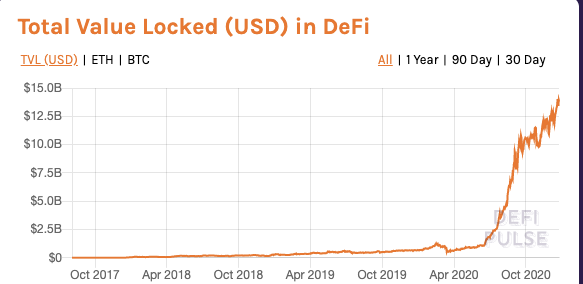
- Total value locked in DeFi contracts has exploded from just $2 million in 2017 to over $14 Billion in December 2020.
Chainlink(LINK): An oracle is a program that connects a blockchain to real-world data. Chainlink created a network of nodes to provide information to and from the blockchain. This enabled chainlink oracles to provide information such as event results, price feed data and statistics. In simple terms, chainlink is the secure bridge between blockchain and the outside world. Chainlink has partnerships with Google Cloud and Oracle.
Compound finance(COMP): Platform to borrow and lend cryptocurrency assets. Compound finance released their own custom coin COMP which exponentially drove up the total funds locked as users could earn more interest from the platform native currency, COMP.
Nexus mutual(NXM): Offers insurance to Ethereum users where members can buy a cover to protect themselves against hacks and bugs in smart contract code. The project aims to remove the need for an insurance company by collectively sharing risk. Although limited to smart contract failure currently, this model has the potential to make its way into car insurance, disability insurance and earthquake insurance.
The next big wave in DeFi starts when Wall Street figures out that crypto has built a better casino -Naval Ravikant
References
The Different Types of Crypto Assets (2019). Available at: https://readmedium.com/the-different-types-of-crypto-assets-3dfa2947f1bb
Nugget’s News — Bitcoin, Cryptocurrency and Finance (2020). Available at: https://nuggetsnews.com.au/
Nonfungible Tokens (NFT) — Quick Guide — Cointelegraph Magazine (2020). Available at: https://cointelegraph.com/magazine/nonfungible-tokens/
Utility Tokens vs Security Tokens: Learn The Difference — Ultimate Guide (2019). Available at: https://blockgeeks.com/guides/utility-tokens-vs-security-tokens/
What Is DeFi? — CoinDesk (2020). Available at: https://www.coindesk.com/what-is-defi