avatarElye

Free AI web copilot to create summaries, insights and extended knowledge, download it at here

2792

Abstract

o nice why one would do so?</p><div id="6627" class="link-block"> <a href="https://readmedium.com/why-i-give-50-claps-on-every-article-i-read-804e2e9c28e2"> <div> <div> <h2>Why I Give 50 Claps on Every Article I Read</h2> <div><h3>Can we all give a round of applause? It could change everything.</h3></div> <div><p>medium.com</p></div> </div> <div> <div style="background-image: url(https://miro.readmedium.com/v2/resize:fit:320/1*lt0Fwmdh4XiaHAXDXbAwbQ.jpeg)"></div> </div> </div> </a> </div><p id="da61"><b>3 Gradual descending trend of claps from 1 clap up to 40+ claps. </b>If we plot a straight line, we could see a clear reverse proportional trendline starting from 1 clap to up to 40+ claps, with the exception of 50 claps, where it spikes up again as mentioned in point 2 above.</p><p id="b55c">The way Medium-claps works is one has to press longer for the clap count to increase. It takes several seconds for one to reach 50 claps. That’s costly for some readers. Besides, most readers like to also reflect on their satisfaction with reading the articles. The common baseline is 1-clap, and the more satisfied, the more the claps, but the bar always increases as the reader reads more articles.</p><p id="fd65"><b>4 Slight spike trend in multiple of 10 and 5 too, i.e. 5, 10, 15, 20, etc.</b> The multiple of 10, like 10 and 20-claps count showed an obvious spike there. And also 5, 15, and 25 claps.</p><p id="9644">Some people don’t like too granular variations of votes. They like votes like 1 to 5. As there are 1–50 now, they will just for 1, 10, 20… to make up for their preference of lesser choice. Perhaps that could be the reason why 1-clap and 50-claps show the spike, as some people prefer a boolean voting system, of either good or bad. Another possible reason is people like multiple of 5, as that’s the basis of our counting system.</p><p id="8f7b"><b>5 Other than single claps, the trend for Medium members and non-Medium correlated well.</b> I doubt this is coincidental, as big enough data do provide some meaningful trends. To be more specific, for this article the Medium member's clap, in general, is slightly higher than the non-Medium members' clap.</p><p id="5418">The well-correlated trend for both Medium members and not Medium members shows the claps behavior data is relatively reliable, and not random. It does reflect the overall readers clapping behavior. Knowing such behavior, we could use it as a yardstick to measure the performance of our other articles.</p><p id="38c3">One example is if you have an article that received more 50 claps than 1 single clap, that means your arti

Options

cle has not reached its full potential. More publicity is needed for the article to reach a wider audience. When it reaches the right amount of audience, the trend of claps will form itself.</p><h1 id="ac10">Is the trend only apply to an article with 2000+ fans?</h1><p id="3f61">To satisfy my curiosity, I look into articles on different fans count and plot the same graph. Below are my findings.</p><figure id="fb63"><img src="https://cdn-images-1.readmedium.com/v2/resize:fit:800/1*8PmAzoe08SoL0NBhR65xJg.png"><figcaption>Trend from an article with more than 1000 fans</figcaption></figure><figure id="7b00"><img src="https://cdn-images-1.readmedium.com/v2/resize:fit:800/1*KWzRwrhu-IDq3vr1uSCLRw.png"><figcaption>Trend from an article with more than 500 fans</figcaption></figure><figure id="622a"><img src="https://cdn-images-1.readmedium.com/v2/resize:fit:800/1*Qy8tViwLPhg5iY6pq9rXlw.png"><figcaption>Trend from an article with more than 250 fans</figcaption></figure><figure id="d7be"><img src="https://cdn-images-1.readmedium.com/v2/resize:fit:800/1*mUH74yIvz-TH6ZnvGeMm-g.png"><figcaption>Trend from an article with more than 120 fans</figcaption></figure><figure id="7fc2"><img src="https://cdn-images-1.readmedium.com/v2/resize:fit:800/1*MN8N5ajtfNKq62erlsaucg.png"><figcaption>An article with more than 60 fans</figcaption></figure><p id="692e">It looks relatively consistent in most aspects of the analysis from the 2485 people clapping articles. Numbers don’t lie. Knowing the numbers, helps us set our expectations better, and decide better our next course of action.</p><p id="535b"><b>P/S: If you plan to clap for this article, maybe you could help prove me wrong, or do something different from your usual instinct, just to mess up the trend 🤪.</b></p><p id="54c2"><b>Articles used to plot the reader clap trends</b></p><ul><li>[1] <a href="https://medium.com/@elye.project/mastering-kotlin-standard-functions-run-with-let-also-and-apply-9cd334b0ef84">The article with more than 2000 fans</a></li><li>[2] <a href="https://medium.com/@elye.project/dagger-2-for-dummies-in-kotlin-with-one-page-simple-code-project-618a5f9f2fe8">The article with more than 1000 fans</a></li><li>[3] <a href="https://medium.com/@elye.project/kotlin-and-retrofit-2-tutorial-with-working-codes-333a4422a890">The article with more than 500 fans</a></li><li>[4] <a href="https://medium.com/@elye.project/understanding-suspend-function-of-coroutines-de26b070c5ed">The article with more than 250 fans</a></li><li>[5] <a href="https://readmedium.com/kotlin-slow-list-and-lazy-sequence-61691fc974c5">The article with more than 120 fans</a></li><li>[6] <a href="https://readmedium.com/kotlins-elvis-better-than-swift-s-guard-53030d403c3">The article with more than 60 fans</a></li></ul></article></body>

Aids for Medium writers

Understand Medium readers' claps behavior

What 16622 claps from 2485 people on an article tells us

Picture by Guillermo Latorre on Unsplash

Medium has a unique way of having readers showing their appreciation for an article, CLAPs 👏👏👏👏👏 …. up to 50 times!

Being curious, I took one of my Medium articles, which has 16622 claps from 2485 people, break them down by the number of claps I got (1 to 50), and also categorize them into 2 groups, i.e. Medium members and not Medium member.

Below is what I get.
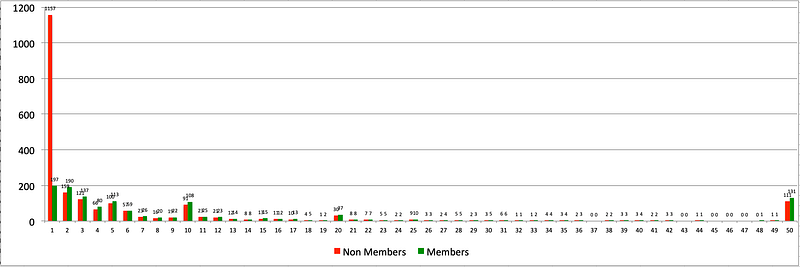
Number of people categorized by the count of claps (categorized into Medium and not Medium member)

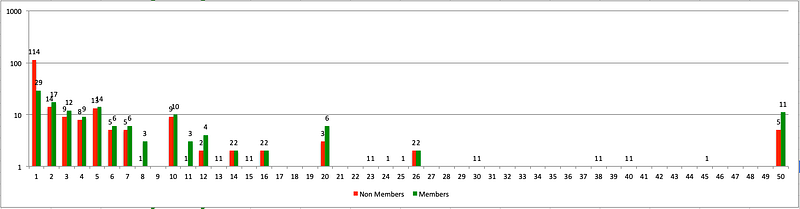
The spike on single-clap has made all other details so tiny, that it hides away some important detail. So let’s make it clearer by plotting the graph with a logarithmic Y-axis (1 to 10, to 100, to 1000) so that the lines get plotted closer to each other.
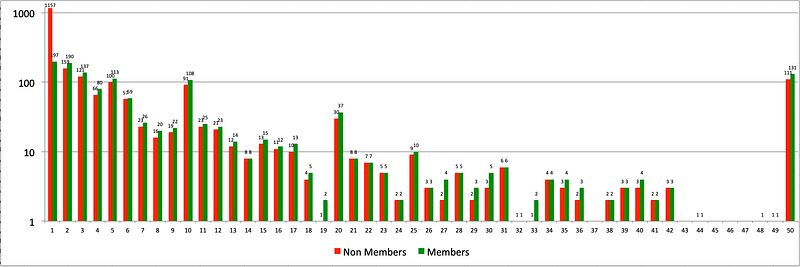
Number of people categorized by the count of claps (categorized into Medium and not Medium member) in logarithmic Y-axis

Cool, now the graph looks much clearer. More details can now be extracted. Several readers clapping behaviors are exhibits as described below

1 Super high single clap number from not Medium members. For this article, about 50% of clapping users.

Perhaps not-Medium member readers might not be aware that the clap can be done more than once, hence resulting in a high single clap count. Or perhaps not-Medium members readers are brought in from Google Search, and after reading, they move on, and hence not spending more time clapping.

2The second obvious spike is the maximum of 50 claps. The 50-clap count is the fourth highest peak, after 1-clap, 2-claps, and 3-claps.

My analysis is, people either go low (1, 2, or 3 claps) or go to the maximum. If someone is willing to clap up to 40, why not just linger a little while to complete the entire 50-clap cycle? The cost is negligible compared to the emotional support the writer gets. Some readers intentionally do so. Jordan Mendiola state is so nice why one would do so?

3 Gradual descending trend of claps from 1 clap up to 40+ claps. If we plot a straight line, we could see a clear reverse proportional trendline starting from 1 clap to up to 40+ claps, with the exception of 50 claps, where it spikes up again as mentioned in point 2 above.

The way Medium-claps works is one has to press longer for the clap count to increase. It takes several seconds for one to reach 50 claps. That’s costly for some readers. Besides, most readers like to also reflect on their satisfaction with reading the articles. The common baseline is 1-clap, and the more satisfied, the more the claps, but the bar always increases as the reader reads more articles.

4 Slight spike trend in multiple of 10 and 5 too, i.e. 5, 10, 15, 20, etc. The multiple of 10, like 10 and 20-claps count showed an obvious spike there. And also 5, 15, and 25 claps.

Some people don’t like too granular variations of votes. They like votes like 1 to 5. As there are 1–50 now, they will just for 1, 10, 20… to make up for their preference of lesser choice. Perhaps that could be the reason why 1-clap and 50-claps show the spike, as some people prefer a boolean voting system, of either good or bad. Another possible reason is people like multiple of 5, as that’s the basis of our counting system.

5 Other than single claps, the trend for Medium members and non-Medium correlated well. I doubt this is coincidental, as big enough data do provide some meaningful trends. To be more specific, for this article the Medium member's clap, in general, is slightly higher than the non-Medium members' clap.

The well-correlated trend for both Medium members and not Medium members shows the claps behavior data is relatively reliable, and not random. It does reflect the overall readers clapping behavior. Knowing such behavior, we could use it as a yardstick to measure the performance of our other articles.

One example is if you have an article that received more 50 claps than 1 single clap, that means your article has not reached its full potential. More publicity is needed for the article to reach a wider audience. When it reaches the right amount of audience, the trend of claps will form itself.

Is the trend only apply to an article with 2000+ fans?

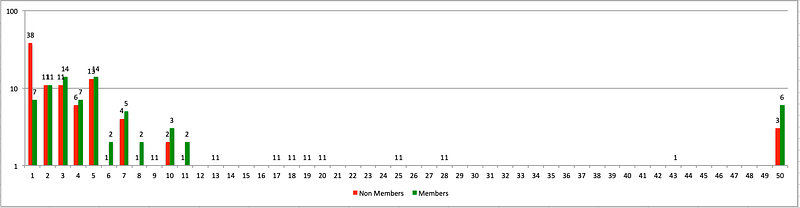
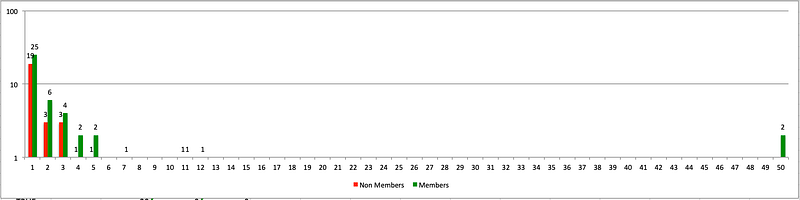
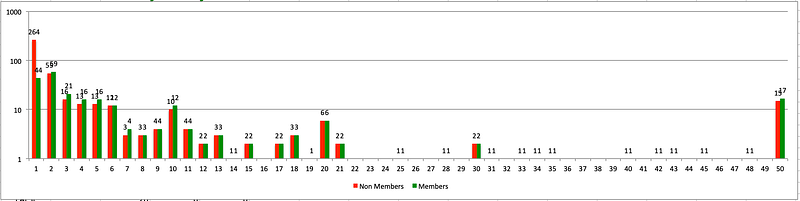
To satisfy my curiosity, I look into articles on different fans count and plot the same graph. Below are my findings.
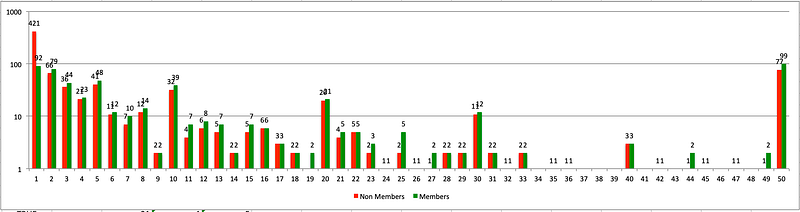
Trend from an article with more than 1000 fans
Trend from an article with more than 500 fans
Trend from an article with more than 250 fans
Trend from an article with more than 120 fans
An article with more than 60 fans

It looks relatively consistent in most aspects of the analysis from the 2485 people clapping articles. Numbers don’t lie. Knowing the numbers, helps us set our expectations better, and decide better our next course of action.

P/S: If you plan to clap for this article, maybe you could help prove me wrong, or do something different from your usual instinct, just to mess up the trend 🤪.

Articles used to plot the reader clap trends

Data Science
Blogging
Writing
Life
Marketing
Recommended from ReadMedium