Holocaust in Education
Undermining the Lessons of History’s Atrocities
The narrative that America cannot survive introspection multiplies and is absorbed by others. Don’t let it re-write history. The unpleasant must be taught.
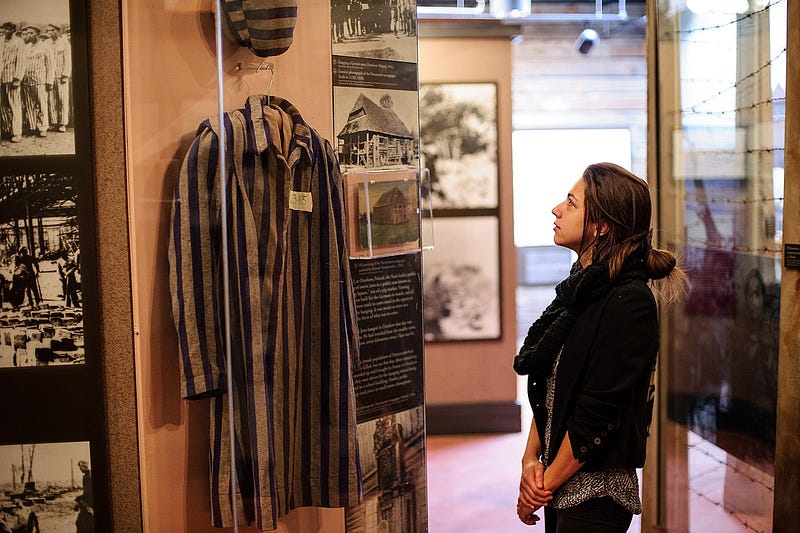
There are those, it seems, that feel American children cannot handle the truth. To question American exceptionalism is to risk shaking our foundational beliefs to the point of disrepair. So those who believe in America the least have identified the topics we must not confront.
These include chapters on America’s shameful history of genocide and slavery. They push to remove these topics from our history lessons or tone them down considerably, as they are too troubling for our precious youth to absorb. This avoidance of uncomfortable topics extends to the Holocaust as well.
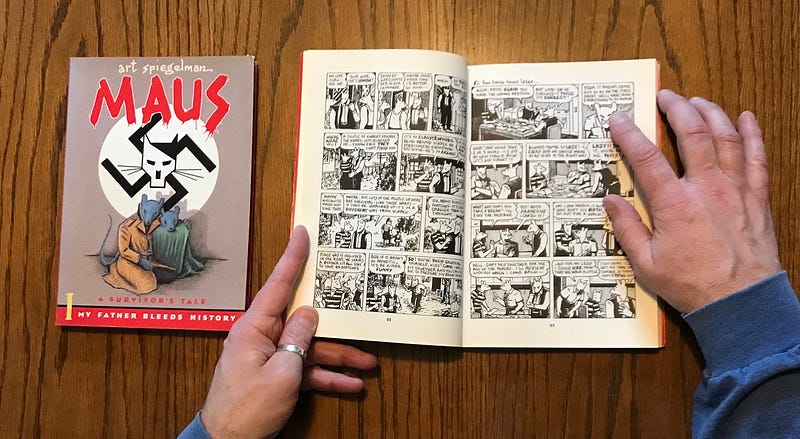
To wit, the McMinn County, Tennessee school board recently voted 10–0 to remove Maus, the Pulitzer Prize-winning graphic novel about the Holocaust, from its eighth-grade curriculum. Ostensibly, this was due to curse words (eight mentions of damn) and depiction of a naked, anthropomorphized mouse, saying the subject matter was “too adult-oriented.”
Maus has been challenged before. But I find the timing on this ban, conspicuous. There is a groundswell of denial in certain quarters on the depth of our nation’s complicity on genocide and racism. Some of these same forces would understate the heinousness of the Holocaust as well.
It is especially because of the magnitude of this atrocity that we must teach it. The last survivors of the Holocaust are passing. In light of virulent open anti-Semitism, we must not sanitize history of this type due to tender sensibilities. Dave Pell addressed this simply in his tweet:
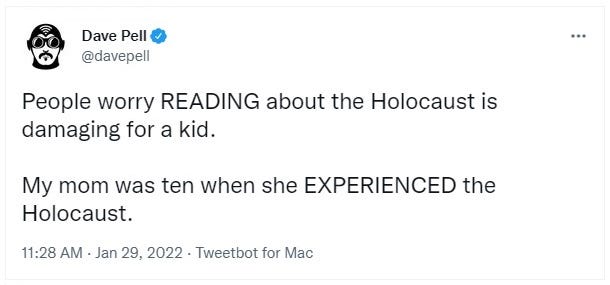
It would seem this statement would not need an explanation, and yet, it elicited the kind of question that might be innocent but is frequently used to undermine the scope of atrocity so as to reduce accountability, reparation, and make change.
I’m honestly not trying to undermine your mother’s experience. But I don’t understand the point you’re trying to make. Does the fact that some young kids experience horrific atrocities mean we shouldn’t be mindful about how and when we teach other young kids about them?
Mindfulness is in vogue. It’s a buzzword that has permeated most industries and is used by people who don’t understand that it’s a practice rather than a solution. It’s ridiculous. I say this as someone who works in mental health, where we have fully embraced mindfulness in a subset of cognitive behavior therapy called dialectic behavior therapy or DBT. I’m also a certified yoga instructor, and someone who identifies as leaning towards Buddhism complete with mediatation practice and study.
I am huge proponent of mindfulness. But this question is absurd.
While I’m sure there are bungled attempts at teaching sensitive topics throughout the classrooms of America, educators have for several generations taught about the holocaust without harming the youth.
Throughout my public education, we were taught about WWII and the Holocaust. The Diary of Anne Frank was on many course syllabi, we saw film of Nazi marches and propaganda, and photos of gaunt prisoners in concentration camps. I’m sure we didn’t see the worst of it, but I wasn’t damaged by this. And I don’t recall any of my peers being damaged, either.
So again, why this concern that we’re mishandling sensitive topics?
The person who asked the question is a writer who can be eloquent and often tries to take a conciliatory approach to bridge the gap of the ridiculous polarization in America. This is why I say it could be a sincere question. But, intentionally or not, it still plays into the hand of those who would undermine progress, either from guilt or more sinister beliefs.
We should not budge an inch, when it comes to teaching about the Holocaust.
We have people actively denying that the holocaust happened, who have been given a platform. And we have people who should essentially carry no guilt for the Holocaust, attempting to lessen its impact on our poor impressionable children. Why is that?
The holocaust should impact every subsequent generation. It’s that awful. And that’s not to say the topic shouldn’t be handled with sensitivity. But we’ve been doing that. We can and we have, in our classrooms, taught about the Holocaust, slavery in the United States, and the My Lai massacre.
Teaching about our history will not damage our children. In watering down our history, on the other hand, to make it more palatable to some adults, we risk our progress and our future. We risk the perpetuation of beliefs that enabled the atrocities.
Epilogue: So much of the coverage on books that are banned seems to be reduced to outrage. On one hand you have parents with concerns over content. On the other you have literary defenders in the name of art and perspective. This coverage frequently dwarfs what makes the books so vital. Rather than denouncing those with concerns, it should be easy to give examples of why the book speaks to you and why it should be taught and remain in on course lists. So here’s mine, for Maus.
One of the things Maus did for me was to highlight how scarcity can impact you for the rest of your life. Art Spiegelman is telling the story of his father’s survival. But he struggles with the relationship he has with him. As the story unfolds, his father tells him all the things he did to survive; to hide jewelry to sell later or when he would wash himself in puddled water in freezing weather to avoid infestations of lice.
Well after escaping Auschwitz and emmigrating to the United States, his father keeps a burner on the gas stove in his rented unit lit, so to save a match, because the gas was free. There was a time when he was barely surviving, where the ability to save a match meant he could light a fire when he was cold, stay warm and live. I haven’t read the book in years, but I remember that.
These are the lessons that art and history give us; not to fear, but to relate… to understand the experience of another.