
Uncover Your Personal And Professional Blind-Spots Using This Psychological Tool
A Johari window to the soul, if you will.
Blind-spot (noun) — an area in which a person lacks understanding or impartiality.
“There’s only one corner of the universe you can be certain of improving, and that’s your own self.” — Unknown
As illustrated by the definition at the beginning of this article, a blind-spot is an area that is obstructed from clear view, leading to an explicit deficiency in understanding or impartiality. In other words, blind-spots are the parts of your personality, and general modus operandi, that are unbeknownst to you.
We all have them — whether we believe we do, or not — and they can be both positive or negative qualities. At its core, the Johari Window represents the collective value of our individual's experiences, feelings, views, attitudes, skills, thoughts, intentions, and motivations. The benefit to becoming aware of these areas of our life is that a more well-rounded comprehension of our personal strengths and weaknesses provides us with the information we need to better navigate our relationships to others and to ourselves.
With no further ado, let’s begin.
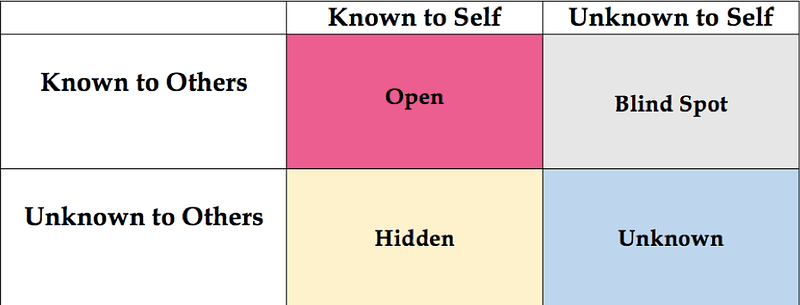
The Four Quadrants of The Johari Window
- Open
This pane of the window represents both what is known to oneself, as well as what is known to others. There is a transparency that exists between the ‘you’ you perceive yourself to be and the ‘you’ that is hence perceived by others, and this area is it.
In a professional environment, leaders who possess a greater area of this sector in particular, are generally viewed as honest, positive, helpful, constructive, sensitive to communications, and more successful at leading a team, overall. These are people who, in a professional context, understand the importance of developing interpersonal relationships and trust as a fundamental constituent of a productive organization.
In a personal context, people who possess and greater area of ‘open’ are largely perceived as being more friendly, extroverted, trust-worthy, dependable, and down-to-earth. By maintaining a high degree of sincerity and truth-fullness in the portrayal of oneself to others, research has shown that individuals are not only percieved as being happy, healthy, and successful, but that they actually are (2).
2. Hidden
This window pane represents all aspects of one’s personality and cognitive processes that is known to oneself, yet kept secret — both intentionally and unintentionally — to the rest of the outside world. Often times this avoided area of the self contains information, thoughts, and feelings that exist as a source of insecurity for the individual.
In a professional setting, it is very natural for certain aspects of one’s personal life to be considered private/intimate knowledge, or perhaps not entirely appropriate to be shared with colleagues and peers. Understandably, this can be a positive thing, and should therefore be objectively assessed and factored into consideration, accordingly.
In a personal context, these areas can harbour more psychologically affecting characteristics, such as secrets, hidden agendas, and fears. Honest reflection in this quadrant of the Johari window can be difficult, though highly revealing.
3. Blind-spot
Ah! The golden quadrant! This pane of the Johari window represents all the things that are known to others about you, but that are currently not fully understood, appreciated, or consciously realized about yourself. This sector can provide invaluable insight to the areas of one’s personality and manner of social conduct, that provide you with the power to significantly and positively affect all aspects of your life.
In a professional setting, there may be patterns in your handling of issues, or moments of contention at work that you are blissfully unaware of, and that would greatly benefit from being brought to light. Similarly, you may not yet recognize how exceptional you are in a particular area, or fail to identify with a quality that others wouldn’t hesitate to, frequently — and much to your surprise — ascribe to you.
In matters of personal life, there may be deficits you are failing to observe within your self and your interpersonal connections, as well as things you would do well to be reminded of by those your know and love. There is much to gain from this sector of the Johari Window, so long as you are willing to separate your emotional attachments from your reality, as it is revealed to you by others.
4.Unknown
Subsequently, this window pane represents all the things that are unknown about you to both yourself and others. This area of this sector experiences a natural decrease in size as an individual grows up, with age and overall life experience contributing to the formation and solidification of a person’s identity and awareness of their disposition.
In a professional environment, the pane of the unknown is most commonly made up of abilities that are either wholly underestimated, or potentially un-attempted, often through a lack of confidence, adequate training, encouragement, or opportunity. The potential for growth in this quadrant is strengthened by a conscious commitment to self-exploration, as well as continual learning.
In personal settings, people who possess repressed issues from childhood, or alternatively, are currently in the process of repressing qualities and characteristics that may actually prove useful to them in the future, are likely going to have to work harder to bring these realizations to the surface. Here, there is an emphasis of overcoming any conditioning that has ceased in serving its purpose.
How To Use The Johari Window
Using the Johari Window is as simple as locating a piece of paper and pen, and finding a generous group of people willing to lend their time and consideration to your personal development.
To use the Johari Window in a professional setting, it is vital that open communication is established, and that impartiality on both sides is adhered to as closely as possible for the sake of professionalism and productivity.
To use the Johari Window in a personal setting is to open oneself up to the commendations and criticisms of others — truly, no small task when it comes to the handling of the ego.
Open —
Participants should utilize the open quadrant to identify the areas of mutual agreement in regards to the individual’s core constituent values and characteristics. The aim of this sector is to recognize that these are the qualities realized through the facilitation of good communication, optimal cooperation, and teamwork. Being on the precisely the same page about these traits is representative of excellence in this area.
Hidden —
The primary subject of the Johari Window should use this quadrant introspectively, as a tool for increasing awareness of the feelings and parts of one’s identity that are kept hidden due to the fear of judgement or shared vulnerability.
The culture that surrounds a person’s immediate circumstance, both personally and professionally, has a major influence on said person’s propensity and/or willingness to reduce the opacity of their facade to the outside world. By making the choice to disclose the characteristics located within the sector, thereby moving them into the ‘open’ quadrant of the Johari Window, the enhancement of mutual understanding, improved group effectiveness and awareness, as well as the betterment of individual performance, can take place.
Blindspot —
Participating members should utilize this sector to expand on any area they feel the subject may lack a distinct or adequate awareness in. It is the duty of team leaders and employers in a professional setting to promote a climate of constructive and non-judgemental feedback. It is the duty of the individual to seek feedback as frequently and profoundly as they feel necessary to strengthen their own perception and comprehension of these qualities.
As it pertains to the feedback itself, individual resilience and responsiveness to negative observations will inevitably vary, and thus is the burden of both the respondent and the receiver to exhibit sensitivity where sensitivity is due.
Unknown —
The requirements of this sector can be seen more akin to recommendations. As the information in this quadrant is intrinsically unknown to all participating members, they ought to, instead, develop suggestions of the areas within which the individual risks observing their hidden potential.
Leaders and employers can work to create an environment that is conducive to self-discovery and the on-going expansion of opportunity. The distinct lack of pressure to succeed in areas of the unknown — due to their inherent nature of being unknown — means that employee morale is supported while output and performance is simultaneously enhanced.
Conclusion
Related directly to one’s awareness and development of emotional intelligence, the Johari Window is an excellent tool for encouraging personal growth and professional success.
Professional application of the Johari Window is supported by the principle that, as communications and interpersonal relations of a team are improved, so, too, is their effectiveness and productivity in working with one another, with an additional benefit of the risk of misunderstandings and unnecessary conflict being significantly reduced.
So the proverb goes that what you don’t know can’t hurt you, but by uncovering your personal and professional blind-spots, you find they begin to start helping you, instead.
Alexandra Walker-Jones — January 2020
Text References:
- Luft, J., & Ingham, H. (1961). The Johari Window: a graphic model of awareness in interpersonal relations. Human relations training news, 5(9), 6–7.
- Osmanoğlu, D. E. (2019). Expansion of the Open Area (Johari Window) and Group Work Directed to Enhancing the Level of Subjective Well-being. Journal of Education and Training Studies, 7(5), 76–85.