
Missile Technology
Ukraine’s R-360 Neptune Cruise Missile
It has the sinking of the Moskva on its scoresheet, but does it have other capabilities?
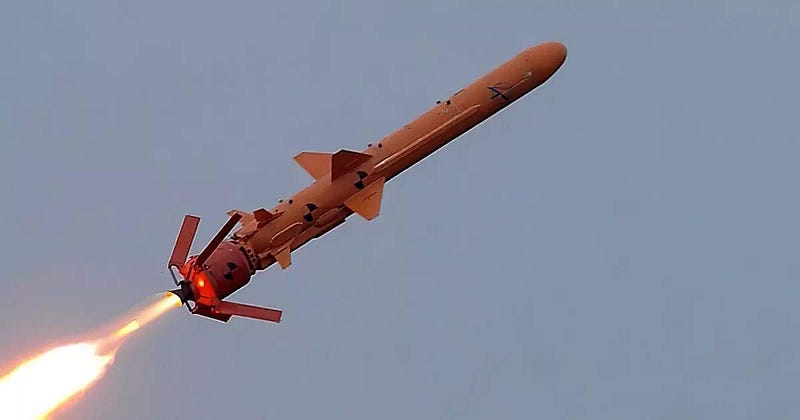
The cruiser Moskva was the flagship of Russian’s Black Sea fleet and the world was astounded to learn on 14 April 2022 that it had been seriously damaged by Ukrainian anti-ship missiles — so seriously, in fact, that it could not be saved and soon sank.
The cruiser was the largest Russian warship to be sunk in wartime since the end of World War II, and the first Russian flagship sunk since Knyaz Suvorov in 1905, during the Russo-Japanese War.
An amazing achievement brought about by Ukraine’s heritage of missile development.
Background
Ukraine’s broad and deep history of missile expertise is rooted in its role during the Soviet era. As a crucial part of the Soviet industrial and defense complex, Ukraine hosted key research and production facilities that contributed to the development and manufacturing of intercontinental ballistic missiles (ICBMs) and other advanced aerospace technologies.
The Yuzhmash production complex in Dnipro, for instance, became a significant hub for missile manufacturing, responsible for producing the game-changing SS-18 Satan ICBM. This missile was viewed as giving the Soviet Union first strike advantage over the U.S., particularly because of its rapid silo-reload ability, very heavy throw weight and large number of MIRVs (re-entry vehicles).
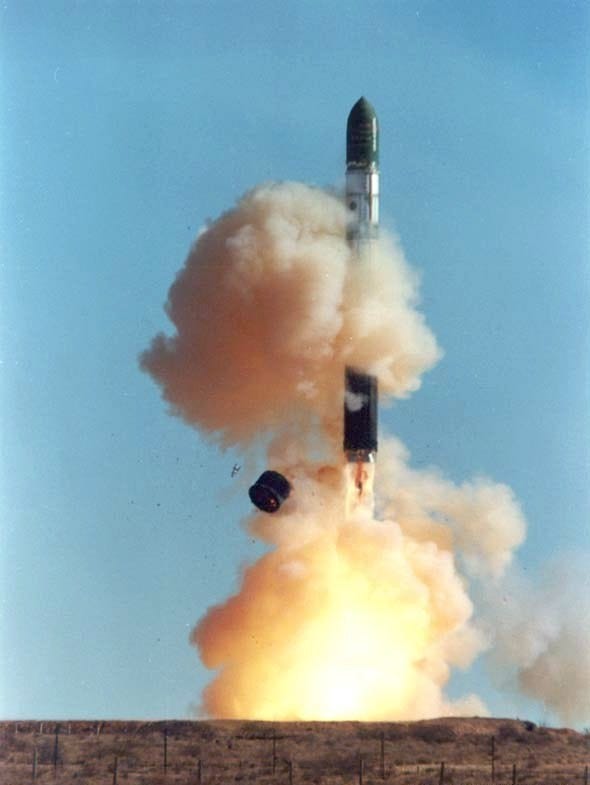
Following the dissolution of the USSR in 1991, Ukraine inherited the third-largest nuclear arsenal in the world. The Budapest Memorandum in 1994 saw Ukraine giving up its nuclear weapons in exchange for security assurances which have proven to be quite worthless.
But despite that renouncement, Ukraine retained significant technical expertise in missile technology and Ukraine is fighting back. This expertise has led to the success of the K-360 Neptune.
The K-360 Neptune
The RK-360MC Neptune (also known as the K-360 Neptune) was developed by the Kyiv-based Luch Design Bureau and was primarily designed to target warships, auxiliary vessels, and landing craft. But it may have other uses too, which I’ll explore later.
The system is designed to operate inland up to 25 km (16 nm) from the coastline.
With a reported operational range of approximately 280 km (175 nm), which some sources put it as much as 300 km, it has proven its potential to hold Russian naval forces at risk from inside Ukrainian territory. However it lacks enough range to attack Russian naval vessels entering/leaving Sevastopol from within Ukraine’s currently held territory. As far as we know it cannot attack vessels within a harbour.
This missile is designed to fly at low altitudes, skimming above the water’s surface, making it challenging for enemy radars and defenses to detect and intercept. These flight profiles increase the odds of the missile reaching its open-sea target, bypassing most conventional naval air defense systems until it’s too late.
A complex system
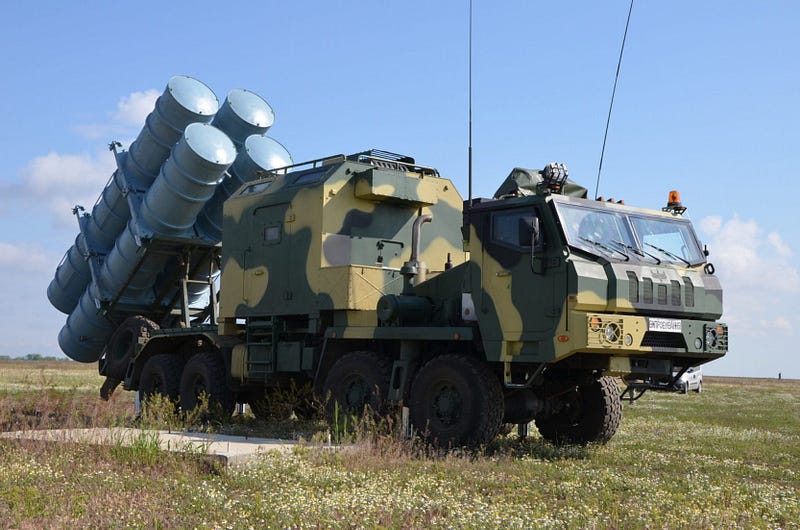
The complete Neptune system comprises multiple components: the missiles themselves, a launcher system, a transport and loading vehicle, and a command-and-control post. Typically, a battery consists of six USPU-360 launchers, each carrying four missiles.
The missile
A Neptune missile including rocket motor is 5.05 metres in length, with a cross-shaped hard wing. A single missile weighs 870 kilograms of which 150 kilograms is the warhead. It uses Ukraine’s own Motor Sich MS-400 turbofan engine which has a high thrust-to-weight ratio.
- Active radar seeker for terminal guidance.
- Low-altitude flight profile to evade enemy defenses.
- Approximately 280 km operational range.
- Subsonic speed.
USPU-360 Launcher System
- Launch platform for the R-360 missile.
- Mobile, based on a wheeled chassis.
- Typically carries four R-360 missiles.
Transport and Loading Vehicle
- Responsible for transporting missiles to the launch site and loading them onto the USPU-360 launchers.
- Specialised equipment to ensure safe and efficient loading of missiles.
- Mobility to quickly relocate and resupply the launchers.
Command-and-Control Post (CCP)
- Centralised system to coordinate the operations of the missile system, from target detection to missile launch.
- Advanced communication systems for real-time C3 coordination.
- Target acquisition and tracking systems.
- Integration with other defense systems for a holistic defense approach.
Support vehicles (optional based on the configuration)
- Provides logistical, maintenance, and operational support.
- Might include radar vehicles, power supply units, maintenance, and repair vehicles, among others.
The system’s modular nature allows for flexibility in deployment, ensuring that the Neptune can be adapted to various operational scenarios and threats.
Re-purposing?
The Norwegian ‘Naval Strike Missile’ (NSM) is an anti-ship missile which has been re-purposed. NSM is able to fly over and around landmasses, travel in sea skim mode, and then make random manoeuvres in the terminal phase, making it harder to stop by enemy countermeasures. In 2016, it was confirmed by the Royal Norwegian Navy that NSM also can attack land targets.
What we don’t know about Ukraiane’s R-360 Neptune is whether is has — or could have — the flexibility of flight profiles that the NSM has. Clearly, sea-skimming is not an option for attacking a land target, in general. That would require the ability to fly up and over obstacles and terrain features, inevitably shortening the missile’s range.
Nevertheless I don’t put it beyond the capability of Ukraine to evolve the Neptune into a land attack cruise missile.
But will they bother to do so?
Future developments
There are rumours that Ukraine has modified the old Soviet-era Tu-141 Stryzh reconnaissance drone, which has a range of 1,000 km. There are reports that it was used to attack Russia’s Engels air base near Saratove in December 2022.
Whether that is correct or not, there is no doubt that Ukraine has the expertise and technological capability to develop their missile armoury to match anything in the world.
The K-360 Neptune has caused serious problems for Russia’s navy and extended Ukraine’s marine cordon in the Black Sea. As the southern counter-offensive continues, it is likely that within a couple of months the Neptune will be able to threaten Sevastopol and Russia’s sea route out through the Sea of Azov.
In the meantime, Ukraine is evolving the Soviet-era Kh-55 air launched cruise missile into the updated Korshun, for air, ground and ship launch to attack static land targets.
Ukraine cannot rely on the West to supply long-range missiles. The ATACMS saga has been going on for almost a year now, and still the US dithers.
The Kyiv Post reported that the former Ukrainian Defense Minister, Oleksii Reznikov, while speaking recently in a public forum in June suggested the range of the missile might be even longer: “We have very good prospects of having Ukrainian missiles with a range of more than 1,000 kilometers.”
So, I think that the K-360 Neptune has reached the end of development (other than the likely updating of ECM measures), but will remain as a solid and effective component of Ukraine’s naval defence armoury.
UPDATE: It seems I spoke too soon. There are reports that Neptunes were used in the recent attack on the dry docks at Sevastopol, when the Russian landing ship Minsk and the Kilo class submarine Rostov on Don were destroyed. The missiles were used to destroy the $1.2 billion Triumf radar system beforehand to blind the Russian defences. As in land target.
Follow me and I guarantee variety in your inbox with some unusual perspectives! I write on a wide range of topics that interest me including humour, tech, space, geopolitics and travel. I also write about…
…curious twists of history

My novels are available at my Gumroad bookstore. Also at Amazon and Apple