avatarJames Marinero, MSc, MBA

Free AI web copilot to create summaries, insights and extended knowledge, download it at here

4378

Abstract

eces, such as the M114, M109, M198, M777 and [French] CAESAR howitzers. The projectile has a minimum range of 3 km and a maximum range of 16 km. (<a href="https://en.wikipedia.org/wiki/M712_Copperhead">Wikipedia</a>)</p><figure id="8bd4"><img src="https://cdn-images-1.readmedium.com/v2/resize:fit:800/1*diE0NaHbzHfNIzCleLPQrw.png"><figcaption>Copperhead projectile cross section. Credit: By U.S. Army — Department of Defense, Public Domain,</figcaption></figure><p id="e7e3">The Copperhead’s guidance mechanism steers the projectile on to the target which is reflecting laser pulses. By continuously adjusting its flight path to align with the reflected laser’s coordinates, the round can accurately strike its designated target.</p><p id="2a79">The round is capable of engaging a wide array of targets, from enemy armored vehicles and fortified positions to structures and even naval vessels.</p><h1 id="2ec2">Comparable munitions</h1><p id="ed11">The 2K25 Krasnopol is a Soviet 152/155 mm cannon-launched, fin-stabilized, base bleed-assisted, semi-automatic laser-guided artillery weapon system. It automatically ‘homes’ on a point illuminated by a laser designator, typically operated by a drone or ground-based artillery observer. (<a href="https://en.wikipedia.org/wiki/Krasnopol_(weapon_system)">Wikipedia</a>)</p><p id="23be">Note that both 152mm and 155 mm versions are available.</p><p id="92fc">Both Ukraine and Russia have these munitions, and I think that it’s likely that this was what was used in the Twitter clip that I included above.</p><figure id="e7e9"><img src="https://cdn-images-1.readmedium.com/v2/resize:fit:800/1*TcdWRjrLmI2JTggvkolnHQ.jpeg"><figcaption>2K25 Krasnopol guided artillery shell. Credit: By Mike1979 Russia — Own work, CC BY-SA 3.0, <a href="https://commons.wikimedia.org/w/index.php?curid=4599808">https://commons.wikimedia.org/w/index.php?curid=4599808</a></figcaption></figure><p id="aa8d">On 14 July 2023 a <a href="https://www.forbes.com/sites/davidaxe/2023/07/14/the-ukrainian-army-has-lost-its-first-super-upgraded-m-55s-tank/?sh=5d69c2a856b2">Ukrainian M-55S tank was hit</a> by a guided Krasnopol 152mm Russian artillery shell. The tank M-55S was damaged but <a href="https://twitter.com/bayraktar_1love/status/1680539826897010690?ref_src=twsrc%5Etfw%7Ctwcamp%5Etweetembed%7Ctwterm%5E1680539826897010690%7Ctwgr%5E8034df78b2f3dc71b0083eb847f76cd18af6301d%7Ctwcon%5Es1_&amp;ref_url=https%3A%2F%2Fwww.redditmedia.com%2Fmediaembed%2F151789e%3Fresponsive%3Dtrueis_nightmode%3Dtrue">reported as still drivable</a>.</p><h1 id="a585">Countermeasures</h1><p id="5b9f">GPS-directed artillery rounds are relatively easily jammed and Russia has found ways to <a href="https://edition.cnn.com/2023/05/05/politics/russia-jamming-himars-rockets-ukraine/index.html">reduce HIMARS effectiveness by jamming</a>— the ECM technology war in Ukraine is continuous.</p><p id="8ce4">Laser guided weapons can be jammed in several ways, but it’s not straightforward. Laser jamming can be used, although you have to question whether this would be widespread (and reliable) on Russian tanks, especially the older models now in use.</p><p id="e415"><b>Shtora-1</b> ( “curtain”) is an electro-optical active protection system or suite for tanks, designed to disrupt the laser designator and laser rangefinders of incoming anti-tank guided missiles (ATGMs). (<a href="https://en.wikipedia.org/wiki/Shtora-1">Wikipedia</a>)</p><p id="685e">These units can automatically launch smoke grenades.</p><figure id="ec41"><img src="https://cdn-images-1.readmedium.com/v2/resize:fit:800/1*UFL-XozZ3EDo1H2XLbhjHA.jpeg"><figcaption>Shtora-1 IR emitter. Credit: By Boevaya mashina — Own work, CC BY-SA 4.0, <a href="https://commons.wikimedia.org/w/index.php?curid=75642705">https://commons.wikimedia.org/w/index.php?curid=75642705</a></figcaption></figure><p id="7302">Several Shtora-1 protected T-90 tanks have been lost to latest generation pulsed-laser ATGMs in Syria and Ukraine.</p><p id="67ed">The simplest jamming method is smoke. Smoke jamming is more effective against laser guidance systems that use visible or near-infrared lasers, as these wavelengths are more readily absorbed or scattered by the smoke aerosol.</p><p id="4c55">However, smoke may be less effective against systems that employ longer-wavelength or infrared lasers, as these can penetrate through

Options

certain types of smoke more effectively.</p><p id="0e49">The Shtora-1 system has twelve smoke grenade launchers and can lay a 15 metre high and 20 metre wide smoke screen in three seconds that lasts about twenty seconds at ranges from 50 to 70 metres.</p><p id="7a23">Smoke could obscure both the incoming ‘illuminating’ beam and the reflected laser light that the projectile detects.</p><p id="c2df">Obviously the projectile has to have clear sight of the target, so low cloud would be be a problem for guided artillery shells, as would a 15 metre high smokescreen.</p><h1 id="9f71">Is it really possible?</h1><p id="25df">The reported range of the Skif is 5 km in daytime and 3 km at night, so there is ample laser power available to designate a target for an incoming artillery round which is approximately on target before final signal acquisition.</p><p id="2a8f">The frequencies and pulse codes that the Skif uses is likely to be a closely guarded secret.</p><p id="c416">The Shtora-1 jammers have been removed from many currently serving T-90s and the more modern S and M variants did not include them. (<a href="https://en.wikipedia.org/wiki/Shtora-1#">Wikipedia</a>)</p><h1 id="25dd">Implications</h1><p id="8488">I’m speculating that the US has many Copperheads in storage, having been replaced in their current operational armoury by more agile guided shells such as Excalibur which do not require line of sight target designators.</p><p id="cdda">Wikipedia does list the US as a current user however, as indeed is Ukraine. Copperheads were in the Australian armoury but are now listed as having been replaced.</p><p id="24b8">Using this weapon system requires a high degree of coordination between artillery spotters/designators and the artillery fire controllers. The target has to be painted until arrival of the munition.</p><p id="71d4">As far as I could determine, the Skif designator has a power output of a few tens of watts, so the battery capacity could possibly be carried by a small drone.</p><p id="2155">If these reports are correct then this smart combination is a cheap and easy way to multiply the effectiveness of Ukraine’s artillery — Ukraine has many more howitzers than it has HIMARS batteries.</p><h1 id="2479">Was it real?</h1><p id="0a82">On balance, I think it’s probable that a Krasnopol round was used for the destruction of the Russian tank, but whether the laser designator was a Stugna-P (Skif) remains unanswered.</p><p id="b720">It would be a relatively straightforward development for Ukraine to adapt the Skif laser designator to work with the Krasnopol artillery round (or vice versa).</p><p id="0055">It provides an interesting insight into weapons systems development in Ukraine. If correct.</p><p id="916f"><i>If you follow me I guarantee variety in your inbox with some unusual perspectives! I live on a boat and write on a wide range of topics that interest me including humour, tech, space, geopolitics and travel. I also write about…</i></p><p id="4aa2"><b>…home-brews</b></p><p id="ea64"><i>If you appreciate stories like these and want to support me and other writers, please consider signing up to become a Medium member. It’s only $5 a month, giving you unlimited access to incredible stories on Medium. If you sign up using <a href="https://james-marinero.medium.com/membership">my link</a>, I’ll earn a small commission at no extra cost to you.</i></p><p id="fb99"><i>Or maybe just <a href="https://ko-fi.com/jamesmarinero">buy me a coffee?</a> and tell me what you liked reading (or not)…</i></p><figure id="9ae6"><img src="https://cdn-images-1.readmedium.com/v2/resize:fit:800/1*QeQr0J6dshTDJHUZ_MtLdw.png"><figcaption></figcaption></figure><p id="bed1"><i>My novels are available at my <a href="https://jamesmarinero.gumroad.com/">Gumroad</a> bookstore. Also at <a href="https://www.amazon.com/stores/James-Marinero/author/B0055RWF6U">Amazon</a> and <a href="https://books.apple.com/us/author/james-marinero/id490200686">Apple</a></i></p><p id="4638">Author’s note: The concept, structure, style and creative content in this story are all my own and I hope that is obvious to a reader. I do not employ third party writers. However, I do occasionally use an AI assistant to research and present small sections of factual content and data. All facts are checked where possible and sources quoted.</p></article></body>

Weapon Systems

Ukraine’s Mix’n Match Tank Destroyer?

A clever combination of Ukraine’s Stugna-P ATGM laser designator and Copperhead artillery round fired from a howitzer, but is it real?
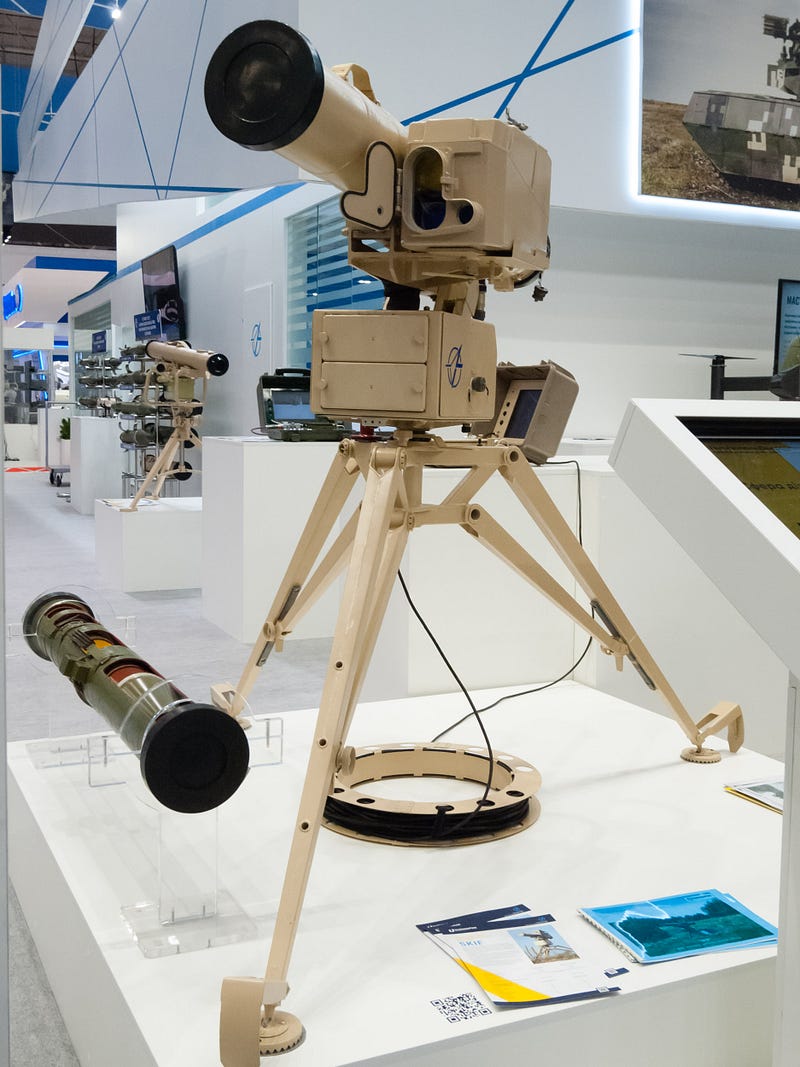
Stugna-P laser designator. Credit: By VoidWanderer — Own work, CC BY-SA 4.0, https://commons.wikimedia.org/w/index.php?curid=107555026

The world is rapidly learning that Ukraine is highly innovative in its fight for survival against Russian aggression. Inventors and designers have innovated weapons, the country’s leaders have fully harnessed the population and new tactics have been put into operation.

I wrote recently about Ukraine’s garage-built ‘home-brew’, low cost drones, and now it seems that there is another innovative meld of existing technologies being deployed against tanks and strongpoints.

There are reports that a Russian tank was destroyed with a 155mm M712 Copperhead (or similar) laser guided artillery shell fired by a Ukrainian AHS Krab self-propelled howitzer.

Of particular interest is that the target was ’designated’ using the laser from a Stugna-P (Skif) anti-tank guided missile (ATGM).

This could be an interesting development, with an active ongoing debate about the details, so I decided to look at the report in more depth.

In summary, it it reported that Ukraine’s own laser designator is being used by Ukrainian ground forces to steer US Copperhead guided artillery shells onto a target.

Stugna-P ATGM (Ukrainian: Skif)

The Stugna-P, known by its export version Skif, is a Ukrainian anti-tank guided missile system developed in the early 2010s by the Luch Design Bureau, a unit of UkrOboronProm. The initial guidance device ПН-С of the Skif was developed and manufactured by Belarusian design bureau Peleng based in Minsk before the crisis of 2014 while the Stugna-P uses a domestic Ukrainian ПН-І guidance device.

Two firing modes are available: manual, and fire-and-forget. Fire-and-forget provides automatic control of the missile flight using a targeting laser beam. (Wikipedia).

When a target is marked by a designator (‘painted’ by an observer aiming a designator at it), the beam is invisible and does not shine continuously. A series of coded laser pulses, also called PRF codes (pulse repetition frequency), are fired at the target.

These laser pulses are reflected off the target into the sky, where they are detected by the seeker on the laser-guided munition, which steers itself towards the centre of the reflected signal. Unless the target has laser detection equipment it is extremely difficult for a target’s operators to know that they are being marked.

The M712 Copperhead artillery projectile

Developed in the late 1970s, this guided munition has proven its efficacy in numerous conflicts and has redefined the way artillery systems engage targets.

The M712 Copperhead is a 155 mm caliber cannon-launched guided projectile. It is a fin-stabilized, terminally laser guided, explosive shell intended to engage hard point targets such as tanks, self-propelled howitzers or other high-value targets. It may be fired from different artillery pieces, such as the M114, M109, M198, M777 and [French] CAESAR howitzers. The projectile has a minimum range of 3 km and a maximum range of 16 km. (Wikipedia)
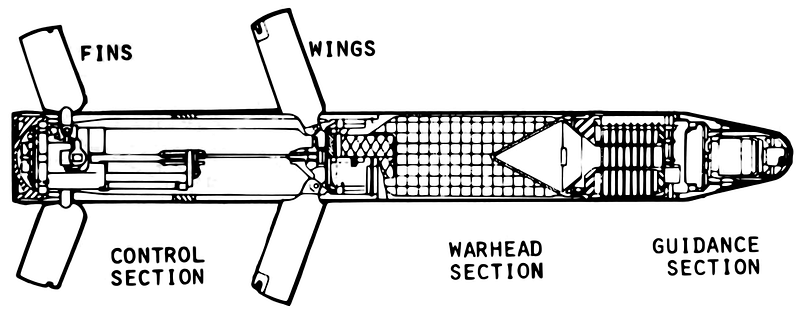
Copperhead projectile cross section. Credit: By U.S. Army — Department of Defense, Public Domain,

The Copperhead’s guidance mechanism steers the projectile on to the target which is reflecting laser pulses. By continuously adjusting its flight path to align with the reflected laser’s coordinates, the round can accurately strike its designated target.

The round is capable of engaging a wide array of targets, from enemy armored vehicles and fortified positions to structures and even naval vessels.

Comparable munitions

The 2K25 Krasnopol is a Soviet 152/155 mm cannon-launched, fin-stabilized, base bleed-assisted, semi-automatic laser-guided artillery weapon system. It automatically ‘homes’ on a point illuminated by a laser designator, typically operated by a drone or ground-based artillery observer. (Wikipedia)

Note that both 152mm and 155 mm versions are available.

Both Ukraine and Russia have these munitions, and I think that it’s likely that this was what was used in the Twitter clip that I included above.
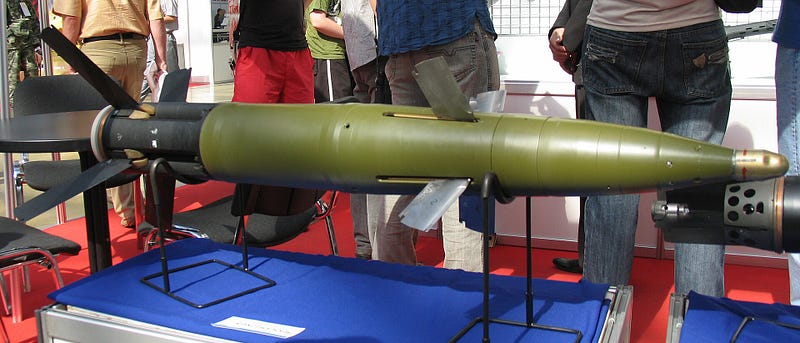
2K25 Krasnopol guided artillery shell. Credit: By Mike1979 Russia — Own work, CC BY-SA 3.0, https://commons.wikimedia.org/w/index.php?curid=4599808

On 14 July 2023 a Ukrainian M-55S tank was hit by a guided Krasnopol 152mm Russian artillery shell. The tank M-55S was damaged but reported as still drivable.

Countermeasures

GPS-directed artillery rounds are relatively easily jammed and Russia has found ways to reduce HIMARS effectiveness by jamming— the ECM technology war in Ukraine is continuous.

Laser guided weapons can be jammed in several ways, but it’s not straightforward. Laser jamming can be used, although you have to question whether this would be widespread (and reliable) on Russian tanks, especially the older models now in use.

Shtora-1 ( “curtain”) is an electro-optical active protection system or suite for tanks, designed to disrupt the laser designator and laser rangefinders of incoming anti-tank guided missiles (ATGMs). (Wikipedia)

These units can automatically launch smoke grenades.
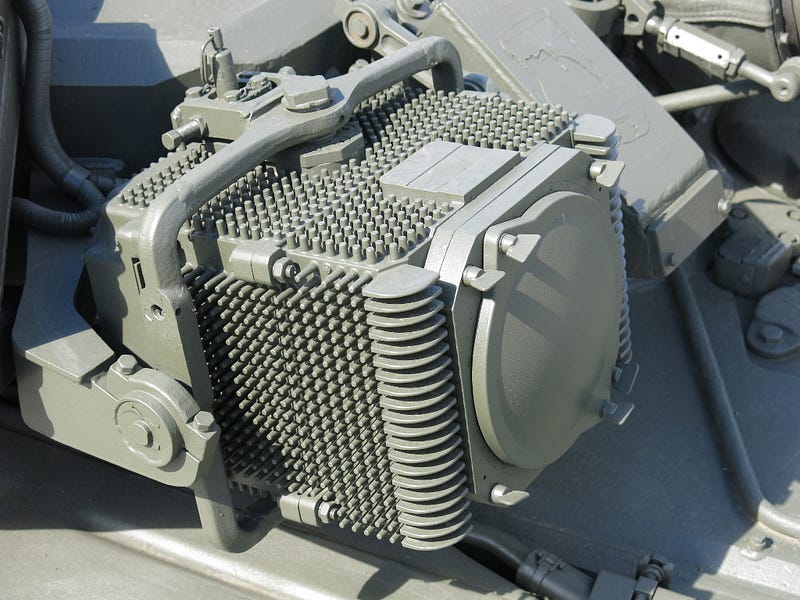
Shtora-1 IR emitter. Credit: By Boevaya mashina — Own work, CC BY-SA 4.0, https://commons.wikimedia.org/w/index.php?curid=75642705

Several Shtora-1 protected T-90 tanks have been lost to latest generation pulsed-laser ATGMs in Syria and Ukraine.

The simplest jamming method is smoke. Smoke jamming is more effective against laser guidance systems that use visible or near-infrared lasers, as these wavelengths are more readily absorbed or scattered by the smoke aerosol.

However, smoke may be less effective against systems that employ longer-wavelength or infrared lasers, as these can penetrate through certain types of smoke more effectively.

The Shtora-1 system has twelve smoke grenade launchers and can lay a 15 metre high and 20 metre wide smoke screen in three seconds that lasts about twenty seconds at ranges from 50 to 70 metres.

Smoke could obscure both the incoming ‘illuminating’ beam and the reflected laser light that the projectile detects.

Obviously the projectile has to have clear sight of the target, so low cloud would be be a problem for guided artillery shells, as would a 15 metre high smokescreen.

Is it really possible?

The reported range of the Skif is 5 km in daytime and 3 km at night, so there is ample laser power available to designate a target for an incoming artillery round which is approximately on target before final signal acquisition.

The frequencies and pulse codes that the Skif uses is likely to be a closely guarded secret.

The Shtora-1 jammers have been removed from many currently serving T-90s and the more modern S and M variants did not include them. (Wikipedia)

Implications

I’m speculating that the US has many Copperheads in storage, having been replaced in their current operational armoury by more agile guided shells such as Excalibur which do not require line of sight target designators.

Wikipedia does list the US as a current user however, as indeed is Ukraine. Copperheads were in the Australian armoury but are now listed as having been replaced.

Using this weapon system requires a high degree of coordination between artillery spotters/designators and the artillery fire controllers. The target has to be painted until arrival of the munition.

As far as I could determine, the Skif designator has a power output of a few tens of watts, so the battery capacity could possibly be carried by a small drone.

If these reports are correct then this smart combination is a cheap and easy way to multiply the effectiveness of Ukraine’s artillery — Ukraine has many more howitzers than it has HIMARS batteries.

Was it real?

On balance, I think it’s probable that a Krasnopol round was used for the destruction of the Russian tank, but whether the laser designator was a Stugna-P (Skif) remains unanswered.

It would be a relatively straightforward development for Ukraine to adapt the Skif laser designator to work with the Krasnopol artillery round (or vice versa).

It provides an interesting insight into weapons systems development in Ukraine. If correct.

If you follow me I guarantee variety in your inbox with some unusual perspectives! I live on a boat and write on a wide range of topics that interest me including humour, tech, space, geopolitics and travel. I also write about…

…home-brews

If you appreciate stories like these and want to support me and other writers, please consider signing up to become a Medium member. It’s only $5 a month, giving you unlimited access to incredible stories on Medium. If you sign up using my link, I’ll earn a small commission at no extra cost to you.

Or maybe just buy me a coffee? and tell me what you liked reading (or not)…

My novels are available at my Gumroad bookstore. Also at Amazon and Apple

Author’s note: The concept, structure, style and creative content in this story are all my own and I hope that is obvious to a reader. I do not employ third party writers. However, I do occasionally use an AI assistant to research and present small sections of factual content and data. All facts are checked where possible and sources quoted.

Ukraine War
Military
Armoured Vehicles
Warfare
Anti Tank Missile
Recommended from ReadMedium