
Ukraine’s “Ironclad” Combat Drone is Sci-Fi Come to Life
When I was in high school, I read a chilling and memorable sci-fi novel called Cold Allies by author Patricia Anthony.
Released in 1993, the book depicts a futuristic world war between nations while the combatants come to terms with alien visitors who decide that global war is the best time to stop by and say hi.
Although the author’s pacing was inconsistent, the writing rough around the edges, and the aliens poorly defined, I still remember this book distinctly for one reason: The American way of warfighting was completely remote-controlled.
Keep in mind, this was the roaring 90s — we didn’t have Reaper drones or Global Hawks yet, so the fact that one of Anthony’s main characters controlled a ground-based combat drone with virtual reality goggles was completely fresh.
(This book actually made me want to buy the Nintendo Virtual Boy — until I tried a demo in Toys R Us in 1995)
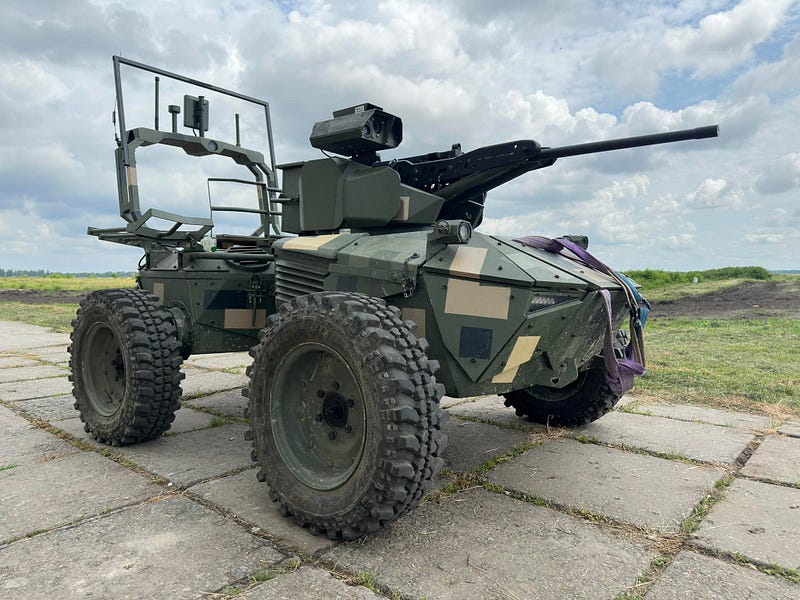
Now, Ukraine has officially fielded its own wheeled combat drone equipped with an M2 machine gun (.50 caliber, informally, “Ma Deuce”) that Ukraine calls the “Ironclad.”
Video footage released by the Ukrainian Ministry of Defense shows the Ironclad in action against Russian forces.
The video bears the watermark of Ukraine’s 5th Separate Assault Brigade and seems to show the drone firing on a Russian position, although it’s not clear from the video whether any Russians were injured or killed.
Last September, Ukraine’s minister of digital transformation Mykhailo Fedorov posted to Facebook:
“Ironclad is a robotic platform that helps the Defense Forces carry out front-line combat missions. Assault enemy positions, conduct reconnaissance, and provide military fire support.
This is a revolutionary product from Ukrainian engineers from Roboneers, which changes the approach to warfare and helps save the most valuable thing — the lives of our soldiers.
The machine develops a speed of up to 20 kilometers (about 12 mph) and is equipped with a thermal imaging camera and a ShaBlya M2 combat turret. It also has an armored carapace that protects against small arms. Ironclad can be controlled remotely from a safe place.”
Digging a little deeper, the Roboneers website claims the drone can spot enemy infantry at 1,800 meters (~6,000 feet) and it uses three cameras: a narrow field of view camera, a wide angle, and a thermal imager — plus a rangefinder.
The Ukraine War has seen some technological leaps in the quest to reduce exposing infantry to hostile fire — first with quadcopter drones that drop ordinance, then first-person-view (FPV) drones that explode, and now ground-based combat drones.
Interestingly, I always thought the future of warfare would be something akin to two nations sending their robots out to fight — this development is another step in that direction.
However, the real advantage will come when you send your robots out to fight while your enemy is still using human soldiers.
In this sense, Ukraine has beat Russia to the punch with the Ironclad drone, which can kill Russian invaders while keeping its operators safely out of the line of fire.
Ukraine has also made excellent use of sea drones against a much larger, traditional Russian navy. These boats were designed to limit the Russian fleet’s operations in the Black Sea.
But while drones currently dominate the air and sea in Ukraine, bringing them down to ground level is a new development.
The U.S. military has been experimenting with robot dog-like drones for a decade now, but has only been using them in units now for four years.
Cape Cod Space Force Station is the latest military installation to receive semi-autonomous quad-legged unmanned ground vehicles (Q-UGVs), or robot dogs, to enhance perimeter security at the Massachusetts base.
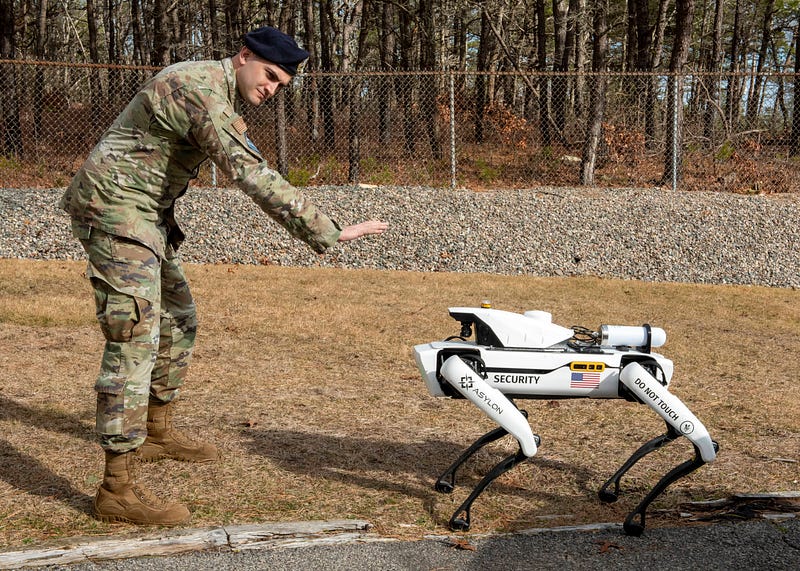
But these U.S. military versions are for security and carrying heavy loads, not killing enemy soldiers.
On a tactical level, there are several advantages to Ukraine’s combat drone:
As mentioned above, the most immediate benefit is the reduction in risk to human soldiers. Why expose Ukrainian soldiers to enemy fire when you can get a high-definition visual by sending in the Ironclad? It’s a great way to get ground-level insights without the risk to reconnaissance units.
Let’s face it: there are simply some places where ariel drones can’t go. For instance, they can’t see under a dense tree canopy or inside buildings.
Another advantage is the psychological impact on Russian soldiers. I don’t know how to best describe it, but getting killed by a robot in a warzone has a different psychological impact when compared to getting killed by a human soldier.
I know. It sounds weird… Death is death on the battlefield no matter where it comes from. But to a soldier, it just feels ignominious to be killed by a machine. There’s nothing valorous about defending a position from a remote-controlled car with a machine gun.
Depending on how many of these drones Ukraine has, if fielded in large numbers, it could really mess with the Russian’s morale.
Of course, like airborne drones, Ironclad will need to contend with the electronic warfare environment and Russian jamming efforts that would disconnect the drone from its operator.
In my mind, the next logical step in battlefield technology is the truly autonomous drone, perhaps controlled by a trained combat AI using swarm tactics.
When the day comes that humans give machines the ability to make the “kill decision” on their own… Well, if getting killed by a human-controlled drone is ignominious, then getting killed by an AI would be downright opprobrious.
Whether we’ll see AI murder bots in Ukraine depends on how long this war lasts. Hopefully, the war ends long before AI enters the fray.
In the meantime, Ukraine should use the Ironclad in any way it can to get the most impact — this includes taking ground, lowering the Russian’s morale, or even in the information war by publicizing Ukraine’s technological prowess.
As for Cold Allies, it’s still not clear to me after all these years whether the book title was referring to the American war machines or the aliens. Regardless, Ukraine now has cold allies of its own making — the Ironclad. And these cold allies will save Ukrainian lives.
Слава Україні


