id="a75d">While the BM30 Smerch is a highly capable weapon system, it has faced several issues and criticisms over the years. One of the main issues is the system’s reliance on a single launch vehicle, the MAZ-543 or MAZ-7917 8x8. It has limited cross-country capability. Sticking to roads is not good military policy.</p><p id="3a9c">Additionally, the system’s missiles have been criticised for their lack of precision, with some reports suggesting that they have caused significant collateral damage in urban areas although this is usually seen positively by Russian forces.</p><h2 id="be1b">Specifications Summary</h2><figure id="e103"><img src="https://cdn-images-1.readmedium.com/v2/resize:fit:800/1*bJcLW_HY5NtnOQdAmmKE8g.png"><figcaption>Author graphic</figcaption></figure><p id="952a">Replenishment time is said to be 23 minutes from the transporter/loader.</p><figure id="c592"><img src="https://cdn-images-1.readmedium.com/v2/resize:fit:800/1*S8yBCFJgbP9SYQhte1b3Kw.jpeg"><figcaption>BM30 System Transporter/loader. An awkward beast. Credit: By Vitaly V. Kuzmin — <a href="http://www.vitalykuzmin.net/Military/ARMY-2016-Demonstration/">http://www.vitalykuzmin.net/Military/ARMY-2016-Demonstration/</a>, CC BY-SA 4.0, <a href="https://commons.wikimedia.org/w/index.php?curid=52213479">https://commons.wikimedia.org/w/index.php?curid=52213479</a></figcaption></figure><h1 id="6c84">Ukraine development</h1><p id="dd53">As of 2014, <a href="https://en.wikipedia.org/wiki/BM-30_Smerch">Ukraine had 80 of these systems</a>, but they are now manufacturing their own improved version, the Vilkha-M.</p><p id="e26f">Here are some of the modifications made to the missile system:</p><ol><li>Increased range: The Vilkha missile has a maximum range of 130 km, which is significantly longer than the 90 km range of the original Smerch missile.</li><li>Increased accuracy: The missile uses a new digital guidance system, which is more accurate than the Smerch’s inertial guidance system.</li><li>New warhead options: Fragmentation, incendiary, and thermobaric warheads. Warhead weight is reported to be 220 kg.</li><li>Improved mobility: The system is mounted on a Ukrainian-made 6x6 truck, which provides better mobility and cross-country capability than the Russian Smerch’s 8x8 vehicle.</li><li>Improved automation: The Vilkha missile system uses a new automated fire control system, which reduces the time required to launch missiles and improves the overall efficiency of the system.</li><li>More missiles per launcher. From the video, it would seem that the <b>Vilkka launcher carries 16 rockets, not 12 as the Smerch has</b>.</li></ol>
<figure id="6e01">
<div>
<div>
<img class="ratio" src="http://placehold.it/16x9">
<iframe class="" src="https://cdn.embedly.com/widgets/media.html?src=https%3A%2F%2Fwww.youtube.com%2Fembed%2FHyqkIZ3zokc%3Ffeature%3Doembed&display_name=YouTube&url=https%3A%2F%2Fwww.youtube.com%2Fwatch%3Fv%3DHyqkIZ3zokc&image=https%3A%2F%2Fi.ytimg.com%2Fvi%2FHyqkIZ3zokc%2Fhqdefault.jpg&key=a19fcc184b9711e1b4764040d3dc5c07&type=text%2Fhtml&schema=youtube" allowfullscreen="" frameborder="0" height="480" width="854">
</div>
</div>
</figure></iframe></div></div></figure><p id="9f08">The Vilkha has been in development since 2015 and was first tested in 2018. The Ukrainian military began receiving the system in 2019.</p><p id="8e26">The latest <b>Russian 9A52–2</b> variant with the automated system has the improvements listed below, and it’s reasonable to assume that the clever Ukraine engineers will have implemented many, if not all of them (<a href="https://en.wikipedia.org/wiki/BM-30_Smerch">Wikipedia</a>):</p><ul><li>delivery of fire from an un-surveyed fire position</li><li>laying of the launch tube cluster with the crew staying in the cabin and without using aiming points</li><li>autonomous determination of an azimuth of the launch tube cluster’s longitudinal axis</li><li>visual representation of graphical information for the launch tube cluster laying, the route of vehicle movement and location as well as a point of destination and direction of movement on the video terminal</li><li>increase in MLRS survivability owing to reduced time of staying at a fire position</li><li>increased comfort for the laying operator, especially in adverse weather conditions and at night</li><li>increased independent operation owing to the navigation and survey equipment, which allows the vehicle to rapidly change fire positions and move autonomously</li></ul><h1 id="be36">Implications</h1><p id="34dd">We have been hearing a lot about the USA’s reluctance to supply the longer-range missile variants for HIMARS and other GMLRS systems provided by its allies.</p><p id="9396">This has been a political sticking point because the USA was concerned that Ukraine would use Western-supplied long-range MLRS to strike into Russia’s legal territory and cause escalation. There was even talk that the HIMARS missiles were fitted with anti-tamper systems to prevent Ukraine from ‘adjusting’ them.</p><p id="d7f2">But now that Ukraine has admitted that the Vilkha was first used in May 2022 and that a 150 km range version is in development, a new picture emerges.</p><p id="339d">My assumption is that they wanted to keep the pressure on the Allies for longer-range weapons while they finalised testing and productionisation (as well as securing component sourcing) of the Vilkha-M. It would also be misleading for Russian military planners.</p><blockquote id="9bec"><p>Let’s put it this way, and we hope that just in time for a counteroffensive, the probability of which is expected in the south, in the direction of the Sea of Azov. The tests will take place on the battlefield,” Vinnyk said. <i>(on <a href="https://t.me/United24media/5820">Telegram</a>)</i></p></blockquote><div id="ce1d" class="link-block">
<a h
Options
ref="https://t.me/United24media/5820">
<div>
<div>
<h2>UNITED24Media</h2>
<div><h3>Ukraine will produce high-precision Vilha-M missiles, - Ivan Vinnyk, First Deputy Chairman of the National Association…</h3></div>
<div><p>t.me</p></div>
</div>
<div>
<div style="background-image: url(https://miro.readmedium.com/v2/resize:fit:320/0*PJ7u_bKCNdg30oRt)"></div>
</div>
</div>
</a>
</div><h1 id="f3b6">Conclusion</h1><p id="0b93">This news about enhanced range will be of concern to Russian military planners — if they don’t already know - because if these Vilkha-M systems become available in any quantity to Ukraine’s forces then they will have to move key logistics hubs even further back from the front line, even back into Russia itself.</p><p id="63b5">— And politically Russia will not be able to accuse the West of providing weapons which can strike Russian territory.</p><p id="03e8">— And most of Crimea will be in range.</p><p id="165c">This will contribute more back-pressure from the military to the high command in Moscow — and Putin.</p><div id="4bf3" class="link-block">
<a href="https://t.me/United24media/5809">
<div>
<div>
<h2>UNITED24Media</h2>
<div><h3>Withdrawal of troops from Zaporizhzhia and Kherson regions in exchange for Crimea: Putin tries to bargain to end the…</h3></div>
<div><p>t.me</p></div>
</div>
<div>
<div style="background-image: url(https://miro.readmedium.com/v2/resize:fit:320/0*gXdXNIUxAo08Bf6E)"></div>
</div>
</div>
</a>
</div><p id="8ce5">I’m just an armchair amateur.</p><h1 id="69f8">Some light relief to end</h1><p id="5937">What a dork.</p><div id="fea3" class="link-block">
<a href="https://t.me/United24media/5782">
<div>
<div>
<h2>UNITED24Media</h2>
<div><h3>The audience laughed at Lavrov during his speech in India when he said that "Russia did not start the war but wants to…</h3></div>
<div><p>t.me</p></div>
</div>
<div>
<div style="background-image: url(https://miro.readmedium.com/v2/resize:fit:320/0*T7UWrG6jdOIbNgfC)"></div>
</div>
</div>
</a>
</div><h2 id="9b49">Sources:</h2><ol><li>“Ukraine Develops Its Own Smerch-Type Multiple Rocket Launcher.” Defense News. <a href="https://www.defensenews.com/global/europe/2018/08/31/ukraine-develops-its-own-smerch-type-multiple-rocket-launcher/">https://www.defensenews.com/global/europe/2018/08/31/ukraine-develops-its-own-smerch-type-multiple-rocket-launcher/</a></li><li>“Ukraine Tests Vilkha Missile System, an Answer to Russian Smerch.” Radio Free Europe/Radio Liberty. <a href="https://www.rferl.org/a/ukraine-tests-vilkha-missile-system-an-answer-to-russian-smerch-/29579085.html">https://www.rferl.org/a/ukraine-tests-vilkha-missile-system-an-answer-to-russian-smerch-/29579085.html</a></li><li>“Ukraine’s Vilkha MLRS.” Jane’s 360. <a href="https://www.janes.com/article/84548/ukraine-s-vilkha-mlrs">https://www.janes.com/article/84548/ukraine-s-vilkha-mlrs</a></li><li>“Ukraine uses Vilkha-M missiles of its own production with a longer range than HIMARS” <a href="https://ukrainefrontlines.com/news/ukraine/ukraine-vilkha-m-missiles-longer-range-than-himars/">Ukrainefrontlines.com</a></li></ol><p id="788d"><i>About me: If you follow me I guarantee variety in your inbox with some unusual perspectives! I write on a wide range of topics including humor, tech, space, geopolitics and travel, together with daily news events and the minutiae of my daily life living on a boat. Yes, I really do live on a boat (some readers don’t believe that). I also write about…</i></p><p id="8022"><b>…Ukrainian arrows</b></p><p id="e25f"><i>If you appreciate stories like these and want to support other writers and me, consider signing up to become a Medium member. It’s only $5 a month, giving you unlimited access to incredible stories on Medium. If you sign up using my link below, I’ll earn a small commission at no extra cost to you.</i></p><div id="451b" class="link-block">
<a href="https://james-marinero.medium.com/membership">
<div>
<div>
<h2>Join Medium with my referral link - James Marinero</h2>
<div><h3>Read every story from James Marinero (and thousands of other writers on Medium). Your membership fee directly supports…</h3></div>
<div><p>james-marinero.medium.com</p></div>
</div>
<div>
<div style="background-image: url(https://miro.readmedium.com/v2/resize:fit:320/0*lwp6wtdzt3PLsNWA)"></div>
</div>
</div>
</a>
</div><p id="307c"><i>Or maybe just <a href="https://ko-fi.com/jamesmarinero">buy me a coffee?</a> and tell me what you liked reading (or not)…</i></p><figure id="7660"><img src="https://cdn-images-1.readmedium.com/v2/resize:fit:800/1*0chfaohu-z_vrO8sI4wdJA.png"><figcaption><i>James Marinero’s novels are available at his <a href="https://jamesmarinero.gumroad.com/">Gumroad</a> bookstore. Also at <a href="https://www.amazon.com/stores/James-Marinero/author/B0055RWF6U">Amazon</a> and <a href="https://books.apple.com/us/author/james-marinero/id490200686">Apple</a></i></figcaption></figure><p id="25e0">Author’s note: The concept, structure, style and creative content in this story are all my own and I hope that is obvious to a reader. I do not employ third party writers. However, I do occasionally use an AI assistant to research and present small sections of factual content and data. All facts are checked where possible and sources quoted.</p></article></body>
Ukraine War
Ukraine Using 110 km Range Surface-to-Surface Vilkha Missiles
Modified Soviet-era BM-30 Smerch Missiles exceed range of current US-supplied GMLRS systems
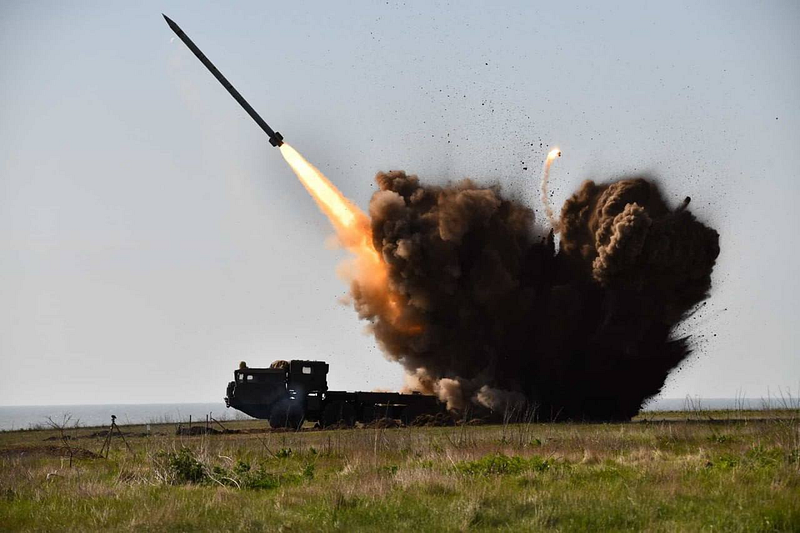
Ukraine has developed its own version of the Smerch missile system called the “Vilkha” (meaning “arrow” in Ukrainian). The Vilkha is a modernised version of the Smerch, with improvements in range and accuracy, as well as the ability to carry different types of warheads.
According to Vinnyk [Ivan Vinnyk, First Deputy Head of the National Association of the Defense-Industrial Complex of Ukraine and quoted by The War Zone], Vilkha-M has already been used in combat. But he did not say where exactly the missiles system had been used.
He said they had been first used in combat in May 2022.
“Their precision is boosted by so-called “gas rudders” — dozens of small holes emitting propellant — used to direct the missile onto the target via GPS. While the Vilkha-M is considered to be quite accurate and a precision munition, it is currently not disclosed how accurate it is,” Vinnyk explains.
Though so far produced in small numbers, the Vilkha-M gives Ukraine a munition that reaches 36 percent farther with more than twice the payload of the GMLRS. — ukrainefrontlines.com (3 March 2023)
Let’s look at the BM30 Smerch and then what improvements Ukraine has made. Then I’ll speculate on the serious implications of Ukraine having a guided weapon of this range.
Development of Russian BM30 Smerch Missile System
The BM30 Smerch is a multiple rocket launcher system (MRLS) developed late in the Soviet era and the system entered service with the military in 1989.
It’s from a long line of Russian MLRS systems with a lineage back to Stalin’s Organ.
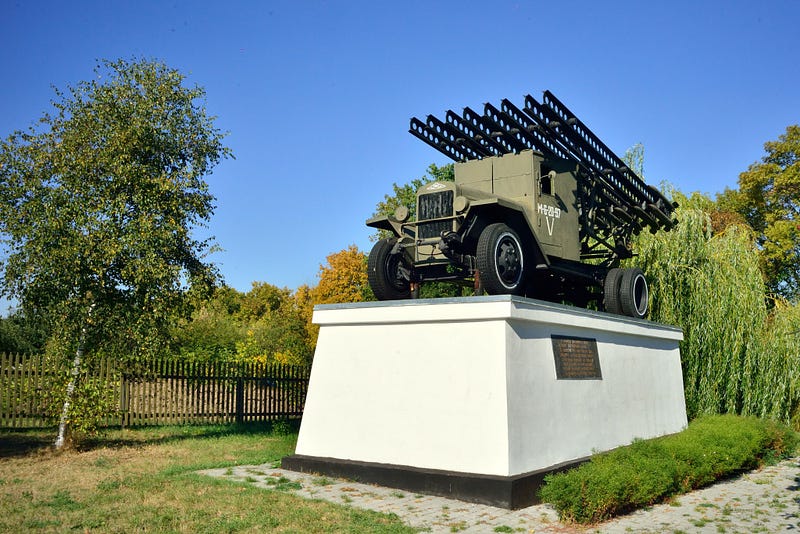
One of Stalin’s Organs. A BM-13 Katyusha multiple rocket launcher. Ironically, this is a photo of a monument in Ukraine. Image credit: By Yurii-mr — Own work, CC BY-SA 4.0, https://commons.wikimedia.org/w/index.php?curid=43866009
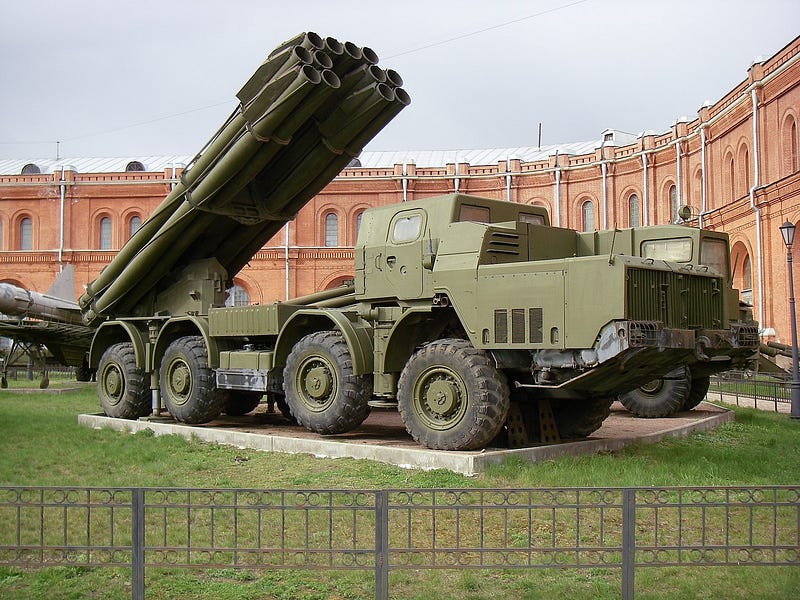
These notes refer to the first Smerch systems which is what Ukraine started with, 80 systems according to Wikipedia, before the USSR collapsed. They were mounted on 8x8 trucks.
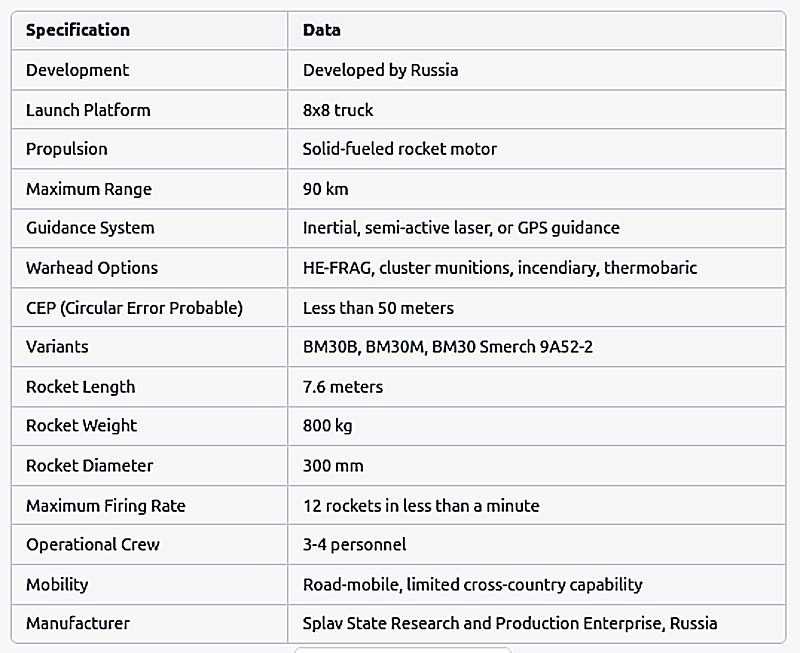
The original BM30 Smerch (‘whirlwind’) was powered by a solid-fueled rocket motor that provided a maximum range of 90 km.
Of course the current versions used by Russia are far more advanced than the originals.
The B30 Smerch missile is 7.6 m in length with a diameter of 300 mm. It uses a solid-fuel rocket motor. The rocket weight is 800 kg and there are 12 missiles in a ‘load’.
Guidance
A variety of guidance systems were available. Some rockets are guided by an inertial guidance system, while others use a semi-active laser seeker or a GPS guidance system. The guidance system allows the missiles to achieve a high degree of accuracy, with a circular error probable (CEP) of less than 50 meters.
Warhead
The most common warhead is a 243-kg fragmentation high-explosive (HE-FRAG) warhead, which is designed to destroy soft targets such as vehicles and buildings. Other warhead options include cluster munitions, incendiary devices, and thermobaric explosives.
Range
The maximum range of the BM30 Smerch was 90 km, although the effective range was typically closer to 70 km due to the need to maintain accuracy. The system can fire all 12 rockets in less than a minute, allowing for rapid saturation of a target area. Current Russian versions (624 series) claim ranges of up to 150km.
Variants
There are several variants of the BM30 Smerch missile system, each with different rocket options and capabilities. The BM30M variant is an upgraded model that includes a new rocket with a range of up to 120 km. The BM30 Smerch 9A52–2 variant is a further upgraded model that includes a new digital fire control system, allowing for improved accuracy and coordination with other artillery units.
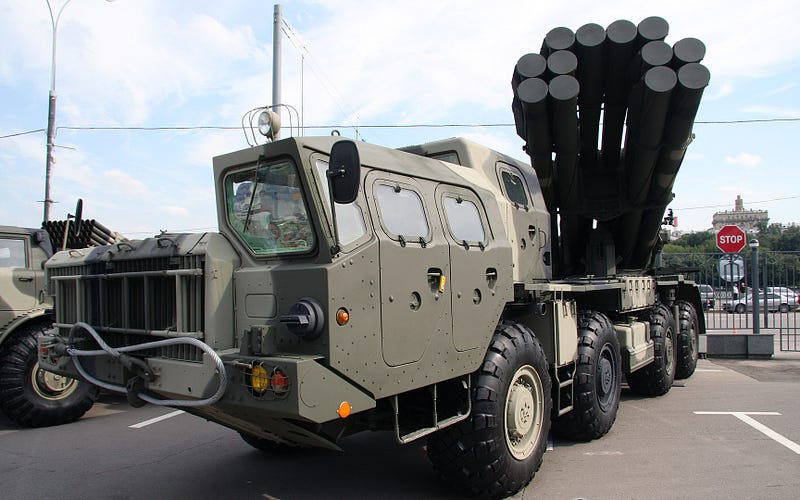
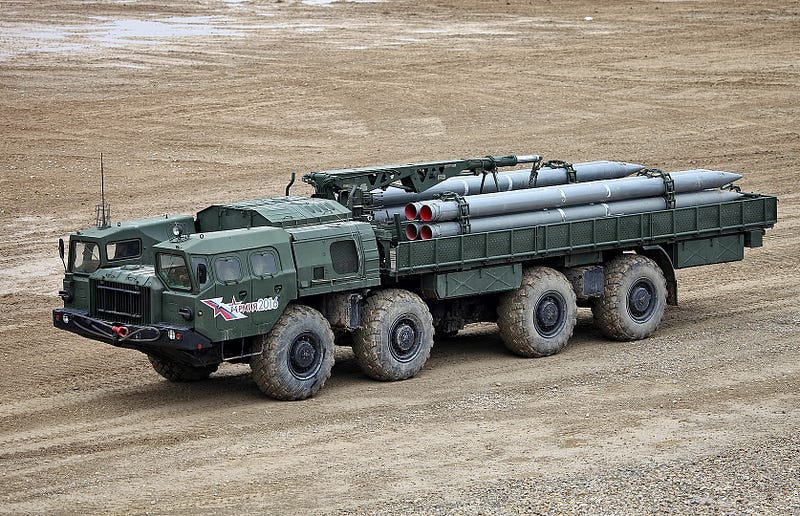
While the BM30 Smerch is a highly capable weapon system, it has faced several issues and criticisms over the years. One of the main issues is the system’s reliance on a single launch vehicle, the MAZ-543 or MAZ-7917 8x8. It has limited cross-country capability. Sticking to roads is not good military policy.
Additionally, the system’s missiles have been criticised for their lack of precision, with some reports suggesting that they have caused significant collateral damage in urban areas although this is usually seen positively by Russian forces.
Specifications Summary
Author graphic
Replenishment time is said to be 23 minutes from the transporter/loader.
Here are some of the modifications made to the missile system:
Increased range: The Vilkha missile has a maximum range of 130 km, which is significantly longer than the 90 km range of the original Smerch missile.
Increased accuracy: The missile uses a new digital guidance system, which is more accurate than the Smerch’s inertial guidance system.
New warhead options: Fragmentation, incendiary, and thermobaric warheads. Warhead weight is reported to be 220 kg.
Improved mobility: The system is mounted on a Ukrainian-made 6x6 truck, which provides better mobility and cross-country capability than the Russian Smerch’s 8x8 vehicle.
Improved automation: The Vilkha missile system uses a new automated fire control system, which reduces the time required to launch missiles and improves the overall efficiency of the system.
More missiles per launcher. From the video, it would seem that the Vilkka launcher carries 16 rockets, not 12 as the Smerch has.
The Vilkha has been in development since 2015 and was first tested in 2018. The Ukrainian military began receiving the system in 2019.
The latest Russian 9A52–2 variant with the automated system has the improvements listed below, and it’s reasonable to assume that the clever Ukraine engineers will have implemented many, if not all of them (Wikipedia):
delivery of fire from an un-surveyed fire position
laying of the launch tube cluster with the crew staying in the cabin and without using aiming points
autonomous determination of an azimuth of the launch tube cluster’s longitudinal axis
visual representation of graphical information for the launch tube cluster laying, the route of vehicle movement and location as well as a point of destination and direction of movement on the video terminal
increase in MLRS survivability owing to reduced time of staying at a fire position
increased comfort for the laying operator, especially in adverse weather conditions and at night
increased independent operation owing to the navigation and survey equipment, which allows the vehicle to rapidly change fire positions and move autonomously
Implications
We have been hearing a lot about the USA’s reluctance to supply the longer-range missile variants for HIMARS and other GMLRS systems provided by its allies.
This has been a political sticking point because the USA was concerned that Ukraine would use Western-supplied long-range MLRS to strike into Russia’s legal territory and cause escalation. There was even talk that the HIMARS missiles were fitted with anti-tamper systems to prevent Ukraine from ‘adjusting’ them.
But now that Ukraine has admitted that the Vilkha was first used in May 2022 and that a 150 km range version is in development, a new picture emerges.
My assumption is that they wanted to keep the pressure on the Allies for longer-range weapons while they finalised testing and productionisation (as well as securing component sourcing) of the Vilkha-M. It would also be misleading for Russian military planners.
Let’s put it this way, and we hope that just in time for a counteroffensive, the probability of which is expected in the south, in the direction of the Sea of Azov. The tests will take place on the battlefield,” Vinnyk said. (on Telegram)
This news about enhanced range will be of concern to Russian military planners — if they don’t already know - because if these Vilkha-M systems become available in any quantity to Ukraine’s forces then they will have to move key logistics hubs even further back from the front line, even back into Russia itself.
— And politically Russia will not be able to accuse the West of providing weapons which can strike Russian territory.
— And most of Crimea will be in range.
This will contribute more back-pressure from the military to the high command in Moscow — and Putin.
“Ukraine uses Vilkha-M missiles of its own production with a longer range than HIMARS” Ukrainefrontlines.com
About me: If you follow me I guarantee variety in your inbox with some unusual perspectives! I write on a wide range of topics including humor, tech, space, geopolitics and travel, together with daily news events and the minutiae of my daily life living on a boat. Yes, I really do live on a boat (some readers don’t believe that). I also write about…
…Ukrainian arrows
If you appreciate stories like these and want to support other writers and me, consider signing up to become a Medium member. It’s only $5 a month, giving you unlimited access to incredible stories on Medium. If you sign up using my link below, I’ll earn a small commission at no extra cost to you.
Or maybe just buy me a coffee? and tell me what you liked reading (or not)…

James Marinero’s novels are available at his Gumroad bookstore. Also at Amazon and Apple
Author’s note: The concept, structure, style and creative content in this story are all my own and I hope that is obvious to a reader. I do not employ third party writers. However, I do occasionally use an AI assistant to research and present small sections of factual content and data. All facts are checked where possible and sources quoted.