
Ukraine War
Ukraine: The Resistance Operating Concept in Action
Reinvented and widened, arguably the US first experienced it in Vietnam. Is it just a fancy name for an old strategy?
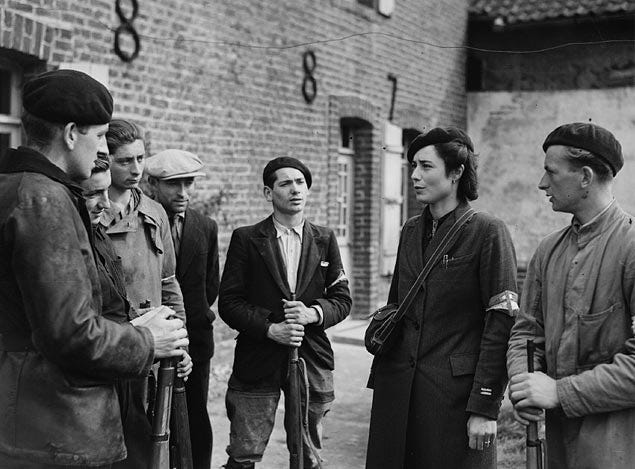
The Resistance Operating Concept (ROC) is a military strategy that was first used during the Russian annexation of Ukraine in 2014. It is a form of asymmetric warfare that relies on small, highly mobile units using guerrilla tactics to fight a larger, conventionally armed force. But beyond that, it aims to harness almost the whole population of a subjugated country in a holistic resistance effort.
This public involvement considerably assists and amplifies the efforts of regular and special forces.
Is it just a fancy name, recycling old ideas?
The requirement
The ROC is said to provide a template for smaller states to counter larger powers and was formalised in 2013 in response to Russia’s conflict with Georgia in 2008.
The ROC was designed to assist Nordic and Baltic countries to conduct ‘resistance operations’ in the event of an invasion or occupation by Russian military forces.
Almost all observers of the Eastern Europe security situation will acknowledge the military advantages that the Russian military has should it’s national leadership decide to cross the borders into the Baltic states, Scandinavian countries, or Poland. It has a significant ground force in its Western Military Region (WMD) as well as in Kaliningrad. The ability of the one of Russia’s neighbors to stop a conventional force attack is limited. — SOF News
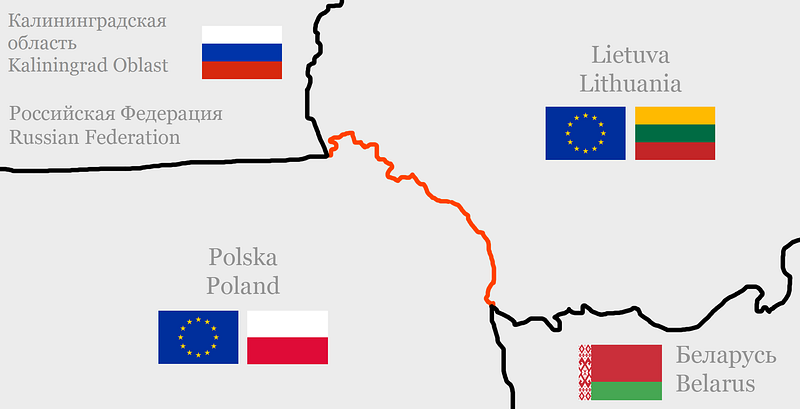
The Suwalki Gap is a particularly valuable and vulnerable geographical link between Russia and Kaliningrad, a Russian exclave on the Baltic.
Flexible and adaptable
A flexible strategy, ROC can be adapted to different situations and terrain. It is an example of how a smaller force can successfully take on a larger, more powerful opponent.
“We have nothing left, neither food nor water. And Ukrainians are all over the place, everywhere”: a Russian military officer spoke about the situation on the front in the Kharkiv region. The phone conversation was intercepted by Ukrainian intelligence.- Ukraine Telegram
DUH…They invaded Ukraine, what did they expect — Russians all over the place?
I mentioned Vietnam — the Viet Cong used extensive networks of tunnels for logistics, field hospitals, barracks and infiltration. That’s not quite what the modern resistance operating concept envisages, but it broadly fits the template.
Dean Koontz
When I first heard of ROC and looked into it in a bit more depth, I was reminded of a suspense novel— it might have been one of the ‘Odd Thomas’ series by Dean Koontz, I think — in which the main character was a sociopathic anarchist. The scene that sticks in my mind is the one where he walks down a street with a tube of superglue. He stops at cars and injects superglue into the lock on the driver’s doors.
That’s the sort of civilian tactic that ROC envisages. Most military vehicles don’t have door locks, but tyres can be slashed or deflated. It doesn’t work on tanks parked in the supermarket lot, and APCs have very tough tyres, not easy to penetrate with a pen-knife. But tyres do burn.
Cellphones
But of course, the use of Starlink has enabled the Ukrainian government to maintain secure civilian communications with cellphones and apps such as Telegram. Civilians can easily act as artillery spotters.
And feed back valuable logistics information. Russia has taken severe hits on it arms and fuel dumps by Ukrainian use of HIMARS. But that was only possible because Ukraine forces had accurate targeting data from behind the enemy lines. Russia is now downsizing its logistics dumps and spreading them more widely to minimise the losses.
This data is coming in even from outside Ukraine. Here is a post about Russian tank movements in Belarus:
ROC: Basic principles
Purpose
As defined the ‘ROC manual’, authored by Dr Otto C. Fiala [abbreviated]:
A. The Resistance Operating Concept (ROC) encourages governments to foster pre-crisis resiliency through Total Defense (also known as Comprehensive Defense), a “whole-of-government” and “whole-of-society” approach, which include interoperability among its forces and those of its allies and partners. B. The government and military, with popular support, take action against an enemy in a traditional conventional defensive environment. The population is the primary actor in a resistance or Total Defense situation.
This manual is a long read — nearly 300 pages — and is aimed at the top down preparation of NATO Baltic countries’ ROC preparation.
Here are some of the Underground components, quoted from the manual.
Underground. The underground is, traditionally, a cellular organization that conducts operations in urban areas that are under the control of the occupiers’ security forces. It is composed of politico-military entities designed to conduct political and military actions. Examples of underground functions include: • Intelligence and CI networks, • Subversive radio stations, • Media networks that control newspaper or leaflet print shops, social media, satellite television, and/ or web pages to disseminate information to the population and outside world, • Special materiel fabrication such as false identification, explosives, weapons, and munitions, • Control of networks for moving personnel, hiding personnel sought by the enemy, handling logistics, and generating funding, • Conducting acts of sabotage in urban centers, and • Clandestine medical facilities.
Many of these components were to a lesser extent deployed/used by the French Maquis and the Viet Cong (and dare I mention the IRA) but the world has changed a lot since those days. Control and use of cyberspace is now an important component in a war, as well as secure communications. The days of secret messages broadcast in BBC news bulletins are long gone.
Tactics for the public
Early in the conflict, the Ukrainian government created a website that explains ways in which Ukrainian citizens can resist the occupiers.
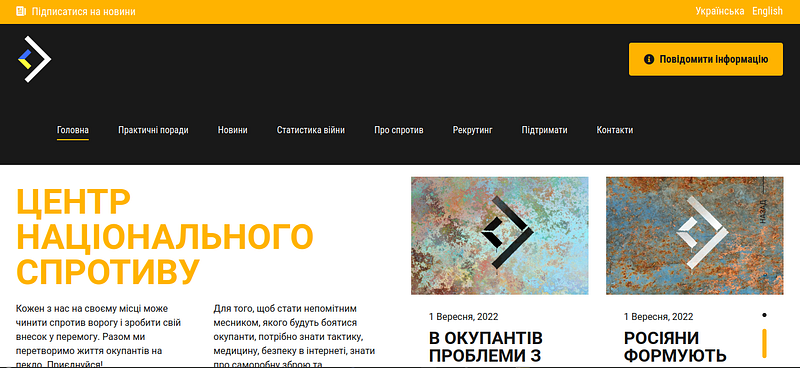
The website describes ways of using of nonviolent actions, including boycotting public events, labour strikes, and even how to use humor and satire to chip away at the enemy. The objective is to disrupt the ability of Russia-collaborating local authorities to govern while reminding the population of Ukraine’s rightful sovereignty.
ROC suggests violent actions as well, including using Molotov cocktails, deliberately starting fires and putting chemicals in gas tanks to sabotage of enemy vehicles.
And superglue in doorlocks? I didn’t spot that one, but I don’t read Ukrainian.
Once again, technology has leaped ahead and we now see teenage Ukrainians using drones to spot artillery targets.
Humour and satire has spread beyond the borders of Ukraine and the #NAFO (North Atlantic Fellas Organisation) is making a meal of Russia, their diplomats included:
More so, this media approach is taken the offensive into the heart of Russia with the doge army.
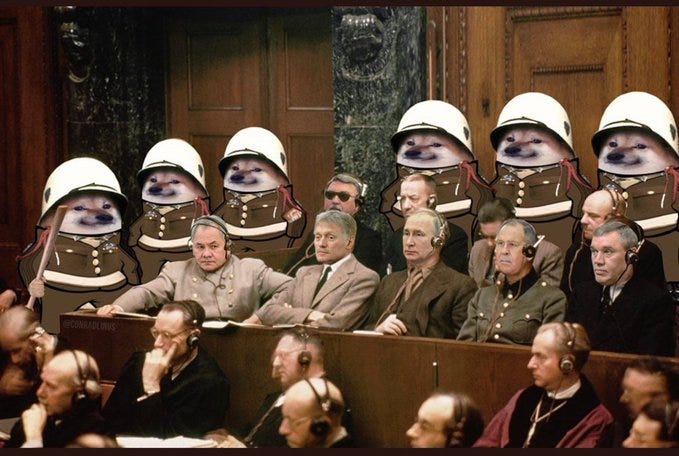
And engaging senior Russian diplomats. There’s a good story about this at Politico.eu (no affiliation).
Increasing uptake of ROC
At first, only Estonia, Lithuania, and Poland expressed real enthusiasm about the new doctrine. But Russian’s 2014 annexation changed all that.
‘Since its inception, at least 15 countries have taken part in some form of training on this resistance doctrine, according to Nicole Kirschmann, a spokeswoman for Special Operations Command Europe, where this was developed.’ — ukrainetoday.org quoting CNN
Conclusion
So, is ROC just a fancy name for an old strategy?
No, in my view it goes beyond that because it is pro-active. It’s about planning and preparing to resist occupation. Historically the tactics were emergent as the crisis developed.
These days the strategy (and some, but not all) tactics are publicly laid out.
Putin would know what his forces would be up against. He’s found out in Ukraine, the hard way.
But could ROC be countered with careful planning?
I doubt it.
About me: If you follow me I guarantee variety in your inbox with some unusual perspectives! I write on a wide range of topics including humor, tech, space, geopolitics and travel, together with daily news events and the minutiae of my daily life living on a boat. Yes, I really do live on a boat (some readers don’t believe that). I also write about…
…the doges of war
If you appreciate stories like these and want to support other writers and me, consider signing up to become a Medium member. It’s only $5 a month, giving you unlimited access to incredible stories on Medium. If you sign up using my link below, I’ll earn a small commission at no extra cost to you.
Or maybe just buy me a coffee? and tell me what you liked reading (or not)!
