Ukraine War
Ukraine: Non-Battlefield Developments
A cyberattack on NATO and US citizens advised to leave Russia, diplomatic rows and threatened coups…
With the approach of the end of the first year of the Russian attack on Ukraine, tension is rising.
The focus in the West by most sane people has been the supply of tanks, other armour, artillery and air defence systems, and ammunition to Ukraine. And here have been strong behind-the-scenes discussions about the supply of F16 fighter aircraft to Ukraine.
But there have been other things happening too.
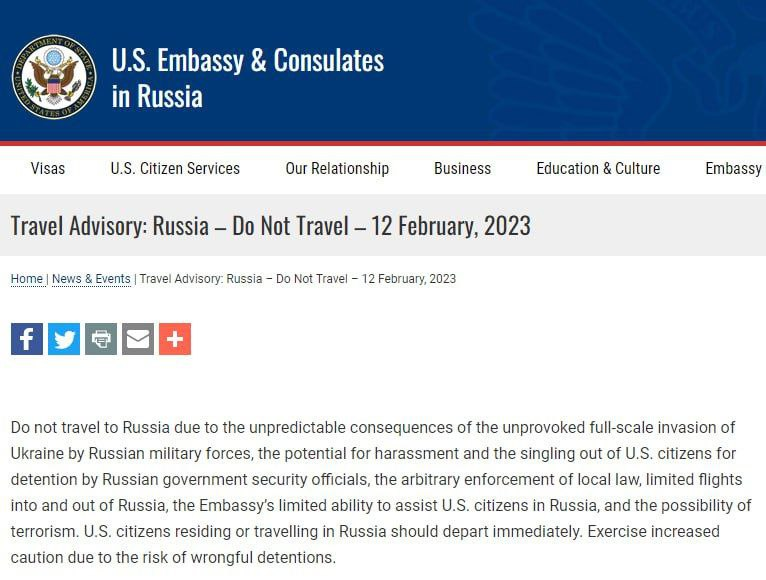
US citizens should leave Russia immediately
This one puzzled me, because it is no different from advice that was given in 2022. But it has been re-iterated.
The US Embassy in Russia urged Americans to leave the country immediately.
“Do not enter the Russian Federation due to the unpredictable consequences of the invasion of the Russian army in Ukraine, the threat of persecution and detention of US citizens by local security officials, restrictions on flights to and from Russia,” the message says.
“US citizens living or traveling in Russia must immediately leave the country,” the message emphasizes.
The embassy published similar messages at the beginning of the Russian-Ukrainian war, on March 5, 2022. And in July last year, during the escalation of fighting in the Donbass.
Cyberattack on NATO
On Sunday 12 February there was a cyberattack on NATO Special Operations Headquarters. I first saw this story on Ukraine War — Intel News on 13 February.
The UK’s Daily Telegraph reported that:
Russian hackers have disrupted contact between Nato and military aircraft providing aid to victims of the Turkish-Syrian earthquake which has claimed at least 28,000 lives.
A Nato official confirmed that the alliance had fallen victim to a cyber attack, which is believed to have been carried out by the Killnet group of hackers.
The Killnet group of hackers claimed responsibility for the distributed denial of service (DDoS) attacks but didn’t give any more details.
“We are carrying out strikes on Nato. Details in a closed channel,” it said on one of its associate Telegram channels.
The website of Nato Special Operations Headquarters, which is based in Belgium, was down for only a couple of hours before it was restored.
I could find no reference to this report on any other major news site except MSN which quoted a source EUROPA PRESS, but note the words ‘A Nato official confirmed…’ in the Daily Telegraph report.
There is a Killnet video about it here.
Killnet
Killnet is a pro-Russia hacker group known for its DoS (denial of service) and DDoS (distributed denial of service) attacks towards government institutions and private companies in several countries during the 2022 Russian invasion of Ukraine. The group is thought to have been formed sometime around March 2022. — Wikipedia
Killnet is radically different from Russia’s highly skilled hackers working for its intelligence agencies’ groups like Fancy Bear and Sandworm…Killnet, on the other hand, is more like an angry, nationalist online mob armed with low-grade cyber-offensive tools and tactics. Its big success is in setting a narrative about the [Ukraine] war. — politico.eu
It’s strange that this Killnet group apparently has no direct affiliation to the Russian FSB or GRU.
Smoke and mirrors?
We know that Putin is preparing something big to mark the end of a year of failed military plans.
Article 5 of the NATO Charter
That story was followed by a re-posting of a story from 28 February 2022:
NATO has said that a cyber-attack on its infrastructure could trigger Article 5 — the so-called ‘all for one and one for all clause’, although invoking that would probably require the agreement of Hungary and Turkey, which countries undoubtedly would be reluctant to assent to the triggering of Article 5.
And there could be others — think Germany, which has been dragging its feet, afraid of the schoolyard bully.
Diplomatic spats
Estonia and Russia are expelling diplomats in a tit-for-tat. The Estonian ambassador was ordered to leave Russia by 7 February 2023. Margus Laidre had been Estonia’s representative in Russia since 2018, and had previously worked in Finland and the UK. He’s now back home.
Estonia responded by asking the Russian ambassador to leave by the same date.
Russia’s move against Mr Laidre comes after Estonia recently ordered a reduction in the size of the Russian Embassy in Tallinn. — BBC
Then Latvia followed suit, recalling their ambassador as Russia gave him until 27 February to pack his bags.
And Lithuania’s ambassador has been back home since April 2022, the recall being prompted by the Russian war crimes in Bucha.
There’s certainly rising tension in the Baltic.
Moldova
In Molodova and its breakaway ‘province’ of Transnistria which hosts Russian troops there is trouble afoot. Their government changed last week and the new President Sandu is on the diplomatic warpath.
President Sandu said the “plot” would involve “protests by the so-called opposition”, aiming to “overthrow the constitutional order”.
Russia’s war in neighbouring Ukraine has put Moldova — one of Europe’s poorest countries — under great strain.
Last week Ukrainian President Volodymyr Zelensky said Kyiv’s intelligence service had uncovered a Russian plan to destroy Moldova.
Moldova, wedged between Romania and Ukraine, became a candidate for EU membership last summer. The country of 2.6 million people has struggled with an influx of refugees from Ukraine and tensions with Transnistria, a breakaway pro-Moscow region where some 1,500 Russian soldiers are stationed. — BBC
Russian missiles last week overflew Moldova en route to targets in Ukraine.
Russia deploys nuclear warships in Baltic
Politico.eu reports that:
Russia has begun deploying tactical nuclear weapon-armed vessels in the Baltic Sea for the first time in the last 30 years, the Norwegian Intelligence Service said in its annual report.
“The key part of the nuclear potential is on the submarines and surface ships of the Northern Fleet,” the Norwegian intel noted.
Conclusion
It could be argued that with the approach of February 24 there is bound to be an increase in tension. And misdirection.
Strange things are happening.
Groundwork is being laid. I’m wondering if there isn’t a bit more afoot.
Will NATO commit to sending advanced fighter jets? Apart from boots on the ground, that’s pretty much the last red line. And it sounds as if Poland may be thinking twice despite having been in the vanguard of F16 supporters.
Sending F-16s to Ukraine would surely provoke a strong response from Putin, in what form we can only speculate (nuclear seems very unlikely), although the reality is that it would probably be at least six months before Ukraine pilots could complete training on the F-16s.
A full-on cyber attack, perhaps (the bad actors in that can be hidden). Or an attack on Starlink (although Musk seems to be playing both sides against the middle on that)?
Who knows?
The world has certainly undergone a few seismic shifts in the last twelve months.
But Article 5?
I think that will not happen — even Putin would wish to avoid that. Surely?
About me: If you follow me I guarantee variety in your inbox with some unusual perspectives! I write on a wide range of topics including humor, tech, space, geopolitics and travel, together with daily news events and the minutiae of my daily life living on a boat. Yes, I really do live on a boat (some readers don’t believe that). I also write about…
…seismic events
If you appreciate stories like these and want to support other writers and me, consider signing up to become a Medium member. It’s only $5 a month, giving you unlimited access to incredible stories on Medium. If you sign up using my link below, I’ll earn a small commission at no extra cost to you.
Or maybe just buy me a coffee? and tell me what you liked reading (or not)…