
Ukraine War
Ukraine: New Drones Update
New ‘gunship’ drone, AQ-400 Kamikaze UAV, Cobra and a Jet - and what about the latest 1,250 km range drones?
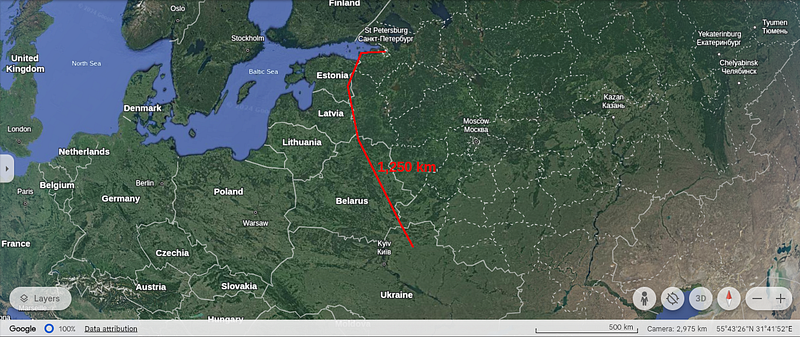
I’ll tell you straight away that I have no information on the latest Ukrainian drones that evaded Russian air defences and hit targets in St Petersburg on successive days, a distance of 1,250 km from Ukrainian territory. That distance was quoted in various news stories.
Ukraine hit targets in Russia’s St Petersburg overnight using a domestic-produced drone that flew 1,250 km (775 miles), a Ukrainian government minister was quoted as saying by Interfax-Ukraine news agency on Thursday.
A Ukrainian military source told Reuters earlier that an oil terminal in Russia’s second city, located some 850 km (530 miles) from the nearest section of the Ukrainian border, was targeted as part of a “new stage of work in this region”.
“…Last night we hit the target, and this thing flew exactly 1,250 kilometres last night,” Oleksandr Kamyshin, the minister of strategic industries who oversees weapons production, was quoted as saying in Davos. — Reuters
Here’s a map with my plot of a possible route of 1,250 km:
Russia’s second largest fuel refinery is out of action.
Typically, Russia said that all drones had been shot down but, then added that ammunition fell on some oil tanks.
[St Petersburg], regional governor Alexander Drozdenko said a “high alert regime” was in place after the incident at the terminal of gas producer Novatek, in Ust-Luga on the Gulf of Finland. He shared a video of what appeared to be a large fire.
Novatek later announced that work at the terminal had been suspended, and said the fire was the result of “external influence” — without providing further details.
The Ukrainians say fuel processed at the plant was being used to supply Russian troops in their war against Ukraine and that this strike “significantly complicates” logistics for the military. — BBC
A day or so later, an oil supply depot in Bryansk was also hit and 3,500 tons of fuel destroyed.
It seems that Ukraine has given up waiting for longer range Western weapons and gone ahead with its own development of drones to hit deep into Russia. Necessity is the mother of invention, and now the West has lost control. Ukraine now needs no country’s permission to hit targets in Russia.
We don’t know what type of drone was used for the St Petersberg attack, except that it was manufactured in Ukraine and that locals had reported a buzzing sound before the explosions. Therefore it was unlikely to have been jet powered.
New Ukraine drones
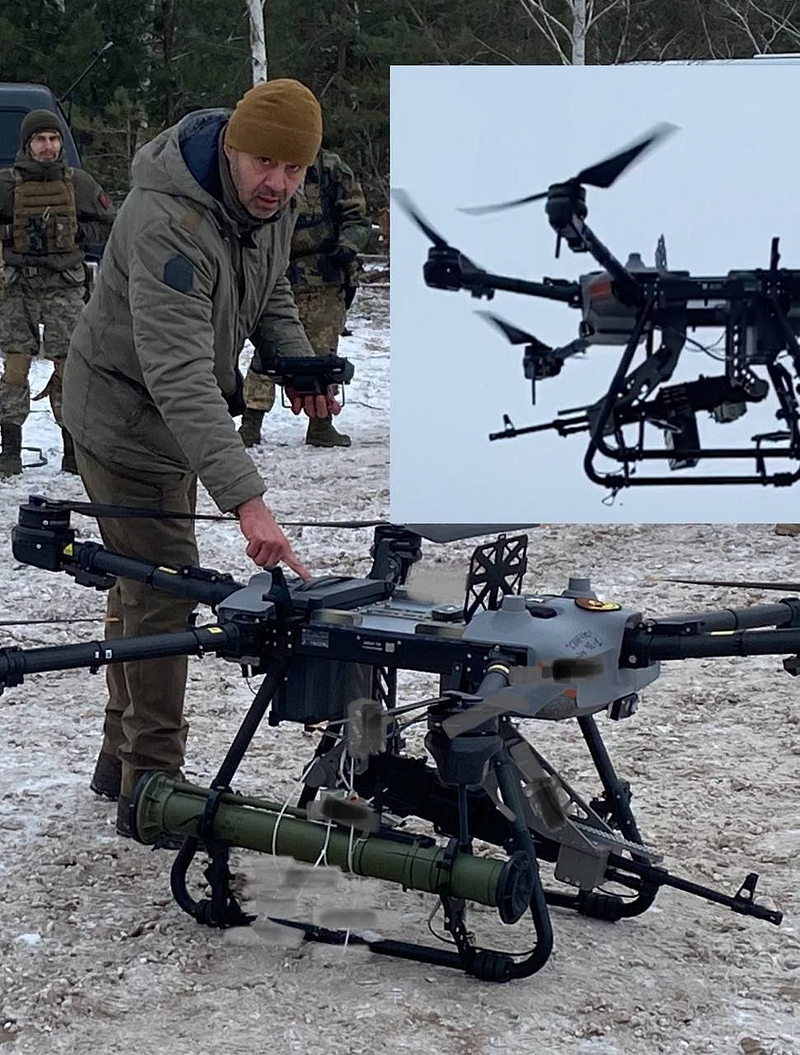
This is a collection of stories about new types of Ukrainian drones that I have collated over the last few weeks. I’ll start with the latest as in the headline picture shown again below.
As yet it has no name, so I’ve called it Anon for now.
Anon
It is an attack helicopter with a mounted PKM machine gun and a Bulgarian Bullspike-AT grenade launcher. The first question that occurred to me was that it cannot be a very stable platform for a grenade launcher, which will have some recoil and therefore ‘spoil’ the aim.
I also note that the inset frame of the drone in flight does not include the grenade launcher. The machine gun is centrally mounted and also there are surely recoil/aim issues with this weapon.
It seems to me that its battlefield utility is questionable. Russia has an equivalent fitted with a 9K111 FAGOT ATGM.
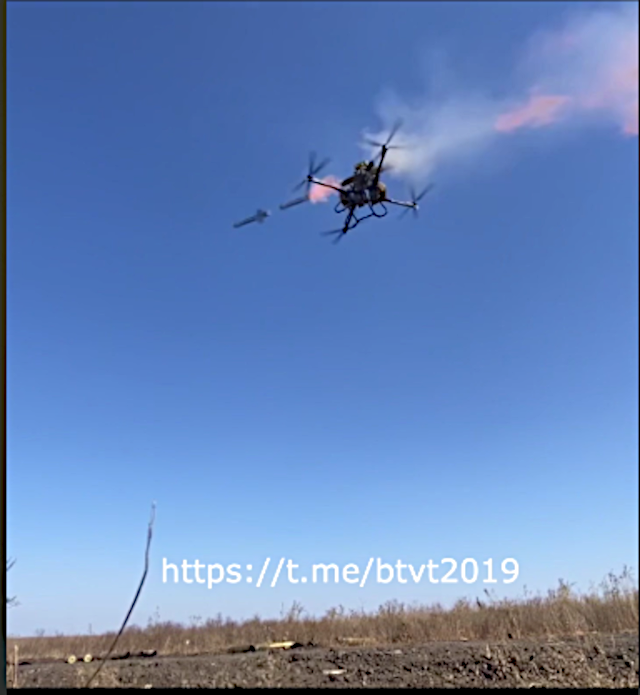
Surely it would be more efficient to use a small fpv drone for whatever target is under consideration? This drone is a heavy investment for the weaponry it carries. So, I’m wondering whether it is just an exercise in FUD: sowing fear, uncertainty and doubt into the minds of the enemy who are already calling the bombing drones ‘Baba Yaga’, a Russian folk lore witch.
AQ400 Scythe
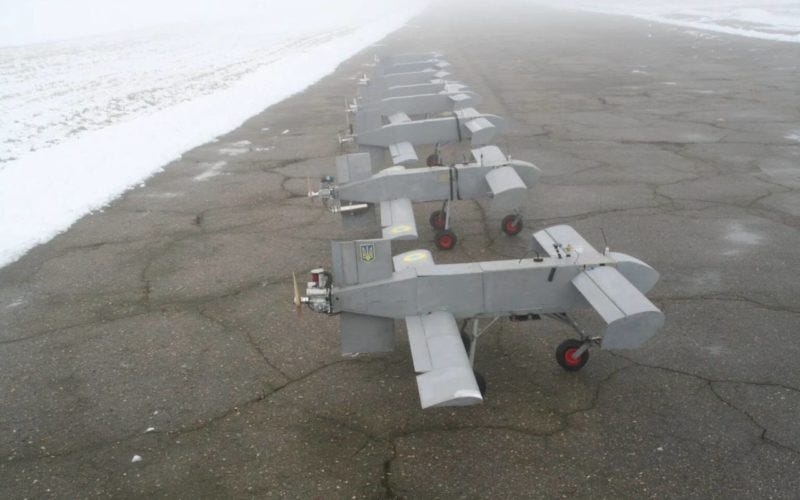
The AQ 400 Scythe is a long-range drone with a cruising speed of 144 km/h, designed to be launched from short runways or catapults, capable of carrying a payload of up to 32 kilograms (can be increased to 70 kg by reducing the flight range). — Terminal Autonomy Inc
The Ukrainian manufacturer said it already produces 100 units per month and plans to increase production to 500 units per month. It also claims a range of up to 950 km, and it is capable of hitting Moscow. The cost is quoted as about $15,000.
With a push prop configuration and the elevators at the front of the fuselage it follows several recent designs we have seen. Its tricycle undercarriage is jettisoned on takeoff, seen in the manufacturer’s video on Twitter.
Given its stated range, it is unlikely to carry cameras or other comms and is probably guided by GPS and therefore theoretically jammable. I think it unlikely to have inertial or terrain mapping guidance at the quoted cost. However, I note the presence of several antennae which could be for target programming, flight control at take-off and ECM.
Cobra
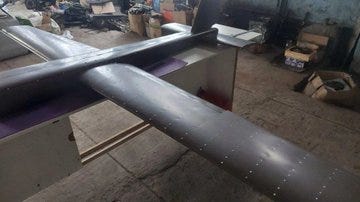
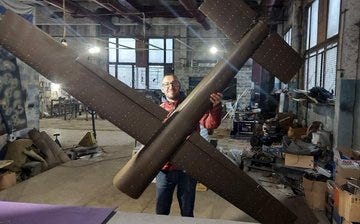
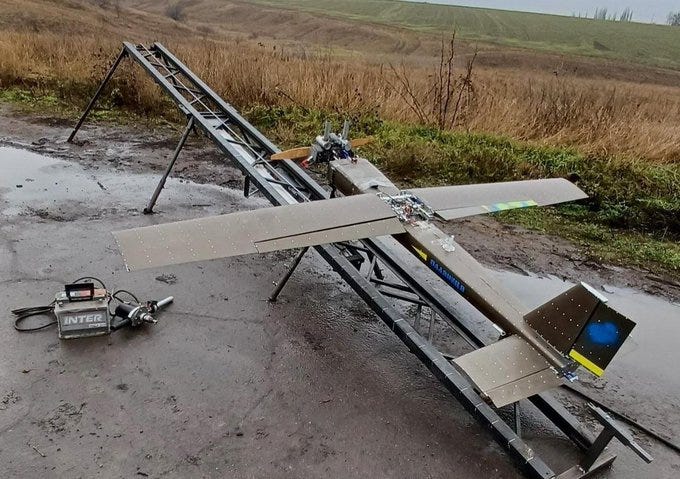
Ukrainian Media: “The Ukrainian Cobra attack drone began to be mass-produced. The production time of one drone is 3 hours. The flight range is 300 km. Carrying capacity — 15 kg. The UAV was developed by engineers from Kryvyi Rih. The drone has a body made of riveted steel. This technology simplified and cheapened the production of UAVs.”
This design has caused considerable comment. Why steel, why riveted?
It does seem very strange unless this is deliberately designed to have a large radar signature and act as a decoy, attracting SAMS and allowing other much less visible drones to penetrate defences.
Riveted construction is bizarre too. Folded metal, spot welded would be easier and quicker. I think that a 3 hour assembly time is incredible unless you have a team of maybe 6 people working at it.
Skyline
This is a turbojet powered drone built by UkrJet. The first image is of a damaged unit which failed to explode when it crashed in Russia. The UJ-25 is an improved version of the UJ-23 Topaz model.
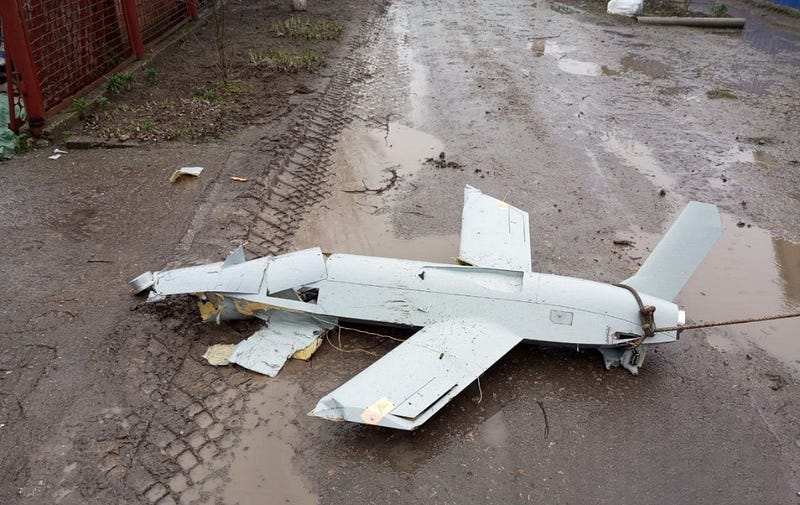
The UJ-25 is a weaponized version of the Ukrjet UJ-23 Topaz target drone. Both aircraft have missile-like main bodies, forward-swept wings, V-tail configurations, and top-mounted air intakes at the rear of the fuselage feeding into a turbojet engine; the UJ-25 differs outwardly only by having forward canards.
Although the Skyline’s specifications are not known, the Topaz has a cruise speed of 600 km/h (370 mph), a top speed of 800 km/h (500 mph), endurance of 90 minutes, and a mission radius of 400 km (250 mi) with a payload weight of 10 kg (22 lb) and is guided either by manual control link or by following a preprogrammed route. As a one-way kamikaze drone, the UJ-25 could have a strike range of around 800 km (500 mi). — Wikipedia
Its UJ-23 Topaz predecessor is said to have a service ceiling of 6,000 metres (20,000 feet).
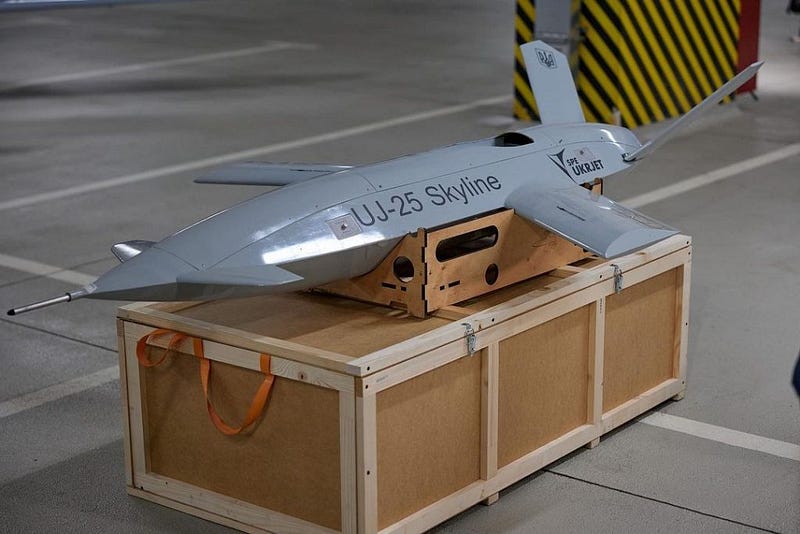
This is capable of reaching Moscow — and beyond — from Ukraine. Its shape, small size and high speed make it harder for AA missiles to hit. I’m speculating that it is probably ramp launched with a drop-off rocket booster. This offer more flexibility as a ‘long’ runway is not required, but with the complication of a booster.
But…
Anon 2
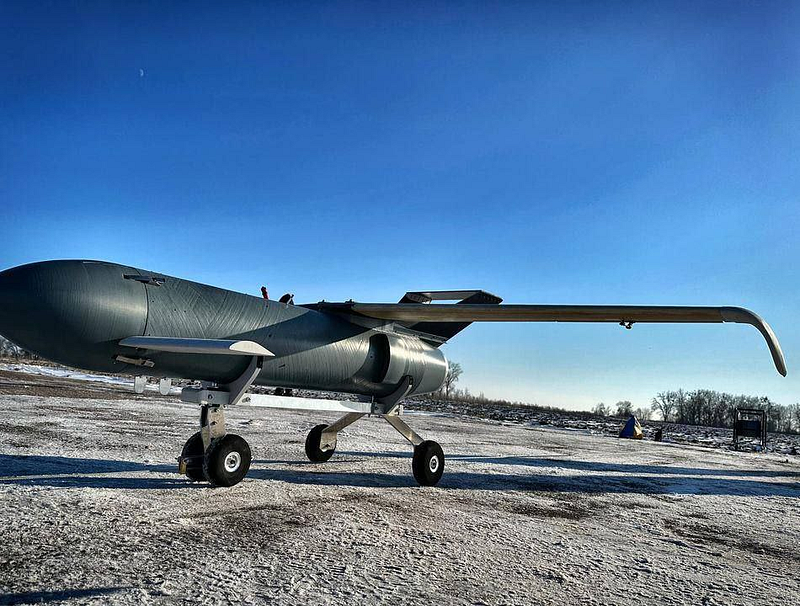
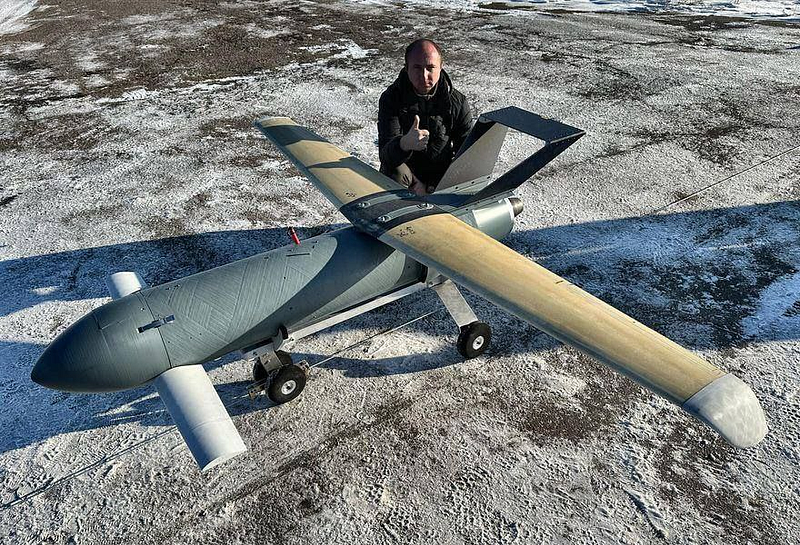
This is another unnamed drone which has recently passed testing. It is turbojet powered and with takeoff on a runaway using a drop-off tricycle undercarriage.
Image source and an impressive video here on Ukraine War — Intel News on Telegram.
Targets
Ukraine continues to extend its range into Russia’s heartland hitting military/ industrial targets. Logistics hubs are important, but Russia has key strategic airbases at Astrakhan (Caspian Sea ~1000 km) and Olenya (Murmansk ~2,000 km) from where Tu-95M and Mig-31K aircraft (Astrakhan) are tasked with missions to launch KH-101 and Kinzhal cruise missiles. Ukraine desperately wants to be able the threaten those bases.
Soon it will be able to do, with or without Western weapons.
What we do know is that the furthest-reaching drones that Ukraine has can destroy an oil/gas refinery 1,250 km from Ukraine, and evade Russian air defences en-route.
Unless the drones were not launched from Ukraine, but somewhere nearer? Maybe even a cargo ship in the Baltic Sea. Now there’s a thought!


