avatarJames Marinero, MSc, MBA

Free AI web copilot to create summaries, insights and extended knowledge, download it at here

6245

Abstract

n calories. Therefore, to feed 2.4 million people, we would need approximately 1,200 tons of food per day.</p><p id="26f2">Accessing food production statistics for Crimea was near impossible. This is what I dug out for 2014:</p><blockquote id="c009"><p>…the semiarid climate that makes Crimea such a popular tourist destination also makes the peninsula largely dependent on Ukraine for water, as well as about 70 percent of its food, according to <a href="http://www.slate.com/articles/news_and_politics/foreigners/2014/03/vladimir_putin_s_crimean_mistake_the_russian_president_is_miscalculating.html">Slate</a>. — <a href="https://www.livescience.com/43815-facts-about-crimea-ukraine-russia.html"><i>livescience.com</i></a></p></blockquote><p id="3b6f">On that basis, Russia would have to bring in 800–900 tons of food a day and, presumably, is already doing so.</p><p id="47e3">That’s about 20 shipping container loads at 40 tons/container. But giving packaging and food densities then I would multiply that by 4. As I see it, that’s probably about 3–5 trains a day. Or maybe 80–120 truckloads.</p><p id="b9d6">However, since 2014 Russia has invested heavily in mechanisation of agriculture, and food production has increased:</p><blockquote id="718d"><p><i>According to official Russian statistics, the Crimean agricultural industry fully overcame the consequences of the blocking of the North Crimean Canal and crop yields grew by a factor of <b>1.5</b> from 2013 by 2016. The reported rapid growth in agricultural production in Crimea is due to the fact that, with the help of subsidies in the order of 2–3 billion rubles a year from the budget of the Russian Federation, agricultural producers in Crimea were able to increase their fleet of agricultural machinery, - <a href="https://en.wikipedia.org/wiki/North_Crimean_Canal">Wikipedia</a></i></p></blockquote><p id="1381">A 50% increase in 3 years? Anyone with an ounce of common sense takes Russian official statistics as total BS, but I accept that some improvement is probable given that it’s now 9 years since 2014.</p><h1 id="287d">Fuel</h1><p id="c571">I could find no credible details of an oil refinery in Crimea. The nearest is in Ilsky near Krasnodar and was attacked recently by drones.</p><p id="2c5f">Based on figures from the International Energy Agency, a first world country needs about 2.2 billion litres of gasoline and diesel fuel per annum. That’s about 6 million litres per day. A typical Russian railway tank car has a capacity of about 50,000–60,000 litres. So in round numbers Crimea would need 100 wagons of fuel every day. 5 trainloads maybe.</p><p id="21f6">But you can be sure that fuel would be rationed for the public. It’s probable that there are substantial reserves — but they are prone to drone attacks as we have seen.</p><h1 id="f43f">Electricity generation</h1><p id="565f">Fuel for electrical generation could be eked out by shutting down civilian power supplies in the event of a blockade. There are no operational nuclear power stations in Crimea, but there are at least four power stations which run mainly on natural gas totalling 4,400 MW. Russia has been building capacity since 2014 and at least two new stations have come on line since then. The substantial Skifska and Faroska natural gas fields are now under Russian control.</p><p id="0e0b">The platforms and pipelines from these gas fields are obvious targets and have been attacked several times. One pipeline terminal and <a href="https://www.nbcnews.com/news/world/russia-ukraine-war-crimea-fire-oil-depot-drones-rcna82088">storage tank complex in Sevastopol</a> were recently attacked by Ukrainian drones.</p><h1 id="ce67">Military materiel</h1><p id="aeb4">This really is the crux.</p><p id="c991">Putin doesn’t give a damn about feeding the general public, or keeping them warm, I’m sure. He can blame Ukraine. Summer’s coming, anyway.</p><p id="ba87">For the garrison, air and naval forces he needs ammunition, missiles and fuel. As well as food and spare parts. Recycling some of the troops might be required.</p><p id="a3bd">Presumably, planes can be serviced in Krasnodar Krai or Saratov.</p><h2 id="d405">Ammunition and missiles</h2><p id="482a">How much would be needed in a siege situation? His commanders would want to build stockpiles for a drive north out of Crimea. But wait — a breakout north would be as difficult as an invasion by Ukraine, wouldn’t it?</p><p id="b1b7">There might be artillery operations along the lines of contact. And the way Russia uses artillery is very ammo-hungry.</p><p id="700f">Russia has been bringing in S-300 AA missiles by train (they’re also now being used as inaccurate surface to surface weapons). That would stop unless they can fit them in planes, which is possible I guess. But risky.</p><p id="1844">Ammunition and missiles for the planes, if they are not being re-armed in Krasnodar would be required.</p><p id="82d0">And Kalibr missiles for his ships? Would the ships still be afloat in port?</p><p id="d59b">Or out at sea?</p><h2 id="c0b4">Fuel</h2><p id="9435"><b>Ground forces</b></p><p id="caca">This would not be a major requirement in the siege context as his forces would not be doing much manouvering as compared with the attempted invasion of Ukraine in 2022.</p><p id="7e99"><b>Airforce</b></p><p id="d104">Aircraft fuel would be needed as the airforce could still do useful work in a siege context. Planes might be able to refuel in Krasnodar Krai and aerial tankers are also an option.</p><p id="c1e1"><b>Naval forces</b></p><p id="1e8c">In the event of Russian sea re-supply lines being cut then Russian naval ships would be trapped in harbour if not already at sea and well away from danger. But even in harbour they might still be a credible force as missile bases— until they run out of missiles or get hit by drones, Storm Shadows or any of the range of missiles now at Ukraine’s disposal.</p><h2 id="9c93">Overall military supply volumes</h2><p id="2154">I’m estimating maybe 25 trains equivalent per day for all the military requirements, maximum, plus fuel. That includes truck equivalents. 500 x 40' container equivalents. Am I way off? Who knows?</p><p id="adff">They can only park so many tanks and BMPs i

Options

n Crimea, and where are they all going to come from anyway?</p><p id="cc60">What would they do with all that materiel sitting around with nowhere to go?</p><p id="900f">So that’s volumes, now routes.</p><h1 id="62ee">The supply lines</h1><p id="d643">Geography makes Crimea hard to invade but makes a modern-day siege pretty straightforward. All Russian movements by land must pass through one of two constrained corridors: The land bridge which is particularly vulnerable, and the Kerch Bridge.</p><p id="ec54">We’ve already seen the Kerch Bridge get hit and put out of full capacity for several months (now fixed) and surely we can expect another attack soon. Ukraine now has British Storm Shadow missiles, and depending on exactly what version has been given by the UK, the Kerch Bridge (road and rail link) might well be in range. And this time it would be multiple breaks and much longer to repair.</p><p id="af0d">The land access to Crimea from the Ukraine mainland has several roads and two rail links which are easy artillery targets for a number of weapons systems, particularly if the UAF can cross the Dnipro river in strength and move south east.</p><figure id="a1d5"><img src="https://cdn-images-1.readmedium.com/v2/resize:fit:800/1*U1kC7pBoQEg2gpxbeRwJog.png"><figcaption>Credit: Copyright © 2011–2021 Red Hat, Inc. and The GNOME Maps authors Map data by OpenStreetMap and contributors Map tiles provided by OpenStreetMap.Map imagery CC-BY-SA 2.0 OpenStreetMap. Author overlays in red.</figcaption></figure><p id="1e37">Dzhankoy is a critical railway junction, but the two north-south rail-links look vulnerable as does the one over the Kerch Bridge (on the first map). The northern lines probably cross several bridges and that would be the obvious critical point. Relaying a track on land is one thing and lines can often be repaired within 24 hrs, but having to rebuild bridges on marshland is not an overnight process.</p><p id="0179">By sea, Ukraine has shown the effective use of explosive <a href="https://www.rand.org/blog/2022/11/the-age-of-uncrewed-surface-vessels.html">uncrewed surface vessels (USVs)</a> working in attacks against Russian warships based at Sevastopol. This new technology in which Ukraine is a master can sink warships and destroy maritime infrastructure. And hit cargo ships. But would Ukraine target ships with civilian crews? I don’t know. But they would not have to if harbours are blocked by naval shipwrecks.</p><p id="2622">Ferries across the Kerch Strait have very limited capacity and are slow moving targets.</p><p id="2a8d">That leaves the air.</p><p id="5b05">Could/would Putin try an air bridge if his land and sea line were cut? Planes flying from Krasnodar Krai could probably get through to Crimea safely outside the range of Ukraine A2A missiles on F-16s.</p><p id="05d3">It would only be for military essentials I think. Not for food. It would suit Putin to have the population starve and be able to blame Ukraine.</p><p id="3f92">He would not waste the planes in a massive airlift.</p><h1 id="46f2">Conclusion</h1><p id="26f9">Just blockading Crimea would be fairly straightforward to achieve. Crimea could not be self-sustaining if effectively blockaded.</p><p id="a225">Food would be the critical resource. We have seen that Crimea can produce 30% of its needs. Perhaps in a siege situation they could up that to 50%.</p><p id="f320">It would be important for Kyiv to minimise the effects on the civilian population. Since 1926 Russia has been packing Russians into Crimea as Stalin cleansed the Tatars and Cossacks. 60% of Crimea’s population is ethnic Russian, 24% ethnic Ukrainians (<a href="https://en.wikipedia.org/wiki/Demographics_of_Crimea">2001 census</a>), with more Russians in the suspect 2014 census. It’s not known what the political leaning is of those ethnic Russians, and that might be a difficult problem for Kyiv to manage.</p><p id="8a66">A large scale airlift would not be practical and what would be the end game anyway — for either side?</p><p id="3297">It would months for a blockade time to have any effect.</p><p id="79a9">Is starving out a population acceptable in the 21st Century? Not when we put it like that, perhaps, but a 50% reduction in available food would certainly cause civil unrest which would be suppressed.</p><p id="6ed9">Would Ukraine want a prolonged siege?</p><p id="0ab8">Crimea is the jewel in Putin’s crown. Would he wait to see Crimea sit-out a siege? I very much doubt it. It would be endless. He would almost certainly escalate if Crimea supply lines are severed — and if he is still in the Kremlin.</p><p id="3fa1">And that’s the danger.</p><p id="8b0a">My overall conclusion is that a blockade is not practical for more than a few months. A blockade should be designed to weaken the military and enable the freeing of Crimea. Civilians will inevitably suffer.</p><p id="95c6">More context:</p><div id="78e9" class="link-block"> <a href="https://t.me/liveukraine_media/9191"> <div> <div> <h2>Live: Ukraine</h2> <div><h3>The recent bombing of a railroad in occupied Crimea could disrupt the supply of weapons, including Kalibr missiles, to…</h3></div> <div><p>t.me</p></div> </div> <div> <div style="background-image: url(https://miro.readmedium.com/v2/resize:fit:320/0*XvvjC0phvkdpTwod)"></div> </div> </div> </a> </div><p id="eec2"><i>About me: If you follow me I guarantee variety in your inbox with some unusual perspectives! I write on a wide range of topics including humor, tech, space, geopolitics and travel. I also write about…</i></p><p id="6a36"><b>…geographical constipation</b></p><figure id="c023"><img src="https://cdn-images-1.readmedium.com/v2/resize:fit:800/1*QeQr0J6dshTDJHUZ_MtLdw.png"><figcaption></figcaption></figure><p id="82f6"><i>My novels are available at my <a href="https://jamesmarinero.gumroad.com/">Gumroad</a> bookstore. Also at <a href="https://www.amazon.com/stores/James-Marinero/author/B0055RWF6U">Amazon</a> and <a href="https://books.apple.com/us/author/james-marinero/id490200686">Apple</a></i></p></article></body>

Ukraine War

Ukraine: Is Blockading Crimea A Realistic Strategy?

What are the key supply lines and pinch points, and how difficult would it be for Ukraine to control them?
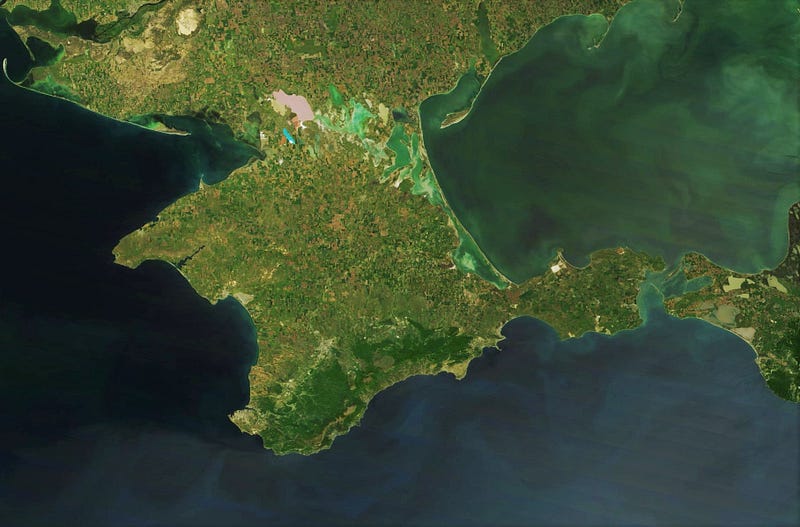
Satellite image credit: NASA, By NASA — [1], Public Domain, https://commons.wikimedia.org/w/index.php?curid=47611517

The recent bombing of a railroad in Simferopol, occupied Crimea, could disrupt the supply of weapons, including Kalibr missiles, to Black Sea Fleet ships, according to UK intelligence.

An explosion on the track where a train derailed blocked the only railroad line to Sevastopol. Despite the Russians’ efforts to repair it quickly, the incident has already disrupted supply lines.

Former U.S. Army Commander in Europe, Lieutenant General Ben Hodges, said that Ukrainian forces with long-range strike capabilities, could “make Crimea untenable for Russian forces”.

Following that, I decided to take an amatuer look at supply lines to Crimea and how difficult it would be to cut them. But first, there seems to be a people supply line.

The population of Crimea is quoted as 2.4 million (2021). That may or may not include members of Russian armed forces. And it’s going up. Recently, Russia has been relocating people from the Ukrainian mainland to Crimea. 70,000 mostly women and children.

Melitopol Mayor Ivan Fedorov says that Russian “evacuation” from the occupied part of Zaporizhzhia region is happening too fast, and huge queues have formed at the Chongar checkpoint on the way from Melitopol to Crimea. — Telegram Live: Ukraine (May 7, 2023)

I wondered why.

Maps

I started with the maps.

Many of the ‘free’ maps on Wikipedia show Crimea as an ‘autonomous republic’. That’s a Russian BS claim and so I have corrected the following map, which we’ll work with as a start. Not all the place names are in Ukrainian and I have been unable to correct those.

In fact, there is a great deal of factual distortion on the Wikipedia page.
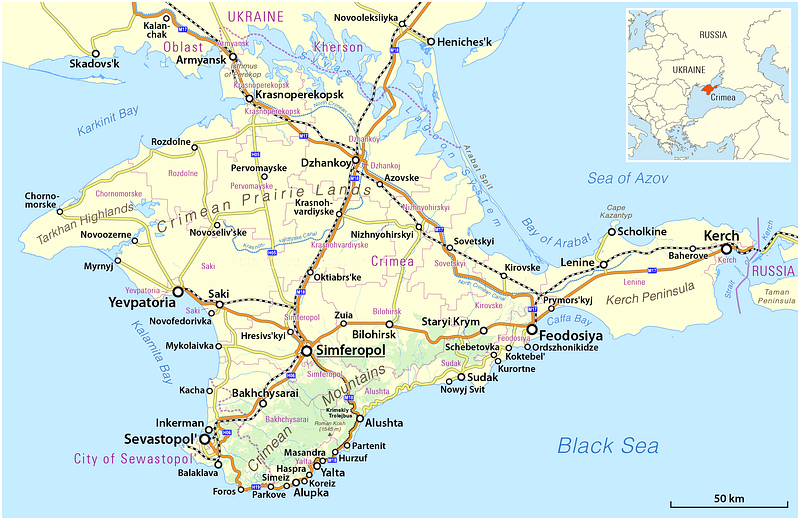
Original Credit: By Maximilian Dörrbecker (Chumwa) — Own work, usingOpenStreetMap datathis file for the orientation map inset, CC BY-SA 2.0, https://commons.wikimedia.org/w/index.php?curid=31740327. Corrections by author to remove words ‘Autonomous Republic’ in line with internationally recognised name, as part of Ukraine

Key resources required to endure a siege

I’ve looked at these under the categories of water, food, fuel and military materiel.

To put this in context, the Berlin Airlift at its peak supplied 13,000 tons of supplies every day, a total of 2.3 million tons over 323 days. And this included even coal which made up 2/3 of the overall tonnage. That was for a population of about 2.1 million people. The maximum the biggest plane (the De Havilland York) could carry was 10 tons.

That’s an average of 7,000 tons per day. Without the coal, 2,300 tons per day. And that’s without the planes being attacked.

Water supply

Other than air (kind of obvious), water is the critical life-limiting resource in any siege. Prior to 2014, the 400 km-long Nord-Krim Kanal supplied 85% of Crimea’s drinking and agricultural water from the Dnipro River. Following Russia’s illegal 2014 annexation, Ukraine blocked the canal (supposedly a commercial dispute), but the blocking dam was quickly removed by advancing Russian troops two days after the 24 February 2022 invasion.
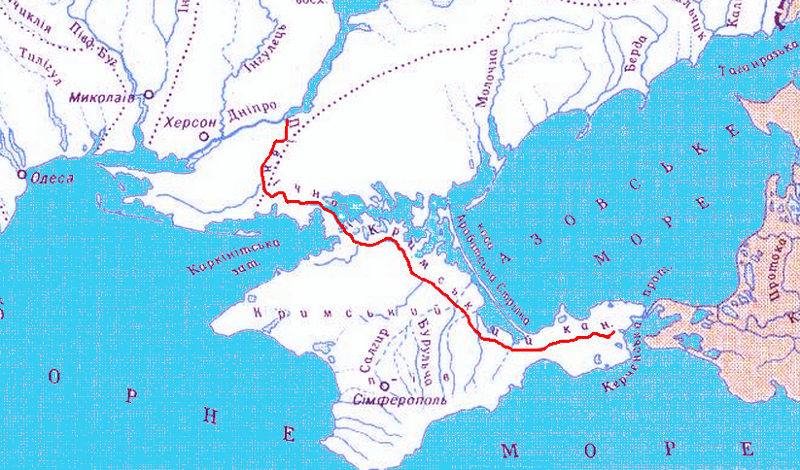
Nord-Krim Kanal. Credit: By Berihert — Own work, CC BY-SA 3.0, https://commons.wikimedia.org/w/index.php?curid=28434474

After Ukraine dammed the Nord-Krim Kanal in 2014, agriculture in Crimea was seriously impacted and the 2014 harvest failed. Russia built a new dam in East Crimea and connected other Crimean water sources to the distribution system.

It’s still a reality of war that civilian infrastructure, including water supplies are targeted.

But from what I have researched, Crimea is now self-sufficient for fresh water.

Food

How much food does a population of 2.4 million people consume?

I knew what the calorie requirements in a temperate climate were, but I needed to go beyond that so I got some AI help.

Assuming a daily caloric intake of 2,500 calories per person, we can estimate the total food requirement. On average, 1 ton of food contains approximately 2 million calories. Therefore, to feed 2.4 million people, we would need approximately 1,200 tons of food per day.

Accessing food production statistics for Crimea was near impossible. This is what I dug out for 2014:

…the semiarid climate that makes Crimea such a popular tourist destination also makes the peninsula largely dependent on Ukraine for water, as well as about 70 percent of its food, according to Slate. — livescience.com

On that basis, Russia would have to bring in 800–900 tons of food a day and, presumably, is already doing so.

That’s about 20 shipping container loads at 40 tons/container. But giving packaging and food densities then I would multiply that by 4. As I see it, that’s probably about 3–5 trains a day. Or maybe 80–120 truckloads.

However, since 2014 Russia has invested heavily in mechanisation of agriculture, and food production has increased:

According to official Russian statistics, the Crimean agricultural industry fully overcame the consequences of the blocking of the North Crimean Canal and crop yields grew by a factor of 1.5 from 2013 by 2016. The reported rapid growth in agricultural production in Crimea is due to the fact that, with the help of subsidies in the order of 2–3 billion rubles a year from the budget of the Russian Federation, agricultural producers in Crimea were able to increase their fleet of agricultural machinery, - Wikipedia

A 50% increase in 3 years? Anyone with an ounce of common sense takes Russian official statistics as total BS, but I accept that some improvement is probable given that it’s now 9 years since 2014.

Fuel

I could find no credible details of an oil refinery in Crimea. The nearest is in Ilsky near Krasnodar and was attacked recently by drones.

Based on figures from the International Energy Agency, a first world country needs about 2.2 billion litres of gasoline and diesel fuel per annum. That’s about 6 million litres per day. A typical Russian railway tank car has a capacity of about 50,000–60,000 litres. So in round numbers Crimea would need 100 wagons of fuel every day. 5 trainloads maybe.

But you can be sure that fuel would be rationed for the public. It’s probable that there are substantial reserves — but they are prone to drone attacks as we have seen.

Electricity generation

Fuel for electrical generation could be eked out by shutting down civilian power supplies in the event of a blockade. There are no operational nuclear power stations in Crimea, but there are at least four power stations which run mainly on natural gas totalling 4,400 MW. Russia has been building capacity since 2014 and at least two new stations have come on line since then. The substantial Skifska and Faroska natural gas fields are now under Russian control.

The platforms and pipelines from these gas fields are obvious targets and have been attacked several times. One pipeline terminal and storage tank complex in Sevastopol were recently attacked by Ukrainian drones.

Military materiel

This really is the crux.

Putin doesn’t give a damn about feeding the general public, or keeping them warm, I’m sure. He can blame Ukraine. Summer’s coming, anyway.

For the garrison, air and naval forces he needs ammunition, missiles and fuel. As well as food and spare parts. Recycling some of the troops might be required.

Presumably, planes can be serviced in Krasnodar Krai or Saratov.

Ammunition and missiles

How much would be needed in a siege situation? His commanders would want to build stockpiles for a drive north out of Crimea. But wait — a breakout north would be as difficult as an invasion by Ukraine, wouldn’t it?

There might be artillery operations along the lines of contact. And the way Russia uses artillery is very ammo-hungry.

Russia has been bringing in S-300 AA missiles by train (they’re also now being used as inaccurate surface to surface weapons). That would stop unless they can fit them in planes, which is possible I guess. But risky.

Ammunition and missiles for the planes, if they are not being re-armed in Krasnodar would be required.

And Kalibr missiles for his ships? Would the ships still be afloat in port?

Or out at sea?

Fuel

Ground forces

This would not be a major requirement in the siege context as his forces would not be doing much manouvering as compared with the attempted invasion of Ukraine in 2022.

Airforce

Aircraft fuel would be needed as the airforce could still do useful work in a siege context. Planes might be able to refuel in Krasnodar Krai and aerial tankers are also an option.

Naval forces

In the event of Russian sea re-supply lines being cut then Russian naval ships would be trapped in harbour if not already at sea and well away from danger. But even in harbour they might still be a credible force as missile bases— until they run out of missiles or get hit by drones, Storm Shadows or any of the range of missiles now at Ukraine’s disposal.

Overall military supply volumes

I’m estimating maybe 25 trains equivalent per day for all the military requirements, maximum, plus fuel. That includes truck equivalents. 500 x 40' container equivalents. Am I way off? Who knows?

They can only park so many tanks and BMPs in Crimea, and where are they all going to come from anyway?

What would they do with all that materiel sitting around with nowhere to go?

So that’s volumes, now routes.

The supply lines

Geography makes Crimea hard to invade but makes a modern-day siege pretty straightforward. All Russian movements by land must pass through one of two constrained corridors: The land bridge which is particularly vulnerable, and the Kerch Bridge.

We’ve already seen the Kerch Bridge get hit and put out of full capacity for several months (now fixed) and surely we can expect another attack soon. Ukraine now has British Storm Shadow missiles, and depending on exactly what version has been given by the UK, the Kerch Bridge (road and rail link) might well be in range. And this time it would be multiple breaks and much longer to repair.

The land access to Crimea from the Ukraine mainland has several roads and two rail links which are easy artillery targets for a number of weapons systems, particularly if the UAF can cross the Dnipro river in strength and move south east.
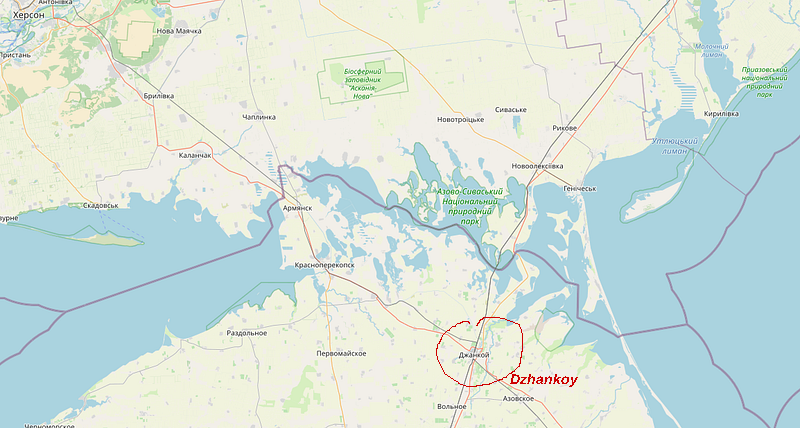
Credit: Copyright © 2011–2021 Red Hat, Inc. and The GNOME Maps authors Map data by OpenStreetMap and contributors Map tiles provided by OpenStreetMap.Map imagery CC-BY-SA 2.0 OpenStreetMap. Author overlays in red.

Dzhankoy is a critical railway junction, but the two north-south rail-links look vulnerable as does the one over the Kerch Bridge (on the first map). The northern lines probably cross several bridges and that would be the obvious critical point. Relaying a track on land is one thing and lines can often be repaired within 24 hrs, but having to rebuild bridges on marshland is not an overnight process.

By sea, Ukraine has shown the effective use of explosive uncrewed surface vessels (USVs) working in attacks against Russian warships based at Sevastopol. This new technology in which Ukraine is a master can sink warships and destroy maritime infrastructure. And hit cargo ships. But would Ukraine target ships with civilian crews? I don’t know. But they would not have to if harbours are blocked by naval shipwrecks.

Ferries across the Kerch Strait have very limited capacity and are slow moving targets.

That leaves the air.

Could/would Putin try an air bridge if his land and sea line were cut? Planes flying from Krasnodar Krai could probably get through to Crimea safely outside the range of Ukraine A2A missiles on F-16s.

It would only be for military essentials I think. Not for food. It would suit Putin to have the population starve and be able to blame Ukraine.

He would not waste the planes in a massive airlift.

Conclusion

Just blockading Crimea would be fairly straightforward to achieve. Crimea could not be self-sustaining if effectively blockaded.

Food would be the critical resource. We have seen that Crimea can produce 30% of its needs. Perhaps in a siege situation they could up that to 50%.

It would be important for Kyiv to minimise the effects on the civilian population. Since 1926 Russia has been packing Russians into Crimea as Stalin cleansed the Tatars and Cossacks. 60% of Crimea’s population is ethnic Russian, 24% ethnic Ukrainians (2001 census), with more Russians in the suspect 2014 census. It’s not known what the political leaning is of those ethnic Russians, and that might be a difficult problem for Kyiv to manage.

A large scale airlift would not be practical and what would be the end game anyway — for either side?

It would months for a blockade time to have any effect.

Is starving out a population acceptable in the 21st Century? Not when we put it like that, perhaps, but a 50% reduction in available food would certainly cause civil unrest which would be suppressed.

Would Ukraine want a prolonged siege?

Crimea is the jewel in Putin’s crown. Would he wait to see Crimea sit-out a siege? I very much doubt it. It would be endless. He would almost certainly escalate if Crimea supply lines are severed — and if he is still in the Kremlin.

And that’s the danger.

My overall conclusion is that a blockade is not practical for more than a few months. A blockade should be designed to weaken the military and enable the freeing of Crimea. Civilians will inevitably suffer.

More context:

About me: If you follow me I guarantee variety in your inbox with some unusual perspectives! I write on a wide range of topics including humor, tech, space, geopolitics and travel. I also write about…

…geographical constipation

My novels are available at my Gumroad bookstore. Also at Amazon and Apple

Ukraine War
Military Strategy
Military Tactics
Crimea
Warfare
Recommended from ReadMedium