ability through echolocation to emit sounds with a frequency of 120 kHz and humans, with excellent hearing, can hear sounds with frequencies ranging from 20 Hz to 20 kHz. Even dogs and cats that have amazing hearing capabilities do not compare to dolphins. Dogs hear up to 45 kHz, and cats up to 65 kHz. — <a href="https://www.dolphins-world.com/dolphin-echolocation/"><i>Dolphins-World</i></a></p></blockquote><p id="bf0a">The returned sounds are received by the dolphin in <a href="http://neuronresearch.net/hearing/pix/FultonCaldwell.gif">two sensors</a> (image link), giving them highly accurate distance, direction and target shape perception. So, they can discriminate between various types of fish and other objects.</p><p id="d908">It appears that the echolocation capability of bottlenose dolphins <a href="https://neuronresearch.net/hearing/files/dolphinbiosonar.htm">surpasses that of all other cetaceans</a>, and man has a long way to got to get close the building a machine of that capability.</p><h1 id="0c1b">A bit of history</h1>
<figure id="ebbe">
<div>
<div>
<img class="ratio" src="http://placehold.it/16x9">
<iframe class="" src="https://cdn.embedly.com/widgets/media.html?src=https%3A%2F%2Fwww.youtube.com%2Fembed%2F1JyLMX_ZrEY%3Ffeature%3Doembed&display_name=YouTube&url=https%3A%2F%2Fwww.youtube.com%2Fwatch%3Fv%3D1JyLMX_ZrEY&image=https%3A%2F%2Fi.ytimg.com%2Fvi%2F1JyLMX_ZrEY%2Fhqdefault.jpg&key=a19fcc184b9711e1b4764040d3dc5c07&type=text%2Fhtml&schema=youtube" allowfullscreen="" frameborder="0" height="480" width="854">
</div>
</div>
</figure></iframe></div></div></figure><p id="9b46"><a href="https://www.businessinsider.com/the-us-navys-combat-dolphins-are-serious-military-assets-2015-3?r=US&IR=T">Business Insider</a> reported that 50 sea lions and 85 bottlenose dolphins were being trained in 2015 at the Navy Marine Mammal Training Program, housed in California’s Space and Naval Warfare Systems Command (SPAWAR) in San Diego. Sources have stated that dolphins could and would never be trained to kill divers, but could mark their presence by releasing a buoy.</p><p id="d751">Russia started investing in marine mammal programs in 1965 after witnessing the U.S.’s success. It is entirely possible that Russia would attempt to train its war dolphins to kill enemy divers, but US commentators doubt that this would be possible.</p><p id="9c80">However, there are stories circulating about the US training dolphins to butt a diver in the chest with a compressed air needle, creating an embolism (<a href="https://www.businessinsider.com/the-us-navys-combat-dolphins-are-serious-military-assets-2015-3?r=US&IR=T">Business Insider</a>).</p><p id="9ee1">Dolphins have been used during war. In 1970 and 1971, five of them guarded an Army ammunition pier in Vietnam’s Cam Ranh Bay, acting as watchdogs to deter NVA/VietCong saboteurs.</p><p id="4c39">Dolphins were also used near Bahrain during the <a href="https://en.wikipedia.org/wiki/Tanker_War">Tanker War</a>, during 1984–88, a late stage of the Iran-Iraq war to protect US naval assets at anchor.</p><p id="e81e">So, it seems that the most common use of dolphins is as marine watchdogs, although they have been used to assist in <a href="https://www.businessinsider.com/the-us-navys-combat-dolphins-are-serious-military-assets-2015-3">marine mine clearance</a> in the Persian Gulf.</p><p id="41ac">But what could Russia be up to, besides using them as watchdogs and mine detectors?</p><h1 id="a3a1">Parachuting dolphins</h1><p id="6a9e">The idea of training airborne dolphins to parachute from 10,000 feet, sounds like cartoon stuff. But this is what <a href="http://www.ukdiving.co.uk/conservation/articles/dolphin_war.htm">ukdiving.co.uk</a> reported:</p><blockquote id="c4f8"><p>But conservation campaigners have seen the evidence and heard the tale first-hand from the former Soviet naval personnel who trained the animals to ‘jump’ from heights of up to three kilometres to avoid detection. Other dolphin ‘soldiers’ were pitched directly from helicopters hovering at 50 feet above the sea.</p></blockquote><blockquote id="6fc8"><p>‘If I hadn’t seen the evidence myself I just wouldn’t have believed it,’ says Doug Ca
Options
rtlidge, a dolphin consultant and front-line campaigner with the Whale and Dolphin Conservation Society (WDCS). He visited the highly secret naval base at Sevastopol on the Black Sea, home to the once-proud Dolphin Division, to advise trainers on alternative uses for their expertise and on care of the animals, now that both are surplus to military requirement. While there he was shown around the unit’s museum and saw a full-size model of a dolphin wearing a parachute harness. He also saw official documents which described the programme.</p></blockquote><p id="66d1">The Soviets were crazy enough to try anything.</p><p id="1751">Maybe their successors are too.</p><p id="aee0">After all they were crazy enough to start another war.</p><h1 id="9eda">A final question</h1><p id="202b">Imagine a shallow-draught vessel travelling at 40 knots (~46 mph) as many USVs do — <a href="https://www.forbes.com/sites/davidaxe/2022/11/20/the-ukrainian-navy-has-no-big-warships-its-winning-the-naval-war-anyway-with-drones/?sh=532193b44fc5">Forbes</a> reported 50 mph for the Ukrainian USV which was used in the Sevastopol attack.</p>
<figure id="2f3f">
<div>
<div>
<img class="ratio" src="http://placehold.it/16x9">
<iframe class="" src="https://cdn.embedly.com/widgets/media.html?type=text%2Fhtml&key=a19fcc184b9711e1b4764040d3dc5c07&schema=twitter&url=https%3A//twitter.com/osinttechnical/status/1586420352380542976&image=https%3A//i.embed.ly/1/image%3Furl%3Dhttps%253A%252F%252Fabs.twimg.com%252Ferrors%252Flogo46x38.png%26key%3Da19fcc184b9711e1b4764040d3dc5c07" allowfullscreen="" frameborder="0" height="281" width="500">
</div>
</div>
</figure></iframe></div></div></figure><p id="142b">The fastest dolphins can swim, in bursts, at maybe 20 mph (estimates vary between 20 and 25 mph) and <a href="https://en.wikipedia.org/wiki/Dolphin">Wikipedia</a> says 18 mph. That’s way short of the speed of a USV in a straight chase. But interception?</p><p id="c611">How would they know it was an enemy craft?</p><p id="388a">And they are very expensive to train and hard to replace, so a suicide dolphin doesn’t make sense.</p><figure id="96df"><img src="https://cdn-images-1.readmedium.com/v2/resize:fit:800/0*aMrJY8fLw2HwcoVE"><figcaption>Ukrainian USV. Image via social media</figcaption></figure><p id="468f">I’ll leave this one with you:</p><p id="0d6a">‘How can dolphins be trained to protect against USVs (unmanned surface vessels)’?</p><p id="aba8">Putin may offer a reward for good answers.</p><p id="4b52"><i>About me: If you follow me I guarantee variety in your inbox with some unusual perspectives! I write on a wide range of topics including humor, tech, space, geopolitics and travel, together with daily news events and the minutiae of my daily life living on a boat. Yes, I really do live on a boat (some readers don’t believe that). I also write about…</i></p><p id="d70e"><b>…the animal world of Vladimir Putin</b></p><p id="fae9"><i>If you appreciate stories like these and want to support other writers and me, consider signing up to become a Medium member. It’s only $5 a month, giving you unlimited access to incredible stories on Medium. If you sign up using my link below, I’ll earn a small commission at no extra cost to you.</i></p><div id="7871" class="link-block">
<a href="https://james-marinero.medium.com/membership">
<div>
<div>
<h2>Join Medium with my referral link - James Marinero</h2>
<div><h3>Read every story from James Marinero (and thousands of other writers on Medium). Your membership fee directly supports…</h3></div>
<div><p>james-marinero.medium.com</p></div>
</div>
<div>
<div style="background-image: url(https://miro.readmedium.com/v2/resize:fit:320/0*xK91x-wqp9tofbhP)"></div>
</div>
</div>
</a>
</div><p id="f7ea"><i>Or maybe just <a href="https://ko-fi.com/jamesmarinero">buy me a coffee?</a> and tell me what you liked reading (or not)…</i></p><figure id="c712"><img src="https://cdn-images-1.readmedium.com/v2/resize:fit:800/1*F7CRvNpnsbM3yYySfOeIjA.png"><figcaption></figcaption></figure></article></body>
Naval Warfare
Ukraine: Dolphins in Naval Warfare
Whether you like it or not, trained dolphins are used widely in naval warfare, even today in Ukraine
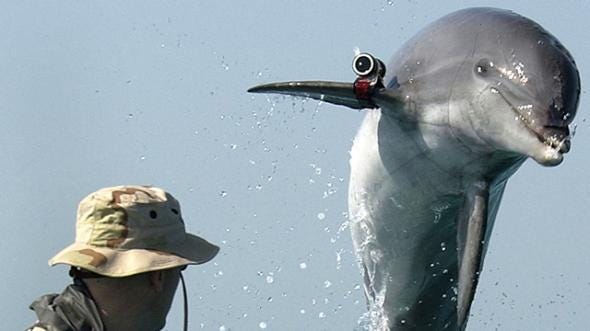
K-Dog, a bottlenose dolphin with Commander Task Unit 55.4.3, leaps out of the water while training near the ship USS Gunston Hall (Persian Gulf in 2003). Image credit : US Navy therefore Public Domain.
And it’s not only dolphins that are used — whales, seals and sea lions are also signed up. If you’ve seen dolphins in the wild (as I do on my boat almost every day) then you can appreciate their speed and agility, and their obvious ability to co-operate when trapping a shoal of fish. They are fast and smart.
Way back in 2016, The Slate reported that “Russian government announced it was looking to buy five combat dolphins: two females and three males, physically unblemished, and in possession of “perfect teeth.””
I’d heard that marine mammals were used in naval warfare, but knew little about it. So, I thought I’d investigate in a bit more depth — check the teeth, so to speak, as you do with a horse.
In April 2022 NBCNews reported that Russia had deployed dolphins to Sevastopol to help protect the harbour from Ukrainian saboteur divers.
This week I read a report that the Russians have increased the number of dolphin pens there from two to three following the Ukrainian seaborne drone attacks of October 29, 2022.
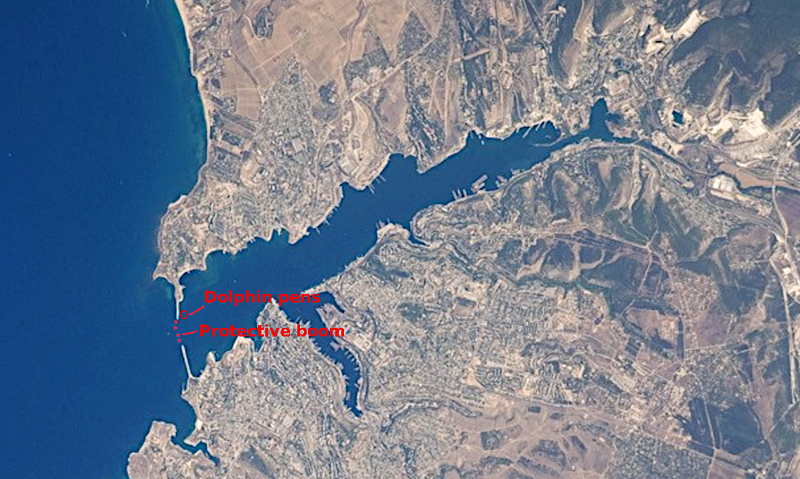
Sevastopol harbour satellite image. There are several other protective booms inside the harbour. Image credit: By This image was taken by the Nasa Expedition 20 crew. — NASA Earth Observatory, Public Domain, https://commons.wikimedia.org/w/index.php?curid=7641388; red overlays by Author.
Why use them?
The answers seem fairly clear: Intelligence, underwater endurance, highly advanced 3-D sonar (bio-sonar) and trainability.
On the other hand, I think that the news that one dolphin had been blown up would cause more fuss in the media than the news that one hundred Russians had been killed.
In the 1980s, the [US] Navy flirted with the idea of using dolphin guards to patrol the Trident nuclear submarine base in Washington. According to the Times, the dolphins would “detect possible saboteurs.” That plan was foiled by animal rights activists, who sued in 1989, blaming the death of one dolphin during training on the Navy’s allegedly cruel practice of making warm-water animals work in icy conditions in Puget Sound. The Navy settled the suit, agreeing to both suspend the project and stop taking dolphins from the wild. — The Slate
Echolocation (bio-sonar)
This is the outstanding feature that makes dolphins, whales and seals such ‘useful’ creature in naval operations.
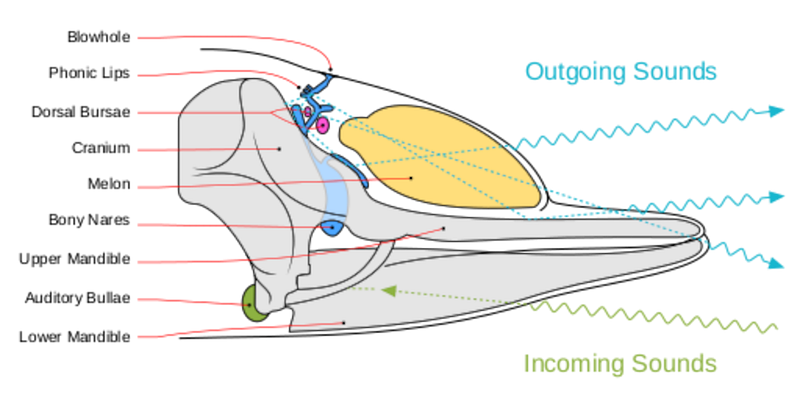
The emitted sounds are heard by humans as ‘clicks’.
… dolphins have the ability through echolocation to emit sounds with a frequency of 120 kHz and humans, with excellent hearing, can hear sounds with frequencies ranging from 20 Hz to 20 kHz. Even dogs and cats that have amazing hearing capabilities do not compare to dolphins. Dogs hear up to 45 kHz, and cats up to 65 kHz. — Dolphins-World
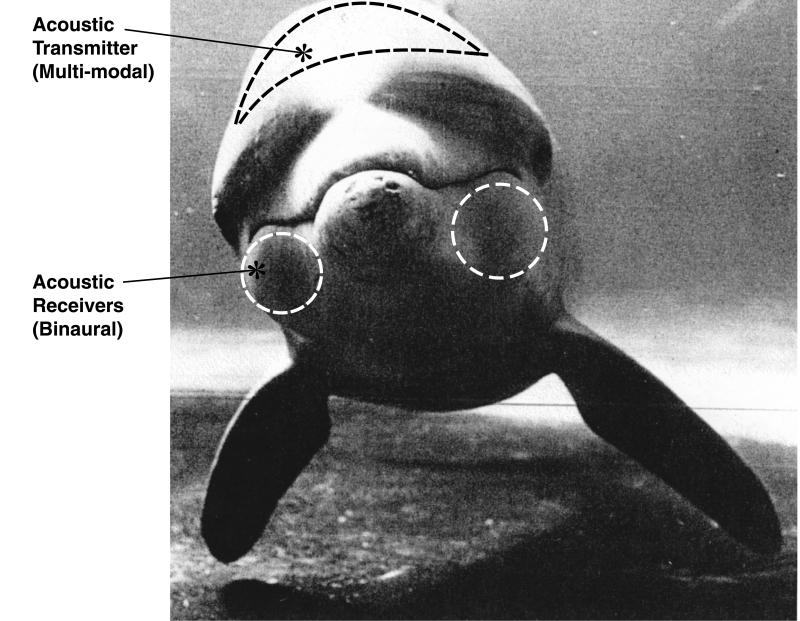
The returned sounds are received by the dolphin in two sensors (image link), giving them highly accurate distance, direction and target shape perception. So, they can discriminate between various types of fish and other objects.
It appears that the echolocation capability of bottlenose dolphins surpasses that of all other cetaceans, and man has a long way to got to get close the building a machine of that capability.
A bit of history
Business Insider reported that 50 sea lions and 85 bottlenose dolphins were being trained in 2015 at the Navy Marine Mammal Training Program, housed in California’s Space and Naval Warfare Systems Command (SPAWAR) in San Diego. Sources have stated that dolphins could and would never be trained to kill divers, but could mark their presence by releasing a buoy.
Russia started investing in marine mammal programs in 1965 after witnessing the U.S.’s success. It is entirely possible that Russia would attempt to train its war dolphins to kill enemy divers, but US commentators doubt that this would be possible.
However, there are stories circulating about the US training dolphins to butt a diver in the chest with a compressed air needle, creating an embolism (Business Insider).
Dolphins have been used during war. In 1970 and 1971, five of them guarded an Army ammunition pier in Vietnam’s Cam Ranh Bay, acting as watchdogs to deter NVA/VietCong saboteurs.
Dolphins were also used near Bahrain during the Tanker War, during 1984–88, a late stage of the Iran-Iraq war to protect US naval assets at anchor.
So, it seems that the most common use of dolphins is as marine watchdogs, although they have been used to assist in marine mine clearance in the Persian Gulf.
But what could Russia be up to, besides using them as watchdogs and mine detectors?
Parachuting dolphins
The idea of training airborne dolphins to parachute from 10,000 feet, sounds like cartoon stuff. But this is what ukdiving.co.uk reported:
But conservation campaigners have seen the evidence and heard the tale first-hand from the former Soviet naval personnel who trained the animals to ‘jump’ from heights of up to three kilometres to avoid detection. Other dolphin ‘soldiers’ were pitched directly from helicopters hovering at 50 feet above the sea.
‘If I hadn’t seen the evidence myself I just wouldn’t have believed it,’ says Doug Cartlidge, a dolphin consultant and front-line campaigner with the Whale and Dolphin Conservation Society (WDCS). He visited the highly secret naval base at Sevastopol on the Black Sea, home to the once-proud Dolphin Division, to advise trainers on alternative uses for their expertise and on care of the animals, now that both are surplus to military requirement. While there he was shown around the unit’s museum and saw a full-size model of a dolphin wearing a parachute harness. He also saw official documents which described the programme.
The Soviets were crazy enough to try anything.
Maybe their successors are too.
After all they were crazy enough to start another war.
A final question
Imagine a shallow-draught vessel travelling at 40 knots (~46 mph) as many USVs do — Forbes reported 50 mph for the Ukrainian USV which was used in the Sevastopol attack.
The fastest dolphins can swim, in bursts, at maybe 20 mph (estimates vary between 20 and 25 mph) and Wikipedia says 18 mph. That’s way short of the speed of a USV in a straight chase. But interception?
How would they know it was an enemy craft?
And they are very expensive to train and hard to replace, so a suicide dolphin doesn’t make sense.
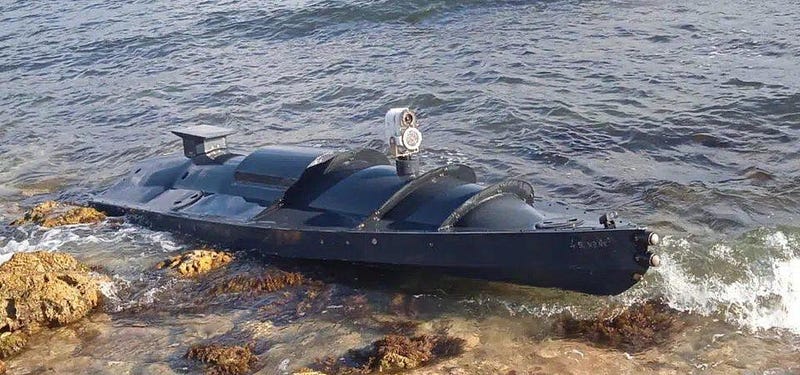
Ukrainian USV. Image via social media
I’ll leave this one with you:
‘How can dolphins be trained to protect against USVs (unmanned surface vessels)’?
Putin may offer a reward for good answers.
About me: If you follow me I guarantee variety in your inbox with some unusual perspectives! I write on a wide range of topics including humor, tech, space, geopolitics and travel, together with daily news events and the minutiae of my daily life living on a boat. Yes, I really do live on a boat (some readers don’t believe that). I also write about…
…the animal world of Vladimir Putin
If you appreciate stories like these and want to support other writers and me, consider signing up to become a Medium member. It’s only $5 a month, giving you unlimited access to incredible stories on Medium. If you sign up using my link below, I’ll earn a small commission at no extra cost to you.