War
Ukraine: Cognitive Warfare
The Ukraine invasion has added to the language of war yet again
Psy-ops have been used throughout history, with some of the earliest examples dating back to ancient China. Examples are also found in the Bible, and there is evidence that Julius Caesar used psy-ops during his military campaigns.
During World War II, psy-ops became a more formalized part of warfare, with both Allied and Axis powers using them in an attempt to gain an advantage. After the war, psy-ops were used extensively by the United States during the Cold War. Voice of America broadcasts were one of the most well-known examples of American psy-ops during this time.
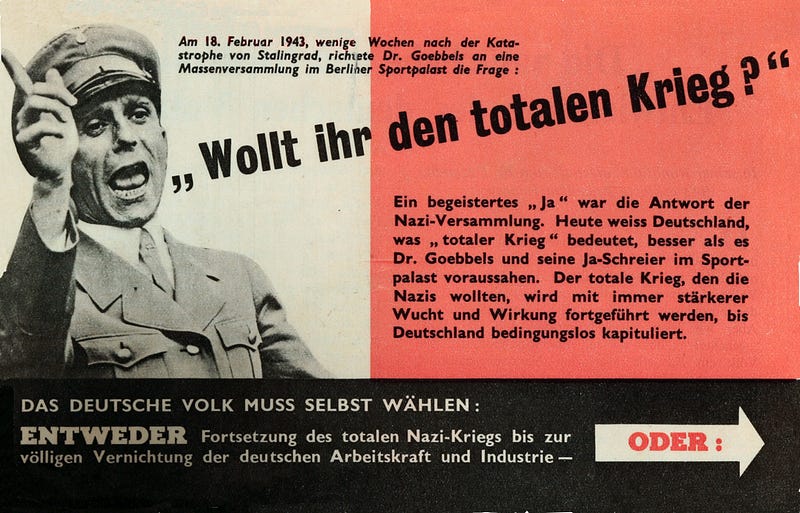
Above is a leaflet meant to be dropped onto a German city. This is an example of psychological warfare on the part of the US 8th Air Force to be dropped on German cities.
Let’s look at the evolution of the concept, from the early 20th century onward.
Goebbels
Joseph Goebbels was a German Nazi politician who was the chief propagandist for the Nazi Party, and then Reich Minister of Propaganda from 1933 to 1945. He is widely recognised as the one of the most skilled proponents, if not the founder, of modern psychological warfare.
It used to be called psy-ops with leaflets being dropped over Nazi-occupied territory in the Second World War. The basic message on that leaflet to the German population was
THE GERMAN PEOPLE MUST CHOOSE FOR THEMSELVES: EITHER continuation of the total Nazi war until German manpower and industry is completely destroyed OR [surrender]
On the other side Germany had the British traitor William Joyce, known as ‘Lord Haw Haw’, broadcasting nightly on the German radio programme ‘Germany Calling’ with a diatribe of mainly false information. But, as with all good lies, there were elements of truth.
But Goebbels’s greatest skill was in manipulating his fellow countrymen to harness them fully behind Hitler’s war machine.
The first Cold War
Then the First Cold War brought The Voice of America to East Germany and other Soviet states (I call it the First because commentators are recognising that we are now entering the Second Cold War).
As a student I occasionally listened to Radio Moscow, a source of amusement because of the slant that was was put on news events — or the complete ignoring of other significant events.
At that time most of us believed — perhaps with some scepticism — what out own media were telling us. But living in a ‘free country’ meant that we had access to other sources if information and viewpoints, such as The Morning Star (formerly The Daily Worker).
So, we could develop our own personal view of world events from the media and hope to arrive at a balanced perspective.
But the whole purpose of psy-ops is to tip that balance, whether in the populace or the armed forces, or both. And it can be aimed at the friend or the the foe.
And of course many countries cut off the other viewpoint.
Information warfare
Then in the computer age, with wide international public access to the internet (with some limitations e.g. in China and Mayanmar), it became information warfare. Some might say it has always been information warfare, but I do think that there is a distinction now that we can see stages in its evolution.
I see it as embracing cyberwarfare (a subsidiary activity) where attacks are digital in nature and where hacking is used to alter publicly available information or websites as well as disrupting, disabling or destroying enemy information and communication systems.
It also includes activities such as propaganda and disinformation, which are designed to influence public opinion and decision-making.
Information warfare can be used to achieve a variety of objectives, including damaging an opponent’s reputation, causing economic damage, or even sparking physical violence.
But then, so did psy-ops, but without the internet.
Cognitive warfare
Now a new name has joined the lexicon of war. ‘Cognitive Warfare’ recognises that there is a whole new subsidiary area of information warfare.
The keys are speed, widely available tools, cellphones and high levels of public access. The rapid dissemination of information and the ease with which it can be manipulated on social media has made cognitive warfare a very powerful weapon in the modern age.
In the Ukraine War we’ve seen social media used like never before.
Sometimes it’s hard to know what to believe.
Deep fakes, staged massacre scenes, staged ambushes — these are all new activities centred around influencing public (and armed forces) perception of a war.
The use of the ubiquitous cellphone with geo-tagging and time-stamping has changed the face of warfare. Drones too, and satellite imagery which can provide ‘proof’ of an event.
Was the Bucha atrocity real or not? I’m convinced it was, but of course Russia says it was faked. Maxar satellite images are used in support of its actual occurrence.
Indeed, cognitive warfare means that modern wars now have at least two major fronts — the conventional front line and the cognitive front line.
Here’s an example of enemy communications being used in a reverse-psychological way on a social media channel. It’s a strange post and I’m not sure what Ukraine seeks to achieve other than to demonstrate Putin’s almost total control of the minds of his own population. But not some of his troops. And of course I have no way of verifying it:
The text is:
In a new interception by the [Ukraine] Security Service of the occupiers’ conversations with relatives, the Russian tells his mother that they are killing civilians and children in Ukraine, but she does not believe him:
“No, you don’t kill civilians and children! … You kill fascists, damn it, trust me. So, quit whining”
There’s a full English translation (no, I didn’t verify this either) accompanying the video.
And so the fog of war has spread into a new environment.
We each have to make our minds up about the truth.
Make no mistake, we are each of us on one of the front lines or sitting on the fence in the fog.
Here on Medium I try to maintain a modicum of balance, but I have disseminated anti-Putin content on Twitter and Facebook and I’m not ashamed to say so. In reality my paltry efforts are not getting through to where they will count — in the hearts of the Russian people.
That’s because Russia has cut off Facebook and Twitter access for its people. I hope that’s message enough for the majority of them.
During WWII it was not illegal to listen to ‘Germany Calling’ in the UK, but in Germany it was illegal to listen to the BBC news. That is an important distinction, apparent today in Russia.
I think of those Russians I met in St Petersburg, Moscow, Krasnodar, Novkuznetsk and a whole lot of other places I worked in during the ’90s and I wonder. What are they thinking about all this?
Cognitive warfare. We’ll hear a lot more of those words.
And in China too.
In fact, anywhere there’s a dictatorship or a suppressive regime.
About me: If you follow me I guarantee variety in your inbox! I write on a wide range of topics including humor, tech and travel, together with daily news events and the minutiae of my daily life living on a boat. I also write techno-thrillers…and about…
…being in the the fog of war, but not on the fence
If you enjoy reading stories like these and want to support other writers and me, consider signing up to become a Medium member. It’s $5 a month, giving you unlimited access to incredible stories on Medium. If you sign up using my link below, I’ll earn a small commission at no extra cost to you.