Geopolitics
Ukraine and the Porcupine Strategy
Ukraine has demonstrated this in action, with finely-tuned tactics, new weaponry, social engagement and a whole-population army
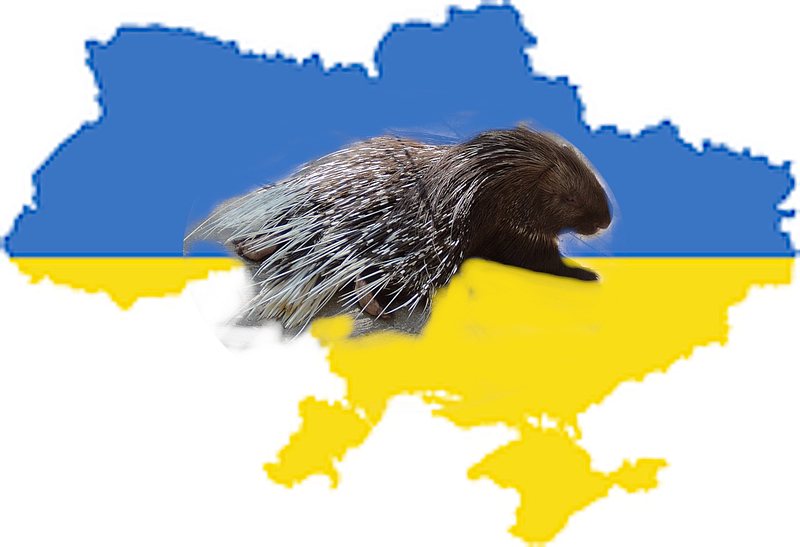
.PNG/180px-Ukraine-Stub-Map_(Renovated).PNG)
There’s a lot of talk these days about geopolitical strategy and one of the key concepts in geopolitics is the “porcupine strategy.” Basically, this is the idea that if you’re a small country surrounded by larger enemies, your best defense is to make yourself as prickly and hard to conquer as possible.
The Porcupine strategy
The porcupine strategy is based on the idea that if you make yourself hard to conquer, then your enemies will think twice before attacking. This can take many forms, such as building strong defenses, having a large and powerful military, developing nuclear weapons, or maintaining alliances with other countries.
All of these strategies are intended to make the country unappealing — and too difficult — for potential adversaries to consider invading.
Throughout history, there have been numerous examples of small nations successfully employing the porcupine strategy to ward off larger powers.
One of the most notable examples is Switzerland’s neutral stance during World War II. Although surrounded by Axis powers on all sides, Switzerland managed to remain independent and sovereign thanks to its well-trained army and its strict policy of neutrality. It was never attacked. Many would say that a neutral country is a necessity for all sides during a war, for political, economic and, let’s face it, state criminal reasons. Switzerland filled that role (as did other countries such as Uruguay).
Its people prospered. Switzerland does not have an outwardly aggressive political stance.
Another example is North Korea’s seventy-year stance towards the United States and the West. Despite being much smaller and less powerful than its adversaries, North Korea has successfully deterred military action by building a strong conventional army, developing nuclear weapons, and intercontinental ballistic missiles. It has an active cyber crime coterie to help finance all this in the face of severe economic sanctions and stays on the front foot with an aggressive stance towards the West.
Its people are, in general, nothing other than brainwashed slaves and the country’s political stance is nothing but pugnacious.
Is Porcupine still relevant?
Does the porcupine strategy still make sense in today’s world?
Some observers take the view that while it may have been effective in certain historical contexts — such as Switzerland’s neutrality during World War II — it may not be as useful today due to the global nature of modern warfare.
For one thing, a country can no longer rely solely on its own defenses to protect itself; instead it must also form alliances with other nations and build up international support if it hopes to remain sovereign. Even North Korea has alliances with other countries.
Additionally, the proliferation of nuclear weapons has drastically changed the power dynamics between countries, making them more unpredictable and creating more potential for devastating outcomes.
So, in a way, it depends how you define the porcupine strategy. Even porcupines have symbiotic relationships.
And the Ukraine War has redefined the Porcupine Strategy.
Ukraine and the Porcupine Strategy
Alliances
It has formed strong alliances with
- the EU
- NATO
- many other countries which are not members of those political/military blocs
These alliances combined with an effective diplomatic onslaught have enable Ukraine to instigate what is probably the most severe sanctions regime against a major state in world history — without those allies being directly involved in the war as combatants.
Social media
Ukraine has fought an outstanding social media campaign and completely dominated the information space relating to the war, at least in the free world.
Within Russia, the state media and social media organs dominate, but nevertheless those have been hampered by Russians’ access to VPNs and apps such as Telegram which have proven hard for Russia to control despite trying to establish a Russian splinternet. The state organs have also been hampered by Ukraine’s cyber army…
Cyberwar
Very early in the conflict Ukraine created an IT Army. This army encourages non-Ukrainians world wide to join the cyberwar assault on Russia, with published target lists and downloadable toolsets.
The IT army and other loosely-associated groups such as Anonymous have been able to hack into Russian state media:
A fully engaged public
There is little argument that the Ukraine public is fully engaged in the war against Russia.
From making Molotov cocktails in the street to teens using their drones to spot Russian targets, the engagement is outstanding.
Smartphone apps
The success of this engagement can be put down largely to Mykhailo Fedorov, the Minister of Digital Transformation. He introduced the Diia web portal through which almost all government services are delivered.
Diia is a portal and application that allows users to receive public services online. More than 70 public services are available on the portal, 15 digital documents and 23 services in the application, including the world’s first official digital passport. The number of users reached 19.4 million of Diia web portal and 18 million Ukrainians of Diia application, respectively. — Wikipedia
There are many other apps, such as the eVorog chatbot on Telegram, novel targeting apps for artillery gunners, war-crime reporting channels.
Weaponry and military tactics
With the widespread use of small, cheap drones for surveillance and offense, this is a war like no other. The sheer inventiveness of Ukraine’s technologists and military command has made governments world-wide sit-up and study the war and the success so far of Ukraine’s forces against an apparently overwhelming adversary.
And last, but not least…
Leadership
Vlodymyr Zelenskyy has emerged as a leader of the kind only ever seen once in a generation. Inspirational, with no typical political background or suggestion of corruption, he has left the comedy stage to become the complete antithesis of Putin.
He has galvanised the world of statesmen and diplomats and is arguably Ukraine’s most powerful weapon.
Not all countries which adopt a Porcupine strategy have such leaders — just think of North Korea’s Kim Jong-un.
But did it work?
Ukraine’s porcupine strategy (if indeed it was consciously employed) clearly did not work. Russia invaded, starting in 2014 with the annexation of Crimea. Russia was not deterred.
And then came the major attempt to overwhelm the whole of Ukraine in 2022.
Did the strategy fail because Ukraine was not sufficiently prickly, because they did not make their spines clear?
Or because Putin’s arrogance and dream of another Russian reich overwhelmed his common sense? Maybe he misjudged the free world’s determination to rebuff him.
We’ll never know — he’s unlikely to write his memoirs, is he?
The world is watching
Ukraine has thoroughly demonstrated its prickliness.
And North Korea is watching. There is very little scope for more international sanctions to be enacted against North Korea. The peninsula is almost on a hair-trigger.
And China faces Taiwan - another Porcupine, although in a different geopolitical context with complex issues about political legitimacy.
As they face-off across the Taiwan Strait, both China and Taiwan are learning from the Ukraine War.
Sun Tzu and the Porcupine
I used to think that Sun Tzu had said all there was to say about war over 2,000 years ago. As far as I recall he did not specifically cover the porcupine strategy although the underlying principles can be seen in his writing.
As I wrote earlier, the porcupine strategy is based on the idea that if you make yourself hard to conquer, then your enemies will think twice before attacking.
They might think twice, but it doesn’t necessarily stop them.
About me: If you follow me I guarantee variety in your inbox with some unusual perspectives! I write on a wide range of topics including humor, tech, space, geopolitics and travel, together with daily news events and the minutiae of my daily life living on a boat. Yes, I really do live on a boat (some readers don’t believe that). I also write about…
…prickly defenders seen from my amateur geopolitical armchair
If you appreciate stories like these and want to support other writers and me, consider signing up to become a Medium member. It’s only $5 a month, giving you unlimited access to incredible stories on Medium. If you sign up using my link below, I’ll earn a small commission at no extra cost to you.
Or maybe just buy me a coffee? and tell me what you liked reading (or not) in a story comment…