
Uganda’s Researchers Are Using AI Technology To Reduce Air Pollution
It’s all started with one man’s vision to breathe clean air and live longer. His name is ‘Engineer Bainomugisha.’ An Associate Professor of Computer Science and the Chair of the Department of Computer Science at Makerere University.
Engineer Bainomugisha was always fond of making human lives better using modern technology and science. He started to work on a mission with his students and a team in 2015 to improve the quality of air.
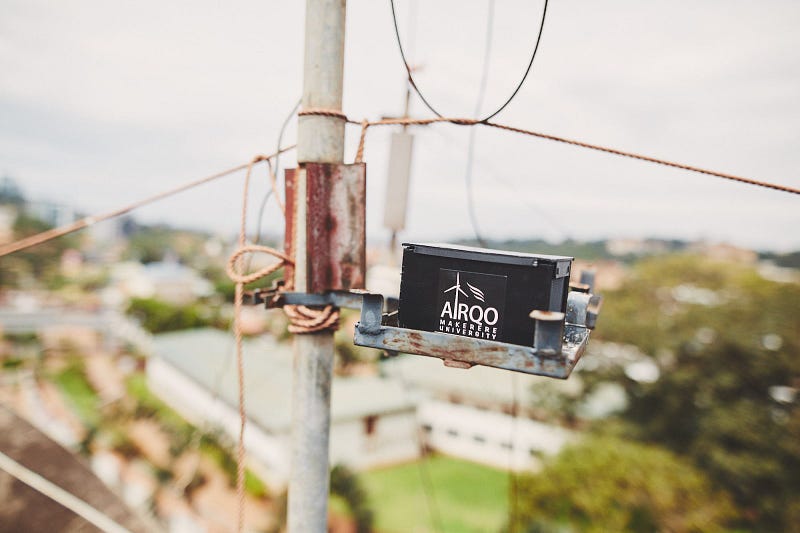
He believes the very first step towards improving the quality of air is to be able to monitor the air. He used small boxes which consists of sensors to monitor the air quality in Kampala, Uganda. These boxes are called ‘Air Monitoring Units’.
Google Helped Him, and Later They Became Official
It all took it-off for Bainomugisha. When they got a grant from Google AI Impact Challenge.
In 2019, Google.org awarded 25M grant to 20 organizations using AI to solve their communities’ problems.
After the access to this grant, engineer Bainomugisha was able to manufacture more of these ‘Air Monitoring Units’ and install them in different parts of Kampala.
Later they built a network with the help of these monitoring units. In 2020 Feb, AirQo was officially launched in Kampala. This app would help common people access the air quality index throughout the city and help them decide to stay in a cleaner air environment.
Let’s Talk About AirQo:-

All the data is driven to AirQo are by small air units which were installed across the Uganda streets. So far, 80 installations of air monitoring units have been set up throughout Uganda.
These units analyze the quality of air using the small sensors within the box. The main purpose of these ‘Air Monitoring Units’ are:-
- Calculating the external temperature humidity
- Calculating air pressure
- Sharing the data
These units are made of low cost sensors and the whole unit works on solar power. This was done to make monitoring units more accessible to the regions with no access to electricity. The important part of this whole unit was the ‘Sim Card’ which is meant for networking because sim cards would help them transfer real data.
Later Artificial Intelligence(AI) helps them drive data based on real-time insights and share it through different networks where common people can access. Thus, by having access to such data via AirQo, people can get to know about their surroundings air quality index.
AirQo shares the whole map of the town and indicated where the sensors are placed. People can tap on the map and look at the air quality of a particular region just by using their phone.
How’s AirQo Doing Now?
Since AirQo works on AI assumptions based on the real-time data. Engineer Bainomugisha believes that making people aware of air quality index and leading them to take actions which will result in a change in environment
Collectively smaller actions will lead us to a cleaner and safe environment.
AirQo had been successfully able to launch awareness campaigns in the streets of Uganda. It recently stated that the Kampala air quality index had been improved to 40% during the lockdown.
The aim of ‘Engineer Bainomugisha’ is to monitor and tackle air pollution across Africa.


