A Trail of the Saucers Investigation
Some of those UAPs are out of this world — and the Pentagon Knows It
Private emails published by Wikileaks — written by a former IT contractor and sent to Clinton/Obama insider John Podesta — refer to American tracking of UFOs arriving from ‘deep space.’
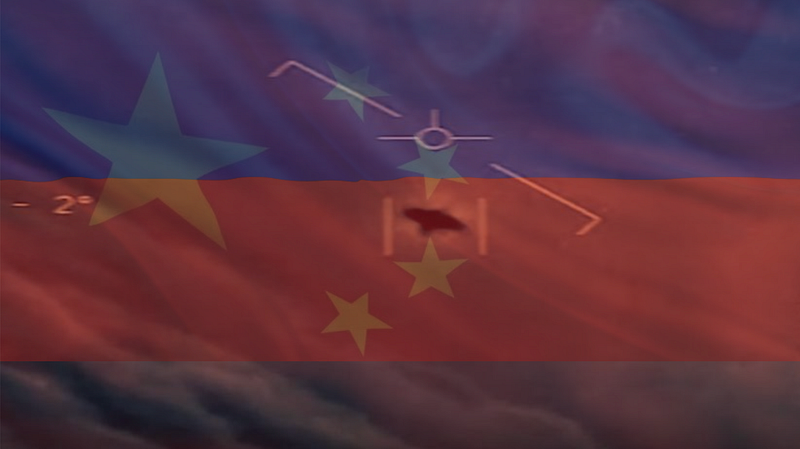
The recent U.S. government report on UAPs and comments from current and former intelligence officials repeatedly fall back on the refrain that those ‘Tic Tacs’ and other mysterious objects buzzing Navy warships may be advanced aircraft built by Russia or China.
They say that — but they know it’s not true.
In yet another example of a UFO puzzle piece hiding in full view and ignored by the mainstream media, emails published in 2016 by Wikileaks refer to regular tracking of UAPs that’s allegedly recorded them arriving from “deep space” and disappearing beneath the Atlantic Ocean off the coast of Florida.
The emails — between Hillary Clinton’s former campaign chairman John Podesta and former IT contractor Bob Fish — were publicly available in 2016 as reporters Leslie Kean and Ralph Blumenthal were working on a story for the New York Times disclosing that the Pentagon had been secretly studying UFOs for the past decade. However, neither that groundbreaking article, nor any subsequent reporting on the phenomenon by other mainstream media outlets has mentioned the Podesta-Fish emails.
While it’s possible to deduce some reasons for that, first let’s take a closer look at Podesta and Fish and then at the emails themselves.
The Players
John Podesta
John Podesta is a familiar name amongst ufologists and in political circles, although less so to the general public. The 72-year-old Democratic political operative served in the White House under Presidents Bill Clinton (as Chief-of-Staff from 1998–2001) and Barack Obama (as Counselor from 2014–15).

Podesta served as Hillary Clinton’s campaign chairman in 2016, although it was the misfortune of having his emails hacked and subsequently published by Wikileaks later that year that elevated his public profile. He has also long been interested in UFOs.
For years, Podesta has called for the government release of UFO files, even going so far as to declare early in 2016 that he’d convinced Hillary Clinton to declassify as many files on the phenomenon as possible. Podesta has also been a supporter of Kean’s investigative work on UFOs; he wrote the forward to her 2010 book.
Bob Fish
Podesta may be the marquee name, but it’s the emails sent to him by the lower-profile Bob Fish that are significant. His professional credentials are impressive. He spent most of his two years in the U.S. Marines on active duty in Vietnam, where he was a shift supervisor for the USMC’s Western Pacific data center. He was honorably discharged in 1971, but remained in the information technology field.
In 1984, Fish was hired by Network Equipment Technologies. Two years later, he started a division within that company to work on federal government projects, most notably the White House Communications Agency under Reagan. His LinkedIn page, which includes his resume, indicates that Fish was the “Director of Advanced Programs” from 1988–1993, “managing a highly classified, global network” for a major (but unnamed) DoD intelligence agency.
Enter Wikileaks
On October 7, 2016, within hours of the Washington Post publishing the now infamous Access Hollywood tapes that featured Republican candidate Donald Trump speaking lewdly to program host Billy Bush about women, Wikileaks jumped into the fray, publishing thousands of emails from Podesta’s personal Gmail account.
Given the circumstances, attention focused largely on the timing of the leak, how Wikileaks had come to possess the emails, etc. To the extent that media reported on the content of the emails, the focus was on those that related to Clinton’s campaign and policy positions. Beyond UFO researchers, few paid any attention to Podesta’s intriguing exchange with Fish.
There was at least one exception: More than a year later, a reporter for the Tampa Bay Times in Florida mentioned Podesta’s emails parenthetically in the context of a story about a reported UFO sighting near MacDill Air Force Base — but he downplayed their content. Fish got his name in the paper, but he was simply “a man named Bob Fish,” without the context of Fish’s history of IT contract work on classified projects for the federal government.

With that background, and given what we’ve learned now about the Pentagon and UFOs, the Podesta emails take on new significance.
On the evening of March 5, 2015, Fish wrote to Podesta from his Earthlink account. Based on “significant personal experience,” he said, “I can attest that UFO hunters are looking in the wrong places. Random personal observations, fuzzy photographs, and crop circles will never ‘prove’ the existence of anything, especially since UFO appearances to humans are transitory and somewhat related to the observer’s state of mind.”
What was needed, he continued, was “hard scientific data collected from instruments that are known to be accurate and reliable.” Which, he added, was available “if one knows ‘where to look’ and ‘what to look for.’”
Podesta thanked Fish by email within hours, indicating that he’d not be able to follow up immediately, but that he would keep Fish’s contact information.
‘Tuck this in your UFO files’
Fish, however, didn’t let it go.

He went on to claim that the federal government does collect hard UFO data with its Defense Support Program (DSP) satellites, which have orbited Earth since the 1970s. The U.S. Air Force describes these as “a key part of North America’s early warning systems” by detecting missile launches, space launches and nuclear detonations.
What Fish says next aligns with his own LinkedIn resume: While working as a government contractor in the early 1990s, he was “involved in several ‘national interest’ activities such as Desert Storm/Desert Shield and Operation Just Cause.” His email continues:
“While I was never fully briefed into the DSP operation directly, I was introduced to them as the US prepared for Operation Desert Shield and Desert Storm. On occasion, I had lunch with a few of them in the cafeteria of a highly classified organization in El Segundo, CA. No one could get into the cafeteria without TS/SCI clearances, so this was not “lightweight group of gossipers.”
One of these times, a member of that group was really excited — said they’d just picked up a Fastwalker (I assumed that same day). He described how it entered our atmosphere from “deep space” (origin actually unknown, of course, but from the backside of the satellite) and zipped by the DSP satellite pretty closely on its way to earth. Not only was it going very fast but it made a 30 degree course correction (turn) which means it did not have a ballistic (free fall) reentry trajectory that a meteorite might have. So, it was under some sort of control — although whether it was “manned” or just “robotic” there’s no way to tell.”
‘Fastwalkers’
We’ll get to Fish’s next email in a moment, but it’s worth pausing here to note that the high-altitude tracking of ‘Fastwalkers’ has been reported elsewhere, albeit in not as prominent a platform as Wikileaks.
Jacques Vallee, the famed French ufologist who was the inspiration for the scientist Lacomb in Close Encounters of the Third Kind, has written many books on UFOs. Not as well-known is this fact: He’s also published memoirs — four thick volumes of them covering the years 1957–1999.
In the third volume, Forbidden Science 3: On the Trail of Hidden Truths, Vallee has an intriguing entry written in Palo Alto on July 20, 1980. By this time, Vallee — a computer scientist and Silicon Valley investor — was deep into his UFO research and was well-connected.
The entry below refers to two people: Dr. Christopher “Kit” Green, who worked in the Central Intelligence Agency for 20 years, and Tom Deuley, a retired Naval officer who would go on to be active with the Mutual UFO Network (MUFON). Vallee has this to say:
Kit and Deuley have access to reconnaissance satellite data. They can now check for the presence of objects within 10 days of a sighting. The satellites of VELA-10 type have repeatedly caught what experts call “FastWalkers,” erratic sources of energy. These may represent previously unknown electrical phenomena, or perhaps UFOs. My clearance is still active, so I could see the images if the need arises.”
‘UFOs had a landing and takeoff spot’
Fish wrote Podesta another email the next day, March 6. Reading some UFO material online had jogged his memory about another incident, which he says took place in the cafeteria building in El Segundo:
“I had lunch with a senior USAF NCO who had worked for Project Blue Book in the 1970s (after it had been “officially disbanded). He was an ELINT technician (electronic intelligence) who flew in RC-135s from MacDill AFB in Florida. The ‘normal’ target was Cuba where they did lots of snooping and sometimes challenging the Cubans to turn on radar and other systems.
He said there were times when they were diverted from these missions to track UFOs off the east coast of Florida. His claim was the UFOs had a landing and takeoff spot in the ocean east of Miami, north of Bermuda. He also claimed there was a specific electronic signature (frequency) emanating from them when they were going into or coming out of the water, so they were easy to track. On several occasions they filmed the UFO as it transitioned from water to air or vice versa.”
Fish goes on to note that this same individual was occasionally assigned to fly in a USAF weather aircraft during “hurricane-hunting” missions over the same area where UAPs were, by then, known to enter and emerge from the ocean.
“His specific assignment was kept secret from the other crew members. He would always report back to a dedicated USAF intelligence officer on base when they returned from a mission. He did not know where the intel that he collected was sent for processing or storage … (h)igh quality film of UFOs is ‘out there’ somewhere!”
Fish reaches what seems a reasonable conclusion from that tidbit: If what the person told him was true: “Blue Book was not disbanded — only the outer layer of the onion (the “public information layer) was stripped away in 1970.”
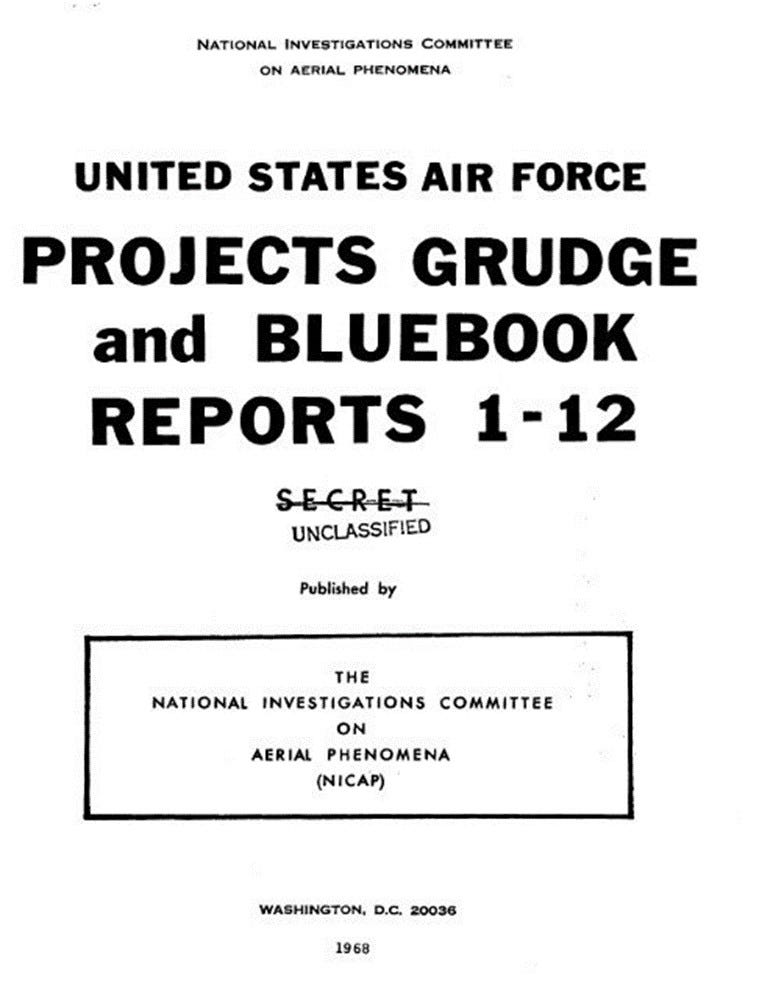
The point merits repeating, or perhaps rephrasing: While the Advanced Aerospace Threat Identification Program headed by Luis Elizondo may have started in 2007 (and supposedly wasn’t looking at any UAP cases earlier than 2004) it’s clear from Fish’s emails and Vallee’s journal entry that after Project Blue Book was shut down in December 1969, the U.S. Air Force remained in the UFO business.
Lacking a complete declassification and release of all UAP files and free, unrestricted tours of Area 51, it may be a fool’s errand to unravel the full scope of what exactly American officials do know about UAPs, but one thing is clear: They know that at least some UAPs are not from China or Russia.
The Role of the Press
So where is the mainstream news media in all this? When emails from well-placed sources describing USAF tracking of UFOs from deep space land on the Internet, why didn’t reporters make inquiries?
In 2016, the answer seems easy enough: Even if — in the midst of a heated presidential campaign featuring (to put it charitably) a “colorful” candidate — a reporter had noticed the UFO references (to say nothing of those linking Podesta and a four-star general with disclosure activist Tom DeLonge, of all people) the “tin-foil hat” stigma associated with even pitching a serious UFO story to an editor or TV news producer would have nipped the idea in the bud.
With the 2017 New York Times revelations about the AATIP and subsequent reporting, it would seem the stigma has finally started to wither and die — deservedly so. But one might ask: If this information was available on Wikipedia in 2016, why did journalists who were deep into reporting a story about the government studying UFOs not include the Fish material in their articles?
There is no question they knew; Kean herself was already in touch with Podesta and was copied on several of the emails. She responded to Podesta on March 7 of that year: “Another confirmation of yet more documents kept from the public. This knowledge belongs to the people under the law!”

As a journalist who has spent most of my life in newsrooms, I would offer an observation in Kean’s defense: The New York Times editing and fact-checking process, in which editors and reporters haggle over what information will and won’t appear in a story, is legendarily rigorous. In even touching the subject, the Times knew they were going out on a limb; on this story — especially on this story — there was literally no room for error; they had to be right about everything.
My guess: The Podesta emails — these ones, at least — and the allegations in them didn’t make the cut because the information was second-hand from unknown sources: A former IT contractor declares that some unnamed individuals told him something juicy nearly a quarter century ago, and that he overheard others (whose names may not even have been known to him) who said something else. Kean or Blumenthal could easily have called Fish (and perhaps they did) but what would have been the point? The chances of learning the identities of the people he was referring to — and then tracking them down and getting them to confirm it — were close to zero.
They already had their story, and plenty of sources who were ready to go on the record. Journalistically, they made the right call.
Epilogue: A Story in ‘Plain Sight’
The tectonic shift in the mainstream media’s approach to the UAP phenomenon we’ve seen in recent years is ongoing.
Reporters are starting to wake up and realize they’ve unwittingly, but willingly, participated in what UAP Disclosure activist Steve Bassett justifiably calls the government’s “truth embargo.” Sections within the American defense and intelligence communities have known for 70+ years that UFOs are real, that E.T.s, or some non-human intelligence, are engaging with humanity. But they’ve spent most of that time lying about it, publicly insisting that there’s no “there” there— and journalists went along with it. Meanwhile, ufologists forged ahead and did the digging for them.
But now some of them are digging on their own, and not just in the United States.
Ross Coulthart Weighs In
Ross Coulthart, one of Australia’s investigative reporter heavy-hitters, is now on the case. Later this month, he has a book on the phenomenon coming out (on Kindle first, then hardback by Harper-Collins later this year): In Plain Sight: An Investigation into UFOs and Impossible Science. The title reflects what is clearly astonishment on his part that journalists have declined to follow up on the pieces of the UFO puzzle available to anyone who cared to look.

Coulthart is no slouch. A member of the International Consortium of Investigative Journalists, Coulthart is an award-winning reporter who has covered intelligence issues, medical scandals, organized crime and even war crimes for both print and broadcast outlets, including Australia’s equivalent of 60 Minutes. Earlier this month, he spoke at length with Bremerton, Wash.-based podcaster Zac Cichy, who recently launched a Patreon-funded program called Project Human. The episode is a must-listen for any journalist covering — or is still skeptical about — the UAP story.
“A large section of the mainstream media is still fast asleep at the wheel,” he told Cichy. “They haven’t woken up to the awesome significance of this. Because I’ve stuck my neck out a little bit, I’ve had phone calls from well-known journalists on very well-known masthead newspapers, TV networks across the world in the last few weeks, and there is this kind of nervous conversation, where they go, ‘Ross, do you really think there’s something to this?’ And I say, ‘Yes, there is!’”
Repeated assertions by former AATIP head Elizondo and former Deputy Assistant Secretary of Defense for Intelligence Christopher Mellon that foreign adversaries might be behind UAPs have taken on an increasingly tired and obligatory character. They know perfectly well that Russia and China have nothing to do with this, but their non-disclosure agreements forces both men to perform a semantic dance around the E.T. question that has started to vaguely resemble something akin to a hostage video. Even so, candor does occasionally slip through, as happened a couple weeks ago when CNN’s Jake Tapper asked U.S. Sen. Mitt Romney for his take:
“I don’t believe they’re coming from foreign adversaries,” Romney replied. “If they were, why that would suggest that they have a technology which is in a whole different sphere from anything we understand, and frankly China and Russia just aren’t there, and neither are we, by the way.”
He said this on CNN. In plain sight.
Trail of the Saucers is published by Stellar Productions and Bryce Zabel, the co-host of the popular new podcast Need to Know with Coulthart and Zabel.