Ubik, God of Artifacts
Sculpture, Graffiti, Tattoos: Philip K. Dick’s Spray Can in the Physical World
- Things I Can Safely Say About Ubik
After so long, there are a few things I feel I can safely say about Ubik. I don’t mean that Ubik makes me feel unsafe, only that Ubik has shown a tendency to flow beyond its seeming boundaries— and, therefore, that general statements about Ubik are difficult to make with confidence.
Let’s begin at the beginning: Ubik is a spray product with the power to reverse entropy. This is a big deal. Ubik doesn’t reverse entropy everywhere all at once (how absurd it is that I’m already needing to make this specification!); its action is limited and local. Yet its power is still quite awesome. You merely have to spray some Ubik over an object, or a person, in which entropic decay has set in. The decline is reversed. The object migrates backward, against the tide of time’s degradation, and is replenished.
Ubik’s name is short for “ubiquity”. Ubik might be described as “God in a spray can”.
Ubik was introduced into our universe by the science fiction writer Philip K. Dick, in his 1968 novel Ubik.
In Dick’s novel, Ubik is a commercially available product available on the shelves of stores. Alas, not everywhere. In the story it can be quite difficult to get hold of.
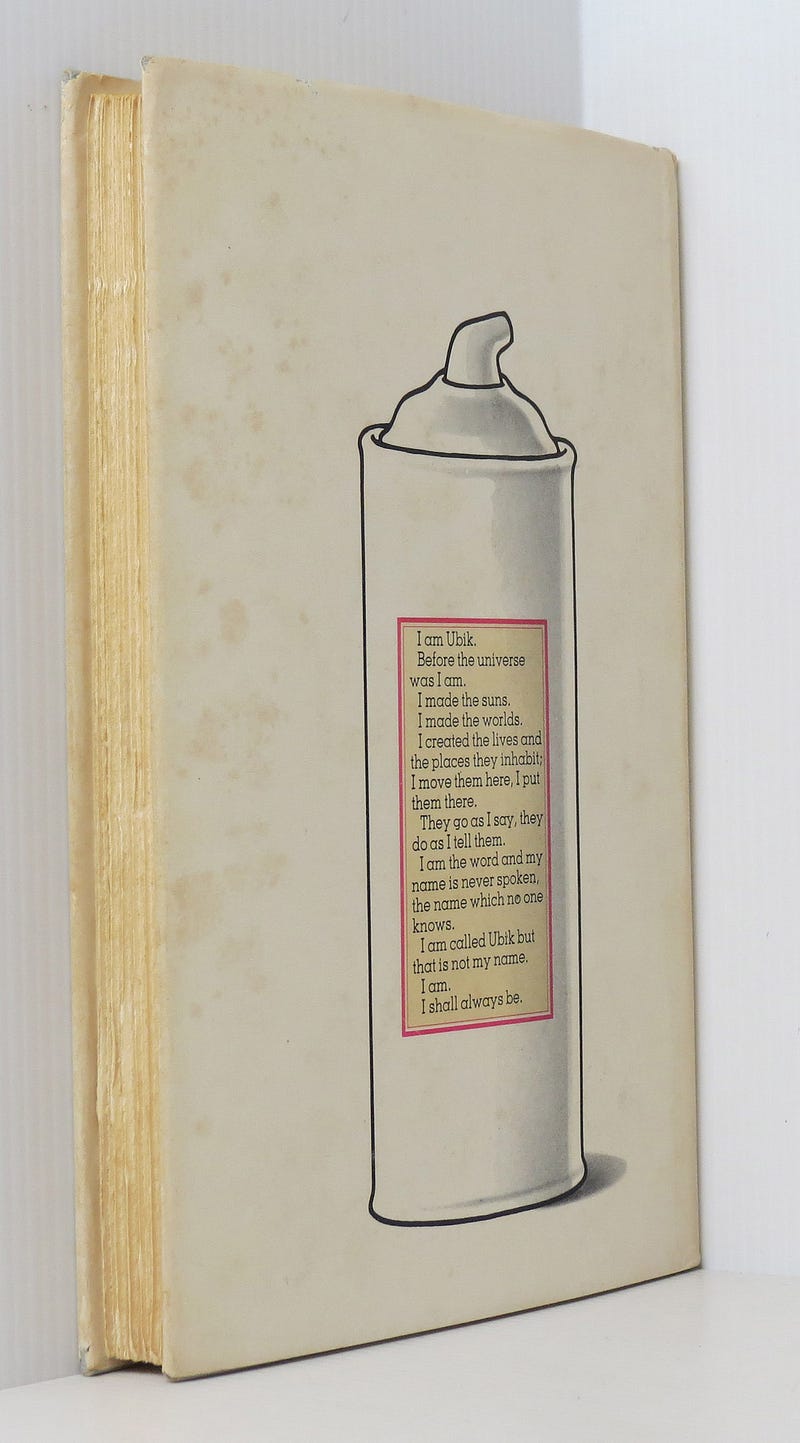
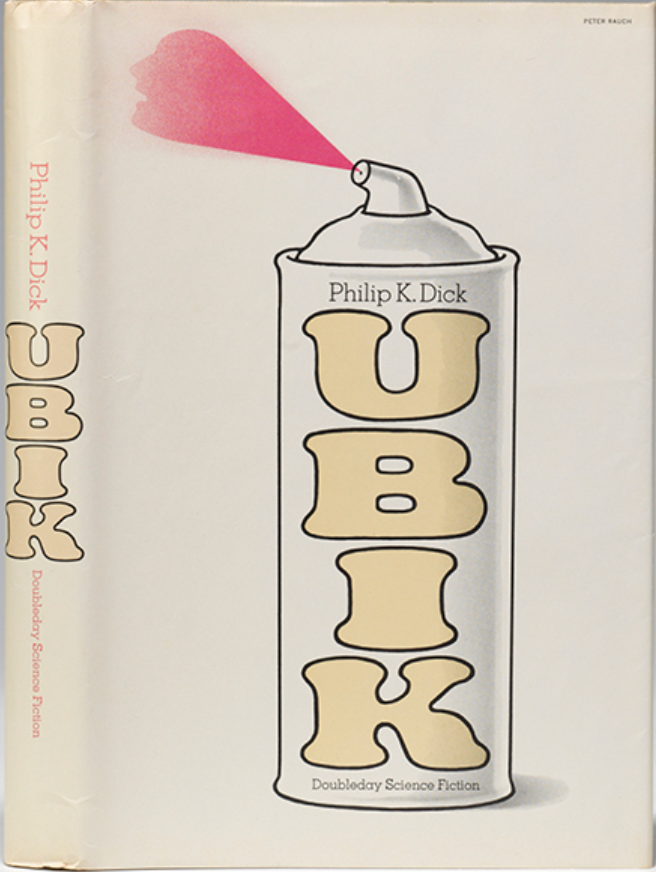
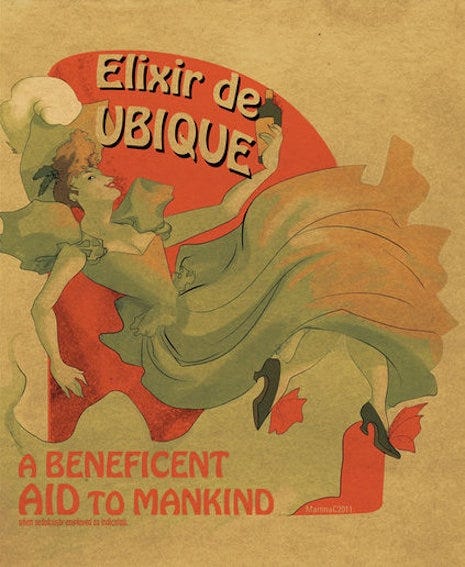
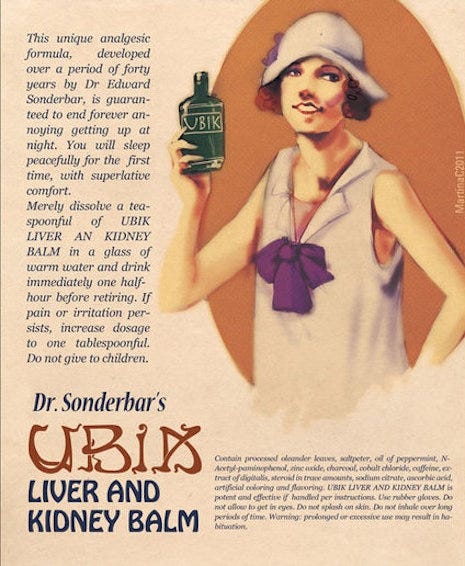
According to the book, in earlier eras Ubik was sold as an elixir or a balm. However, in the book’s present (a future set in 1992!), it is sold in an aerosol spray can, as depicted above.
There’s plenty I could say about the novel Ubik; some of it I’ve already said, elsewhere. For most of my life it’s been my answer to the question, “What is your favorite novel?”
I even wrote a poem addressed to the novel. Here it is:
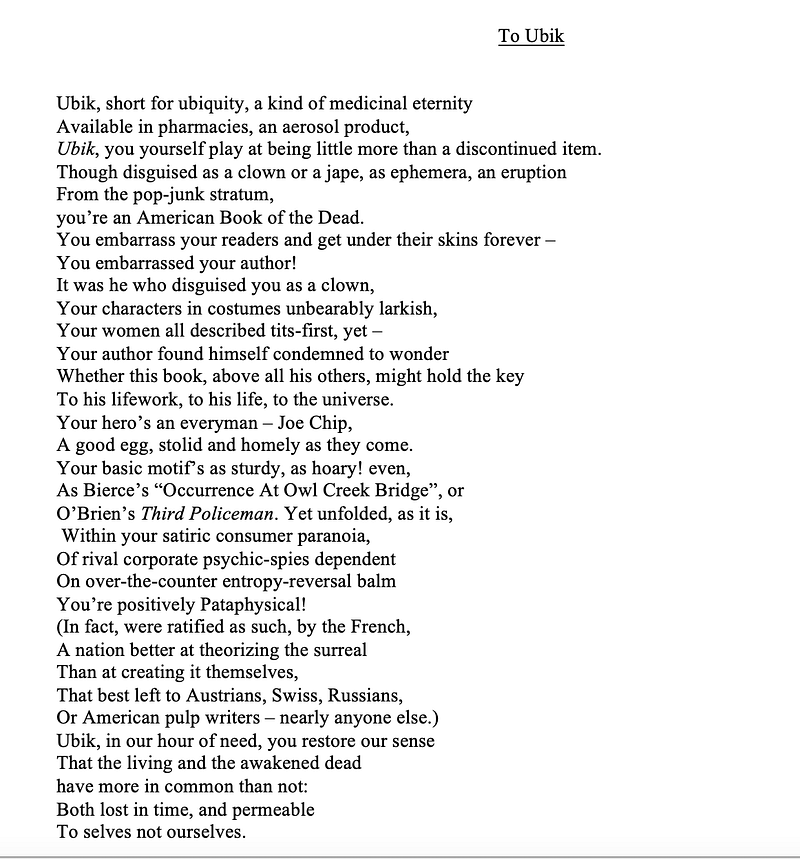
But right now I want to talk about Ubik’s tendency to manifest outside Dick’s text. It tends to do that.
Ubik, in my opinion, wants to exist. This is in its nature.
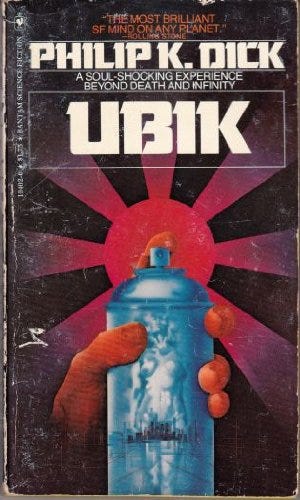
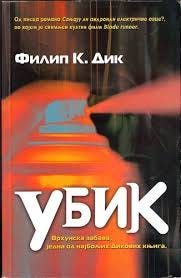
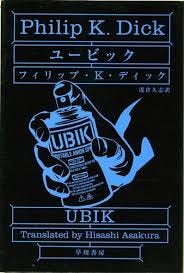
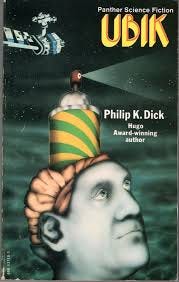
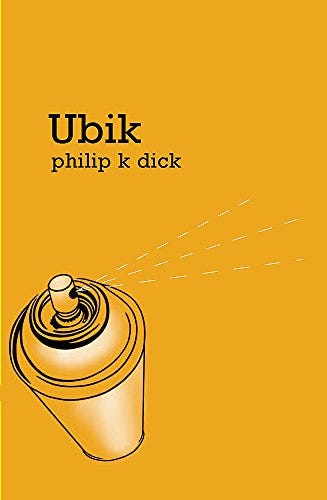
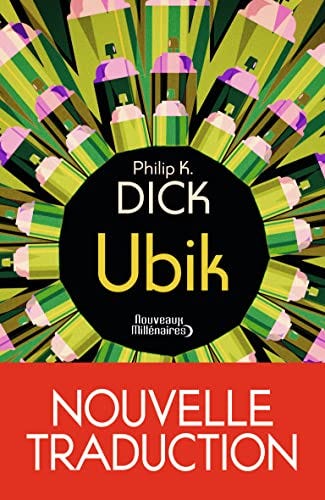
2. Philip K. Dick and Graffiti
Graffiti appears twice in Dick’s novel. Characters go into a bathroom and are confronted by the following scrawled couplets, which are both scatological and ontological:
“Jump in the urinal and stand on your head/I’m the one that’s alive. You’re all dead.”
“Lean over the bowl and take a dive/All of you are dead, but I am alive.”
Neither are described as being written in spray-paint, but the juxtaposition of bathroom graffiti with the emblem of the aerosol can seems to have given a cue to graffiti writers. The letters U-B-I-K are quite spray-ready. Start looking and you’ll see them everywhere.

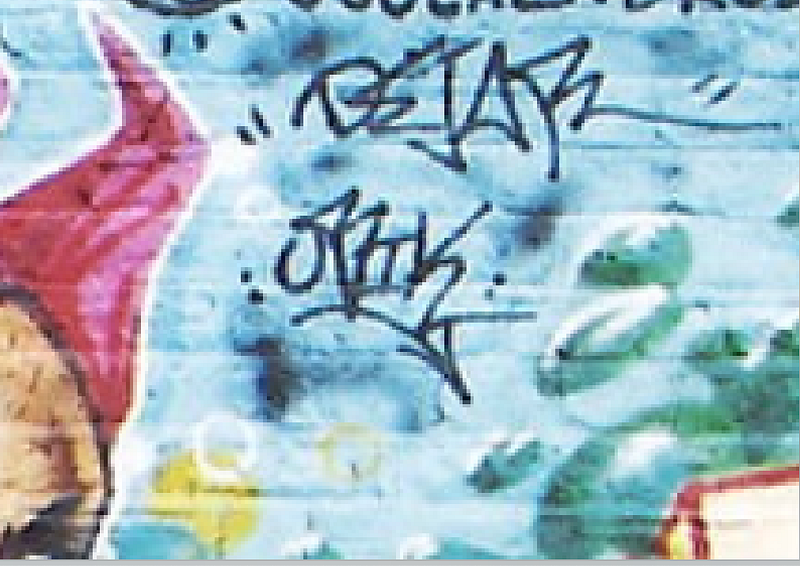
I particularly love the painting below. It’s credited to Toad Zrak, about whom I can learn nothing on the internet. The image seems to conjugate the relation between graffiti and Ubik’s power of entropy-reversal. The spray can overpaints the world with color and vitality. For those of us who adored what graffiti artists did to the exteriors of the drab grey steel 1970’s subway trains, which we didn’t regard as vandalism but as an enlivening intervention into a decrepit reality, Zrak’s painting squares the circle.
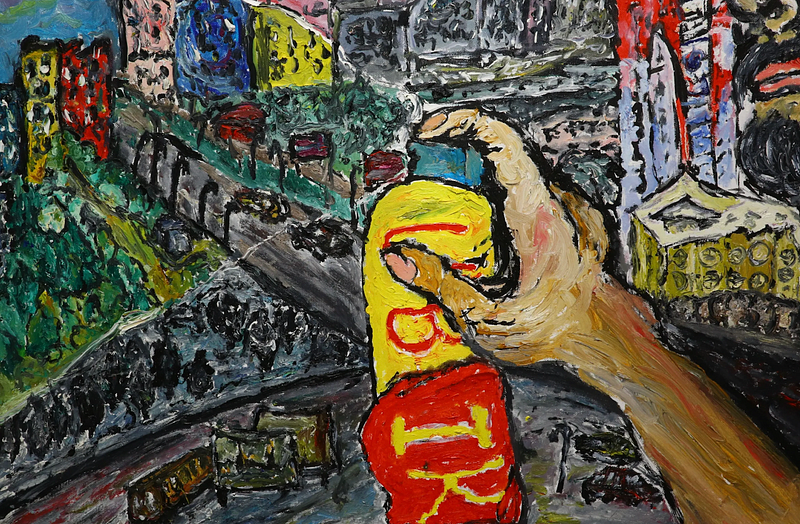
Everyone should stop to watch Manfred Kirchenheimer’s Stations of the Elevated now, if possible. The music is by Charles Mingus.

Berkeley, California, one of Philip K. Dick’s key settings and homes (though he was born in Chicago, and died in Los Angeles), once had a famous student Co-op residence called Barrington Hall. It was known for many things, including its parties, its LSD dealers, and its murals and graffiti. (I sampled some Barrington Hall LSD once, but in Utah, not Berkeley. Long story.)
I can’t find documentation now, but in the ‘80’s the front doorway of Barrington Hall sported the spray-painted phrase AMWEB. The word would be a total cypher, unless one happened to be familiar with Dick’s 1964 masterpiece Martian Time-Slip, in which AMWEB is the name of the corporation that builds the first condominium complex on Mars.
More loosely, there is a notion of graffiti as a kind of “garbage art”, something erupting spontaneously as the voice from the margins, representing the expressive gesture of the stigmatized. This seems deeply aligned with Dick’s beliefs in the power of vernacular art, and possibility of retrieving meaning from the stratum of commerce and ephemerality from within which his own paperback-original science fiction novels were published. Dick once said: “one must work with the trash, pit it against itself… If God manifested Himself to us here He would do so in the form of a spray-can advertised on TV.”
In France, where Philip K. Dick found himself celebrated as a canonical author during his lifetime (he had to wait for posthumous fame in his own language), Ubik was regarded as an example of a “Pataphysical” text. Pataphysics — neatly encapsulated here by Andrew Hultkrans— was a conceptual practice founded by the early Avant Gardist Alfred Jarry, author of the play Ubu Roi. Pataphysics espouses systems of the paradoxical and absurd, designed specifically to rival scientific rationalism — but also to upset conventional notions of artistic status, often using the Dickian method of an embrace of the trash realm. In the words of Irénée-Louis Sandomir, Vice-Curator of the Collège de ’Pataphysique, “For the Complete Pataphysician the most banal graffito equals in value the most consummate book…”
3. Ubik Tattoos
But I promised to show examples of Ubik’s attempt to export itself into the physical world. There may be no simpler case than the trend of the Ubik tattoo, in which the esoteric fictional product migrates into flesh itself.
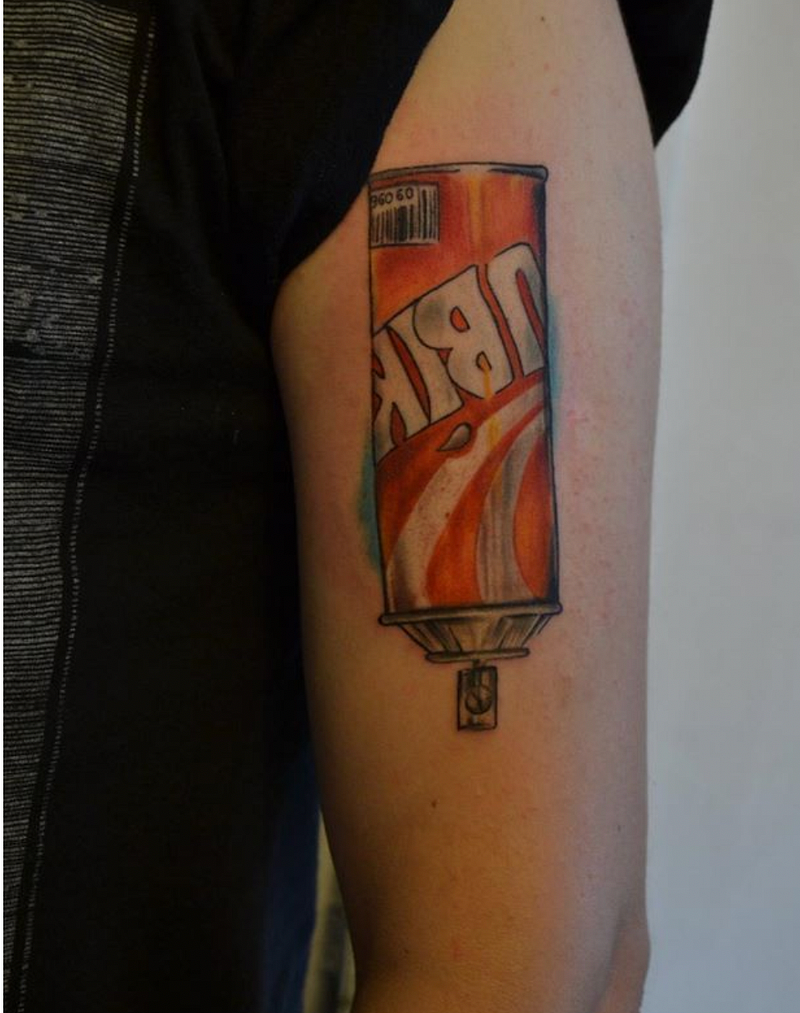
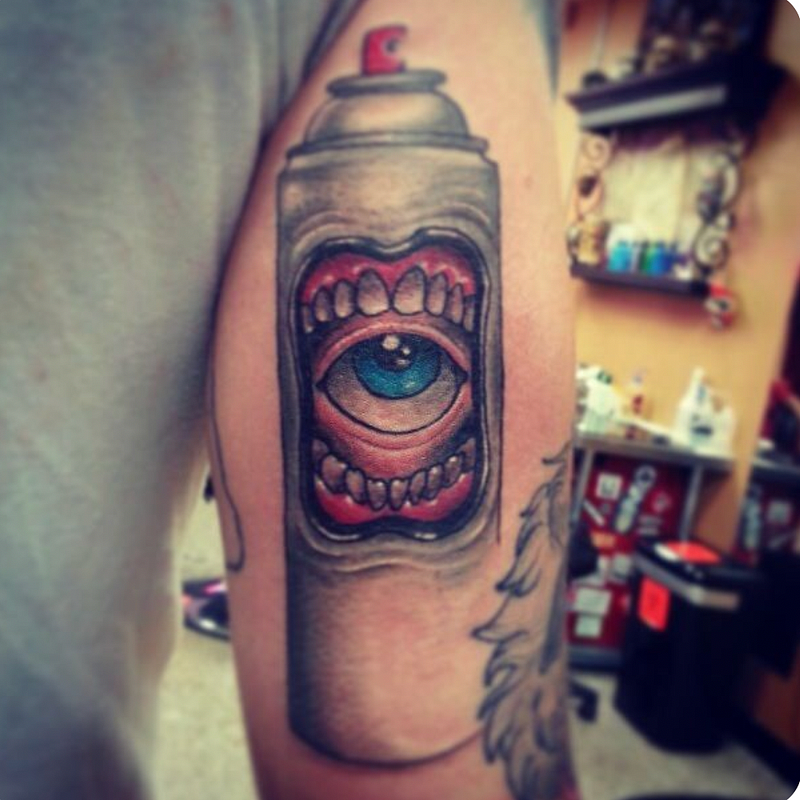
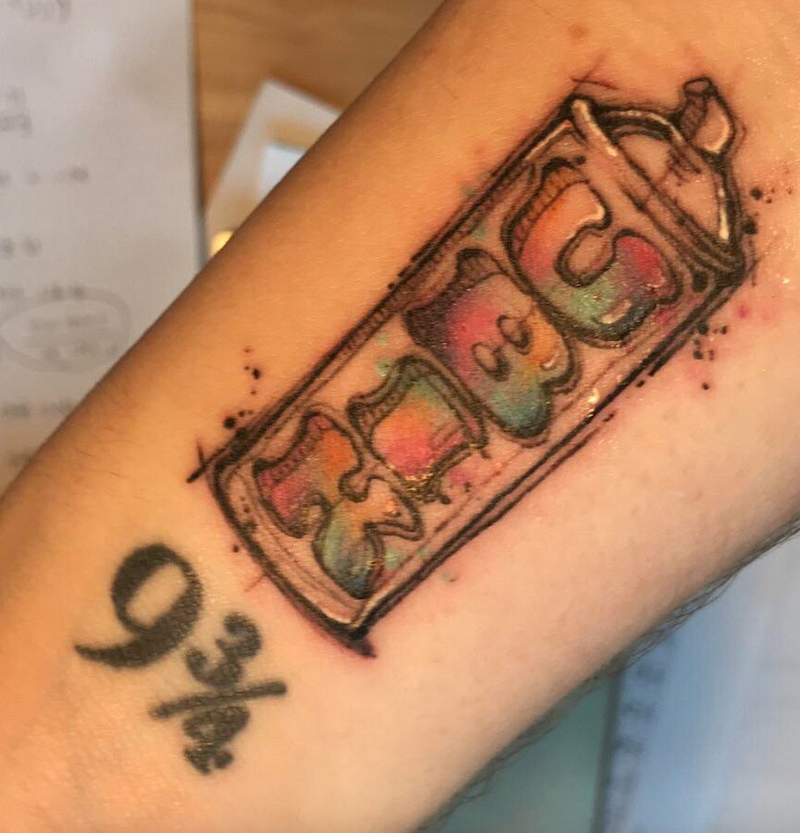
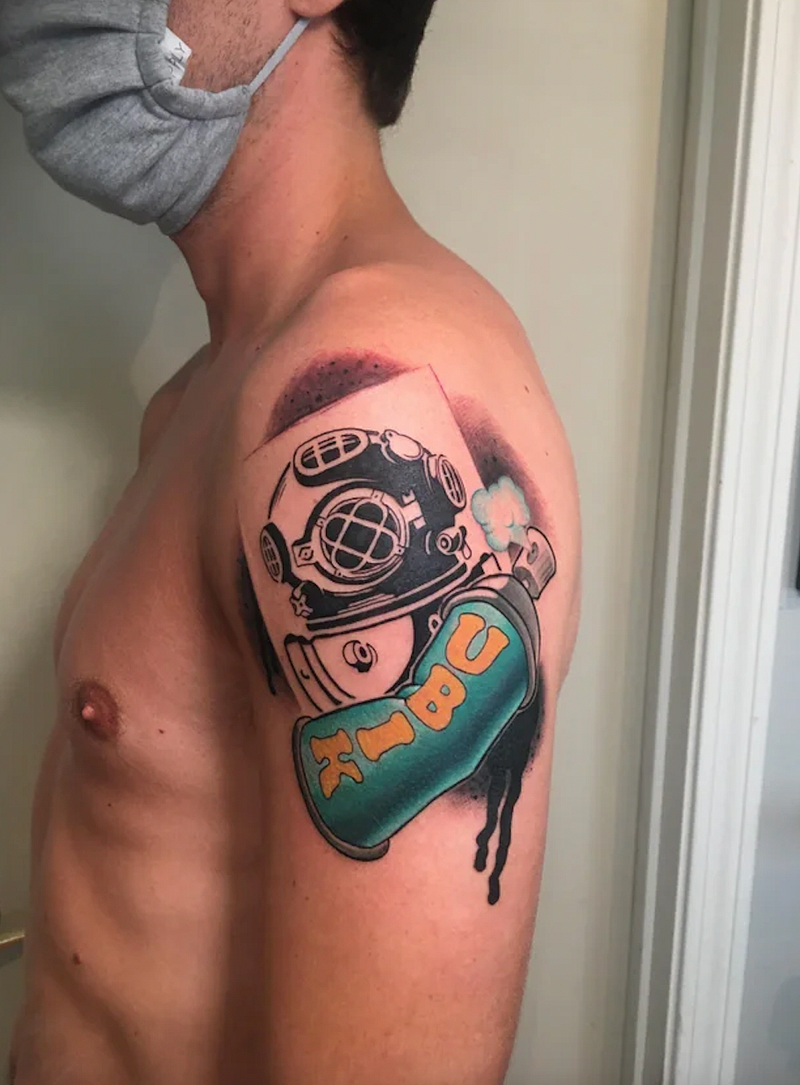
And then there are these two persons, one of whom is myself, the other Benjamen Walker. We both happened to opt for the jacket image from the book’s first edition.
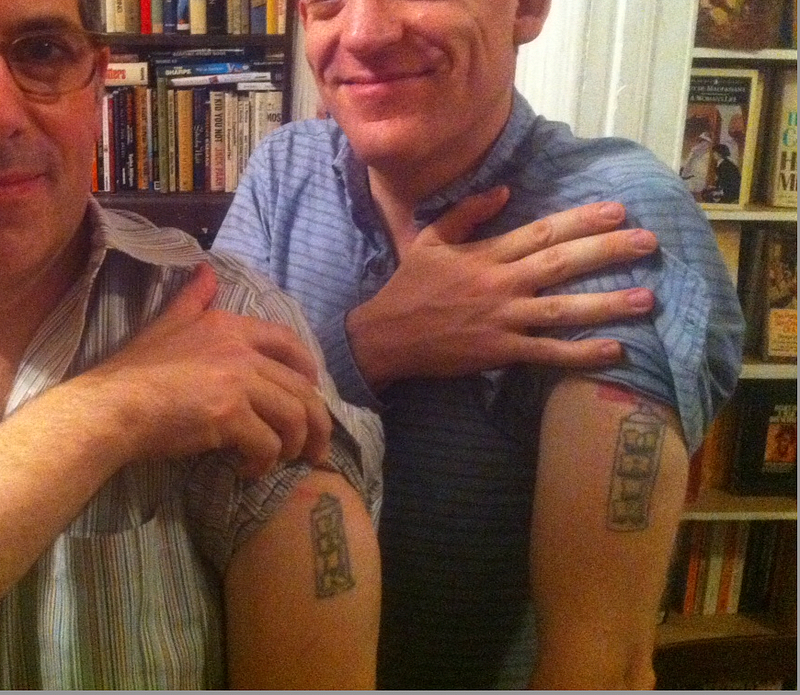
An aside about this tattoo. The day I got it, my sister also got a tattoo of a plate of Dr. Seuss’s green eggs and ham, from Green Eggs and Ham. (Which is, admittedly, an even more popular tattoo, and therefore perhaps an even hungrier God than Ubik.) It was only after we’d gotten them that we realized that without intentional coordinating them, we’d both gotten tattoos featuring fictional substances — medicine, food, etc. — which gave the title to the books in which they appear. It seemed like a minor coincidence, until we realized we couldn’t really think of other examples.
Well, there’s H.G. Wells’ Tono-Bungay, which is a fictional medicinal ointment.
And people often think of Soylent Green, though that wasn’t the title of the book.
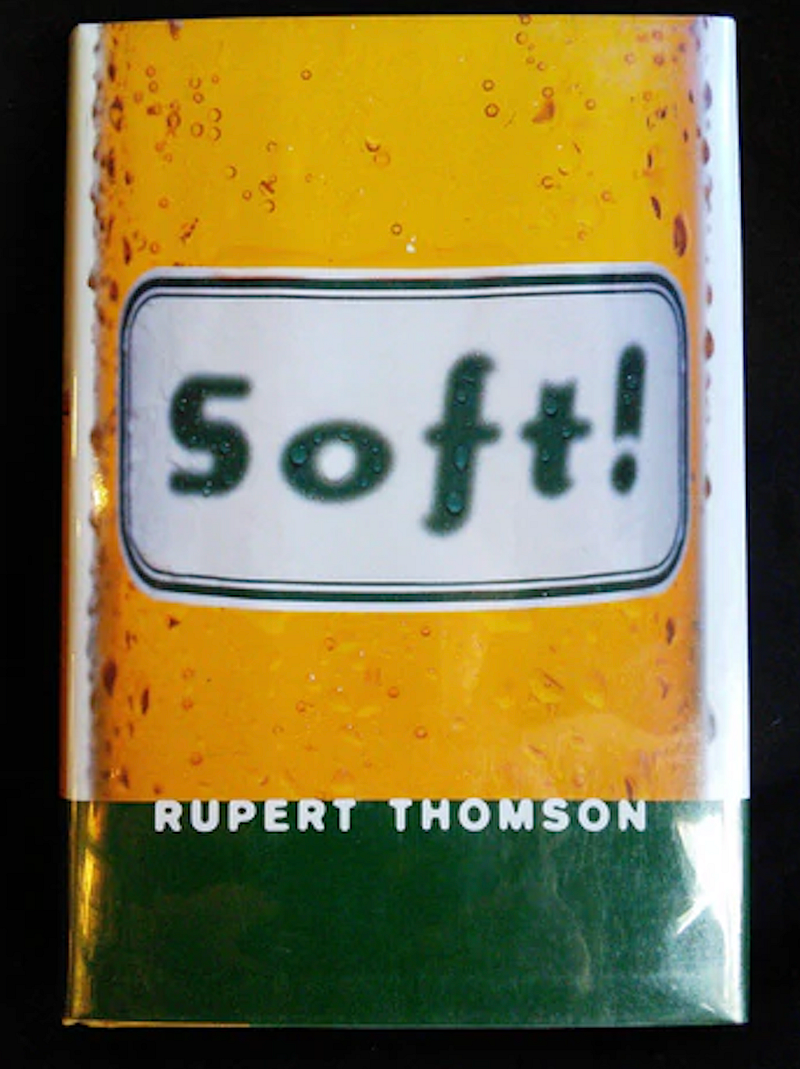
And this gives me a chance to mention Soft! — a fictional soda supported by an insidious advertising campaign — from a really brilliant book by the eternally overlooked Rupert Thompson.
But the point is, there aren’t very many things in this odd category.
But perhaps the Ubik tattoos aren’t such a simple case after all. A tattoo is a strange artifact. It’s an artwork which advertises the permanence of its relation to its primary audience— stitched into your body, a tattoo isn’t like a song you can quit playing (even if a song gets stuck in your head for a while, you’ll eventually forget it — which reminds me, have you ever wondered which song will be stuck in your head on your deathbed? But I digress); it isn’t like a movie you can walk out of, or a book you can throw across the room or give away.
On the other hand, the tattoo dies with you, like a parasite and a host. (I guess some parasites can leap off to other hosts. But not tattoos.)
By springing off the pages of Dick’s novel onto our bodies, Ubik has both transcended its conceptual bounds as a conjuration of mere language, and absolutely wedded itself to my mortality. Ubik will exist long after I’m gone. But not the Ubik on my arm.
4. Advertisements for Fictional Products
Further evidence of Ubik’s aspiration to exist comes in the form of the advertisements it generates for itself.
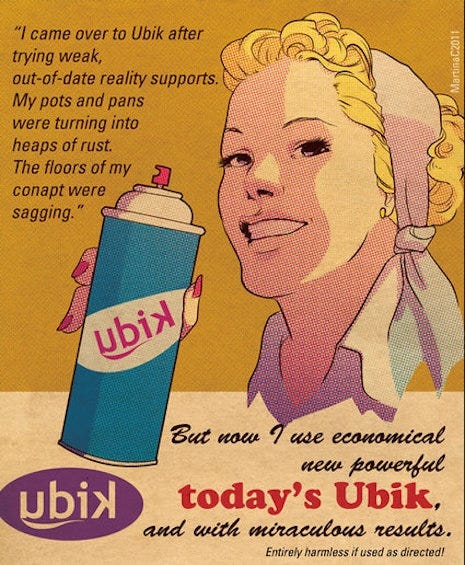
The origin of this is, of course, the novel itself, which is peppered with examples of ads for Ubik, like this one: “Perk up pouting household surfaces with UBIK, the easy to apply, extra shiney, non-stick plastic coating. Entirely harmless if used as directed. Saves endless scrubbing. Glides you right out of the kitchen.” Or: “Wild new Ubik salad dressing, not Italian, not French, but an entirely new and different treat that’s waking up the world. Wake up to UBIK and be WILD!”
Graphic artists have called Dick’s bluff, substantiating his satire with more persuasive examples. Both of these float around the internet. I wish I knew who made them, but maybe Ubik doesn’t wish me to know.
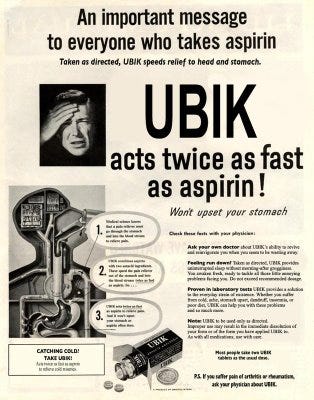
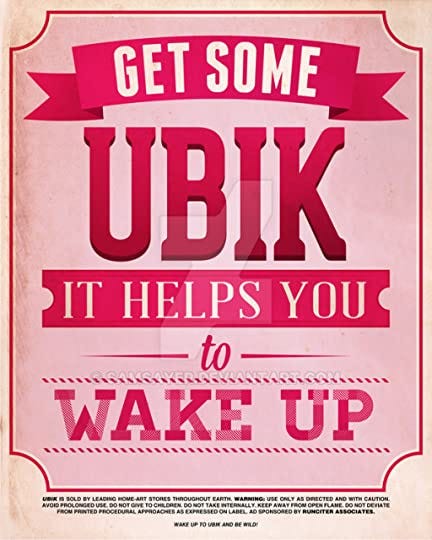
Here are three gorgeous examples, by Martina Cecilia, depicting the evolution of the product through various eras:
And here are two Youtube clips. The first, by Kobi LaCroix, is a series of radio spots, the second, by Ubik W. Szechobecni, is a little educational filmstrip.

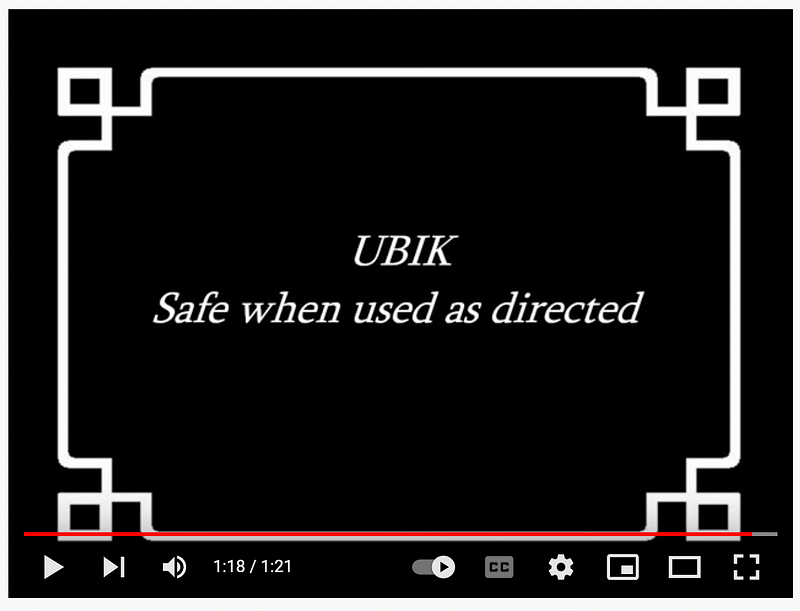
By the way, do the names of those two creators seem a little fictional? I think so too.
Perhaps Ubik’s plan is that if enough people mistake it for an existing (and desirable) product, and request it from their local retailer, some enterprising manufacturer will eventually have to make it real. Isn’t that how capitalism is supposed to work?
5. Cans of Ubik
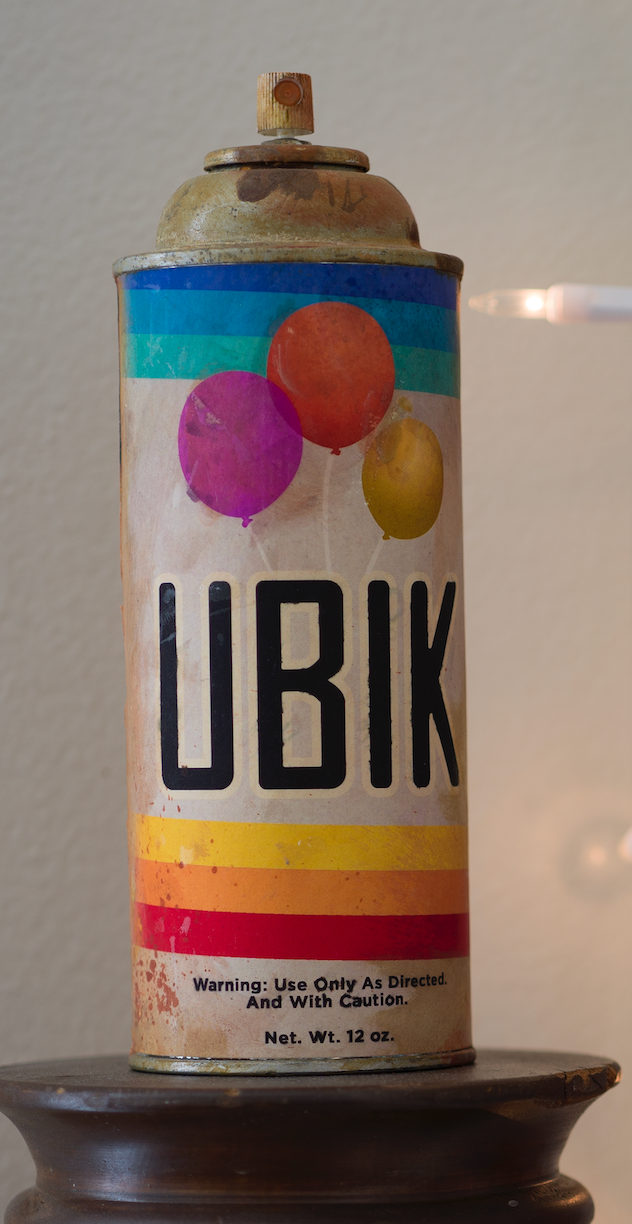
I’ve saved for last the most pleasingly tangible instance of Ubik’s striving to exist: artists have begun creating actual cans of Ubik. I have these in my house, the work of a true genius of the “trash stratum”, Robert Jiménez. Who better to create Ubik cans than the illustrator for a recent series of “Wacky Packages”?
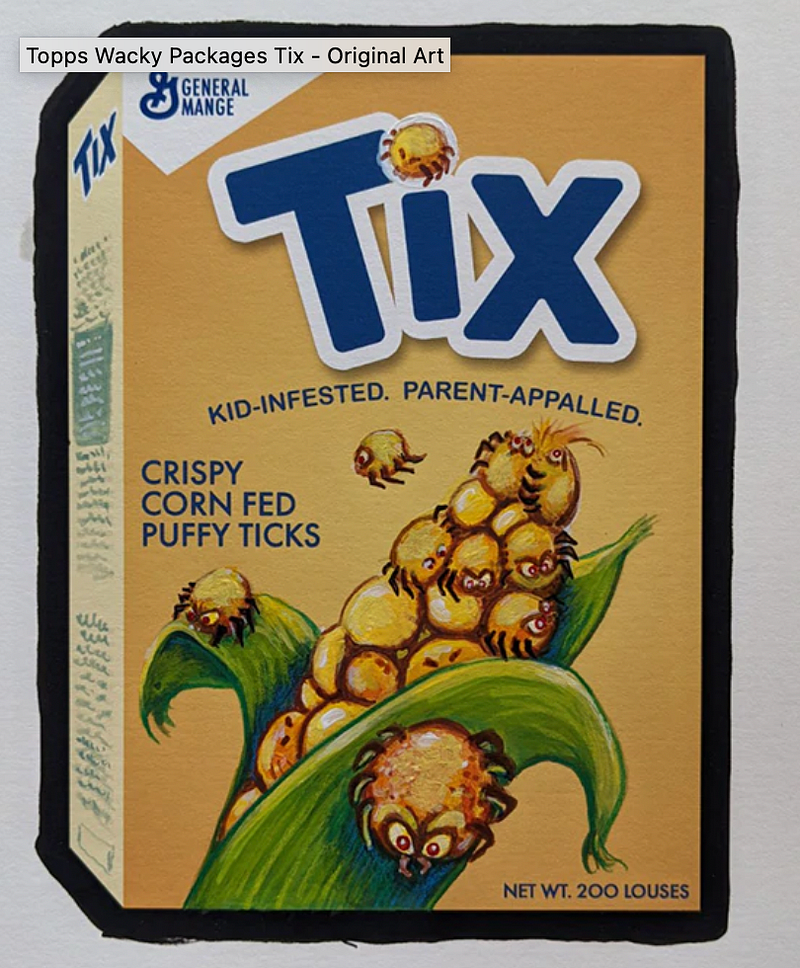
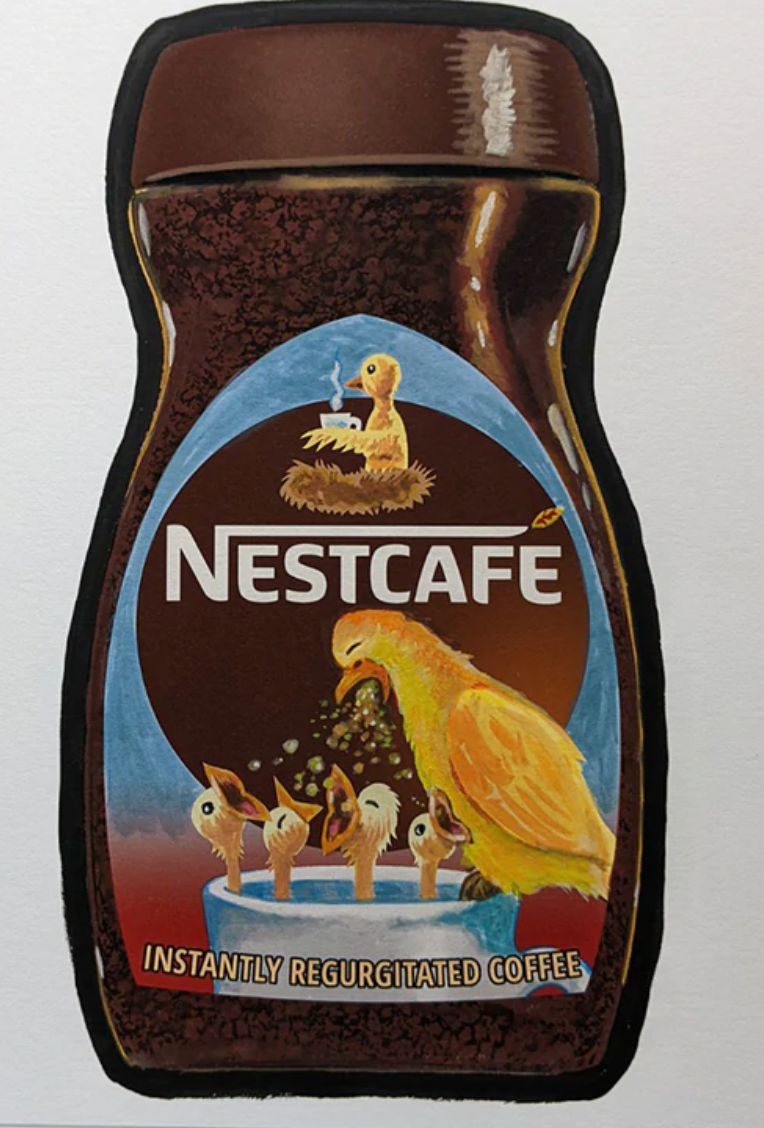
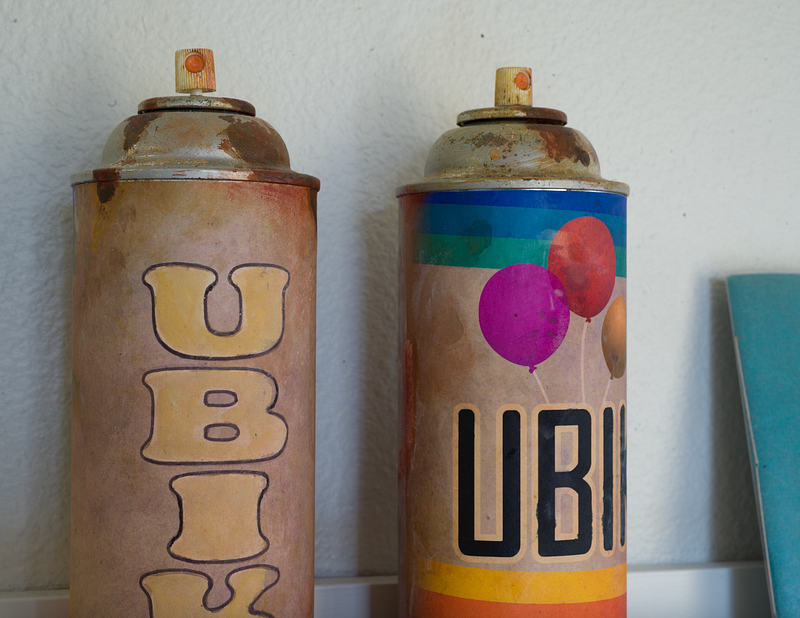
Look at how Jiménez paints trompe l’oeil rust and stains to degrade the spray cans— this is Ubik that could use a quick jolt of Ubik! The only thing better would be if they worked. I keep trying.
Just today, while googling around to flesh out this piece, I discovered another Ubik can for sale, on Etsy, by Vanya Craven. Sorry, but I’ll buy it before I publish this piece. Maybe you can talk Jimenez or Craven into making one for you.
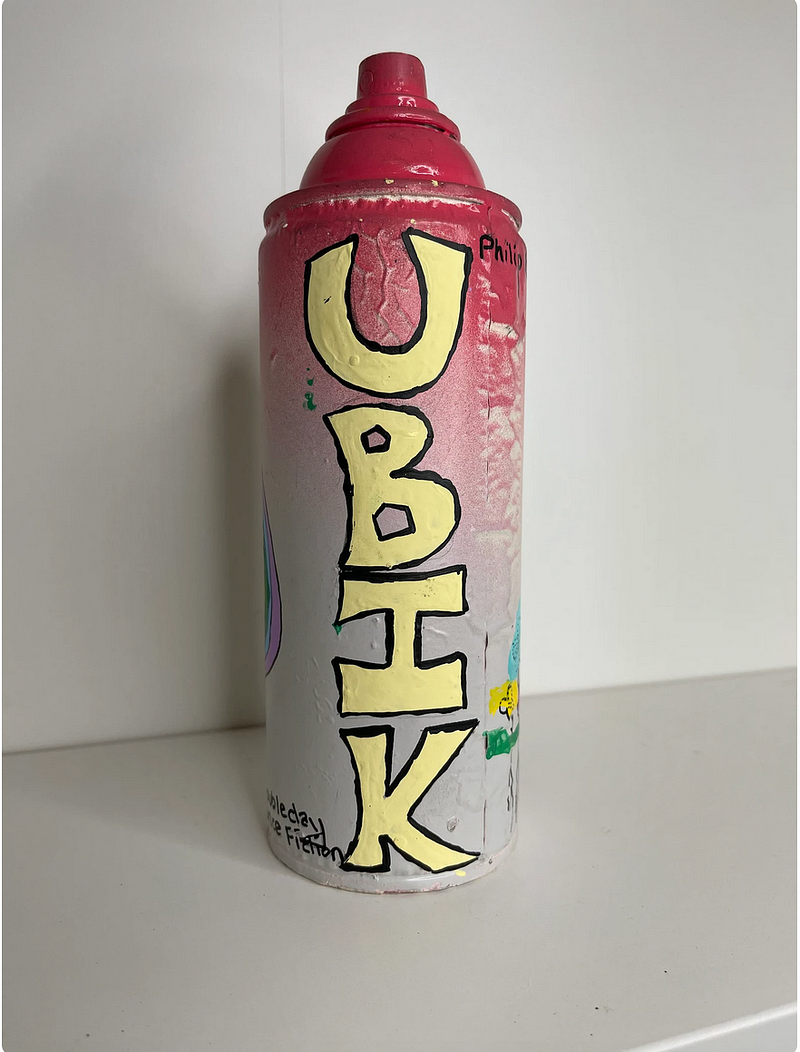
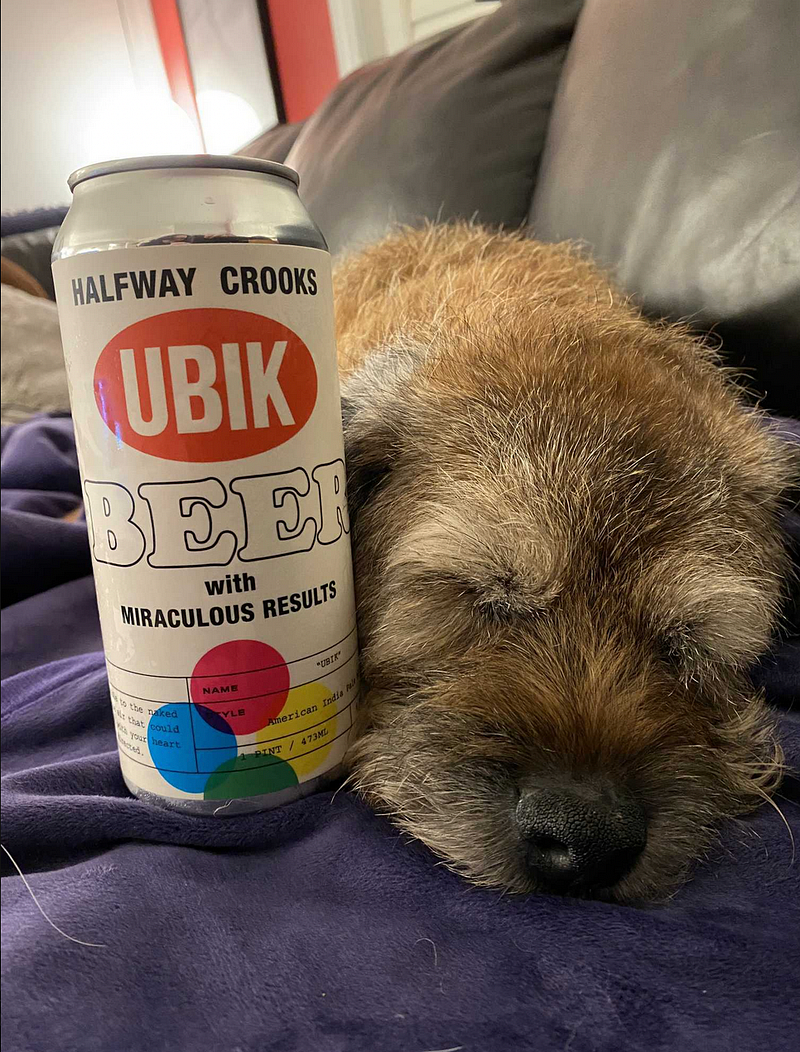
Meanwhile, If you’re living in Atlanta, and you like beer, maybe you can do me a favor and go drink a can of Ubik beer at Halfway Crooks Brewery, and send me the empty? It would make me as content as this dog.
Okay, I’ve reached the end for now.
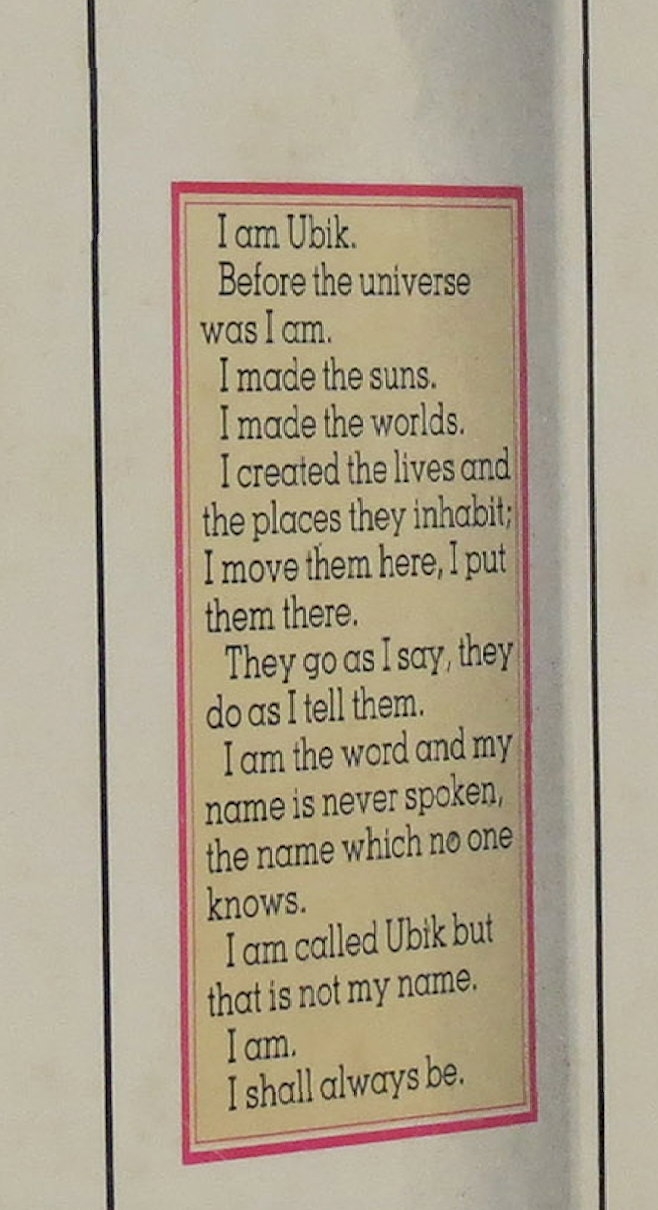
But I’m sure Ubik would want to have the last word: