
DO NOT DISTURB
The Tyranny of Telemarketers — Are You Tired of Daily Spam and Robocalls?
Something has GOT to give — and soon — because I’m on the war path against these invaders of my privacy
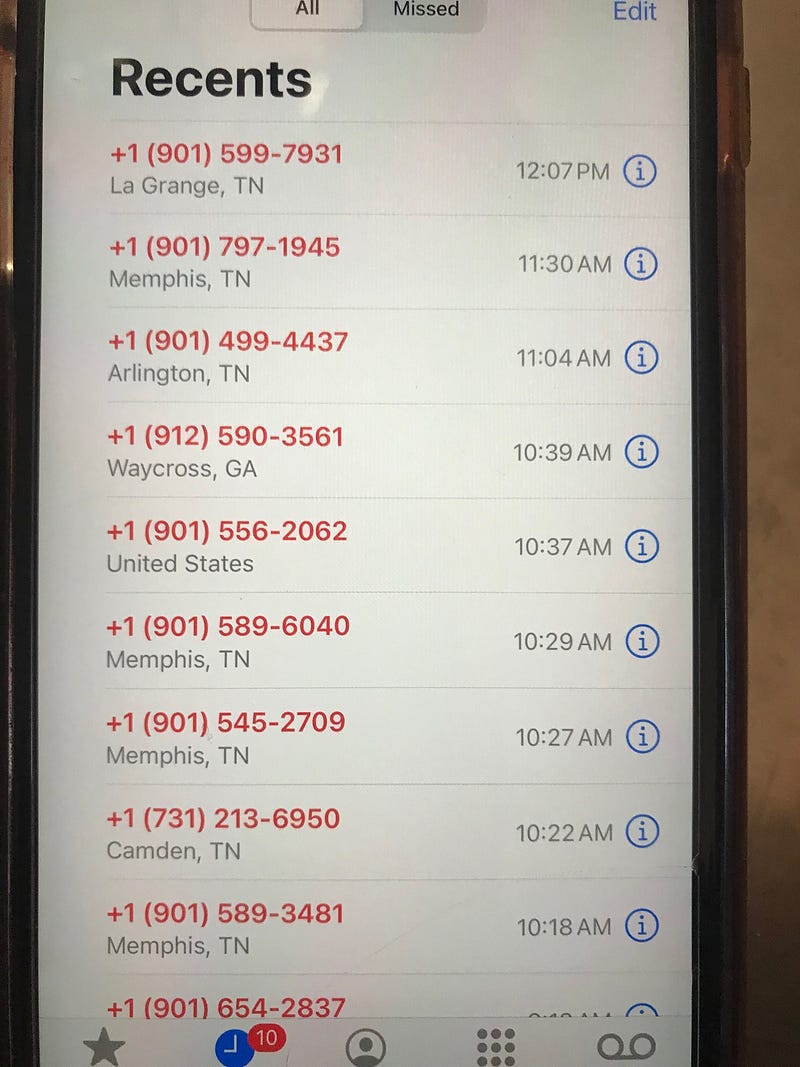
Unwanted, annoying, intrusive, persistent, unrelenting … doesn’t even begin to describe the crushing avalanche of robocalls I’ve been getting. Are you getting them too?
From 8:00 AM till 6:00 I’ll sometimes get as many as 15 to 20 a day. On a good day, maybe 8 to 10 calls.
Most don’t leave messages but ones that do are selling student loan repayment plans (I never borrowed a dime for college or grad school), car warranties (nope), someone offering me a way out of my medical debt (huh, first I’ve heard about it?). Or, congratulations — I just won $100,000!
For over a year I’ve had to set my iPhone on “silence unknown callers.” It does the trick as far as screening out the spammers but the downside is I may miss calls from someone I want to hear from who’s not in my contact list.
Robocalls are a nuisance but people must be responding to them and falling for their inevitable scams because the business just keeps ballooning.
The Federal Trade Commission recently reported that over a billion robocalls hit American cell phones every month.
Last year Business Insider conducted a survey that found 46% of Americans reported getting robocalls daily and another 24% receiving them multiple times weekly.
What’s causing this increasing tsunami of robocalls?
We’re losing protections in three areas
- Technology — Technological advances haven’t fixed some of the flaws that enable robocalls to flourish from untraceable sources.
- Financial incentives. It’s incredibly cheap and easy. Whether it’s illegal scammers or legitimate businesses trying to sell you insurance, telemarketing from distant shores is immensely profitable.
- Laws and special interest groups. Business Insider reports powerful lobbyists supporting the unregulated environment for robocallers outnumber anti-robocall consumer group lobbyists 100 to 1. There are American companies fine with the unregulated robocall industry. Draw your own conclusions on who these lobbyists funnel money to.
What kinds of robocallers are out there?
Some are legit. Those are the ones pestering you to death to buy burial insurance, auto warranties and alarm systems.
But a preponderance of calls are either sketchy or downright illegal. These include calls from people pretending to be from your bank, law enforcement, or the IRS. Scammers love to prey on seniors.
Don’t answer any unknown callers, especially from these area codes
First, don’t assume a caller ID showing a “local” number is in fact a local caller. The caller may even look like it’s from someone in your neighborhood with a number similar to yours.
Have you ever gotten a call from your OWN phone number? Now that’s spooky, and I’ve had it happen several times — but that is another story!
They could be calling from anywhere in the world — and in some cases you might get stuck paying for an overseas call if you ring them back.
But, if the area codes that pop up in your called ID are any of these, you’ll know for sure it’s not from the United States.
- 268–Antigua and Barbuda
- 284–British Virgin Islands
- 473–Grenada, Carriacou and Petite Martinique
- 664–Montserrat
- 649–Turks and Caicos Islands
- 767–Commonwealth of Dominica
- 809, 829, 849–Dominican Republic
- 876–Jamaica
According to the Federal Trade Commission, if you call back one of these area codes (as well as others) you’ll probably get connected to an overseas number. Someone will try to keep you on the line as long as possible to extract international toll fees — from which the scammer gets a share.
So many scams — so little time
If you answer a call from an unfamiliar number you suspect is a robodialer, your number is marked as good by the scammers — even if you don’t engage with them.
They’ll resell your number to other companies because they’ve identified a real live human is on the other end.
The FTC tells us the less you answer these calls, the fewer robocalls you’ll receive. I doubt that. I don’t answer any of them, yet I’m receiving more and more daily.
The one-ring scam
Ever had this to happen? Your phone rings just once. You look at the caller ID. You don’t recognize the number but, just out of curiosity, you call back. Because, well — it might have been something important.
This is what’s known as a “one-ring scam.” The idea is that just hearing the one ring arouses curiosity and concern.
And it works! People want to know who it was trying to call them and why they hung up after just one ring!
Psychology at work. Scammers are not necessarily dummies.
Can you hear me?
All the time we’re told “this call is being recorded,” right? A scammer may try to get “proof” you agreed to purchase a $450 online security package which they allegedly placed on your computer.
When you dispute it there’s a recording of you saying “yes.”
How did they get you to say “yes”? Someone previously called, said “Hello” and then innocuously asked, “Can you hear me?” When you say “yes” you’ve provided in your own words the response they were looking for.
Bottom line: Don’t respond to any questions that can be answered with “yes.”
Fighting back with consumer protections
The FTC tells you to report robocalls at ftc.gov/complaint. Good luck with that!
They also instruct you to limit unwanted sales calls by registering your phone numbers. You can do this online by going to DoNotCall.gov. Or you can call them at 1–888–382–1222 or TTY: 1–866–290–4236 to get placed on the Do Not Call List. I’ve done that just for chuckles.
There’s also a service called Robo Revenge. If you’ve got an iPhone it’s in their app store called DoNotPay. They allegedly help you file a lawsuit against robocallers by tricking them into revealing the origin of the scammers’ calls.
I don’t know how effective they are because many of the scam operations are in foreign countries.
Then there are companies like Nomorobo. For a monthly fee they’ll block telemarketing calls before they ever reach your phone.
Other third-party blocking apps include Call Control, Hiya, RoboKiller, Truecaller, and others. Some carrier services offer this same service — for a fee.
You CAN profit from robo scammers but don’t count your money yet
The Telephone Consumer Protection Act of 1991 made it illegal for companies to send out unsolicited phone calls and texts. But here’s the catch. You must contact the offending business and instruct them not to contact you.
If you can prove in court you’ve done that, and the company continued to send unwanted calls, then the business must pay you anything from $500-$1,500, per call!
So yes, you could actually make money from robocallers. From what I’ve read there are people who’ve done it. But it would take a lot of time and effort to do so.
Help might be on the way with Stir/Shaken technology
In 2021 the Federal Trade Commission required all major wireless carriers to start using Stir/Shaken technology. First developed in 2018, this new technology verifies all incoming and outgoing calls routed through carrier networks.
It identifies and displays on caller ID spoofed or spam calls and blocks them before they reach your phone.
Smaller providers with fewer than 100,000 subscriber lines are also being required to use Stir/Shaken but have been given a two-year extension on implementation, pushing their deadline to June of next year.
Although Stir/Shaken sounds sexy and is receiving all kinds of hype, I’m not seeing any benefits yet. I suspect my carrier is one of those “small providers” that won’t start using Stir/Shaken until next summer.
Final thoughts
Until then, don’t expect me to answer your call if I don’t already have you in my contact list.
I, for one, have had it up to here with these unrelenting assaults.
If you know of any other solutions out there to combat this daily onslaught of unwanted calls please let us all learn about it here.
If you like my stories and want to read more from me, please use my referral link! https://medium.com/@deborah.camp/membership Your $5 monthly membership supports me and other writers on Medium. Get unlimited access to every story, daily. Maybe you’d like to write on Medium (unleash that inner writer and earn some money too!) Either way, here’s my link to get you started: https://medium.com/@deborah.camp/membership