
Two Women’s Memoirs of the Civil Rights Movement: One White, One Black
Drew Gilpin Faust and Anne Moody testify to the ‘Necessary Trouble’ they made in the American South
Review essay:
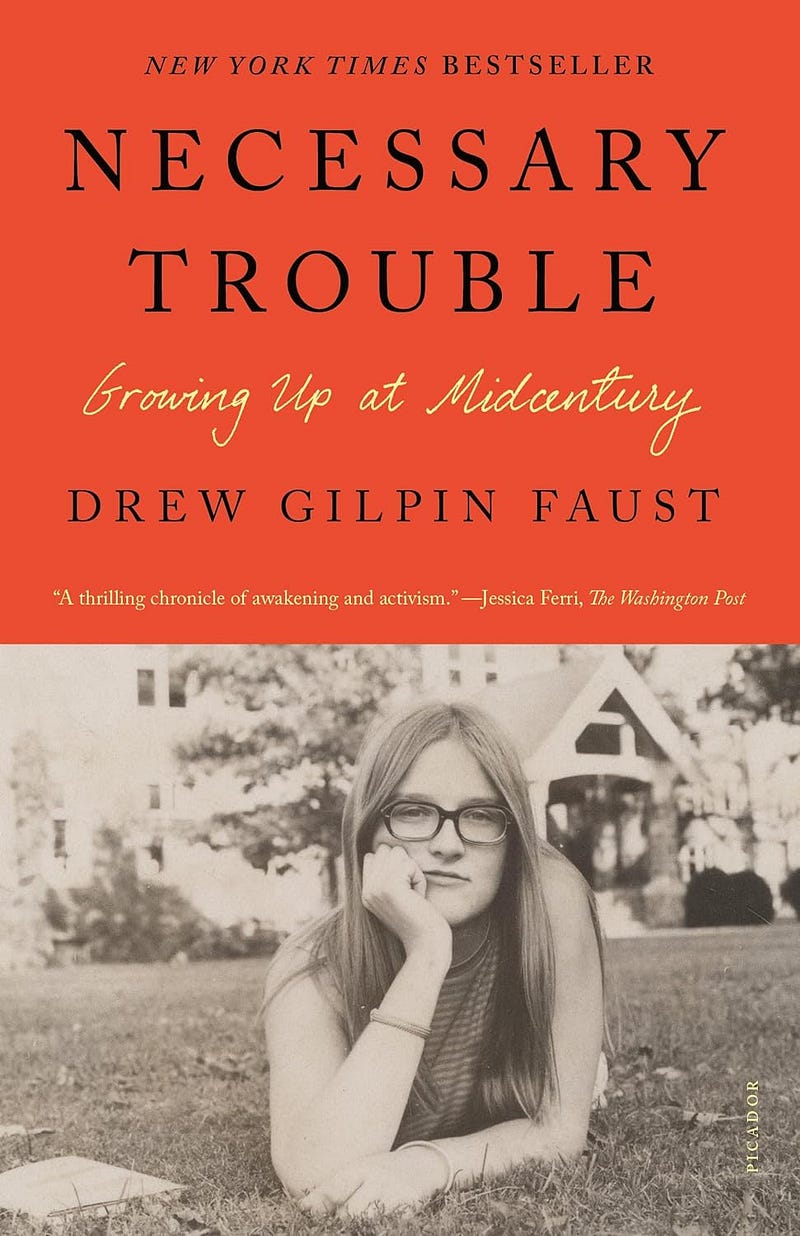
Drew Gilpin Faust, Necessary Trouble: Growing Up at Midcentury (Farrar, Straus, and Giroux, 2023)
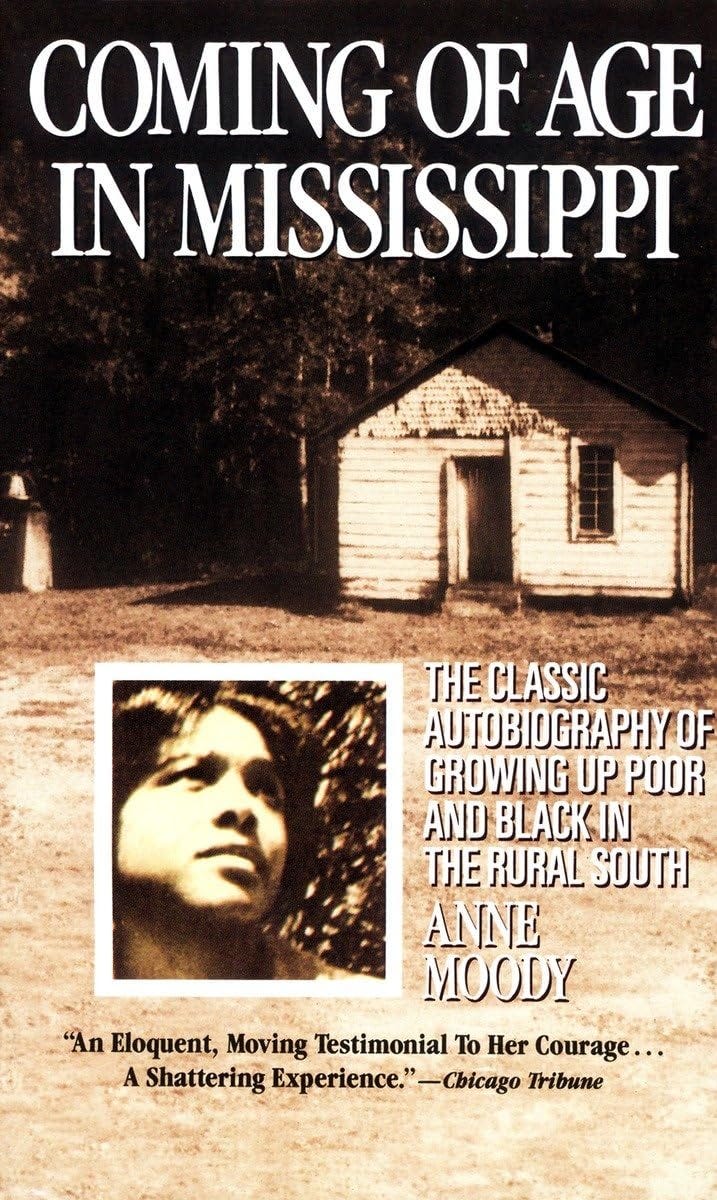
Anne Moody, Coming of Age in Mississippi (Dial Press, 1968; Dell, numerous reprint editions, 1969 onward)
Two girls, born seven years apart: one into a privileged white Virginia family, the other into a Black Mississippi sharecroppers family. Each of them propelled herself into the thick of the civil rights movement that took off in the mid-1950s.
Each had much to lose, the starkest of which was life itself — and in that time and place, that’s no hyperbole. The American South was a dangerous place in the 1950s, as it had been for three hundred years and still is today.
For Essie Mae (Anne) Moody, danger crowded her childhood from all sides. “I’m still haunted by dreams of the time we lived on Mr. Carter’s plantation,” she begins her memoir. She and her younger sister Adline were watched by their mother’s eight-year-old brother while their parents went to work the fields every day. George Lee, a child himself, tormented the girls, and lied to their father when he set their shack on fire. Essie Mae got a terrible beating for something she did not do.
When the next child, Junior, was born, their father abandoned the family, moving away and ultimately remarrying. Her mother, known in the family as Toosweet, moved herself and the three children in with their great aunt Cindy while she tried to find work. “The house was so crowded, the four of us had to share a bed together.”
Aunt Cindy had a mean husband and our presence made him even meaner. He was always grumbling about us being there. “I ain’t got enough food for my own chillun,” he was always saying. Mama would cry at night after he had said such things.
— Coming of Age in Mississippi, chapter 1
Toosweet soon found a job as a domestic, and then a waitress, and was able to rent a house for the family, though their diet still consisted mainly of beans and leftovers from the white family’s table. They moved repeatedly over Essie Mae’s childhood as her mother went from one employer to the next, trying to keep them all afloat.
At five Essie Mae started school, in a class taught by the minister of Mount Pleasant Church. The man taught by yelling and freely wielding a thick switch. “He was a tall yellow man with horn-rimmed glasses that sat on the edge of his big nose. He had the largest feet I had ever seen. He was so big, he towered over us in the little classroom like a giant.” Moody figured out that if she hid in the toilets behind the church, he wouldn’t miss her. Soon so many of the kids had joined her in the toilets that even this oversized bully noticed and herded them back into the classroom — fortunately so winded that he couldn’t beat them with that switch.
Anne Moody’s childhood was one long set of deprivations and disruptions, losses and brutality. More than one house burned down. Another baby came, mysteriously, and then was taken away to live with his father’s family. She narrates brilliantly, allowing us to see and feel the texture of that life.
There were joys. The kids loved their uncle Ed, so different from George Lee. He taught them about the natural world and quizzed them on the names of trees. “Sometimes Ed took us fishing too. He knew every creek in the whole area and we’d roam for miles. Whenever we caught fish we’d scrape and cook them right on the bank of the creek. On those days we didn’t have to eat that hard cold pone of bread Mama left for us.”
With Ed, Anne Moody had her first jarring encounter with the untaught racial mysteries of Southern life. Ed took the kids to his home at Grandma Winnie’s, which Anne had never visited. Ed’s sister Alberta started yelling at Ed to fetch water for the laundry. “Sam, yo’n Essie Mae help Ed with that water. And, Walter, take Adline and Junior on that porch outta the way.”
I stood dead in my tracks with my mouth wide open as the two white boys jumped when Alberta yelled Sam’s and Walter’s names. One boy ran to the wash bench against the house and got a bucket and the other picked up Junior, took Adline by the hand, and carried them on the porch.
“Essie Mae! Didn’t I tell you to help Sam and Ed with that water?” Alberta yelled at me.
“Where is Sam and Walter?” I asked with my eyes focused on the white boy on the porch with Adline and Junior.
“Is you blind or somethin’? Get that bucket and help tote that water,” Alberta yelled.
— Coming of Age in Mississippi, chapter 2
How Sam and Walter came to be Ed’s brothers when Ed was Black and they were white was something Anne’s mother refused to discuss with her. And why these white boys were nice to her and treated her like family was unfathomable. Her mother made sure she and her siblings didn’t return to that big house full of puzzling relatives.
Drew Gilpin’s racial awakening came at the age of nine. Whereas Anne Moody’s first memories were of growing up in a crowded sharecropper’s shack, Drew Gilpin’s were of living in a big house on the Shenandoah River, on a farm that held several tenant farmer’s dwellings. A couple of rather mysterious white men lived in those outer structures, and there were several Black servants who cooked, cleaned, and drove.
In 1950, the population of my county, Clarke, was 17 percent Black. Every adult Black person I knew worked for whites as either a laborer or a domestic. The established practices of Jim Crow had changed little for more than a half century. Nevertheless, this was not the Deep South. There were no signs designating water fountains or waiting rooms COLORED or WHITE. In my small rural Virginia community, people just knew. Or learned. This, too, was part of a landscape that I came to take for granted but did not really see…..Prejudice was hidden beneath a surface of politeness and civility that scarcely masked the assumption of superiority, of greater intelligence, of entitlement.
— Necessary Trouble, chapter 4
The family’s Black servant Raphael was driving Drew home from school when she heard someone remark on the radio that Virginia law forbade Black children to attend school with white children.
Drew was shocked. She asked Raphael if this was true. “I remember that Raphael never answered my question.” Even in genteel Virginia in 1957, it would have been dangerous for a Black man to discuss racial politics with a young white girl.
At the age of nine, Drew Gilpin’s first action in the civil rights movement was a long letter to President Eisenhower, protesting school segregation as unfair and unChristian. That letter still resides in the Eisenhower Library, where an archivist dug it out at Faust’s request fifty years later.
She signed her letter “Catharine Drew Gilpin,” though she never used her legal first name in her daily life. “I wanted to be known not just as white and nine but also as a girl.”
Just beyond the shock of learning about her white relatives came Anne Moody’s ruptured friendship with some white children who lived near the family’s most recent rental. The kids became close. When they ran into each other at the movie theater, the Moody kids joyously greeted their friends and followed them into the ‘white’ lobby. When Toosweet saw where her children had gone, in this strictly segregated venue, she grabbed them, shouting, “‘Essie Mae, um gonna try my best to kill you when I get you home. I told you ‘bout running up in these stores and things like you own ‘em!’…When we got outside, we stood there crying, and we could hear the white children crying inside the white lobby. After that, Mama didn’t even let us stay at the movies” (Coming of Age in Mississippi, chapter 3).
The friendship changed after that, Moody writes. They did start playing with each other again. “But things were not the same. I had never really thought of them as white before. Now all of a sudden they were white, and their whiteness made them better than me.” From this momentous realization, Anne moved quickly to the revelation that everything the white children had was better than what she and her siblings had: their toys, their houses, their schools, even the downstairs seats in the movie theater — all better.
I used Anne Moody’s brilliant memoir for many years in my US History survey. The voice changes subtly in each of four parts: childhood, high school, college, and the movement. Moody survived her rough childhood with a loving but overstressed mother and an absent father. Still in high school, she traveled in the summers to jobs where she could earn money. She excelled in her segregated high school and went on to junior college, and then to Tougaloo College in Jackson, Mississippi, one of the premier historically Black colleges in the South.
Today, Tougaloo’s home page boasts justifiably of the college’s role in the civil rights movement of the 1960s.
Tougaloo College’s leadership, courage in opening its campus to the Freedom Riders and other Civil Rights workers and leaders, and its bravery in supporting a movement — helped change the state’s economic, political and social fabric of Mississippi and the nation.
— “About Tougaloo College,” https://www.tougaloo.edu/about-tougaloo-college/our-history).
Fresh from fighting poor Natchez College’s restrictive rules and maggot-infested grits, Moody arrived on scholarship at Tougaloo, a new universe of beautifully groomed campus lawns and every race and shade of student. She writes of her student life: her first kisses, her basketball days, her building a gymnastics team at her new college for a talent show. She reveals her fears and her anger as well as her plunges into abiding friendship.
And at Tougaloo she gets involved, deeply involved, in the scary Mississippi movement. Her roommate is secretary of the NAACP chapter on campus and invites Anne to join.
I promised her that I would go to the next meeting. All that night I didn’t sleep. Everything started coming back to me. I thought of Samuel O’Quinn. I thought of how he had been shot in the back with a shotgun because they suspected him of being a member. I thought of Reverend Dupree and his family who had been run out of Woodville when I was a senior in high school, and all he had done was to get up and mention NAACP in a sermon. The more I remembered the killings, beatings, and intimidations, the more I worried what might possibly happen to me or my family if I joined the NAACP. But I knew I was going to join, anyway. I had wanted to for a long time.
— Coming of Age in Mississippi, chapter 20
Moody and her cohorts, Black and white, faced unfathomable danger in those years of action in the early 1960s. Her family was threatened; she and her colleagues slept in backwoods shacks with guns at the ready, subsisting on peanut butter and songs. Their stubborn courage is beyond heroic. Her story of those years is riveting and it is no wonder that her memoir has never gone out of print.
White privilege and class privilege sat uneasily on Drew Gilpin, partly because despite the farm and the horses and the assumptions of superiority and position, there were always arguments at home about money.
Nonetheless, at thirteen Drew went off to Concord Academy, a selective girls boarding school in Massachusetts. “I reveled in this new environment of intellectual rigor, openness, and challenge, of empowered females and high expectations. But the school was overwhelmingly homogeneous; it was essentially a community of well-off white Anglo-Saxon Protestants. ….And I was living as well in a world even more racially segregated than the one I had left in Virginia” (Necessary Trouble, chapter 7).
She spent four years in this school teetering on the edge of a new world of feminism and discussions, in white Concord, of racial justice. She was shocked when at the end of her junior year her parents allowed her to go on a Quaker-led summer trip with a mixed race/mixed gender group through the so-called Iron Curtain, into East Germany, Czechoslovakia, and Yugoslavia. It was the height of the Cold War. The trip was richly educational. The students were not arrested nor harassed, but Faust realized later that their tour was fraught with hazard. The young East German who had been assigned to be their guide, and who participated respectfully in their debates about the comparative political freedoms of the West and the Soviet bloc, was never again allowed to serve as a guide.
The next year, 1964, brought a journey closer to home: a student group organized by the same Quaker leader, Dick Hiler, to travel into the South to explore the racial tensions that had lit up the region with fires, lynchings, and gunshot killings in the previous decade.
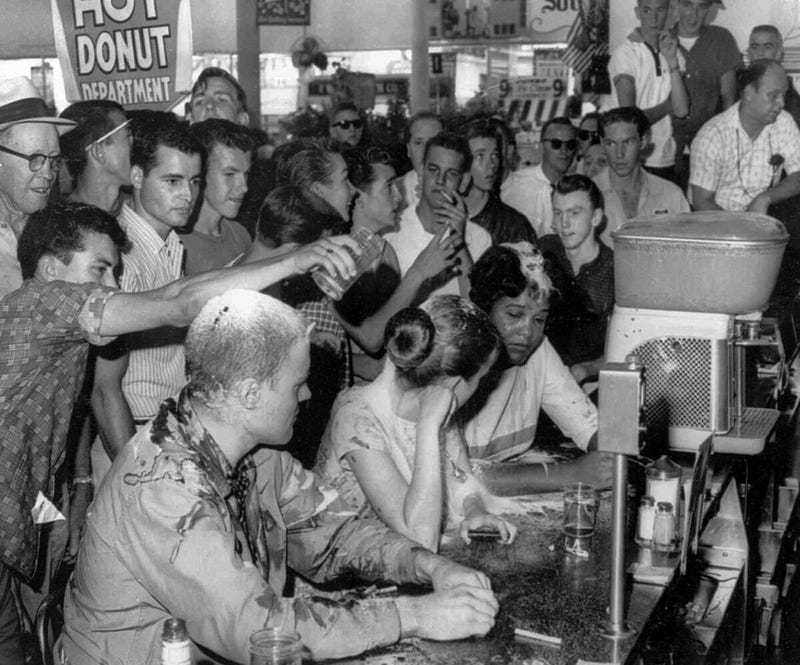
During that trip Drew grew close to her fellow travelers, white and Black. She heard way more justification for segregation than she could stomach, including the underlying terror of ‘miscegenation’ (race mixing) that seemed to power the fear of cross-racial sexual relationships — or maybe vice versa. She and her fellow students arrived in Mississippi a year after Anne Moody and her fellow students had sugar, ketchup and mustard poured on their heads at a lunch counter in Jackson. Gilpin also became uncomfortably aware that their very presence in the homes and churches of kind Black families endangered those families.
At Bryn Mawr College Drew Gilpin found another women’s community, like Concord Academy, driving forward with women’s leadership in intellectual fields, yet stuck in the ‘olden days’ in matters of parietals and dress codes. Drew got involved in student leadership, to tackle those social issues as well as the larger political roles of college students in the civil rights and antiwar movements. She ended her college career as head of Self Gov.
In her freshman year, after the brutal police beatings at the Pettus Bridge, Drew enlisted her then-boyfriend to drive with her into Alabama to participate in the second Selma to Montgomery march. By then, though, she had begun to be aware of the splits in the civil rights movement: splits that, along with the rising tide of anti-Vietnam War passion, changed the ways she and other student radicals participated in contemporary politics. The struggle came back to the campuses themselves.
Drew Gilpin loved history and majored in the subject. She turned most of her large student projects into reflections on the bearing of history on current issues. The book ends with her graduation from Bryn Mawr in 1968, as she prepares to take some time before graduate school, to work in the Philadelphia office of HUD, a recently founded federal agency focused on American cities.
Yes, Drew Gilpin Faust borrowed the title of her memoir from John Lewis. And yes, she asked for his permission, and he said he would be ‘honored.’
Faust knew Lewis, not in the heat of the civil rights movement, where they both were bloodied, Faust politically and intellectually, and Lewis spiritually and physically, but many years later, during her long tenure as the President of Harvard University (2007–2018).
Faust has had a long and rich academic career, culminating in her position as the first woman president of Harvard. Anne Moody disappeared into a quiet career in New York City doing various jobs while writing a comparatively modest two published volumes — though one of these is an American classic. Faust is still writing and speaking. Moody died at 74 in 2015.
My years as a student in Cambridge ended fifteen years before Faust arrived as the first dean of the Radcliffe Institute, a few years before she was appointed Harvard’s president. Like her, I earned a PhD in American history and I knew of her work on women, war, and the American South. I regret that I did not meet her professionally. I regret that a lot.
Faust’s This Republic of Suffering (2008) helped us teach the Civil War on a level both deeper and more universal than even the war’s formative influence on our racial, political, and military history. Her work helps link those to our human bodies and our understanding of cataclysmic death and upheaval.
Unlike Faust, I was not a brave warrior on the front lines of progressive justice — not from lack of conviction, nor from complacency, but from cowardice. Seven years younger than she, I too spent my high school years in a New England girls’ boarding school. Yes, I did fight against an antiquated dress code and I did write angry songs and attended a few antiwar demonstrations. But her youthful energetic passion sparks in me, to be honest, shame as well as admiration. She has done so much with her privilege, including querying it at every turn.
And Anne Moody’s astonishingly honest memoir of struggling for justice — really, for a life of freedom for all — helped us bring the frontline fight for Black rights to generations of students that, until the last few years of resurgent racism, school shootings, and anti-LGBTQ+ agitation, they had the luxury to know little about.