
“How the Mighty” Chapter 6— Arthéme
Two Women
Death swirls around them today
Arthéme clutched her mother, as the explosions boomed around them. Nothing terrifically earth-shaking, though that last one felt as if it might be in the next field, and a soft rain of dust filtered down into the cellar.
“The walls are not strong,” her mother murmured, and Arthéme remembered that the farmhouse might be newly constructed — only a century old — but that her father had said that the foundations went back to le Moyen Âge.
“Well, they have lasted all this time, Maman. Stones don’t get old like people. They are stones! They will still be here when we are gone!”
“Yes, but if les Amis drop a bomb on top of us, that might be at the same moment!”
They sat in silence for some time, mother and daughter thinking about mortality, as one did far too often in these dreadful days.
The cellar would not be a good place to die. It had no romance to it, no grace, no beauty. Old things stacked in the corners. Empty racks where once Papa’s wine and cider had been battalions strong. Memories of better times.
Memories of Paul.
Arthéme sighed. If she had been alone, she might have finished what that damned whistling soldat had interrupted. But with her mother there, holding her hand, here in the dim silence, no chance.
Silence?
“They have gone, Maman!”
But now there was a sound upstairs. Somebody opening the door. Footsteps in the kitchen above.
“Madame Osmont, Arthéme!”
“Have they gone, Père?”
Père Olivier, checking on his flock. Maman flew up the stairs, but Arthéme lagged. The priest knew her secret thoughts, after all, and though he told her that the Father above knew everything and more, Père Olivier was still a man, here and now, despite the rose.
Maman was sobbing in the priest’s arms. She had been so scared, the noise had been so loud, how was she to protect her child?
The child, eighteen years in this world, rolled her eyes.
Père Olivier smiled at her, patted Maman on the back and disentangled himself free.
“You are safe now. Véronique is frightened, and Henri is full of milk.”
“Are the rosbifs really coming at last?”
“No,” the priest replied. “Not the Anglais, not here, but les Americains! Listen now.”
The silence had gone. Sometimes, when there was a storm, the sound of the waves carried to the village. This was louder than a storm, and it crackled and roared, growing louder as they stood in their thoughts.
“Finally, the liberation,” Maman laughed. “We are free again!”
“Not yet,” the priest replied. “The Germans are still here, making all that noise. It may be that the battle will sweep over us yet. You must come to the church. Our Lady will protect us there.”
He moved to the door. “I must go now, there is much to be done. Take care today. Que notre Père au-dessus de nous bénisse et nous protège tous.” May our Father bless us all.
On an impulse, Arthéme ran to the priest and gave him a squeeze. “Toi aussi, Père. ‘Revoir!”
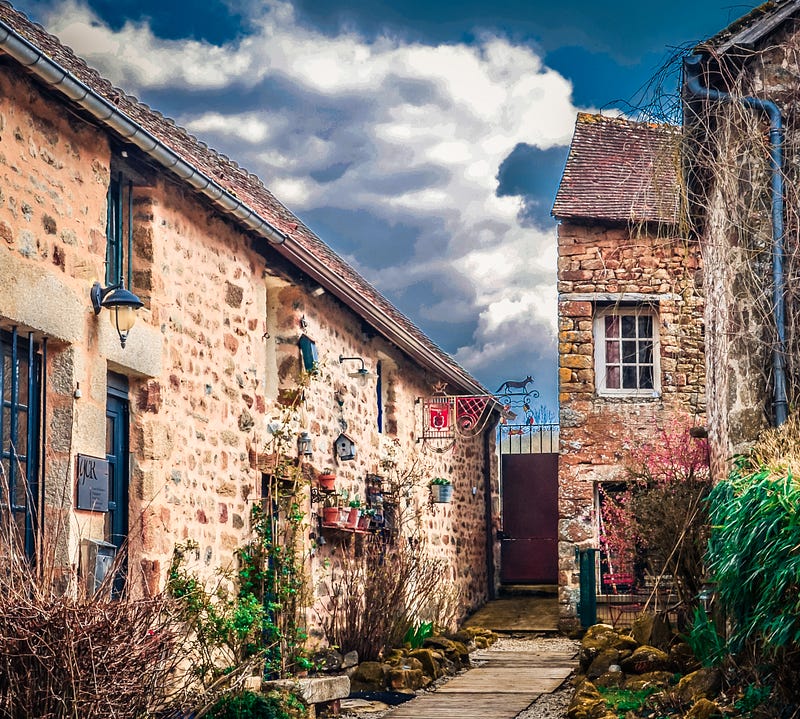
Here is where I stood for a year, as I sank under the tide of history, and then the pandemic forced us all into our cellars. Did I really need this chapter? What did these two women have to say to each other? Surely they knew each other’s minds? And there was nothing happening, anyway. All the action is on the beach, a kilometre away, and I have to puzzle out the details.
But my thoughts always came back to Normandy. I had a chance at returning this year, taking a tour with some Americans, and I tried to make that happen, but in the end the virus swept that aside, like everything else.
I love those narrow Norman lanes. William’s knights, Napoleon’s eagles, the German battalions, the American jeeps must have all displaced the farmers and their wagons past the old grey stones of the walls and the inns and the farms.
The cooking is hearty, the cider crisp, the fields and the woods and the hedgerows tie the land together like an old quilt. And the Normans walk and run and play on their wide golden beach, as they always did, glad to have it back after the long ago years.
Scant wonder that Americans — and this Australian — should find it a place to treasure, full of beauty and the weight of history.
Britni
The whole story:


