
Two Towers and Twenty One Years
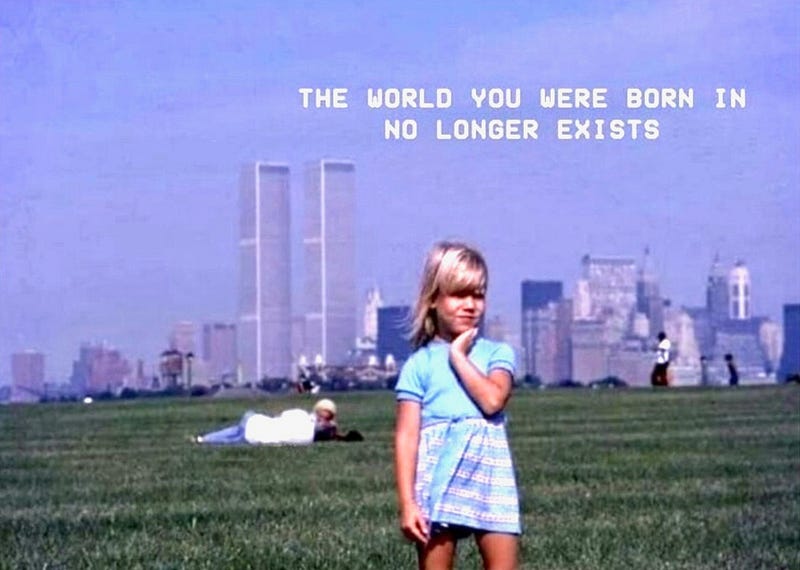
I was five years old when 9/11 happened. But I still had a childhood.
Sometimes it’s hard not to feel mournful for the kids growing up today. Sometimes it’s easy to understand why fewer and fewer of us are having children in this disease-ridden world. This is a difficult time to explain to the young. I have to remind myself, though, that this chaos isn’t entirely new.
There’s a growing part of me that’s beginning to feel sympathetic for what my parents must have gone through in raising me. Throughout so much of my life it’s been easy to view my mother and father as sure-footed adults. It’s been painful growing to understand that they, too, were once children who were so suddenly thrust into a daunting world of adult decisions and responsibilities. It’s strange to think how dizzying that must have been for them too, and stranger still to think how terrifying it must have been to bring a child into this dizzying, dizzying world.
I was five years old when 9/11 happened and it’s one of the very first memories that I have. It was the first time I saw adults confused and scared. My mom drank her morning coffee with tears in her eyes and sat in her beige-blue recliner, eyes glued to the cathode ray tube television screen as billows of smoke rose from the North Tower of the World Trade Center. She wrestled alone with the idea of driving her only son into preschool that day, unsure whether or not her country was under attack.
In school that day the teachers were equally unsure how to behave, how to protect us from the reality of what was happening. They were focused on that same TV screen that my mother had been captivated by. They stared at it, shell-shocked, teary-eyed and muttering quietly amongst themselves. I wondered why.
If ever I’d been in the room with the news on, it had never been positive — mounting chaos in the Middle East, explosions and terrorist attacks weren’t unusual. They were staple features of that weird talking head chatter adults seemed to like so much. It felt difficult to understand that this seemingly banal part of adult’s entertainment experience could be upsetting them more than the Lion King had upset me.
Now, when I see my little cousin, his smile gleams — even through his mask. In these moments, I see flickers of the joy that this world can offer. But only flickers. He’ll grow up. His ecstatic smiles will fade with the passing seasons. I resent the things he’ll have to see, the new normals he’ll have to accept.
I want to protect him from them, from any of the futures that might force him to look back fondly on these strange days of domestic decay. I wish he understood the childhood he was missing — not so that he could envy it, but so that he might somehow transcend all of this turmoil. It’s a lofty vision.
But when he does think back on these earliest days, what will he remember? Will he think longingly about these dystopian days in the same way I think about the morning cartoons, MP3 players and the extinct candies of my childhood?
Will the thought of masks trigger the warm, fuzzy yearning that the SpongeBob theme song and smell of Eggo waffles do for me? Will he look back at all of this confusion and remember only the calm? Will he fall into the illusion of thinking that we terrified adults actually have some grasp on the ground beneath our feet?
I don’t remember much of what happened immediately after 9/11. I don’t remember the confusion or the feelings of unity that followed. I don’t remember the ground shifting at a break-neck pace beneath my feet. But by the next time I walked into an airport, it surely had. I didn’t understand that yet though.
My world was jungle gyms and kickball games, Nintendo 64 and tree-climbing, Gameboy games and caterpillar hunts. The wars in Iraq and Afghanistan were abstract concepts that could never have distracted me from my games of make-believe Jurassic Park with my best friend Gabe.
I was privileged. Disease and starvation and insanity and addiction and grief were things that I was aware of, but only loosely. They could slip my mind unnoticed for entire weeks at a time.
It’s easy not to notice the future being sold out from beneath our fingertips when the payments happen in installments. Where was I when the wars started? Was I swinging on the jungle gym or playing Simon Says when the troops were deployed?
Where was I when Steve Jobs invented the first iPhone? Was I catching fireflies or jumping on a trampoline when the stock market collapsed? Somewhere stretched in between silly band bracelets, or lost in old cartoons, or concealed within the distant echoes of ice-cream truck jingles, our futures drifted quietly away from us.
Is it actually possible that children today can see the beauty beyond all of this chaos we’ve left them? It’s hard for me to imagine, but then, I’m not nearly as good an imaginer as I once was.
Help support me by signing up for Medium here! By signing up through this link, you’ll be giving me a direct commission as well as getting access to the work of thousands of other writers. Thank you so much for reading!


