
Two Things to Practice If You Want to Achieve Your Goals
It’s less about how often you practice, and more about how and what
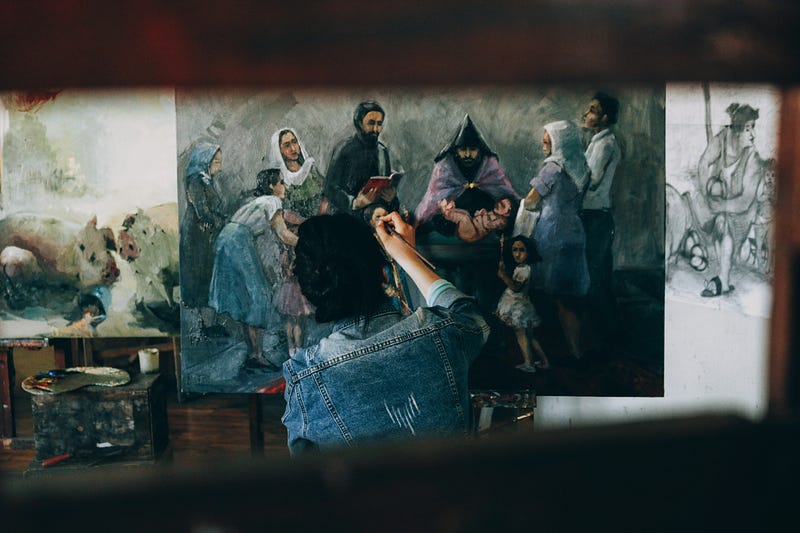
All people are artists, and most of us are working to make our life canvases as beautiful as they can be.
And for any work of art to be truly exquisite, the artist must practice his craft. This is also true of the “art” we create in our lives.
But the fact is not just any practice will produce a magnificent piece of art (or a well-lived life). That kind of artistry requires strategic practice, willpower, and laser-sharp focus.
One of the greatest artists in history, Michelangelo, is proof of this.
He stated of his craft that “a man paints with his brains and not with his hands,” and this is probably why his greatest masterpieces took so long to complete. For example, his famous sculpture David took two years to finish. His painting of the Sistine Chapel took four.
All it takes is one look at his work to see he carefully contemplated each piece of marble and each brushstroke. He probably first imagined the end result, then chiseled and re-chiseled, painted and repainted, until what he saw with his eyes matched the vision in his head.
Part of Michelangelo’s genius was that he understood something we all need to consider when trying to accomplish our goals: the hands work quicker, but the brain works better. And this is why we need to be willing to change our approach, revise the way we practice, and expand our timelines to achieve our aspirations.
Here are two steps to get you started.
Step One: Practice Deliberately
Successful self-help authors Tony Robbins and James Clear both emphasize the importance of “deliberate practice.”
Deliberate practice differs from regular practice in that it is not a “drill and kill” activity. The main philosophy of deliberate practice involves understanding the adage of “practice makes perfect” is flawed.
Of course, showing up and putting in the work is always essential, but people who practice deliberately know this activity is not enough to ensure significant progress.
For example, in an article entitled “The Beginner’s Guide to Deliberate Practice,” James Clear emphasizes that “mindless activity is the enemy of deliberate practice,” explaining “the danger of practicing the same thing again and again is that progress becomes assumed.”
In other words, we often conclude that simply repeating an activity is the key to overall improvement. But those who practice deliberately embrace another strategy, which Clear outlines as a four-step process. He states:
“Deliberate practice always follows the same pattern: break the overall process down into parts, identify your weaknesses, test new strategies for each section, and then integrate your learning into the overall process.”
In simple terms, deliberate practice means recognizing that the small picture is more important than the big one. It involves separating the skills required for optimal performance into individual practice sessions with specific purposes.
For example, an artist whose goal is accurately drawing human features may deliberately practice only on mastering his representation of the human eye. This practice may involve studying other artists’ work, watching tutorials, and then experimenting with different shapes, sequences, and strategies to achieve his objective.
However, the next deliberate practice session may involve honing his skill in recreating the human nose or lips.
By breaking down the essentials of his craft into separate chunks, the artist’s goal of accurately capturing the human face will be more successful than if he simply draws the whole face each time he practices.
Another example of deliberate practice can be seen in the steps taken by a person whose goal is to lose weight. For instance, he or she could “practice” a morning routine. During these sessions, the focus would center only around the beginning of the day activities, with the sole purpose of adding more movement and making more nutritional choices.
By placing the emphasis only on these hours and experimenting with different ways to incorporate physical activity and healthy eating, one essential piece of the person’s weight-loss equation begins to be solved.
And we can apply this same type of deliberate practice to move us closer to the personal goals you’ve set for yourself.
Step Two: Practice Patiently
Let’s say you are the artist mentioned above. You would likely experience frustration at spending so much time on such small parts of the bigger picture. After all, you want to draw a perfect face now, not only an ideal set of eyes or lips. And while the desire for immediate gratification is natural, the psychological hurdles it creates are poisonous to one’s overall success.
Entrepreneur states that “frustration is the emotional energy that drives quitting.” And if we allow this frustration to build up, every aspect of our goals is put in danger.
For example, Lifehack compares both impatience and patience to “energetic components” that affect how quickly and easily we can achieve success, stating:
“If we regularly lose our cool, we create an energetic space of resistance. This makes it difficult to achieve what we want and slows the manifestation process down.
Through the virtue of patience, we place ourselves in the energetic space of allowance. This means we can achieve more, often in less time and without the need to push. We create a pull motion instead.”
In other words, when we experience the anger, fear, and self-doubt that accompanies impatience, we hinder the very processes needed to make forward progress.
Think about the physical and emotional drain that occurs when we spend a lot of time waiting (and worrying) that our work is not paying off as quickly as we hoped. By obsessing so much over the passing of time, we lose the motivation, inspiration, and energy that allows us to achieve more in the present.
Forbes explains the repercussions of this cycle of negative thought, emphasizing that the end product is “mental fatigue,” a condition that “sends your brain into overdrive, leaving you exhausted, hampering your productivity and overall cognitive function.”
So when we hold on to frustration because the results we want don’t appear as quickly as we like, we impede our ability to think logically. Fatigue also sets in due to the mind-body connection, leaving us too tired to do the things needed to continue to improve. In addition, our brain often shuts down its creative faculties because there is simply not enough energy to think imaginatively.
The solution?
Relax. Come to terms with the fact that very few success stories happen in a short amount of time. Believe in the process. Understand the work you are doing and the time you are spending will all pay off in the long run.
The Bottom Line:
Artist Leonardo DaVinci says, “One can have no smaller or greater mastery than mastery of oneself.”
So perhaps that is the most critical skill we need to practice. Because if we can accomplish this feat, we become capable of reaching the success we previously thought impossible.
It’s no secret that our ambitions are complicated puzzles not easily solved. And racing against a clock that stubbornly refuses to cater to our desires causes psychological chaos that eats away at the likelihood of achieving our aims.
Scattering puzzle pieces looking for random connections is not the real way to see our passions realized. The best method requires focusing on each small piece and how it connects to the whole picture. And most importantly, it involves accepting that completing the puzzle may take a while.
The good news is when we embrace these truths, we can be satisfied knowing that while others may have completed the puzzle more quickly, our final product will be more perfect. Each piece will blend seamlessly into the next — no rough edges, no bent pieces, no jutting bumps that show we have frantically forced one piece into another. And that end result is what separates the apprentice from the artist.
So paint thoughtfully, practice mindfully, and forget the ticking of the clock. Sooner than you think, you may create the masterpiece you’ve been longing for.