Two Social Media Platforms Every Writer Must Use for Personal Branding
As a writer, own your brand
As a writer, do you see yourself as a brand?
I did a quick Google search on a writer I follow, Ev Williams. If you are writing on Medium, you know who he is, he happens to be the guy who started this writing platform.
Yet, if you Google his full name, Evan Williams, Google thinks you are searching for the Evan Williams bourbon whiskey brand. Ev comes second.
It could be the reason, he chose to be called Ev, which if you search for, will give you the results for the electric vehicle.
On Google, he is Ev Williams, the technology entrepreneur, and he also writes on Medium.
Who can better be the face of the brand, than the one who started it all? In the same way, Apple had Steve Jobs. We buy things because we like the brand, and in most cases, we like the person behind the brand.
If you are writing on Medium, maybe you happen to like Ev Williams.
People buy people. In the world we live in now, even writers need personal branding.
It all starts with what people see on the search engine results page (SERP) about you. Everyone searches everyone, readers will search the name of the writer they fancy, and that happens to be you.
Brand vs People
On Google search, brands take precedence over people. In the world we live in today, people are brands too. People google people, and for writers, we need to start owning our brand, because you are your brand.
Writers, own your brand.
But I am a writer, I only want to write.
If that is, how you view your writing, writing is your hobby, which isn’t bad at all, we all have our hobbies.
As a writer you need to tell your story, Dr. Sean Gresh from Northeastern University, said it best, “Personal branding is one’s story.”
And this is what separates us from the rest, we have a gift for words, telling our own story comes second nature to us. We as writers can create the narrative about our brand, the way we want it.
Author’s website vs Social Media
Ideally, authors or writers should have a website. As writers on Medium, we own our stories, our content, but we don’t own the platform.
It is easy for anyone to own a website. There are a plethora of choices, it all starts with registering your brand as a domain name. Your name, your brand, your website.
It is still cumbersome, especially for those who see their writing for now, as a hobby and not as a career or a business.
The next best thing is to be on social media. If you want, you can create a separate social media presence for your writing.
Be on these social media platforms
As a writer, you have to be on Twitter. Some writers use Twitter to spread the word about the stories they have written or published. It is a place to communicate with your audience or fans and fellow writers. Twitter is where you share your thoughts as a writer in bites and pieces.
And if you are not yet on Medium, every writer or blogger should be on it. Medium has a high domain authority rank which means Google trusts the website.
Did I just say Medium is a social media platform?
IMHO, Medium in some ways, is a social media platform, instead of likes, stories get claps and responses, and instead of friends, people can follow you. It is like Twitter and Blogger put together, both are Internet platforms that Ev Williams founded.
A story can be shared, with other people through other social media platforms like Twitter.
With your presence on Twitter and Medium, it can help you dominate Google search results about you as a person, and as a brand.
Why not the other social media platforms?
They are good for other things but not for dominating Google search results. Google seldom shows results from Facebook, if at all, crawls Facebook posts.
Facebook is a great way to reach new audiences and readers.
As writers, we don’t want to think about marketing, unless we move from a mindset of a writer to that of a writer-preneur. For us, less is more, and in the process of creating your brand as a writer, you only need Twitter and Medium.
Creating a Personal Branding Identity on Google
Why Google?
You need to be where people do their online search, and Google remains to be the biggest search engine in the world.
Your presence on Medium and Twitter helps a lot. The content you write on these social media platforms is all yours, you have full control of what will show up on Google.
If you are a Medium writer, you have won half of the battle. The stories you write and publish, help you with building, your brand. On Google, it can show up on the results page.
The recent change on Medium as it moves towards being a more relational Medium, allows you to change your account URL to a subdomain or you can choose to keep it as a subdirectory.
Either way, the URL is key to improving your search results on Google. Remember that, Medium has a high domain authority rank which Google loves.
Both your Twitter profile and Medium profile will show on top of the search results.
Most of the time, Wikipedia dominates the featured snippets the first thing that shows up on Google results.
About featured snippets
Featured snippets are in a special box at the top of your search results with a text description above the link. If you search with the Google Assistant, featured snippets might also be read aloud. Most featured snippets only contain one listing.
Featured snippets include: Information quoted from a third-party website. A link to the page. The page title and The URL of the page.
The quoted content in featured snippets can be a paragraph, a list or set of steps, or a table. — Source: Google
Wikipedia is different, it is an oddball. Its neutral point of view (NPOV), means it isn't a good place for a brand or personal brand. Once you are on Wikipedia, it is open for revisions, which means, you have no control of what Wikipedia says about you as a person or as a brand.
Which makes it even more important to be on Twitter and Medium, in most cases occupy the second and third spot of the Google search result page.
The Ev Williams personal branding case study.
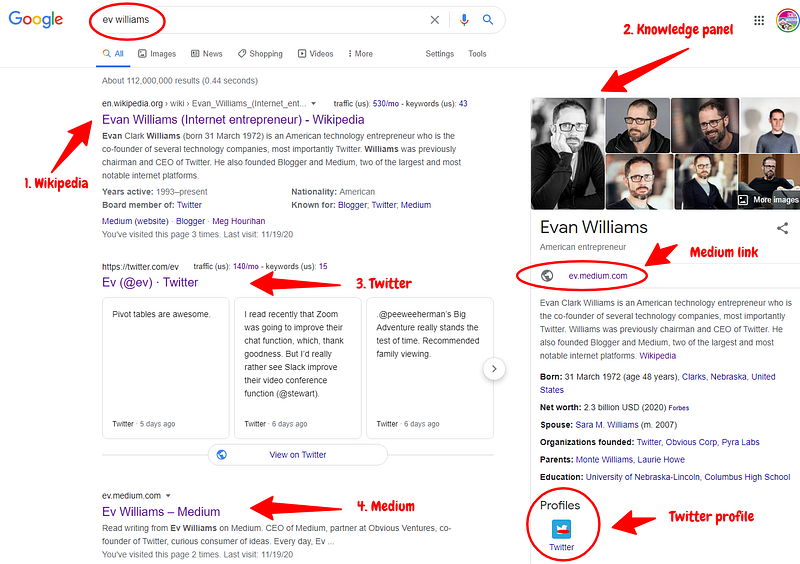
On desktop, SERP will look like this:
- Wikipedia article about Ev Williams.
- Real-time tweets from Ev Williams’s Twitter account.
- Ev Williams’s Medium Blog — his About page.
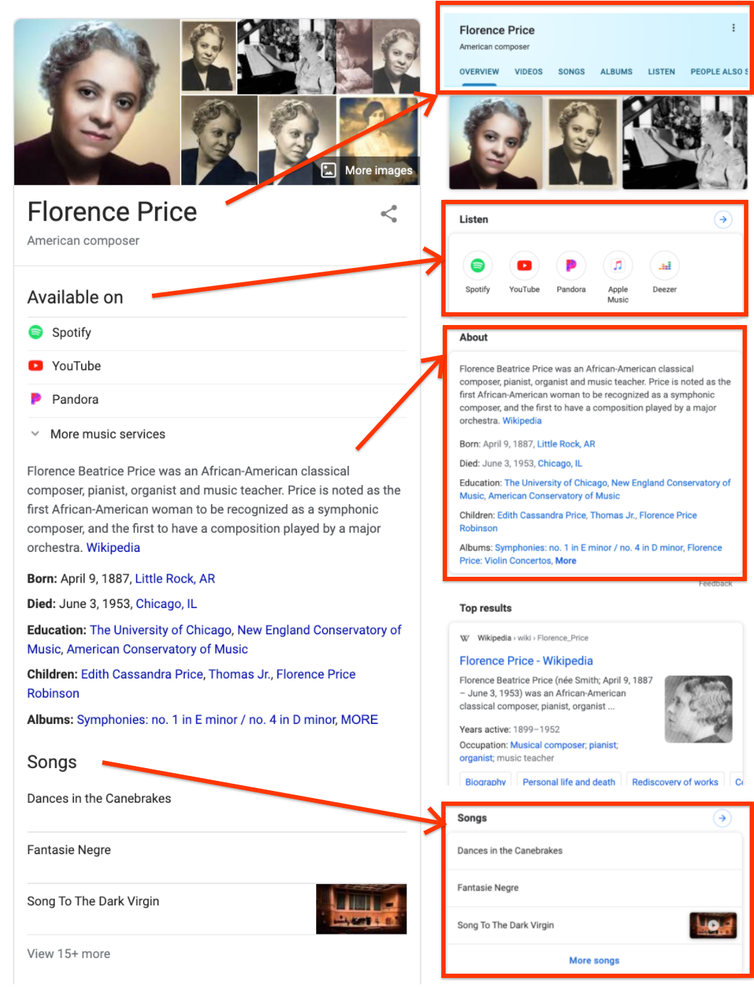
- The Google Knowledge Panel
Google Knowledge Panel — What is it?
Here comes the interesting part, the information displayed on the right is called the knowledge panel. Most of the information that you see on Google Knowledge Panel comes from Google’s Knowledge Graph, our database of billions of facts about people, places, and things. The Knowledge Graph allows us to answer factual questions. One of its favorite sources is Wikipedia.
From Google: Our systems aim to show the most relevant and popular information for a topic within a knowledge panel. Because no topic is the same, exactly what is shown in a knowledge panel will vary. But typically, they’ll include:
1. Title and short summary of the topic
2. A longer description of the subject
3. A picture or pictures of the person, place or thing
4. Key facts, such as when a notable figure was born or where something is located
5.Links to social profiles and official websites
Knowledge panels might also include special information related to particular topics. For example:
1. Songs from musical artists
2. Upcoming episodes from TV shows
3. Rosters of sports teams.
On mobile, where most search activity is happening, information gathered by the Knowledge Graph appears interspersed with the overall results. The Knowledge Panel appears on top of the mobile search results.
For comparison, you can see how the information gathered by the Knowledge Graph appears on mobile.
Building your brand on social media
We focus on where you have full control of what people can see or read about your brand online, on Twitter, and Medium.
Even Ev’s Medium blog URL is prominent on top of the knowledge panel, https://ev.medium.com/.
This is where, as writers, we need to be as creative as we can be when we write about our About Me page.
On Medium, you have 160 characters, make it work for you, and remember it shows up on Google results too.
The same goes for Twitter, you have 160 characters, to add to your Twitter profile.
Think of your About Me page, as an elevator pitch, what your readers should know about you in 30 seconds or less or 160 characters. Be creative.
As a tip on self branding, I linked my Medium blog URL on my Twitter, and connected my Twitter to Medium, you can read my About Me page here.
Consistency is the key. Look at how Ev does it, he is Ev on Twitter and Medium. You might argue that he is Ev Williams and we are not, but still, you need to be consistent on social media.
Final thoughts on Branding
But why even bother with branding?
In the world we live in, trust is a valued currency and as people get to know you, that currency increases in value and so is your brand.
If writing is your second or third act like mine, people don’t know you are now a writer. To help me grow an audience, I need to reintroduce myself as a brand. I have to reinvent my brand and it starts with taking stock of what people already see online.
Taking control of the narrative
As writers, we tell stories, and as Dr. Sean Gresh from Northeastern University, said, “Personal branding is one’s story.”
As with finding your writer’s voice, it will take time to build your brand. The only thing we need to remember is a brand should never veer away from its core values. As a writer, you need to be true to yourself and your audience.
I live, by what Steve Jobs said about marketing, “Marketing is about values, and think different.”