
Two Reasons Why We Make Mistakes
And a few tips on how to deal with being human.

In 1999, psychologists Christopher Chabris and Daniel Simons released their famous basketball video. If you've never seen it, I invite you to watch it before you read the rest of this article. It's less than a minute and a half. The spoiler alert is below.
I've used this in leadership development workshops for many years; on average, one-third to one-half of participants did not see the gorilla. In a study at Harvard, Simons and Chabris reported that fifty percent of participants missed the suited-up beast pounding its chest as it danced across the screen. Many people are shocked they didn’t notice what was right before their eyes.
Kind of like real life.
Simons and Chabrus explain missing the gorilla because of inattentional blindness: when people are focused on one thing, they can easily overlook something else.
That's why talking on a cell phone while driving is dangerous — the brain is engaged in one thing and can't take all the available information.
Let's face it: we live in a very switched-on, overstimulated world, constantly bombarded with sensory input.
The busier we are, the heavier the load we carry, and the more stressed out we are, the more likely we can miss essential information, make less than fully informed decisions, judge others and situations quickly, and jump to conclusions without considering all the facts.
So, inattentional blindness is one reason we make mistakes, but there's another, too.
Former Harvard professor Chris Argyris explained how our brains selectively take in data, add meaning, and form conclusions and beliefs in milliseconds. He captured this neurological process in a model called the "Ladder of Inference."
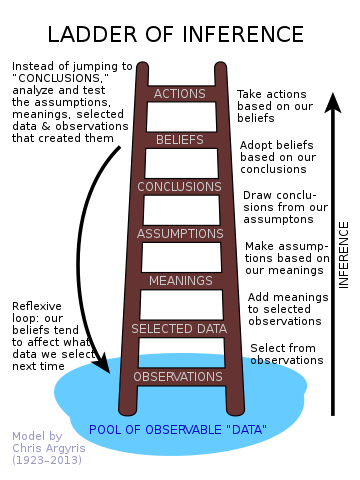
It's easy to make assumptions and false interpretations — our brains do it automatically, wanting to finish what they interpret as incomplete stories.
Someone we know ignores us when we pass by them; we complete the story by thinking they're aloof or avoiding us. We worry they're ghosting us if someone doesn't promptly answer an email. Our boss calls us unexpectedly to a meeting; we think the worst.
These are undoubtedly problematic to a degree, but the real problems occur when we act on our incorrect inferences and false stories. Who among us hasn't caught themselves making an assumption about someone, only to realize later the assumption was completely wrong?
Argyris's theory also applies to what happens when our made-up stories become beliefs.
Anna Pease, the senior editor at Management Consulted, says,
Once you form strong beliefs, you may find yourself increasingly selecting data that ends up reinforcing those very same beliefs. This is the “reflexive loop.” It leads you to quickly move up the ladder toward decisions and actions that seem very fact-based. But in reality, they are ultimately a function of the beliefs you had before even considering the objective facts of the situation.
This "reflexive loop theory" helps explain why it's difficult for people to change firmly held beliefs and biases.
Imagine someone you know has a reputation for being obnoxious at social gatherings. People will be on the lookout for that person's bad behavior. If someone is consistently quiet in team meetings, those who think that person is disengaged will look for evidence of disengagement. Strong political views are strengthened by selectively choosing facts that support a particular belief.
We find what we focus on.
So, we're human, and it's easy for us to make mistakes, not a big revelation.
But there are a few things we can do to meet the challenges we face and handle them skillfully.
Welcome to the middle path.
The middle path.
Buddhist philosophy invites us to live not through extremes like indulgence or self-denial but by pursuing the middle path, where we discover the merging of what lies on the edges.
When we walk the middle path, we are between aggressive and passive, attachment and aversion, or gullible and dismissive. We are curious, open-minded, and forgiving of ourselves and others, seek balance, and strive to maintain present-moment awareness.
The principles of the middle path help us live more conscious lives, and if we get off track, we recover more quickly.
Here are a few middle path principles.
Self-awareness.
We develop self-awareness through life experience, feedback from others, and a commitment to personal growth, introspection, meditation, mindfulness, and other spiritual practices.
The more self-aware you become, the more you know your strengths and weaknesses and how to integrate opposite characteristics.
If you have an aggressive personality, learn to take a breath, slow down, and not get hooked. If you're more passive, learn to stand your ground.
If you speak too much, learn to listen and engage in dialogue. If you are very quiet, learn to speak up.
Curiosity.
Are some of us born more curious than others? Perhaps. Can we develop more curiosity? I say yes, we can.
I developed more curiosity when I surrounded myself with curious, open-minded people. I noticed their attitudes, how they asked questions, and how they expressed their opinions with strength, honesty, and respect. I learned that becoming more curious didn't weaken me. It made me stronger.
Yes, the company we keep makes a difference.
Practically speaking, how can we be more curious?
Want to build a better relationship with someone? Have a conversation about what you don't know about each other.
Not sure what to make of a situation you're faced with? Before making a decision, ask what you don't know.
Before you judge someone for doing something you wouldn't do, ask yourself what you don't know about them.
Staying with what you know gets you nowhere. Asking what you don't know blazes new ground. Learning and growth require sticking your neck out and being uncomfortable.
Real listening.
Author Stephen Covey said, "We do not listen to understand. We listen to reply."
Real listening means shutting down the internal commentary and the "rehearsal effect," a term coined by psychologist Carl Rogers. The rehearsal effect is the response you create in your head when someone is speaking.
Who hasn't played around with the words to get them "right" to eloquently prove our point, win the argument, or show how smart we are? Of course, while we are rehearsing our rebuttal, we're not listening — we're merely waiting for them to finish so we can speak. No wonder there's so much conflict in the world — rarely is anyone fully listening to someone else.
The next time you listen to someone, breathe deeply and lock into what they're saying. Forget about the chatter in your head.
Open-mindedness.
The more self-aware and conscious we are, the more we realize our view of the world is only one perspective of many. When we lack self-awareness, we believe our view of the world is the right and only possible stance. This is arrogance at its finest.
Arrogance says differing points of view are wrong, and anyone with one of those is a jerk. Nobody thinks someone who agrees with them is a jerk. Jerks are only those in disagreement. (The next time you think someone is a jerk, notice that you disagree with them).
When we accept our view of the world is one of many, we're on the middle path.
Final thought.
"We do not see things as they are. We see things as we are."
— The Talmud
Get a free copy of 111 Inspiration Quotes here, along with an occasional newsletter and updates on my soon-to-be-published book.


