avatarMeziechi Nwogu

Free AI web copilot to create summaries, insights and extended knowledge, download it at here

2470

Abstract

<figcaption><b>Image Credit: <a href="https://economictimes.indiatimes.com/magazines/panache/chinas-zhurong-rover-explores-mars-sends-pictures-of-dusty-rocky-red-planet/articleshow/83457206.cms">the Economic Times</a></b></figcaption></figure><h1 id="93ec">New International Space Station Owned by China</h1><p id="90e0">China, on June 17th, launched the Shenzhou-12 spacecraft with three Chinese astronauts onboard the Y12 carrier rocket from the Jiuquan Satellite Launch Center situated in Inner Mongolia.</p><p id="5b3c">They will be the first in a steady stream of Chinese astronauts to work at Tianhe. The<a href="http://www.xinhuanet.com/english/2021-04/29/c_139915159.htm"> 22-ton</a> Tianhe is the core module of a future Chinese space station (Tiangong space station). It will serve as the control center and host three astronauts for 3–6 months.</p><p id="0b38">By 2022, the two lab modules, the Wentian and Mengtian, will be attached to the Tianhe. Both module increase will increase the total weight to<a href="https://www.globaltimes.cn/content/1189098.shtml"> 66 tons</a>.</p><p id="e8c0">When spacecraft dock with the Tianhe during crew missions, <a href="http://www.xinhuanet.com/english/2021-04/29/c_139915159.htm">the weight will further increase to 100 tons</a>.</p><p id="ca6f">The Tiangong space station is built and designed to last for 10 years. However, with repairs and refits, the space station can last for 15 years.</p><p id="b662">The US-led International Space Station will be funded until 2024. After 2024, nobody is sure whether it will still be supported. If that is the case, then the only available space station after 2024 will be Chinese. Previously, the US refused China to use the International Space Station; it wouldn’t be surprising if China returned the snub.</p><p id="2a14">Constructing the Tiangong space station will offer the world an alternative to the International Space Station (ISS) for conducting space science experiments. Already, China, in May 2018, issued a call for applications for scientific experiments to <a href="http://www.unoosa.org/oosa/en/informationfor/media/2018-unis-os-496.html">be hosted in its space station</a>. So far, China has <a href="https://spacenews.com/international-experiments-selected-to-fly-on-chinese-space-station/">accepted applications</a> from institutions based in Belgium, Germany, France, Japan, India, Italy, the Netherlands, Norway, Russia, Spain, Switzerland, and others.</ # Options p><p id="0d0a">Some of the experiments to be carried out include the effect of space radiation, space medicine, bioengineering, microgravity, and others.</p><figure id="174d"><img src="https://cdn-images-1.readmedium.com/v2/resize:fit:800/0*0l0JPZ4qxVajTBaH"><figcaption><b>Image Credit: <a href="https://theconversation.com/chinas-tiangong-space-station-what-it-is-what-its-for-and-how-to-see-it-160456">the Conversation</a></b></figcaption></figure><h1 id="5dc0">China’s View of Space</h1><p id="9fc8">The International Space Station is where American and Russian astronauts work together even as their governments point nuclear missiles at each other.</p><p id="9701">Michael Collins, one of three astronauts on America’s Apollo 11 mission to the moon in 1969, <a href="https://time.com/5624528/michael-collins-apollo-11/">told</a> a journalist from <i>Time:</i></p><p id="4561"><i>“I’m very much in favor of international cooperation. After the flight of Apollo 11, Neil, Buzz and I were lucky. We made a round-the-world trip. I think 25 major cities, something on that order. And I was flabbergasted. I thought that when we went someplace they’d say, “Well, congratulations. You Americans finally did it.” And instead of that, unanimously the reaction was, “We did it. We humans finally left this planet and went past escape velocity.” That’s not the terminology they used, but I thought that was wonderful. North, white, rich, poor, black, white, east, west — what other achievement can bring all of those disparate interests together? Nothing I can think of, except the first lunar landing did. Albeit very briefly. But it did.”</i></p><p id="6fde">Compare the statement above with what Ye Peijian, the Chief Commander of the Chinese Lunar Exploration Program, said in <a href="https://www.wsj.com/articles/china-pushes-for-primacy-in-space-11546171206?mod=article_inline">2017</a>: <i>“the universe is like the ocean: the moon is like the Daioyu Islands, and Mars is like Scarborough Shoal.”</i></p><p id="8f3f">The Scarborough Shoal is an island in the Philippines, while Diaoyu is the Mandarin name of Japan’s Senkaku Islands. China is claiming the Senkaku Islands as its territory and has unilaterally annexed Scarborough Shoal.</p><p id="cb12">Many view space as a place where countries can set aside their disputes and cooperate with each other. Unfortunately, Beijing views space as an extension of its rivalries with the United States.</p></article></body>

Two Giant Leaps by China Regarding its Quest to Conquer Space

Beijing’s space ambitions reach new heights.
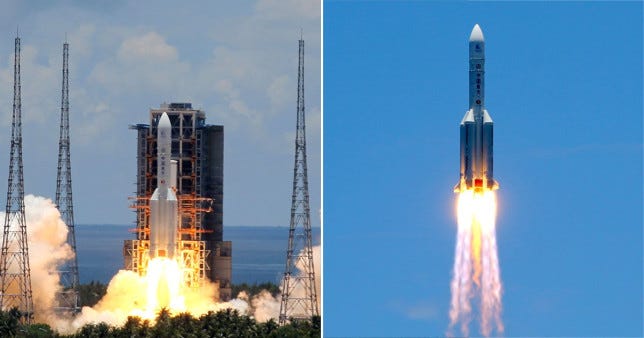
Image Credit: Metro.co.uk

China recently completed two monumental accomplishments in outer space exploration. The first involved landing a rover on Mars.

Thus, China is the third country to ever land a spacecraft on Mars, after the United States and Russia.

China is the sixth country to successfully get a probe to Mars, after the United States, the Soviet Union, India, the European Space Agency, and the United Arab Emirates.

China’s second accomplishment was the launch of three astronauts to reach the Tianhe core module.

Mars Mission

The Mars mission’s name is Tianwen-1, which means “Questions to Heaven”. Beijing launched a spacecraft in July 2020, and it landed on the red planet in May.

Once the spacecraft landed, it released the Zhurong rover, which began its Mars tour on May 22nd.

Zhurong is exploring Utopia Planitia, also known as Nowhere Land Plain. It is a basin in northern Mars created possibly through a meteor impact. Therefore, the Zhurong rover will analyze the region’s geological structure, soil features, ice level, and other characteristics.

Zhurong both launched and landed around the exact times as America’s Perseverance rover. Many saw the coinciding launches and landings as a new US-China space race & competition.
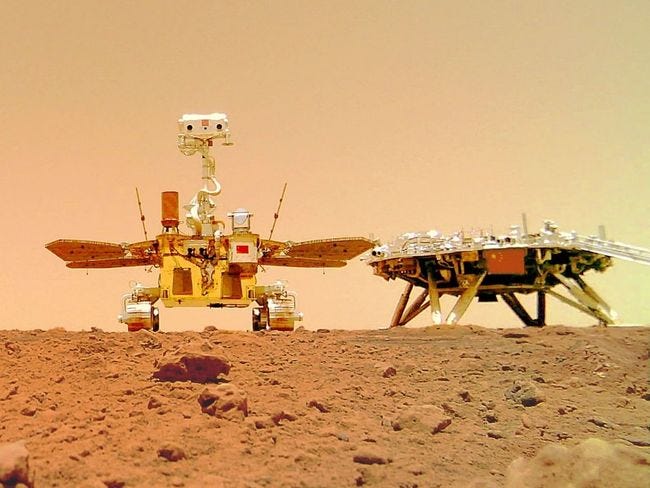
Image Credit: the Economic Times

New International Space Station Owned by China

China, on June 17th, launched the Shenzhou-12 spacecraft with three Chinese astronauts onboard the Y12 carrier rocket from the Jiuquan Satellite Launch Center situated in Inner Mongolia.

They will be the first in a steady stream of Chinese astronauts to work at Tianhe. The 22-ton Tianhe is the core module of a future Chinese space station (Tiangong space station). It will serve as the control center and host three astronauts for 3–6 months.

By 2022, the two lab modules, the Wentian and Mengtian, will be attached to the Tianhe. Both module increase will increase the total weight to 66 tons.

When spacecraft dock with the Tianhe during crew missions, the weight will further increase to 100 tons.

The Tiangong space station is built and designed to last for 10 years. However, with repairs and refits, the space station can last for 15 years.

The US-led International Space Station will be funded until 2024. After 2024, nobody is sure whether it will still be supported. If that is the case, then the only available space station after 2024 will be Chinese. Previously, the US refused China to use the International Space Station; it wouldn’t be surprising if China returned the snub.

Constructing the Tiangong space station will offer the world an alternative to the International Space Station (ISS) for conducting space science experiments. Already, China, in May 2018, issued a call for applications for scientific experiments to be hosted in its space station. So far, China has accepted applications from institutions based in Belgium, Germany, France, Japan, India, Italy, the Netherlands, Norway, Russia, Spain, Switzerland, and others.

Some of the experiments to be carried out include the effect of space radiation, space medicine, bioengineering, microgravity, and others.
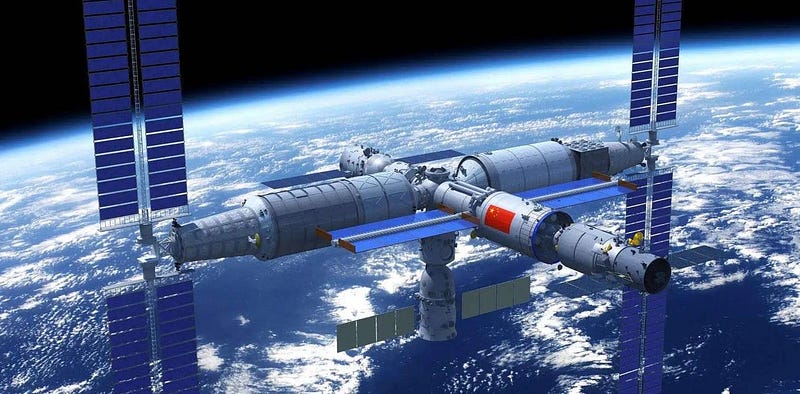
Image Credit: the Conversation

China’s View of Space

The International Space Station is where American and Russian astronauts work together even as their governments point nuclear missiles at each other.

Michael Collins, one of three astronauts on America’s Apollo 11 mission to the moon in 1969, told a journalist from Time:

“I’m very much in favor of international cooperation. After the flight of Apollo 11, Neil, Buzz and I were lucky. We made a round-the-world trip. I think 25 major cities, something on that order. And I was flabbergasted. I thought that when we went someplace they’d say, “Well, congratulations. You Americans finally did it.” And instead of that, unanimously the reaction was, “We did it. We humans finally left this planet and went past escape velocity.” That’s not the terminology they used, but I thought that was wonderful. North, white, rich, poor, black, white, east, west — what other achievement can bring all of those disparate interests together? Nothing I can think of, except the first lunar landing did. Albeit very briefly. But it did.”

Compare the statement above with what Ye Peijian, the Chief Commander of the Chinese Lunar Exploration Program, said in 2017: “the universe is like the ocean: the moon is like the Daioyu Islands, and Mars is like Scarborough Shoal.”

The Scarborough Shoal is an island in the Philippines, while Diaoyu is the Mandarin name of Japan’s Senkaku Islands. China is claiming the Senkaku Islands as its territory and has unilaterally annexed Scarborough Shoal.

Many view space as a place where countries can set aside their disputes and cooperate with each other. Unfortunately, Beijing views space as an extension of its rivalries with the United States.

News
Politics
Space
World
Recommended from ReadMedium