
Two Crows
And Their Human Assumptions
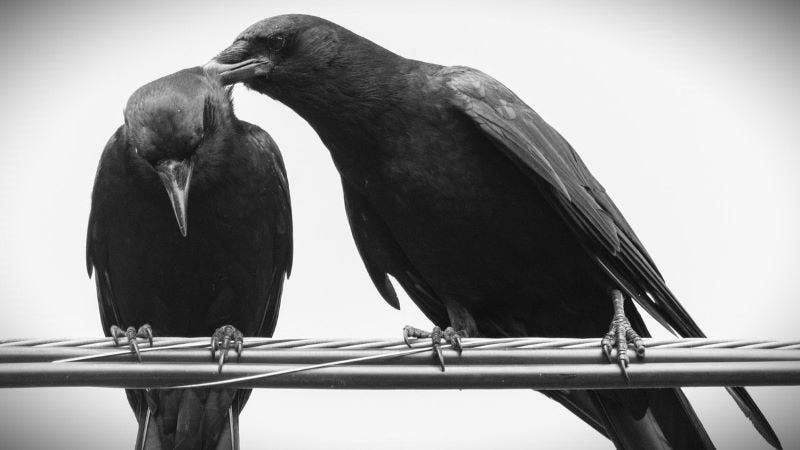
Two birds on a wire She’s giving him an earful He blinks a lot
True story. I saw them. Mr. Crow a little larger than Mrs. Crow. Mrs. Crow turned toward Mr. Yap, yap, yapping away. And then some more of the same.
Mr. Crow stares straight ahead and he does blink a lot. A lot.
Of course, what I saw could have been a totally different scenario. It could have been Crow Senior and Crow Junior (I don’t know how to tell the sex of crows, especially from a distance). Junior asking, for the two hundredth time for permission to fly into and over the nearby, and to Junior inviting forest. Senior, who has stated, many more times than once, that if Junior ever asks again, he, Senior, will not respond. The answer is already given and is a standing answer and it is NO. Blinking to prove how much he is now ignoring Junior.
But why, why, why? Junior Yap, yap, yaps on while Senior studiously ignores. He has told Junior why already. Many times. The nearby forest is not safe for a young crow, who is still too small to defend himself, too is still too slow to outfly pursuers. Who is still too young to know better.
Junior will have none of this and so goes on and on and on hoping against hope that Senior’s reply might change. Well, it will change in a year or two, of course, but Junior is thinking in terms of minutes not years.
Of course, that might not at all have been what occurred on that wire. It could well have been the young Miss Crow pleading with her mother, Mrs. Crow, to let her marry Suitor Crow. Again, the answer is a standing NO. Suitor Crow comes from the equivalent of a Gypsy Crow Clan, sworn to never intermarry with Miss and Mrs. Crow’s clan. It is so completely out of the question that Mrs. Crow refuses to even listen, though she can’t help but blink a lot, in disbelief or frustration who knows. Meanwhile, Miss is going on and on and on at a windy rate.
Of course, that might not at all have been what occurred on that wire.
And that is the strange (or not so strange once you think about it) thing about what you see. So often you add your own scenario and interpretation. So often you make out but a small portion of what you observe before you leap, headlong and unhesitatingly straight into what you assume is going on. Based on? Well, based on previous (correct or incorrect) assumptions most likely. Sometimes even based on evidence, as it were. You ask them what is going on. They answer. You conclude: Ah, now I see. But that was then, now is now, and Mr. Crow might not be a Mr. at all. Mrs. Crow might not be a Mrs. Might not even be a crow, might be a raven, though I doubt that, based on size. And you don’t speak Crow, so cannot ask.
We have an almost unshakeable predilection to paint by numbers as it were, to fill in the missing colors in anything we observe, or the missing notes in anything we hear. It’s as if we’re allergic to the incomplete, to the fully explained, to the remaining question(s) ruining what should be certain.
It’s a very human habit. I’m as guilty as the next guy.
On the other hand, the rare, the truly observant, the truly honest, seems to tolerate the unadorned, the uninterpreted, and stays quite content with what he or she actually saw, heard, et cetera. Nothing added, nothing subtracted (which is often the case if we don’t like what we see: let’s see only half, or a quarter, or as happens sometimes, nothing at all).
I believe that many arguments or disagreements or confusions flower from the stems of the falsely adorned.
© Wolfstuff
P.S. If you like what you’ve read here and would like to contribute to the creative motion, as it were, you can do so via PayPal: here.


