
Two Books by Badass Women
An Old Testament prophet and an anti-feminist
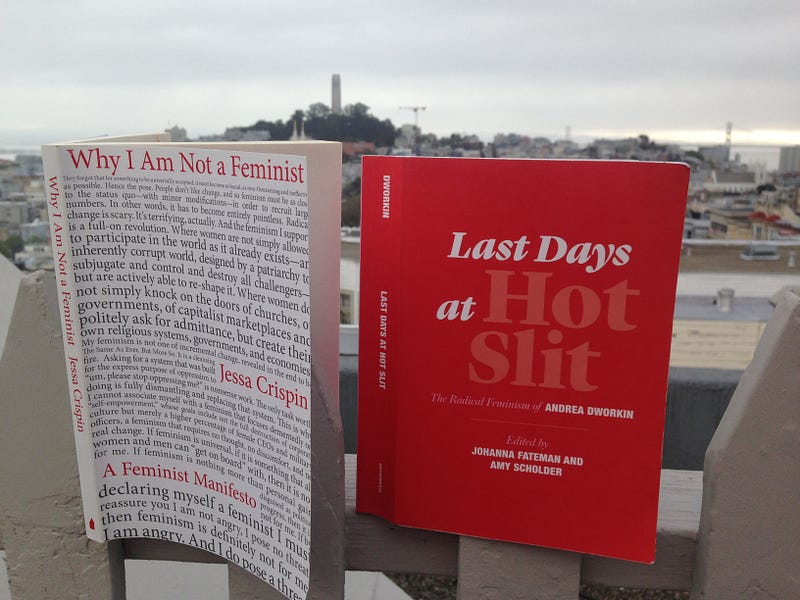
I’ve called myself a feminist my entire life but never learned anything about the history of the movement or read any feminist texts. That changed last month, when semiotext(e) came out with Last Days at Hot Slit, an anthology of writing by radical feminist Andrea Dworkin, who died in 2005 at age 58.
I’ve been curious about Dworkin for a long time, because I’d heard that she campaigned against pornography despite public scorn. I also have the impression that most pornography is pernicious, so I wanted to read the arguments of someone smarter than I am. How did she respond to the first amendment issue? On what basis did she make her case?
I liked that scholars had selected the pieces to include in Hot Slit. Otherwise, I wouldn’t know where to begin. And I liked that there was an introduction outlining Dworkin’s life, because I surely needed one.
I can’t say I got a platform to use against pornography, but I devoured the book. Dworkin’s writing is apocalyptic; it pushed me through a landscape of outrage and despair. Many of her essays were shocking and compelling. But even more compelling was Dworkin herself — the way she lived her life. Here are a few things I learned about her along the way.
Last Days at Hot Slit
The Radical Feminism of Andrea Dworkin
Dworkin was a brilliant, strong and ambitious person, but was stymied at every turn by her gender. Although her father doted on her as a child, her mother didn’t approve of her non-conformist behavior — not girly enough. And when she was molested in a movie theater at age nine, her mother deemed it unimportant (“Nothing happened!”) since it hadn’t been rape. Dworkin wrote about the experience in her essay, “My Life as a Writer.”
“The commitment of the child molester is absolute, and both his insistence and his victory communicate to the child his experience of her — a breachable, breakable thing any stranger can wipe his dick on.”
You get the picture. She’s a badass. She doesn’t pull any punches. I like that kind of writing, and my copy of Hot Slit is underlined and dog eared throughout.
In high school, a teacher seduced her, suggesting that her superior intellect made their affair a rebellion against the status quo. (Uh-huh.) Then at 18, she got arrested at an anti-Vietnam War protest and was mauled during multiple strip searches and a brutal internal exam while in jail for four days.
Upon release, with the encouragement of fellow protestor Grace Paley (whom she’d met by accident in the crowd), she wrote letters to newspapers that spurred an investigation which eventually shut down the New York Women’s House of Detention. But her arrest and graphic descriptions of sexual mistreatment alienated her parents.
Dworkin always paid a price.
Johanna Fateman, who co-edited Hot Slit and wrote the introduction, characterized that experience this way: “In an apt foreshadowing of what’s to come — at age eighteen, before her feminist awakening is even on the horizon — she’s willing to brand herself with an image of sexual shame in the name of justice.”
“At age eighteen, before her feminist awakening is even on the horizon — she’s willing to brand herself with an image of sexual shame in the name of justice.”
Fateman, by the way, is currently working on an experimental non-fiction novel about Dworkin’s life.
In her youth, Dworkin dropped in and out of Bennington College in Vermont, which was an all girls school when she attended. Her description of the atmosphere in 1966–68 reminded me of my own experience at UC Santa Barbara in the ‘70s, where my sudden realization of pervasive sexism became the theme of a nervous breakdown that sent me home my second year.
“We imagined, in or ignorance, that we might be novelists and philosophers. A rare few among us even aspired to be mathematicians and biologists. We did not know that our professors had a system of beliefs and convictions that designated us as an inferior gender class — and that that system of beliefs was virtually universal — the cherished assumption of most of the writers, philosophers, and historians we were so ardently studying.”
After graduating, while working with a peace movement in Amersterdam, Dworkin met and married a Dutchman who became abusive. She endured domestic violence for three years, eventually escaping and going into hiding with a female friend, Ricki Abrams, who gave Dworkin her first books about feminism: Kate Millett’s Sexual Politics, The Dialectic of Sex by Shulamith Firestone; and Sisterhood is Powerful, an anthology edited by Robin Morgan.
All three of those books are also mentioned in this tribute to Kate Millett which was published in the New York Times when she died in 2017. Millett’s work is called “the book that made us feminists.” Now all three books are on my reading list.
Inspired by the burgeoning feminist movement, Abrams and Dworkin began a book of their own which they planned to call Last Days at Hot Slit. But Abrams abandoned the project after friends who made pornography were offended by an early draft. Abrams wasn’t willing to take the social condemnation she knew would come from their anti-porn stance — but Dworkin was.
“We agreed that I would finish the book and get it published,” Dworkin wrote. “The vow that I made — out loud, to myself but with Ricki as witness — was that I would become a real writer and I would use everything I knew to help women.”
“The vow that I made — out loud, to myself but with Ricki as witness — was that I would become a real writer and I would use everything I knew to help women.”
Dworkin finished the book, published as Woman Hating, and kicked off her career as a radical feminist. She came back to Amerika (as she spelled it throughout her life), grew fat, wrote fiery polemics, spoke on college campuses, published widely, and for a time joined forces with the religious right in an attempt to outlaw pornography by deeming it a violation of women’s civil rights — a legal strategy which had some success in Canada.
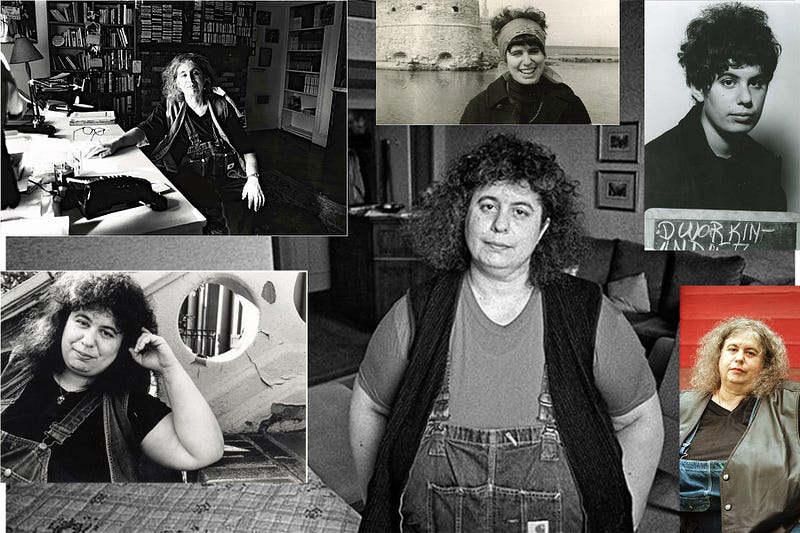
Over the years, she endured ridicule, hate and vicious criticism. She also had cherished champions and friends, including her lifelong agent, Elaine Marksman, who believed fervently in Dworkin’s work and went above and beyond the call of duty in promoting it, and her life partner, John Stoltenberg, a gay man whom she lived with for 30 years, and eventually married.
I was moved by Stoltenberg’s description of their relationship to Ariel Levy, reporting for New York Magazine after Dworkin died of myocarditis in her sleep. Here’s a quote from that story.
“‘They never tell you when you fall in love with somebody that the odds are that one of you will go first. I’ve been trying to remember when I realized — it had to have been in the first year or two — that my life’s work . . . what John Stoltenberg is here for . . .’ He starts to sob. ‘I’m sorry . . . is to make sure that her life’s work be done. I’ve done other things — things I like to do, things I’m good at — but I have never conceived of my life’s work other than as the home, the rock, the means, the support, the harbor, the net, the comfort, the embrace, whatever was needed so she could go on. ’Cause I figured it out real early that she was brilliant. I knew I was in the presence of somebody who had greatness.’”
“I figured it out real early that she was brilliant. I knew I was in the presence of somebody who had greatness.”
I found some of Hot Slit difficult to read, there are brutal and graphic descriptions of rape in the excerpts from her novel Mercy, and the essay “Whores.” Plus a close analysis of a photo that appeared in the magazine Hustler is unbearably gross and obscene.
In “My Life As a Writer,” Dworkin explains why.
“My only chance to be believed is to find a way of writing that is bolder and stronger than woman hating itself — smarter, deeper, colder. This might mean that I would have to write a prose more terrifying than rape, more abject than torture, more insistent and destabilizing than battery, more desolate than prostitution, more invasive than incest, more filled with threat and aggression than pornography. How would the innocent bystander be able to distinguish it, tell it apart from the tales of rapists themselves if it were so nightmarish and impolite? There are no innocent bystanders.”
Gloria Steinem once compared Dworkin to an Old Testament prophet. But I see her more like Prometheus, the Greek god who gave humans fire and was punished for it for eternity — tied to a rock where he got his liver eaten out by a eagle every morning. At night his liver would regenerate, only so he could endure the torture again the next day.
Just as her adulthood began with a sexual assault, so did Dworkin’s decline. Five years before her death, Dworkin published a piece in the Guardian about being drugged and then raped in a Paris hotel the year before, a story that was widely disbelieved and even mocked by some feminists like Susie Bright, who wrote on her blog that Dworkin had “completely lost her mind.”
Hot Slit, like Dworkin’s life, is dark territory. But I was inspired by its ferocity and prescience. Dworkin described the nature of intersectionality before the term existed, backed Monica Lewinsky when the whole country was against her, explained how the patriarchal system allowed Nicole Brown Simpson to be murdered, and exposed the depth of our sexual assault epidemic 50 years before #MeToo.
If Dworkin didn’t get enough respect while living, I hope she knew it would come after death. One clue that she did is a letter she wrote to the editor of the New York Times after it panned two of her books. An excerpt was included in the introduction to Hot Slit.
“I despair of being treated with respect, let alone fairly, in your pages. The review of “Ice and Fire” and “Intercourse” (May 3) is contemptuous beyond belief. In an adjacent column, Walter Kendrick, who has written a pro-pornography book and has equated me with Hitler in the pages of The Village Voice, is congratulated for insulting me. Thirteen years after its publication, your reviewer comments that “Woman Hating” is brilliant — thanks. And only four years after the publication of “Right-Wing Women,” it too is called brilliant. Don’t get ahead of yourselves. Neither book, by the way, was reviewed by the New York Times.”
After the March publication of the anthology, the Times and the New Yorker printed admiring reviews. Now Dworkin is finally getting her due.
Why I Am Not a Feminist: A Feminist Manifesto
By Jessa Crispin
If Andrea Dworkin is an Old Testament prophet, then Jessa Crispin is a stand-up comic. Her foul-mouthed sass feels airy and refreshing after the heavy weather of Hot Slit.
Many have sung Dworkin’s praises since the publication of her anthology. But Crispin did it sooner. She has long admired Dworkin, Crispin says in this 2017 book. That’s probably because they have something in common: unmitigated badassery.
Crispin starts by saying everybody is a feminist these days, then explains why that’s a problem — because the movement has dropped serious advocacy for issues that matter to women in favor of a pink-pussy-hat-wearing “feminism lite.”
Today’s feminism is a “lifestyle choice” that trumpets “girl power” while ignoring the need to burn the socio-political system to the ground. Okay!
Crispin decries the current “outrage culture” that punishes men for misspeaking instead of focusing on bigger issues like universal childcare, paternity leave, or free access to reproductive healthcare that could substantially change woman’s lives.
She tells the story of Tim Hunt, a “Nobel prize-winning chemist who was removed from his post at a university because he told a bad joke taken out of context by someone online.” His quip had to do with women scientists getting distracted in the lab environment and falling in love. Detractors failed to mention that’s how he met his wife.
“Political correctness that is not matched with institutional change is ineffective, and disproportionate punishment does nothing but create resentment and fear,” Crispin writes.
Crispin says Western feminists don’t respect other points of view. “Our job…should be listening to the wants and needs of women that might differ from our own. The condescending attitude of Western feminists toward women in Muslim countries — this idea that these women need to be rescued from their head scarves and their traditions — is a good illustration of that. Never mind the fact that rescue and protection are patriarchal ideas. Our attempts at conversion are asking women to devalue what they find valuable about their existence, to take on our values of independence, success, and sexuality.”
She wonders if our hearts are in the right place. “Not every woman wants to participate in the consumerist mindfuck that is the culture we live in, filling the holes in her heart and soul with shoes and limited edition crop tops from Topshop.”
She points out the movement is irrelevant to the working class. When feminists urged women to leave their kitchens and join the workforce, they failed to realize that impoverished women “have always scrubbed toilets and floors, have always been paid to touch other people’s bodies as nurses and assistants and sex workers…
“The house might be a prison, but when freedom looks like wiping up someone else’s vomit and urine under migraine-inducing fluorescent lighting, can you actually blame someone for asking to be let back into their cell?”
She says equal representation isn’t the solution. While the feminist movement works to get more women in government and corporate leadership, the patriarchy keeps chugging along.
“Unfortunately, many will think the only thing wrong with the system — and by ‘system’ I mean this whole complicated world that we inadequately convey with words like ‘patriarchy’ or ‘capitalism’ — is that it is not allowing them entry,” Crispin writes.
“A women CEO can proudly stand up and proclaim her belief in feminism — after all, it got her to this position of power — while still outsourcing her company’s labor to factories where women and children work in slave-like conditions, while still poisoning the atmosphere and water supplies with toxic run-off, and while paying her female employees disproportionately low salaries.”
She proclaims that misandry is no better than misogyny. “We use terms like ‘toxic masculinity,’ we refer unquestioningly to the ‘problems’ testosterone creates in a way we would be outraged by if men referred to the ‘problems’ estrogen creates.” In fact, “most women are not fundamentally better than most men” and to promote that idea is sexist and wrong. “Saying or believing that women are special also, by default, dehumanizes men.”
She wonders if we’ve undermined some important feminine values. Our urgency to get women into the work and public spheres “meant in part abandoning the feminine spheres of home, care, and community. There was no equal effort to make space for men in the feminine pursuits. As a result, what you see is a kind of hyper-masculinized world.”
She wonders if the feminist label even matters when strong, independent, original thinkers like Bjork say they aren’t feminists and body-modified sex kittens like (fill in celebrity name here) say they are.
And she urges us to re-think the whole shebang. “To question this is not to run screaming back to the kitchen, to allow men to make our decisions for us and go back to our subjugation. It is to ask if maybe there were things we discarded that we should go back and reclaim. It’s to ask if maybe we need to pause for a moment and rethink not only our strategy but also our goals.”
Crispin goes on in the book to address beauty, romantic love, and personal fulfillment, skittering from witty remark to surprising insight at breakneck speed, raising question after question about our current state of affairs. Many of her complaints resonated with me. I finished the slim volume in one night.
I like how she pushes to broaden the movement. “The patriarchy is more than a matter of woman’s personal freedom,” Crispin writes. “It is not us versus them. It is the system by which the powerful maintain their position through the control and oppression of the many. Misogyny, as well as racism, homophobia, and whatever word we will come up with to classify the pretty obvious fear and hatred of the impoverished that dominates our public life, is a logical outgrowth of the patriarchy.”
Crispin asks feminists to put down their pussy hats and pick up the hard work of building a better culture, and she believes that we can.
“It’s the philosophy that powers feminism — that men and women are equal in value and strength — that will allow us to re-imagine the world together, in a way that is beneficial to all and not only for ourselves.”
For more book reviews see:
For more stories of interest to women, follow Fourth Wave.


