
Two Beautiful Ways to Calculate the Golden Ratio, 1.618…
“Geometry has two great treasures; one is the Theorem of Pythagoras; the other is the division of a line into extreme and mean ratios. The first we may compare to a measure of gold; the second we may name a precious jewel.”’ Johannes Kepler

Fibonacci, also known as Leonardo of Pisa, was a mathematician who lived from 1175 to 1250. In Italian, the name Fibonacci means ‘son of Bonacci.’ During a period in Europe when mathematical advancement almost came to a halt, Fibonacci went with his father on business trips where he visited many Arab and eastern countries.
Fibonacci’s father helped Fibonacci continue his education in the countries he went to and made him take math classes from Muslim scholars. Fibonacci liked the number system used by Muslim scholars for its beauty and easiness. He then decided to spread the information he had acquired all over Europe. The number system Fibonacci spread is the number system we are using now.
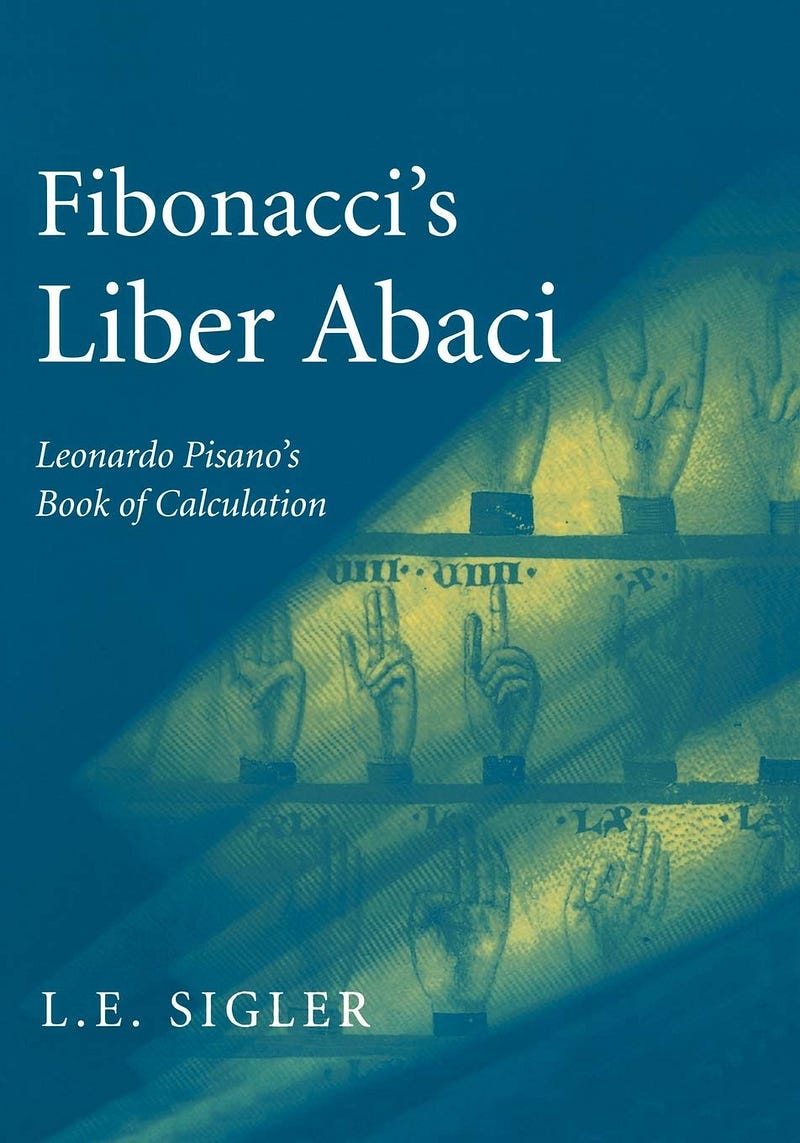
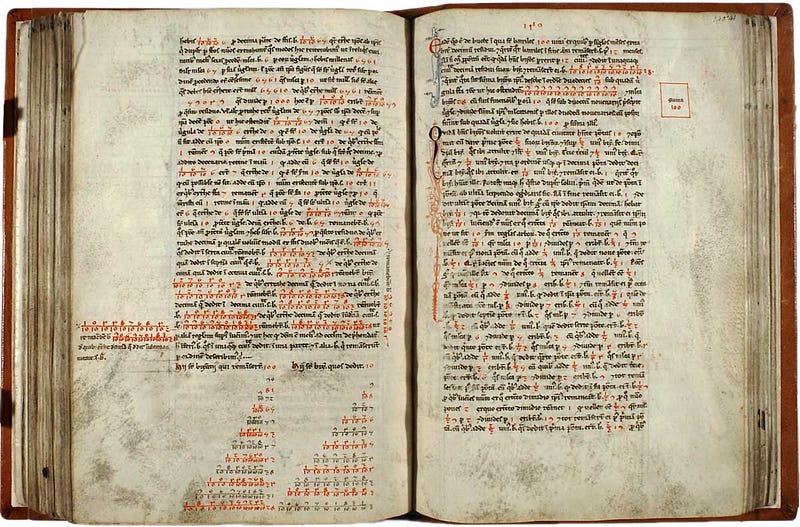
When Fibonacci returned to Italy, he quickly passed his knowledge down to a book called Liber Abaci by 1202. In the book, Fibonacci generally introduced the number system used by Muslim scholars. He then performed four easy mathematical operations for the Europeans who had just started learning this number system. In fact, Fibonacci went even further and put information about Algebra and Geometry in his book. For those interested, you can obtain Fibonacci’s Liber Abaci book here.
Human nature is usually not open to change and will fight to stop it, and this is the same for the Humans living 1000 years before us. That is why in the beginning, Europeans and Italians went against Fibonacci’s book. However, the developing trade connections between the Europeans and the Middle East forced them to learn this new number system.
Yet, what made Fibonacci so famous today isn’t his book Liber Abaci. It is an intelligent question regarding rabbits that helped lay the footwork for mathematics, and Fibonacci’s question is like the question below.
Let’s say your friend gave you a pair of baby rabbits, a male and a female. These rabbits grew to become adults at the end of their second month, and they reproduced a male and a female rabbit every month. The pair of rabbits they reproduced grew to become adults by the end of their second month and started reproducing a male and a female every month as well. And the pattern goes like this. Then how many rabbits would there be at the end of each month?Even though this question may seem difficult at first, solving it is solving a simple algebra question. First;
Let x represent the pair that will have offspring, and
Let y represent the offspring pair that are too young to have children. Then,
Let’s represent the rabbit couple count after each month n with F_n. Meaning we can calculate the first few months like this:
y                  1 = F_1
x                  1 = F_2
xy                 2 = F_3
xyy                3 = F_4
xyxyy              5 = F_5
xyyxyxyy           8= F_6
........           .......
If we continue in this pattern, we would attain a sequence like this: 1, 1, 2, 3, 5, 8, 13 ,2 1, 34, 55, 89, 144, 233, 377… . If you have noticed, we find the next number in the sequence by adding the two numbers before it. At the end of the day, these are Fibonacci numbers, we call this pattern the Fibonacci sequence, and we could formulate this like the example below.
F_0 = 1
F_1 = 1
F_n = F_n-1 + F_n-2 for n>2.
Yet, this is not the only different thing about the Fibonacci sequence. We obtain many different results if we play with numbers in the pattern. For example, we could divide each number with the number before in the sequence.
If we say: 1/1, 2/1, 3/2, 5/3, 8/5, 13/8, 21/13, 34/21, …, F_n+1/F_n, and then write the answers in a new pattern, we would obtain something like this:1, 2, 1.5, 1.6, 1.625, 1.6153, …., 1.618..., 1.618..., 1618..., ….As you can see, after a point, the sequence continues in the form of 1.618. This number is the mathematical equivalent of the golden ratio, which is well known by mathematicians and is one of the biggest pieces of data in popular mathematics. At the beginning of the 20th century, the greek letter ϕ (Phi) was used for the first time by James Mark Barr instead of the infinite number 1.618. Φ = 1.618…
So how are we sure this golden ratio exists as the Fibonacci sequence goes to infinity? How do we know that we’ll get almost the same ratio when we divide the one billion and oneth number by the billionth number of the sequence? Because we can prove this in many various mathematical ways.
Proof of the Golden Ratio with the Limit of the Fibonacci Sequence
Our claim is this;
If we think there is a limit to the Fibonacci sequence and call it L, then as n goes to infinity, the limit of (F_n+1)/(F_n) will be L= 1.618…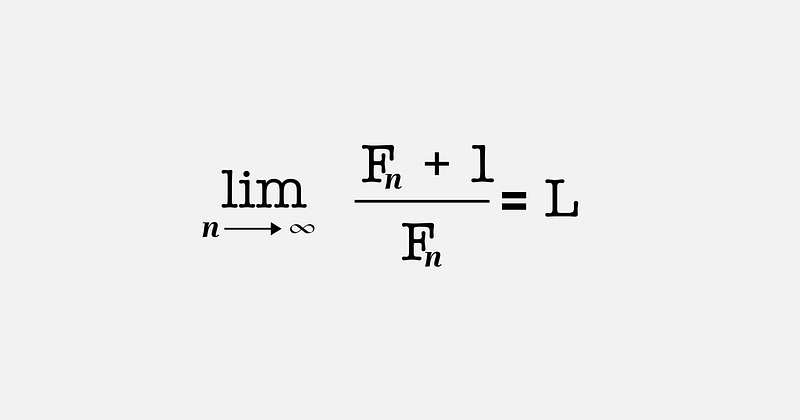
This limit has easy proof. That is if we write n+1 instead of n.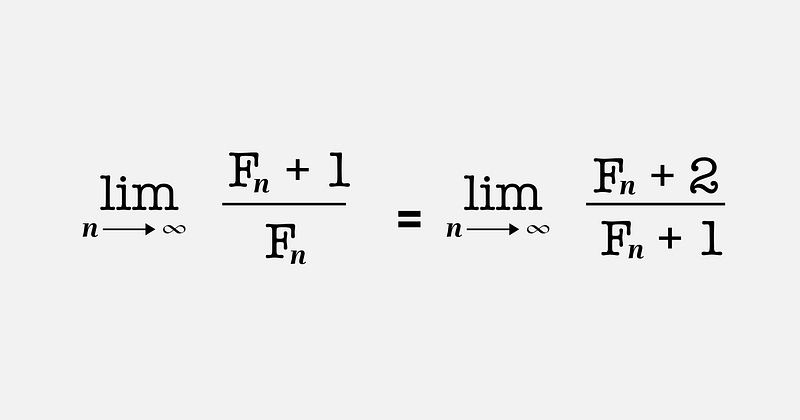
In the Fibonacci sequence, F_n+2 is the addition of the two numbers before it which are F_n and F_n+1. Therefore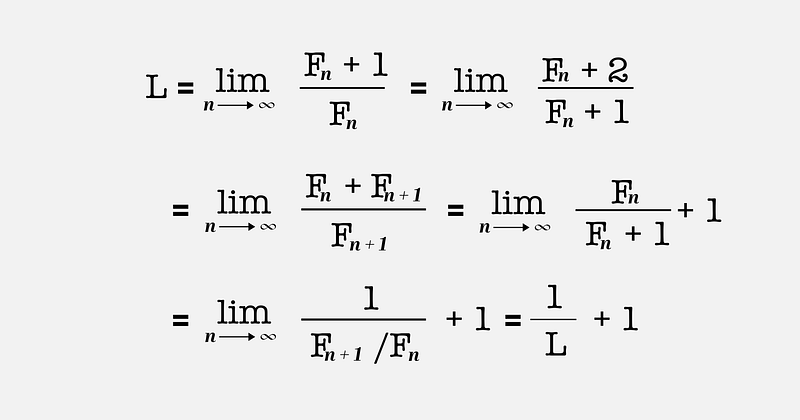
We could write the solution as L²= L+1. If we simplify this equation further, we will get the quadratic equation of L²-L-1=0. By solving this, we would get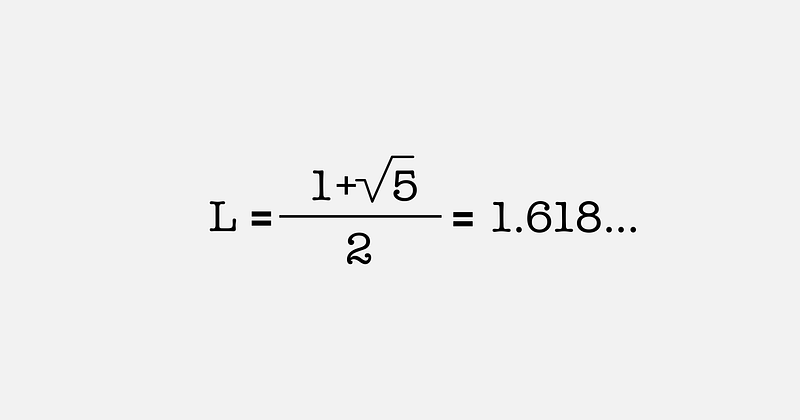
Thus, if we follow Fibonacci’s sequence to infinite, the ratio of two numbers next to each other after a point will always start with 1.618.Fibonacci and The Golden Rectangle

Fibonacci’s numbers have been used in the past in art and design. Antique Greek architects believed that a certain ratio between the width and height of the human eye was more noticeable, making people like that ratio more. As you may have guessed, this ratio equals ϕ or 1.618… For example, the Parthenon temple was built according to this ratio.
Gustav Fechner, one of the pioneers of experimental psychology who lived in the early 1800s, did an experiment where he showed different rectangles to a group of people, and most people picked the rectangle with the golden ratio. Today, many books, iPads, and tablets are still designed for this ratio.
If you want to see the beauty of the golden ratio with astonishing examples, you should check Rafael Araujo’s mesmerizing geometrical drawings using the golden ratio.
But how can we find this golden ratio or ϕ in a rectangle?
Let’s say there is a line between two points, A and B, and the line length will be |AB|. Let’s also pick a point C between the two A and B points. Then it should be known that |AC|= x and |CB| = y.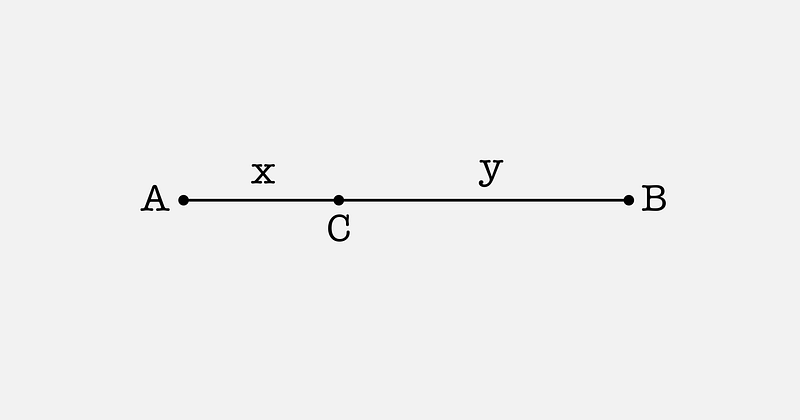
Now let’s show that the |AB|/|AC| and |AC|/|CB| ratios are equal to ϕ or the golden ratio.First, let’s try to make an x and y ratio equal to the above-mentioned ratios.So, |AB|/|AC| would be equal to (x+y)/x, and |AC|/|CB| would be equal to x/y.Now we need to find the values that satisfy the equation (x+y)/x = x/y and the ratio x/y or ϕ.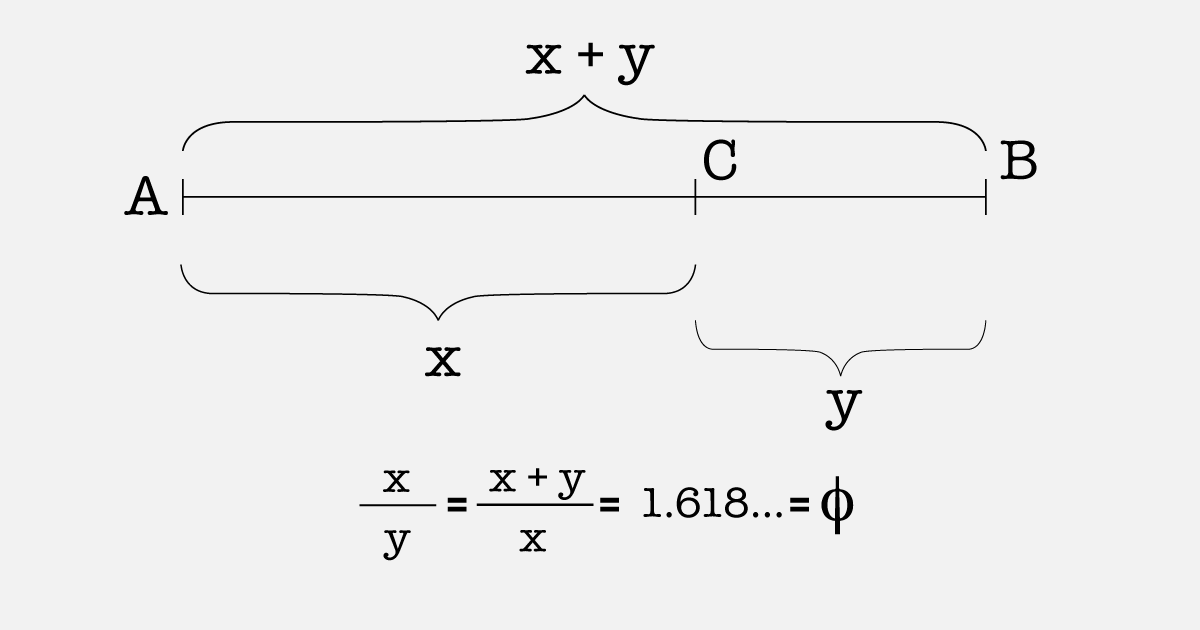
If we cross multiply the equation (x+y)/x = x/y we would get the equation xy + y² = x².Since we are trying to find the x/y ratio, we would divide the whole equation by y², making the equation come down to x/y + 1 = (x/y)².If we write ϕ instead of x/y, the equation will become ϕ + 1 = ϕ².If we write it in standard form, it would be ϕ² — ϕ — 1 = 0.To find the roots of the equation above, we need to use the quadratic formula below.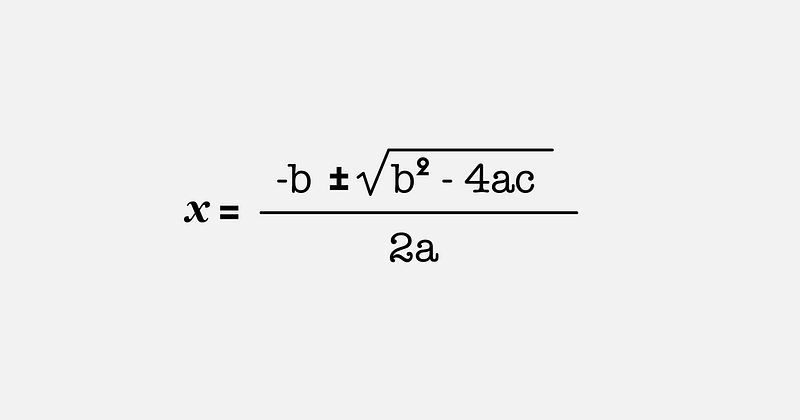
To apply the quadratic formula, we need to find the a, b, and c values. For the equation ϕ² — ϕ — 1 = 0 the values would be a=1, b=-1, and c=-1.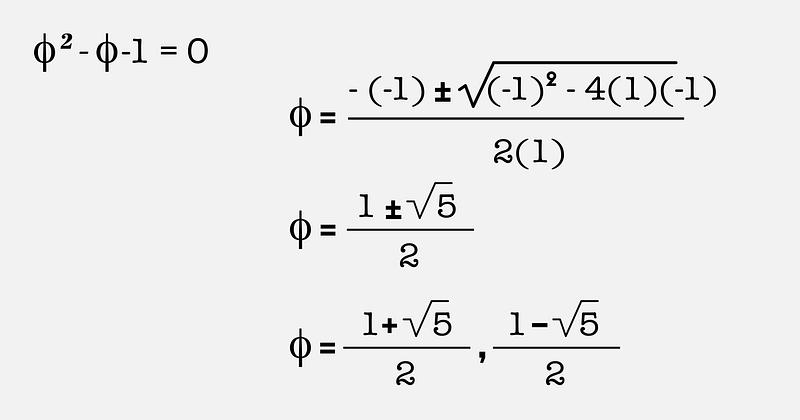
We found two answers, one positive and the other negative. However, since our x and y values are positive, the answer of x/y has to be positive. Making the answer: ϕ= (1+√ 5)/2 = 1.618…We have again obtained the golden ratio using a simple rectangle.
Note 1: Beyond Euclid! is my weekly newsletter that brings you only high-quality math and science stuff to ensure you are having a good week. Please do yourself a favor by subscribing to Beyond Euclid and enjoy it! And if you can be a member and support my work, that would be awesome! Thank you!Note 2: I get commissions for purchases made through links in this post.