
Frameworks for Studying Twitter
This article is part of Section 5 of #SocialPxD — ReEngagement with Twitterville.
Let’s look at the basic structure of the Twitter platform. There are many ways to describe the structure of Twitter. For example, if you see Twitter as a “Media” platform, you can adopt the model of communication: Sender — Message-Receiver. I see Twitter as a “Social” platform and build a model of interaction: Act — Tweet — React.
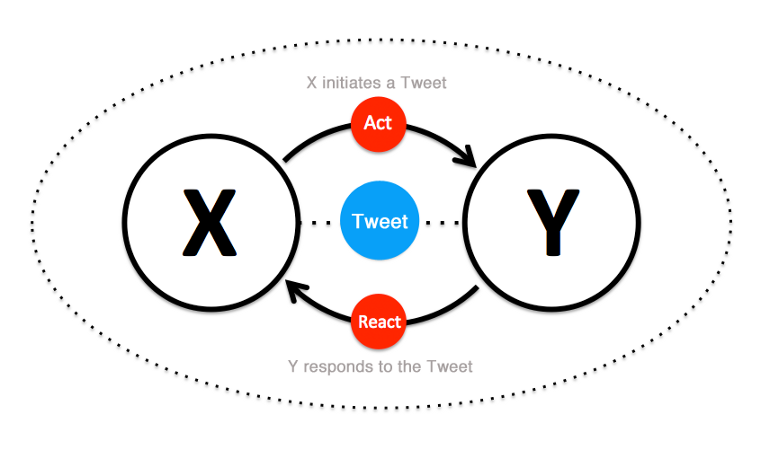
From the perspective of action, I don’t choose Tweet as the basic unit of Twitter, but the interaction based on Tweet as a basic unit of Twitter. User X initiates a tweet (Act), User Y responds to the tweet User X initiated (React). User X and User Y connect to each other (Connect) through a tweet (Tweet).
The Tweet part, the Act part, the React part, and the Connect part are Invariant Structure of the Twitter platform. This structure defines what the Twitter platform is and it has never changed.
Now, let’s pay attention to the Act part. The way of initiating a tweet had several major changes and minor changes in the history of Twitter. For example, the original tweet is text only with a 140 character limit. In 2011, the platform announced its own integrated photo-sharing service which allows users to upload a photo and attach it to a tweet. In 2013, the platform launched Twitter Cards which allows developers and media to connect their apps, media, products, photos, videos and galleries to Tweets. These two updates dramatically change the way of initiating a tweet, I consider them as major changes.
According to wikipedia, “In 2016, Twitter announced that media such as photos, videos, and the person’s handle, would not count against the already constrictive 140 character limit. A user photo post used to count for a large chunk of a Tweet, about 24 characters. Attachments and links would also no longer be part of the character limit.” These features can be seen as minor changes.
While the major updates change the Invariant Properties of Twitter platform, the minor updates only impact on the Variant Properties. Before adding photos to tweet, Text-only was the key Invariant Property of Twitter for many years. Now Visual Card is the key Invariant Property of Twitter.
We can apply the same principle to the React part and the Connect part. The way of Reacting and the way of Connecting point to the Invariant Properties of Twitter. For example, Retweet and Retweet with Comment are major updates of the React part. The Following/follow feature didn’t change.
Full article:
#SocialPxD — ReEngagement with Twitterville
An Introduction to Ecological Physics Method
Contents
1 Gibson’s Ecological Approach 2 Twitterville as Ecological Environment 3 Ecological Mechanics 4 Information as Light 5 Ecological Invariant 6 Ecological Events 7 Ecological Perspective 8 Ecological Affordance 9 Ecological Information 10 Picture, Video and Visual Awareness 11 Make Use of Action-Centered Platforms 12 What’s Next?