
Twisted Devotions
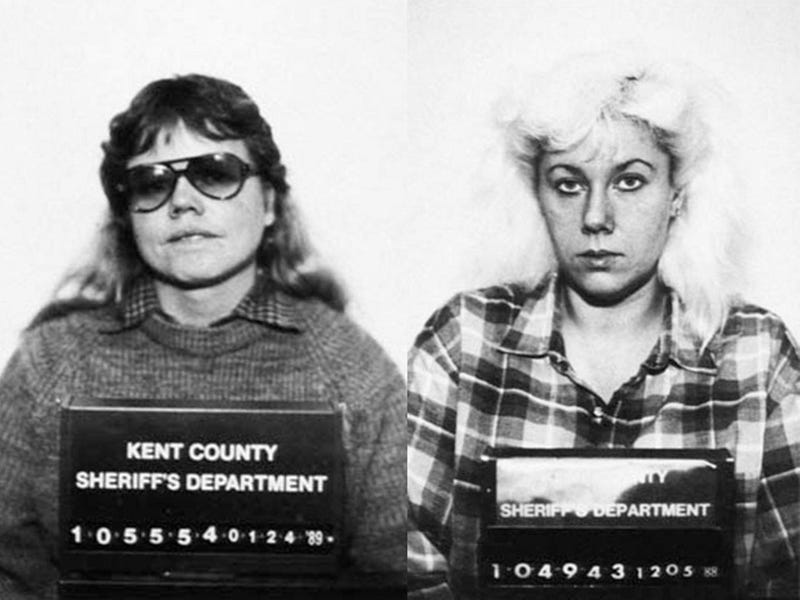
Two nurses’ aides in Michigan used murder to cement their bond.
In January of 1987, Marguerite Chambers was a patient at the Alpine Manor, a nursing home in Grand Rapids, Michigan. She had been diagnosed with Alzheimer’s Disease twelve years prior and was entering her fourth year as a resident at the home.
Her doting husband Ed visited her in Room 614 frequently; he would sit in a chair next to her bed, chat with his wife and hold her shaking hand. She had lost her ability to communicate, so Ed was not always able to understand what his wife was trying to tell him. Yet these visits were part of Marguerite’s routine, so there he sat, rubbing the back of her hand with his thumb.
One cold winter night, after Ed left, Marguerite was sleeping when she lost her ability to breathe. She awoke in a panic, her eyes darting about to find the source of the unyielding pressure over her nostrils and jaw.
Overwhelmed by whatever was cutting off her air supply, she quickly lost consciousness. She survived the assault and regained consciousness the next day, but in her state of dementia, was unable to comprehend or communicate what had happened to her. A nurse checked her blood pressure, and found it was within the normal limits for a woman of her age, yet Marguerite remained restless.
In the late hours of January 18, 1987, licensed nurses made their rounds to distribute medications to their patients. The Blue Danube played softly in the hallways. After lights out, two nurses’ aides working the night shift at the manor approached Room 614, where Marguerite was just beginning to doze off.
The more feminine of the duo, the blond woman, stood behind, looming in the door to watch the hallway. After she confirmed the coast was clear, her masculine, brunette counterpart approached Marguerite with a cloth. As she crept towards the patient, the blonde lingered, still watching from the door.
The brunette stood beside Marguerite’s bed, and holding the cloth over her mouth and nose with an unrelenting pressure, one hand squeezed her nostrils, the other violently thrust her chin upwards, shoving her toothless gums together. Her attacker made eye contact with her wide eyes and watched her thrash as she struggled for breath.
A grotesque groan escaped from deep inside her belly as her lungs rose and collapsed frantically. As soon as the assailant was sure Marguerite took her last breath, the brunette scurried to the blonde; together they made their escape and fled to an unoccupied room to further relish the murder they had just committed.
The next morning, staff found the patient unresponsive. They cleaned out her room and let the family know they should come retrieve her belongings. The family had been in to visit Marguerite the day before and had brought her a balloon bouquet. One of the balloons was now missing.
The two murderers, Gwen Graham and Cathy Wood, were ecstatic; their relationship was still new, and they had just celebrated the New Year as a couple for the first time.
Gwen, the masculine brunette, was able to find a match in her blonde lover Cathy. They were enamored with each other, and each of the women wanted to do anything she could to show the other just how much she loved her.
The two had met the previous year, when Gwen had moved from her hometown of Tyler, Texas, to Grand Rapids, Michigan. They worked together as nurses’ aides at the Alpine Manor, where they quickly struck up an affair, and used their job to strengthen the bond of their own relationship further.
At first, to bring some sort of excitement to their job, the two women liked to play pranks on their coworkers and patients. They created drama among the staff, and would frequently move patients into other rooms. Yet after a while, the women got bored with their usual games, and invented a new game to keep work and their relationship exciting.
The women dreamt up their newest adventure, one they called “The Murder Game,” which they thought would nourish their relationship. They hoped to create a list of victims whose first names would spell out “M-U-R-D-E-R”, and declared that for every life they took, their “love bond” grew stronger.
There was a romantic element behind their killings that they thought nurtured their love; conversely, if they ever broke up, it could mean life in prison for the both of them. Thus, the two women promised to love each other forever plus however many days, or lives, they claimed.
Born August 6, 1963, Gwendolyn Graham was raised on a farm outside of Tyler, Texas, until she was in 5th grade, when she and her family moved to Michigan. She had a loveless childhood. Her father was a disagreeable man with often abusive ideas about how a child should be raised. He forbade Gwen’s mother from holding her daughter, believing that allowing a child to be held by its mother would make the child weak. Instead, he spent time teaching Gwen the realities of life and death by forcing her to watch the slaughter of chickens and pigs.
When she was 11 years old, Gwen’s dog Misty barked at a horse, causing the rider to be thrown from the saddle. Gwen’s father made her older brother shoot Misty and forced his young daughter to watch. This haunted Gwen. After her dog’s death, she went into the yard where she was buried and dug up her remains. She kept Misty’s teeth and skull in a heart box for most of her adult life.
In her teenage years, Gwen’s father became a violent substance abuser. He frequently got excessively drunk and sexually molested Gwen. It was during this time when Gwen began slicing her skin open with razors and burning herself with cigarettes. By the time she left her house at the age of 18, she had over thirty scars on each of her arms from her self-mutilation.
Gwen said she never knew why she really did it, but did know that she was angry and part of herself wanted to look ugly so that it would never happen again.
Catherine Wood was born the year prior, on March 7, 1962 at an army base in Washington state, but had a similarly grim childhood. The Woods would relocate to Massachusetts shortly after Cathy’s sister Barbara was born, and soon after, their father would be shipped off to fight in the Vietnam War. He would not be around much after that, but whenever he was, Cathy’s father criticized her for her physical appearance, which made her feel ugly and uncomfortable. Cathy was able to develop a strong bond with her sister, but she didn’t socialize much outside of that, and instead preferred to spend her time in solitude.
“I spent a lot of time by myself, I read a lot,” Cathy would later tell the court about her childhood. “My dad was… he drank a lot, he was an alcoholic, he was abusive, so I stayed by myself most of the time.”
As she entered her teenage years, Cathy felt that she should be interested in boys, so she began the search for a relationship. She began dating a nice boy named David, and for the most part, she was happy.
One day, as Cathy was passing by David’s house, she saw his car in the driveway and went up to the front door. She was greeted by the boy’s mother, but when she asked for David, his mother was confused. She had a daughter, not a son. She led Cathy inside and showed her a photograph of David with long, flowing hair wearing a floral pattern dress.
After learning this, Cathy confronted David to discover that she actually identified as female, going by her given name Debbie. No one knows exactly why Debbie did this, but it would hurt Cathy deeply.
When she was 16, Cathy met and started dating a man named Ken Woods. After their first date they went home together and briskly asked him to undress. This was only to confirm he was biologically a man. The two dated for a while, and after Cathy got pregnant when she was 17, they decided to get married.
They moved to Walker, Michigan, where Cathy would give birth to her daughter, Jacqueline, in 1980. However, immediately after Jackie’s birth, it was clear that Cathy was uninterested in being a mother. Jackie later described her mother as narcissistic, manipulative and a pathological liar, and has said she “spent most of her life afraid of her mother and her constant extremely drastic mood swings”.
This tension in the household led to a strained relationship, and despite Ken doing everything in his power to hold on, Cathy grew agitated. Cathy would admit, “I didn’t like him touching me and didn’t like spending any time with him and there was always fighting… I never had any peace.” Cathy filed for divorce in 1986. She allowed Ken to leave with Jackie, and she began looking for jobs.
The National Longitudinal Study of Adolescent Health conducted research focusing on crime, and proposed a link between maltreatment and criminality. It was suggested that child abuse roughly doubles the probability that an individual engages in any type of delinquency.
Another study published in 1988 found that at an agency for homosexual adolescents, over forty percent of youth seeking services reported experiencing physical violence, with approximately half of the violence occurring within their families, mostly in interactions with parents. Twenty-two percent of clients within this agency also reported experiencing sexual abuse.
A third study, published in 1999, reveals the growing consensus that people who identify as gay, lesbian, or bisexual, either in adolescence or adulthood, experience higher rates of maltreatment during childhood and adolescence. Homosexual and bisexual individuals, as compared to heterosexual respondents, showed higher frequencies of self-reported parental maltreatment by either parent.
Although not definitive, it is likely that the LGBTQ community is more likely to face abuse from their parents than heterosexual children. Despite all of this, out of the many members of the LGBTQ community who did face maltreatment in their youth, most did not grow up to murder, save for men like Jeffrey Dahmer and Robert Berdella.
So why Cathy and Gwen? What happened to them that led them to kill?
Michigan was an LGBTQ+ friendly state in the 1980s; in 1972, two Human Rights Party candidates, who later came out as homosexual, were elected to Ann Arbor city council and are known as the first openly homosexual public office holders in the US. Nancy Weshsler, one of these officeholders, would be replaced by Kathy Kozachenko in 1974, the country’s first openly gay or lesbian candidate to win public office. In December of 1972, the anti-discrimination ordinance was amended to include sexual orientation, making Ann Arbor the second city to pass an LGBTQ inclusive anti-discrimination ordinance.
The Alpine Manor, located in Grand Rapids, Michigan was especially known for its acceptance of the lesbian community. Cathy would not begin exploring this side of herself until she began working as a nurse’s aid in 1985.
After Cathy started her new job and met some of her coworkers, she developed a confidence that made her a bit of a social butterfly. She frequently went out with her new friends, and soon began a relationship with another aid named Dawn Male. In the following year, Gwen Graham started working at The Alpine Manor.
One day at work, Cathy was in the employee lounge, sitting and chatting with her girlfriend at the time, Dawn, when another one of her coworkers strolled in. By this point, coworkers Cathy and Gwen knew of each other but had not interacted much. However, on this particular day, Gwen was wearing her nurse’s uniform with the sleeves rolled up; the scars from her youth visible. Cathy recalls when she saw Gwen’s scars and noted that as the moment she started “watching” Gwen.
Gwen and Cathy quickly struck up a friendship, and as they spent more time together, their bond became undeniable. Amid their warm embraces, the two shared childhood trauma and the abuse they received from their fathers.
Gwen appeared to be the more masculine woman, a strong, silent type. She was quiet and worked hard, but Cathy was clearly in charge. She had the upper hand with Gwen and most of the staff as well; she was sharper than most nurses. Their relationship began positively, but when their drama, tricks and pranks began, their coworkers soon felt as if it were “them versus the world.”
The two women had both been diagnosed in their teenage years with two different personality disorders that likely made them feel more comfortable in their relationship with each other. Gwen had borderline personality disorder, and Cathy, apart from being a pathological liar, was pathologically narcissistic.
Borderline personalities tend to feel empty and fear loneliness, which means that they will search for someone who is likely to relieve their feelings of solitude. They also tend to gravitate towards a person who will accept the inconsistency; being angry with you one minute, loving you, stealing from you the next minute, then expecting love in return.
Narcissistic personalities, on the other hand, come off as strong and genuine in their passion, but what seems to be genuine care or love for their partner, is typically just how their partner makes them feel about themselves. The narcissist sees their partner as a tool for getting whatever it is they want.
Recall how Cathy didn’t even notice Gwen until she noticed the scars on her arm from her self-harm, signs of someone who was broken and could be easily manipulated.
A relationship between these two personalities began passionately, with an incomparably intense desire, an obsession of sorts, soon to implode and avalanche towards a toxic repulsion for the other. But Gwen and Cathy, determined to prove this wrong, decided they would be together forever.
On October 31, 1986, the couple attended a Halloween costume party. Gwen dressed as an Alpine Manor patient, with medical restraints around her wrists and ankles. That night at their apartment, after the party, Cathy bound Gwen to the bed with these restraints. She then pulled out a cloth to place on Gwen’s mouth and nose, and the two performed a sado-masochistic activity referred to as breath play, depriving themselves of oxygen.
Shortly after, the women began stalking the nursing home, lurking the hallways, constricting the noses of their potential victims, clamping shut their nostrils, watching for reactions. Some victims reported these attacks, but due to their states of conditions, no one believed them.
If they struggled or seemed strong enough to fight them off, the women would give up and spare them, but if the victims seemed too weak to fight off their own suffocation, they received a “mercy killing”.
Beginning with the murder of Marguerite Chambers in January of 1987, the women would kill four more patients in four months. They soon gave up The Murder Game and decided that rather than spelling out a word, it would instead be easier if they just killed the weakest victims. By April the women suffocated Mae Mason, age 79, Edith Cook, 98, Myrtle Luce, 95, and Belle Burkard, 74.
Mae Mason celebrated her 79th birthday on February 2, 1987 when her daughter and granddaughter visited. Mae’s nurses’ aide was Shawn Dougherty. On February 16, Shawn was making her rounds, but when she tried to open the door to Room 207, found it jammed. When she finally yanked the door open, Cathy and Gwen were standing inside. They giggled and rushed past her, Cathy taunting, “the joke’s on you”. When Shawn entered Room 207 she found Mae covered in her own excrement. Shawn scrubbed the feces off her body with a terry cloth, which Mae grabbed onto and clutched as she stared at Shawn with wide eyes. Early the next morning, Shawn would return to her patient’s room, only to find her lifeless in her bed; gray skin, eyes shut, jaw slumped to the side.
Myrtle Luce, Room 206, had experienced a series of small strokes which left her with an organic brain disease similar to Alzheimer’s. Her son said “her heart was too strong for her own good… she had hypertension and arteriosclerosis, but her heart kept pumping.” The staff at the home played The Blue Danube for her. In the early hours of February 10, 1987, a night shift supervisor, Martha Slocum, found Myrtle Luce dead. Cathy said she combed Myrtle’s hair and found a damp washcloth on her bed, and “looked at Myrtle and her nose was… smooshed… no one noticed it but me. Martha says Cathy “never attended to the body at all… she never saw the body, even when it was moved.”
Belle Burkhard had spent the last eight years at the Alpine Manor. Her body was succumbing to nature; she was senile, deaf and blind, yet remained cheerful in her old age. Cathy had been assigned as Belle’s carer two weeks prior, but Cathy found her “frustrating” and difficult to care for. In the morning of February 15, another aide found Belle in her room, 112, with reddish bruises around her nose, right cheek and temples. Given her history of seizures, her condition was brushed off. February 25, 1987 was Gwen’s scheduled day off, but she picked up a shift that day, to get overtime and work with Cathy. In the early morning of February 26, Cathy was left alone in her station. Gwen approached her from down the hallway, and took her place, watching the hall as Cathy headed into Room 112.
In a prison interview, Cathy insisted Gwen went into Belle’s room and that she heard “groans and the rustle of sheets and gurgling out loud, like dry-heave noises…” Minutes later, an intruder walked out of Room 112 and turned away into the hall. A washcloth hung out of her back pocket as she strolled down the hall.”
Cathy found pleasure in each experience, describing their crimes as “easy and kind of fun,” because their victims were defenseless. She said Gwen once told her that each of the killings provided an emotional release for her, with the exception of Edith Cook, who Gwen said was killed to end her suffering from gangrene.
Dawn Male, who was fired from her job at the nursing home late in the summer of 1986, said Cathy and Gwen told her about the murders when she visited the women in their home in Grand Rapids.
“I didn’t believe them,” Dawn said. “I thought it was a joke, a sick joke, but a joke. Head games.”
To prove their story, Dawn said the women took her into a bedroom and showed her several random objects on a shelf, which they said had been taken from each of the murdered patients. The collection of socks, jewelry and other seemingly meaningless trinkets alarmed Dawn, but she did not think much of it at the time.
They always killed the women in the same way. Upon nightfall Cathy and Gwen would select their victim, then approach her room. Cathy acted as lookout while Gwen creeped in with her terry cloth. She would stalk towards her victim, sleeping in bed, and prepare to clamp the rag over their mouth and nose. Gwen would look down upon the woman, when she cupped the terry cloth over her fragile face, she pressed down and blocked her airways until she felt the woman take her final breath under her hands. Cathy and Gwen would then retreat together to relive the thrill of the murder.
Gwen and Cathy’s behavior after their Halloween party shows that this method of killing might have been their fantasy. When just fantasizing was no longer enough to satisfy them, they had to accommodate and construct a new plan.
The murders were ritualistic killings.
These murders were not spur of the moment, crimes of passion, but rather pre-constructed and premeditated fantasies. However, because the reality did not match their fantasy, they had no choice but to repeat their crimes, hoping to perfect their method and have it match their vision.
The women committed the murders in such a way that did not raise suspicion and people in nursing homes are expected to die. Due to this, there is little evidence outside of Cathy Wood (the pathological liar)’s testimony.
About six months into their relationship, Gwen decided she was no longer willing to be subjected to the abuse of her pathologically domineering lover. She moved out of the apartment she and Cathy shared and attempted to move on, dating another nurse from Alpine named Heather.
Cathy soon learned of Gwen’s new romance, and began threatening Gwen and her new lover. She went to Gwen’s new apartment wielding a pistol and said she had the ability to send Gwen to prison if she continued this new relationship with Heather.
For Cathy, the murders she and her ex-girlfriend committed acted as leverage. They served as an insurance; she now had the ultimate blackmail to keep Gwen from ever leaving her. During this time, Cathy sent Gwen a romantic poem, of sorts, to subtly remind her of their murder pact and the implications behind that.
I can love you Gwen I think you’re great For this afternoon I cannot wait That’s when we’ll wake up & That’s when I’ll kiss you That’s when I’ll hold you Oh Gwen, I miss you. Bunny hop over here And let me lick you on the ear. I want to get married Right now right away Don’t make me wait Till the day when you’re mine Oh, please say You’ll be mine Forever and five days
Gwen was so frightened by Cathy’s determination, and eventually decided the only way to end the stress was to move back in with Cathy. As soon as she did this, the abuse worsened. Gwen recounts an incident that occurred during this period.
In a prison interview, Gwen said, “Cathy tied me up and put a gun between my legs… I was begging because I thought she would shoot me. And, then she stood there for a minute with it in me and then she took it out and looked at me all strange and left the room.”
Cathy also remembers this episode taking place, but in her version it is Gwen committing these actions.
Cathy could not assuage her obsession with Gwen. When she discovered Gwen having an affair with another woman, Cathy said, “I thought I’d never be happy again, I thought I was going to die. I cried all the time. I couldn’t talk, I didn’t eat… If I couldn’t have Gwen, no one would!”
Gwen put up with a relationship she described as psychologically abusive for another three months, but after nine total months of Cathy, she had decided enough was enough and tried to get as far away from her as possible. Gwen and Heather moved back to Gwen’s hometown of Tyler, Texas, where they lived relatively peacefully for quite some time.
Despite all of the effort Cathy went through to make herself appear as the vulnerable and abused partner in their relationship, it is clear she held the dominant role over Gwen. In order to establish power and control over Gwen, Cathy utilized coercion, as well as physical and emotional abuse.
Then, in 1988, Cathy Wood, feeling nostalgic, reached out to her ex-husband Ken Wood. They had a relatively normal conversation, but then Cathy told Ken she had done some horrible things.
When pressed, she responded, “What do you think is the worst that a person could do?
Ken thought for a moment before answering, “murder”, to which Cathy responded,
“Try six times that.”
Ken sat with what Cathy confessed to him for six months before he decided to go to the police. He had always known Cathy to stretch the truth, and initially thought of her confession as some sick prank or lie that she had decided to rope him into.
“I thought about the families of the victims; so many people were going to get hurt,” Ken told the media in 1989. “But Cathy wasn’t getting any better. I sensed a lot of guilt. She couldn’t let go of what had happened. … I went to the police because she needed help.”
Police soon discovered that many deaths were recorded in the year of 1987, but, as the Alpine Manor is a nursing home, none of the deaths really seemed suspicious. It was also true that out of the five alleged victims, only two did not get cremated. However, police knew how easy it would be to conceal a murder among so many natural deaths, so they opened an investigation.
ichigan’s Attorney General at the time, Dana Nessel, said that “as a nurse’s aide, Wood was one of the people who could have and should have made these women comfortable in their waning years. Instead, she helped inflict terror and death… the wilful targeting of those victims because of helplessness, the abuse of the caretaker relationship, the pure malice evidenced by taking souvenirs of the victims.” Mr. Nessel wrote in his brief of the case, “that this is an exceptional circumstance that warrants exceptional consideration.”
The Walker, Michigan Police Department opened a full investigation, and ran background checks on the two women. They found that Cathy had no criminal record and after reaching out to the police department of Tyler, Texas, discovered Gwen had an outstanding warrant for bad checks. Detectives flew out to Tyler to talk to her about bouncing bad checks, obtained a search warrant and searched her house, but came up empty.
Detectives Roger Kaliniak and Tom Friedman went to Alpine Manor to pull some files, employee and patient records, and discovered that Cathy Wood and Gwen Graham had in fact both been on a shift when each of their potential victims died. With this, they decided to begin Cathy’s questioning.
At first, Cathy completely denied any murders had occurred, claiming that she only told her ex-husband that as a joke. However, after forty minutes of interrogation, Cathy broke down and confessed that the murders did occur, but she didn’t actually kill anyone herself. She painted Gwen as the mastermind behind the murders and said that her ex-girlfriend had coerced her into participating, but she was only the lookout. She insisted that she could prove it with the letters between her and Gwen and some of the trophies they allegedly took from the patients they killed.
Police found the love letters when they searched her house, but there was no sign of any of the trophies Cathy claimed to have. With no evidence to verify her claims, police convinced Cathy to take a polygraph test.
She failed the test, leading the operator to believe she was making the entire thing up.
However, Detective Friedman felt certain that Cathy Wood was telling the truth about the murders. He suggested to Cathy that he believed she failed the test because she was not admitting to her full role in the murders. She got up and walked out of the room without saying a word.
Three days after failing her polygraph test, Cathy confessed. After some period of questioning, Cathy decided to reveal more of the details of the murders to police in exchange for a plea deal.
Police exhumed the two bodies of the victims who had not been cremated. The coroner found no physical evidence of homicide, but if they had been smothered like Cathy claimed, there would be no evidence left after so long. Thus, based solely on Cathy’s testimony, the victims’ causes of death were changed to “homicide” and arrest warrants were served for both Cathy and Gwen. By this point, Gwen had also slipped up. Her new girlfriend, Heather Baragar, would later testify that Gwen confessed the murders to her as well.
“She joked around about it,” Heather said. “She’d say, ‘I killed six people.’”
It’s believed that as many as 12 elderly residents could have been targeted, but the couple was only successful in killing six of them. Court documents released last year stated the couple successfully killed five patients and tried to kill “at least five others, but were unsuccessful because some of the elderly men and women fought back”.
Cathy presented an idealistic version of herself during Gwen’s trial, but court documents, close friends, coworkers and family members of Cathy Wood confirm she is extremely manipulative and a pathological liar.
Cathy made up a fictitious story to tell the courts. “Gwen told me she liked walking past the nursery and she wanted to take one of the babies and smash it against the window,″ Cathy testified. She added that she “had to stop her somehow.”
Gwen reflects on Cathy’s dishonesty and manipulative behavior, saying that she thinks “Cathy expected to get me locked up and that she was going to walk away and go home. I don’t think she expected to do a day… I thought the first year, she’d give it up, but she didn’t.”
Ken Wood also admits to seeing her psychopathic side, using their marriage and home life to reveal Cathy’s symptoms of pathological narcissism.
Cathy’s own daughter, Jackie believes that in the trial, Gwen was favored as the mastermind behind the crimes, however, based on her experiences and discussions with people surrounding the case, believes that her mother was behind it all.
Jackie says Gwen was the one who spent time with her when she had visits with Cathy, and always found her to be kind. She knows her mother to be extremely intelligent; she recalls a time when Cathy told her father Ken Wood she wondered what it would be like to kill somebody.
Jackie remains empathetic for her mother, and understands how her traumatic past led her to commit horrendous crimes. She relates to her on some level, “feeling like you’re not lovable and feeling like you’re not good enough and going to extreme measures to guarantee you’re loved,” she said in an interview.
In November of 1989, Gwen Graham was found guilty of five counts of first-degree murder and one count of conspiracy to commit murder, and was sentenced a life sentence for every life she took, without the possibility of parole. To this day she remains in the Women’s Huron Valley Correctional Facility in Pittsfield Charter Township, Michigan.
Cathy Wood was found guilty of one count of second degree murder and one count of conspiracy to commit second-degree murder. She received only 20 years on each count, but was granted parole in October of 2018, after 29 years.
While Gwen will likely never see the light of day, Cathy, who was eligible for parole since 2005, was released in 2020. This comes as a shock to many, especially Gwen, who believes that Cathy should also be serving life in prison. Gwen described Cathy, in a prison interview in 2019, as evil. She said Cathy “thought it was a game, and she won, and in the end, she’ll win. If I die here and she’s walking around free, she’ll win.”
Retired detective Roger Kaliniak, who worked on their case, believes that “Cathy Wood was the mastermind, she was the one that was pulling strings on Gwendolyn Graham… Gwendolyn Graham handled the dirty work and Cathy Wood was the brains behind it.”
The parole board denied Cathy’s release eight times prior, saying she was not remorseful and would pose a threat, but police said she began acting as a model prisoner, so was granted her freedom, leaving the public in outrage.
John Engman’s mother-in-law, Mae Mason, was murdered by the women. He thinks Cathy is a danger to society, and feels sorry for the people who now have to live around her.
Roger Kaliniak fears Cathy will strike again now that she has been released, he says, “she is a serial killer and could do it again. Most of them do.”
The story of Gwendolyn Graham and Catherine Wood gives a harrowing look at a passionate and manipulative love affair turned sour, and raises questions of how mental health, trauma and codependency impact relationship stability. Their story serves as a drastic example of how two people’s energy can feed off of each other in the wrong way.
There are still many inconsistencies in both Gwen and Cathy’s story, leaving us wondering who was really the instigator behind the murder spree that occurred at Alpine Manor in 1987. One can assume that both women have the motivation to lie in this situation, so it is difficult to say who did the manipulating and who got their hands dirty. Only the two ex-lovers will ever really know; Gwen, in her jail cell, and Cathy in her sister Barbara’s home in Fort Hill, South Carolina.
Cathy Wood might enjoy walks around Fort Hill’s own Reflection Pond, a favorite place for Carolina children to play and the elderly to relax. Patrons of the local Publix might have even pushed their shopping carts right by the serial murderer and not even realized it.
A Note on Sources
Principal sources for my story include multiple primary sources, including newspaper reports (The Morning Call, Associated Press News, United Press International News, Dayton Daily News), articles published by those working on the case, court documents with witness and suspect testimonies, and several podcasts (some of which included interviews with Cathy Wood and Gwen Graham, as well as Cathy Wood’s daughter Jackie). I watched television news reports on the case and also compiled research on the connection between homosexuality and child abuse and child abuse and crime, as well as general societal trends of Michigan at the time. I also looked at several psychiatric journal entries to understand mental health diagnoses such as Borderline Personality and Narcissistic Personality Disorders and how mental illness impacts relationships. I also consulted Janet Currie and Erdal Tekin’s Does Child Abuse Cause Crime?, Lowell Cauffiel’s Forever and Five Days and Peter Vronsky’s Female Serial Killers: How and Why Women Become Monsters. These secondary sources allowed me to develop a more concise understanding of the case in its entirety, and revealed to me that the story was much more complicated than it seemed on its surface.


