
Twelve Principles for Regenerative Living
How the twelve permaculture principles can be applied to create regenerative relationships with ourselves, our cultures, and the Earth.
Permaculture is a design system based on emulating the relationship patterns of nature. With its roots in agriculture, permaculture is now widely applied to our inner and social worlds as well. Permaculture is a regenerative framework, meaning its implementation increases the health of the systems that implement it (this is in contrast to sustainability frameworks, which merely perpetuate themselves as they are).
This article will use a social permaculture perspective to explain the twelve permaculture principles. The twelve permaculture principles were created as a “cheat sheet” to learning and emulating the patterns of nature. They are permaculture’s version of biomimicry’s “life’s principles.” Our format introduces each permaculture principle with descriptions of how they manifest in nature, the psyche, and society.
For reference, here is a graphic of the twelve principles with the three permaculture ethics at the center:
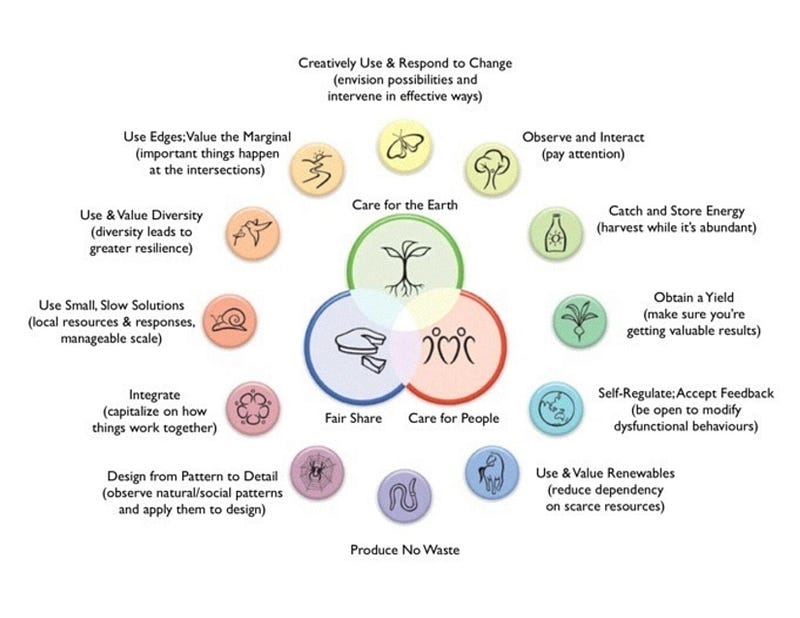
Each of these principles gives a design strategy that can be easily “cut and pasted” into a design for a natural, personal, or social system. Before we dive in, I want to clarify what I call the “master principles” of permaculture, which, while not made explicit in permaculture, are the theoretical underpinnings of the principles.
The Master Principles
The master principles of permaculture are the meta-principles that govern life at the highest scales: the theory of natural selection and the laws of physics.

Natural Selection
The theory of natural selection tells us that natural systems change over time in such a way that optimizes their survival. Thus, all of the permaculture principles which follow evolved on this basis. The permaculture principles exist in their current form because they are the patterns that are most effective at ensuring system success.
The permaculture principles exist in their current form because they are the patterns that are most effective at ensuring system success.
Natural selection tells us that natural systems are inherently selfish — that is, systems evolve behaviors that allow them to consistently replicate themselves. Permaculture addressees this selfishness through the introduction of the permaculture ethics, which will be only briefly mentioned in our conclusion.
Laws of Physics
The laws of physics also constrain the behavior of natural systems. Each pattern in nature can be described in terms of natural laws.
The natural laws which give the greatest insight into the behavior of living systems are the laws of thermodynamics. Thermodynamics describes how energy flows through systems, increasing their entropy. An understanding of thermodynamics may assist your learning of permaculture, however, it is not strictly necessary. If you are curious, I recommend you read my primer, The Two Things You Didn’t Realize Govern Everything.
With this housekeeping out of the way, let’s dive into the twelve permaculture principles and the applications they find in nature, psyche and society.
Principle One: Observe and Interact
The first principle implores us to observe and interact with our environment before introducing any new designs.
Nature
Wild animals are acutely aware of their environments. They depend on careful observation for safety and finding food and water. Vervet monkeys, for example, listen to the chirping of birds to get information about their environment. The calls of starlings help them determine which predators are nearby.
Psyche
The first permaculture principle is embodied by behaviors that allow us to gain better insight into the functioning of our own minds. Practices such as psychotherapy, meditation, and art are all based upon observing and interacting with ourselves. Self awareness is the birthplace of wisdom and insight.
Society
Social application of the first principle leads us to first observe and understand our culture before taking action to change it. By empathizing with the perspectives of others, learning the norms, and understanding the milieu, we can uncover its leverage points. As a practical application, imagine that you are managing a new team you are unfamiliar with. Your success is in large part contingent upon understanding the motivations, habits, and expectations of the team’s members. Without understanding their perspectives, you will be less effective as a manager.
By empathizing with the perspectives of others, learning the norms, and understanding the milieu, we can uncover its leverage points.
Principle Two: Catch and Store Energy
The second principle recognizes that change happens when energy flows from one place to another. In being intentional with where energy is stored in a system, we are designing the dynamo from which all the system’s effort will originate.

In being intentional with where energy is stored in a system, we are designing the dynamo from which all the system’s effort will originate.
Nature
Beavers build dams to store water, slowing its loss of energy down a river. In so doing, they create hugely productive wetland ecosystems providing habitat for a diversity of plant and animal life, including the wetland trees on which they depend.
Psyche
Catching and storing mental energy allows us to replenish our reservoirs when we feel drained. The language we use to describe mental states gives us clues to how we store and release energy: we speak of “recharging” after a long day of work, of the “weight” carried by an idea, or the “coldness” with which someone interacts with us.
To “refuel” our minds, it is important to rest, eat clean and nutritious foods, exercise, and explore. Our mental energy can also be stored outside of ourselves, in a journal, a painting, or a song. In this way, it can be tapped later as needed.
On the flip side, it is also important to ensure our energy does not get too condensed in one place, leading to a blockage. The release of blocked energy in our bodies is the basis of energy healing modalities such as reiki and acupuncture. Finally, insights and moments of clarity may arrive when mental energy is allowed to flow freely without maintaining attention in any particular place. We can remember that Einstein was quoted as saying “I thought of it while riding my bike.”
Society
Social energy is the collection of the energy of its individuals. Structures such as businesses, governments and religions serve as energy harvesters, focusing the efforts of the individuals involved. We also gather our collective efforts through events and communications. By consciously designing these systems to maximize social energy transformation, we can keep our efforts focused and synchronized.
The Permaculture Action Network is an organization based on the principle of catching and storing social energy. Their model is to partner with musicians and cultural events around the world in promoting and organizing permaculture action days following events. In this way, they capitalize on the social energy of music performances and festivals, capturing their energy by building social bonds between participants and making tangible improvements in communities.
Principle Three: Obtain a Yield
The third permaculture principle asks us to keep our eyes on the prize: positive results. Obtaining a yield means orienting our designs to produce value that didn’t exist before. Critically, we must identify the needs of our systems in order to determine how to create yields that meet those needs.

Nature
Every organism works to produce a particular yield — reproduction. However, most often, a single system produces many yields for itself and for the other systems around it.
Mychorrizal fungi are fungi that live in the soil and associate with the roots of plants. They form relationships with plants based on reciprocity; plants allow them to infiltrate their roots because the fungi are able to procure minerals which the plants cannot. The fungi, in return, receive carbon from the plants. The relationship functions because each partner is obtaining a yield in their relationship with the other which they would not be able to obtain by acting alone.
Psyche
Obtaining a psychological yield means directing our mental energies toward ends that meet a purpose. A psychological yield could be anything from happiness to knowledge to focus. A key first step in designing your life to obtain psychological yields is identifying your psychological needs.
What gives your life meaning? How do you feel most fulfilled? Remembering to use the first two principles as aides, observing and storing our mental energies, we can determine what activities provide us the most personal value. These are activities that become self-replenishing, ensuring our continued flourishing as individuals and creating ripple effects into our societies.
Remembering to use the first two principles as aides, we can determine what activities provide us the most personal value. These are activities that become self-replenishing, ensuring our continued flourishing as individuals and creating ripple effects into our societies.
Society
Ultimately, our social institutions exist to serve psychological and physiological needs. Organizations can meet these yields on at least two levels — the level of their participants and the level of the greater social ecosystem in which they exist. It is unfortunate that many organizations sacrifice one of these yields for the other.
Many organizations create individual yields for a small few while inhibiting the ability of many to achieve the yields they need. This is capitalism at its worst. On the flip side, many activist groups in the world focus exclusively on meeting social yields — policy changes, for example — while neglecting the yields of their own members. This is the cause of activist burnout. The end result is that these groups fail to meet their social goals because the members have been forced to look elsewhere to meet their individual needs.
One of the central aims of social permaculture is to design systems that equalize this discrepancy by creating sufficient yields for all. Only by giving appropriate weight to both individual yields and social yields can systems survive in the long term. This is one of the ways in which natural systems offset their inherent selfishness. The health of the one depends on the health of the many, and that of the many on that of the one.
One of the central aims of social permaculture is to design systems that equalize this discrepancy by creating sufficient yields for all. Only by giving appropriate weight to both individual yields and social yields can systems survive in the long term.
Principle Four: Self-Regulate & Accept Feedback
Natural systems have structures established which ensure they use new information to improve their operations.

Nature
The complexity and adaptability of an ant colony is based upon simple rules of feedback and self-regulation. These rules are enforced through pheromones. Different stimuli result in different pheromones being produced. For example, when an ant colony is under attack, pheromones cause larval ants to develop differently, turning them into soldiers to defend the colony. When the invader is gone, the pheromone will diminish and the life cycle of the ants will return to baseline.
Psyche
Self-regulation and accepting feedback within the mind requires we embrace the fact that we are all works in progress. What may have been true for us in years past may not be true now. What makes us happy now may in time lose its luster. By loosening our grips on identity, expectation, and habit we may find fresh avenues toward peace and progress.
What makes us happy now may in time lose its luster. By loosening our grips on identity, expectation, and habit we may find fresh avenues toward peace and progress.
Society
For any system to integrate self-regulation and feedback, accurate information must be available. Free and unbiased press, research, and arts are essential to the functioning of a regenerative society due to the role they play in allowing the society to self-regulate.
For an organization, sharing information with employees such as earnings reports, salaries, benefits, hiring processes, and reviews is helpful. Once information is available, democratic processes can be introduced into our organizations. For a company, this can mean introducing employee ownership structures, evaluation processes, and agency over one’s work.
Principle Five: Use and Value Renewables
Renewable resources are resources that passively replenish themselves. Utilizing renewables reduces the amount of energy that must be input to maintain systems.

Nature
The primary renewable resource which powers the planet is, of course, the sun. From the sun comes the cycles of the seasons, the tides, and weather patterns, each of which can be considered a renewable resource in its own right.
Grizzly bears hunting salmon during the fall salmon run is a prime example of animals using renewable resources. One of the primary benefits of renewable resources is their predictability — bears have learned to visit specific rivers at specific times of year to take advantage of a resource that recurs. In this way, they can reduce the amount of time they find exploring new hunting grounds in search of less predictable and nonrenewable food sources.
Of course, just because a resource is renewable doesn’t mean that it can be endlessly consumed. Natural systems produce renewable resources in finite quantities. When humans join in on the salmon run and overfish, there may not be enough to go around.
Psyche
The human psyche is our greatest renewable resource. At a fundamental level, our consciousness is self-replenishing. Just like the beat of the heart or the cycles of the breath, awareness is ever-present and effortless. By learning the ebbs and flows of our mental processes, we can take advantage of the abundance springing within each of us. Fulfillment, motivation, and creative potential have their deepest wells within. To flourish, we can shift our focus away from transient external standards and toward the timeless essence of our humanity. Find your highest excitement and follow it.
Our consciousness is self-replenishing. By learning the ebbs and flows of our mental processes, we can take advantage of the abundance springing within each of us. Fulfillment, motivation, and creative potential have their deepest wells within.
Society
The energetic currency of society is human connection. Our instinct to connect is self-replenishing. Connection powers our drive to form groups, to express ourselves, and leave the world better than we found it.
Unfortunately, the other side of our drive to connect is our drive to separate. We build distinctions between those groups we are part of and those we are not. Fear and greed are also renewable resources. I do not believe it is possible to wash these vices from our society. Therefore we must ask, how can we leverage them to be beneficial for us? Can our drive to outcompete neighboring groups bring us together?
The modern history of the Olympics provides an answer. The Olympics are a competition explicitly pitting the nations of the world against one another while simultaneously creating a forum of peace and celebration of all. The challenge for our corporations, classes, governments, militaries, and religions is to do the same and convert our innate drive to outcompete into an opportunity to unite.
Principle Six: Produce No Waste
The living systems of our planet are constantly cycling energy, materials and information. The output of one system becomes the input for another. In this way, toxins are reprocessed and requirements for external inputs are reduced.

Nature
When fall comes, trees lose their leaves. These leaves, too costly to maintain, lose their life support, turn brown, and fall to the ground. Once there, they become the foundation of a host of different organisms. Birds collect them for their nests, worms enjoy the moisture they capture, and fungi and bacteria eat them. Eventually, the components of the leaves work their way back into the soil where they become the building blocks for new leaves.
Psyche
Every experience we have helps build our mental ecosystem. In our minds, no thought or emotion is wasted. Each adds a new piece to our conception of self.
Unfortunately, many of us are too familiar with the notion that parts of us are useless — perhaps we would rather do without our doubts, our vices, or our traumas. Yet our negative experiences are often the source of our compassion and creative inspiration. Shunning these experiences creates more trouble for us down the line. If unprocessed, our negative feelings will keep returning, crystallizing and preventing new ones from emerging.
On the other hand, opening ourselves fully to our experiences allows us to put them to good use. We can compost our memories, our feelings, our thoughts and turn them into a new form more useful to us.
As Murakami writes in Kafka on the Shore (pg. 9),
Become like a sheet of blotting paper and soak it all in. Later on you can figure out what to keep and what to unload.
Society
Much like those thoughts within us which we are tempted to ignore or cast aside, society is too filled with individuals who have been treated the same by others. Consider the interaction you can have from your car with someone holding a cardboard sign looking for help. How can you behave to ensure this interaction doesn’t go to waste? In other words, how can this interaction create value for society? A smile or a simple hello can create lasting value for all involved.
Principle Seven: Design from Patterns to Details
Designing from patterns to details means creating changes in your system based upon the overall behavior you want the system to have, rather than the configuration of any individual element within it.

Nature
If you look at a hillside in the northern hemisphere, the south face will have a different character than the north face. The trees will be taller, the slope will be greener, and different plants will be found there. This is because the southern face has greater exposure to the sun. Recognizing the simple pattern of greater sunlight allows us to make predictions about the details of what is found there.
We can predict all kinds of details about natural systems based upon the patterns of their environments. Latitude helps us predict which species will flourish in an area. The oxygen level in the atmosphere helps us predict the size of the largest insects. The genetic history of an organism helps us predict its behavior.
From the perspective of ecosystem designers, starting with a focus on the patterns of your region will help you select elements that fit it best. The ecological designer working on a landscaping project does not start with a list of plants they really like to eat, but with the climate and other conditions of the landscape itself.
Psyche
Our psychological patterns are the aspects of ourselves that are present no matter how old we are, what we are doing, or how we are feeling. The sum of these patterns could be called our character or inner nature.
Our psychological patterns are the aspects of ourselves that are present no matter how old we are, what we are doing, or how we are feeling. The sum of these patterns could be called our character or inner nature.
To improve our psychological lives working from patterns to details, we first must catalog our mental patterns. Here is a list of questions that you can ask to identify your mental patterns:
-What motivates you? -What are the core beliefs you have about yourself? -What makes you feel valuable? -How does your psychological state change based upon external c-circumstances, such as your environment, the time of day, or the season?
By using this line of questioning to identify my psychological patterns, I have been able to improve my mental health and productivity. For example, I have a rough picture of activities I engage with based on the time of day. These activities are the details that I have filled in based upon patterns that depend on the time of day.
Structuring my days based from the patterns that dominate at specific times of day improves mental health and productivity because I plan certain activities when I am most likely to be excited about doing them. I can also cut myself some slack when I engage in unproductive activities at the time of day when I generally have the most severe symptoms from my health conditions. I avoid activities that might be in opposition to my common patterns at a particular time of day. By doing this, I create more harmony in my life.
Below is a schedule of a typical day for me, listing the pattern experienced first and then possible detailed activities:
Early Morning
Pattern: high energy, relaxation & creativity
Details: catch up on personal communications, ponder difficult problems, tackle open-ended creative projects
Late Morning
Pattern: high stress, physical pain, fatigue, lack of motivation
Details: rest in bed, reading, watch TV, social media, take a bath
Mid Day
Pattern: low focus, low physical energy, moderate mental energy
Details: perform administrative tasks, catch up on logistical communications, perform rote tasks like my taxes
Mid Afternoon
Pattern: low mental energy
Details: replenish energy with a stimulant, do physical activity, do house chores
Early Evening
Pattern: resurgence in energy and creativity
Details: work on creative projects, personal communications, prepare a large dinner
Late Evening
Pattern: low focus, low energy, relaxation
Details: no “productive” activities, instead focus on relaxing activities like reading, TV, walking
Similarly, I can design other scales of my life based upon the patterns which work at that scale. For example, my personal activities change based on the season and my choice of career is based upon decade-scale goals.
Society
The famous TED talk, “How great leaders inspire action” by Simon Sinek provides a fantastic view of the patterns-level determinants of social behavior:
In the talk, Sinek describes how consumers make purchase decisions based upon the perceived motivations of suppliers. Simply put, Sinek argues that people are motivated to make purchase decisions based first upon why the company offers their products, followed by how, and finally, what the product actually is.
Sinek’s framework is both a restatement of the “design from patterns to details” principle as well as an insight into a social pattern that can be applied to designing the details of our social systems.
Following this pattern, organizations seeking to create behavior changes should first convey their “why,” followed by their “how,” and finally, the “what.”
This pattern can be easily applied to other types of decisions from voting to the choice of social circles.
Principle Eight: Integrate
All of nature’s systems are connected. This principle asks us to look at the effects of design decisions on entire systems, rather than just the niche we are focused on. In addition, this pattern recognizes that nature tends to incorporate new elements into existing systems rather than separate new elements into subsystems.

Nature
When oil drilling rigs are constructed in the ocean, they become artificial reefs, havens for sea life from corals to sponges to fish. What could be seen as an intrusion into the ocean becomes part of it. This tendency to integrate is seen at all scales in nature — horizontal gene transfer in bacteria, the naturalization of species in new ecosystems, and the interbreeding of humans and Neanderthals are all examples of integration at work.
Psyche
The distinguishing ability of the human mind is its capacity to process huge amounts of information and create order from it. New experiences are interpreted based upon our sense of identity and previous memories and impressions. Our psyche has two choices for how to interpret new stimuli — integration and rejection.
While there are times when rejecting new experiences has advantages, the best choice is generally to integrate them. Integrating new experiences gives us a more accurate picture of our world and a more coherent sense of our identity.
Most powerfully of all, mental integration is what gives us our individuality. While we have many common experiences, no one else has the same blend of experiences and traits as us. Mental integration births the individuality which allows us to contribute to the world in ways no one else can.
Society
Just as integrating our experiences as individuals gives us a creative edge, integrating different individuals within groups gives the group a creative edge. Interdisciplinary teams view problems in ways that siloed teams cannot. Integrated business models create more social yields than segregated business models. Finally, bringing many voices together in a social group protects society from inequality and injustice.
Principle Nine: Use Small, Slow Solutions
The ninth principle of permaculture is an elaboration of the maxim “don’t bite off more than you can chew.” It teaches us that effective changemaking occurs one step at a time.

Nature
Coral reefs are among the most diverse ecosystems on the planet. They provide important services to other systems, such as protecting tidal areas from storms. Building a coral reef is an extremely slow process — it begins when a single coral polyp lands on a suitable surface and starts to grow. Over time, the growing coral provides shelter for additional animals and anchor points for additional corals. With each new coral, additional structure is created, providing new growth points and increasing the size of the reef. Eventually, reefs can grow so large that they are visible from space — all because of the small, slow steps taken by each member.
Small, slow solutions are embodied by the ubiquitous spiral fractal in nature. Learn more about spirals.
Psyche
Many of us struggle with chronic physical and mental health challenges. Our culture abounds with “quick fix” approaches to solving these problems, whether surgery, a new diet, or prescription drugs. Yet the most effective solutions in the long-run are those which are simple and easy to implement and can become a part of our daily lives.
For example, a daily meditation practice can improve many aspects of our lives. But the positive effects are generally not seen immediately. Instead, the positive effects of meditation build over time, with each session increasing our resilience just a little bit. While each morsel of benefit might seem small at the time, they have greater staying power. Just as a single coral polyp can make room for five more to grow, so too does one small increase in mindfulness open the door to many other improvements.
Society
While there is something to be said for dramatic social change of the type wrought by revolution, effective change usually happens slowly over time. These small changes build on one another, eventually leading to great gains over time. Examples of this are found everywhere we look in history.
For example, while we rightfully deplore the conditions faced by people of color in America today, we must recognize that it was only a couple of generations ago that lynchings were celebrated in mainstream press. While the year-to-year improvements in racial justice are small, the net effect of these small changes over time is tremendous. Dramatic social changes like those codified during the civil rights era help speed the process along, but true social change hinges on psychological transformations of individuals, which are slow by nature. To create a future free from racism, each of us must do the internal work of eliminating it within ourselves. Then we can band together to eliminate racism from our groups, our institutions, and our world.
Principle Ten: Use and Value Diversity
Natural systems consist of huge numbers of organisms all interacting with one another in a complex web. This diversity produces resilience and creativity.

Nature
The rise of separate sexes is widely credited as one of the critical developments in the rise of complex life on Earth. The advantage of sexual reproduction is an increase in genetic diversity. Offspring resulting from sexual reproduction are unique, with far greater variance than offspring produced asexually. This genetic diversity is an investment in research and development and a biological insurance policy against disturbance. It allows populations to evolve more quickly. The same benefits are conferred to diversity in all realms of life.
Just like an R&D program or an insurance program, the benefits of increasing the diversity of a system are difficult to anticipate precisely. Increasing the diversity of a system is not something that can be done on-the-fly when necessary, just as it is too late to get insurance when you have an accident and it is too late to begin a research program when your company’s sales start slipping. Instead, diversity must be built into the daily operations of the system so it is prepared to respond to disturbances when they arise.
Increasing the diversity of a system is not something that can be done on-the-fly when necessary, just as it is too late to get insurance when you have an accident and it is too late to begin a research program when your company’s sales start slipping. Instead, diversity must be built into the daily operations of the system so it is prepared to respond to disturbances when they arise.
Psyche
Incorporating diversity into our psychological lives buffers us from disturbance and allows us to progress, just as diversity in genetic material offers the same advantages to populations.
To incorporate diversity into your mental life, you can expose yourself to stimuli which you are unaccustomed to. That way, when unexpected things happen, you are more likely to have previous experiences to relate them to. In addition, you will be able to see your normal routine in a new light when you have new context to pull from. To incorporate new stimuli into your life, you can listen to new music, read books about subjects you’re unfamiliar with, explore different cultures or try new foods.
Another way to incorporate diversity into your mental life is by learning new skills. Learning skills that interest you, even if you don’t have a direct application for them at the moment, will keep your mind flexible and allow you to fill new roles as needed.
Society
Incorporating diversity into our social groups can take many different forms. One of my favorite examples is role rotation. Consider rotating the roles within your team on a regular basis so every member of the team has experience with a diverse array of skills. While this may be difficult at first, and people will have different competencies and strengths, this protects your group from bottlenecks of power. That way, decisionmaking is distributed more democratically in your organization and there is no overdependence on just a few members of the group in a critical time.
If everyone has experience facilitating meetings, many people can fill that role when the normal facilitator gets sick. If everyone has experience in marketing and social media, you can have all hands on deck for promotions during a major product launch.
Principle Eleven: Use Edges and Value the Marginal
The shifting boundary regions between systems combine and amplify the richness of each. Marginal areas are also where systems confront the richness of the unknown, bringing forth new possibilities.

Nature
An old-growth forest ecosystem might be dominated by just a couple of tree species. These trees build the architecture for the rest of the species found there — determining what food is available for animals, what the soil conditions are, and what other plants can survive in their shade. In an old-growth forest, fungi usually dominate the soil microbiome.
Meanwhile, an adjacent meadow may be dominated by just a few species of grass. The grasses serve the same role in their niche that the trees do in theirs, restricting the other life found there. In a meadow, bacteria usually dominate the soil microbiome.
Where the old-growth forest meets the meadow, the constraints of each ecosystem are liquified. Fungi and bacteria both inhabit the soil. Species from each ecosystem are found. Additionally, new species found in neither are also able to inhabit the edge space between them.
Where the old-growth forest meets the meadow, the constraints of each ecosystem are liquified. Fungi and bacteria both inhabit the soil. Species from each ecosystem are found. Additionally, new species found in neither are also able to inhabit the edge space between them.
Psyche
This permaculture principle is probably my favorite to apply to psychology. It directs us to explore the edge-spaces of our consciousness. There, in the uncertainty and discomfort, we can push the boundaries of what is possible for our existence.
In the calm center of consciousness, the place where we spend most of our time, simple categorizations and models dominate. This is the realm of simplification which allows us to navigate the world efficiently. When we explore beyond this comfortable place, paradox reigns. The line between what is true and false or right and wrong washes away. Past the edge of certainty, anything is possible. Our intrinsic exploratory nature pushes us to chart new regions of the mental map — just make sure to keep a compass in your pocket in case you want to find your way back home.
To explore the edge spaces in your mind, consider the different hats or masks you wear in your life. Perhaps you put on one face for your family, one for your close friends, one at work, and one when no one else is around but you. How are the boundaries between these different selves defined? What would happen if you mixed them up, bringing some of your personal world into your working life or some of your family life into your life with friends? Is there value you can create by working in the edge spaces between these different lives?
Society
As the great Phoebe Bouffay once said:
“I’d give anything to not be appreciated in my own time!”
Friends, “The One Where Chandler Crosses a Line”
The sentiment behind this satirical quote is the dark secret wish held by creatives everywhere — that we are misunderstood because we are ahead of our time. This is simply another way of saying that our work is at the edges, the margins, of society. By placing our creative energies at the edge, we push society forward further than we can by just “preaching to the choir.”
So how do we find these social edges? Well, we have to know where the center of energy within society is in order to figure out where the edges are. Once we bathe in the waters of the ordinary, we train ourselves to recognize the extraordinary when we see it. Indeed, as hinted at by Phoebe, a good meter of your success in working in the marginal is the response of the mainstream. If your organization's work is looked upon with skepticism, awe, or bafflement in the mainstream media, its probably because you are working at the edges. But remember that what was the edge 20 years ago — social media, for instance — is squarely in the center today.
Your work might not get the credit that it deserves in the moment. That’s okay. If you’re getting too much credit in the moment, your work is too far within the comfort zone of the establishment, and therefore it is not likely to exert a significant change on the mainstream.
Principle Twelve: Creatively Use and Respond to Change
System disturbances provide opportunities for new designs. When change occurs within or outside of your system, respond by leveraging the new connections being made.

Nature
When the tide comes in, coastal waterways become flooded with water. This gives sea creatures the opportunity to access food sources that aren’t available during low tide, when inland waters are cut off from the ocean. Likewise, when the tide goes out, birds take advantage of the exposed ocean floor to forage for food along the beach. In each case, these organisms are taking advantage of changes in their environment to find opportunities that weren’t previously available.
Psyche
With the onset of the coronavirus pandemic, psyches around the globe are experiencing changes never before seen. We are forced to abandon old habits leaving a vacuum of attention. This vacuum can be filled with experiences that we only dreamed of before.
For example, I have been furloughed from my regular job as the public relations director for Goldin Solar. I have responded to this change by taking much-needed rest, focusing on my health, pursuing my own creative projects, and preparing the garden for another season.
Likewise, any other changes in our mental worlds provide opportunities for new habits to form, new personas to be created, and new work to be done.
Society
Changes rippling through individual lives add up to changes that bubble to the surface of society. Likewise, social changes cause changes in the psychological experiences of individuals. Continuing with our example of the COVID-19 crisis, our social systems can adapt to changing conditions leaving us stronger than we were before the crisis. Programs such as the Universal Basic Income find a testing ground in times of rapid change. Volunteer coalitions form to address the immediate needs of the crisis and can shift to serve a new function once the crisis has passed.
I have written extensively on the capacity for social systems to emerge stronger as the result of changes. Read about antifragility and creative destruction.
Unfortunately, social systems also have the capacity to leverage changes to accomplish nefarious goals. Indeed, dictators from time immemorial have leveraged social environments of turmoil, despair, and economic distress to rise to power. Therefore, we must pay close attention to the transformations that take place in the wake of social change.
Now You Know the Cheat Codes
Designing systems using nature as a model allows us to take a shortcut. After all, natural systems have spent 3.8 billion years developing these patterns, while human systems have evolved for mere thousands of years.
As I mentioned at the start, there is a pair of threads that lead our entire discussion. These are the laws of natural selection and thermodynamics. The laws of natural selection tell us that the most basic of all life’s principles is the innate selfishness of natural systems. This is the ultimate principle from which every other principle of life derives. While permaculture is rife with dialogue about the unity and interdependence of all things, the reality is that this unity and interdependence only exists insofar as it serves the interests of the systems involved.
Each of the patterns explored here has evolved to ensure the success of the genes which implement them. Nature makes no distinction between good and bad systems, only successful and unsuccessful ones. The mosquito and the virus benefit from the same patterns as the nonprofit. The most despicable human urges for warfare and control are adaptive strategies designed with these same permaculture principles as tools.
The mosquito and the virus benefit from the same patterns as the nonprofit. The most despicable human urges for warfare and control are adaptive strategies designed with these same permaculture principles as tools.
This is why permaculture was created not only with the twelve principles elaborated in this article but with a set of ethics that serve as criteria for when it is justified to implement the principles.
The Permaculture Ethics
There are three permaculture ethics: Earth care, people care, and fair share. Good design depends on our ability to use these ethics as a filter to weed out the nefarious schemes from the benevolent ones.
In short, the Earth Care ethic prioritizes the welfare of all Earth’s inhabitants. Actions are justified in proportion to the benefit they provide for the Earth’s living systems as a whole. The People Care ethic prioritizes the welfare of human beings. This recognizes that our ethical systems rightfully prioritize human interests. Finally, the Fair Share ethic prioritizes equity. This ensures that our actions do not sacrifice the needs of the few for the needs of the many, checking the scale balancing Earth Care and People Care.
Additional Resources
I have linked to related articles throughout the text. I encourage you to pursue them to learn about individual topics covered in this guide. Additional resources include:
AskNature.Org, a database of the strategies of living systems
PermaculturePrinciples.Org, which offers another perspective on these principles:
OrlandoPermaculture.Org, mylocal permaculture chapter. Permaculture groups exist throughout the world and I encourage you to explore Facebook and Google to find one near you.
PermacultureAction.Org, a nonprofit dedicated to putting these principles into place through direct action around the country.
Eliot Kersgaard is a writer and living systems designer based in Orlando, Florida. They can be reached at 303–304–4659, [email protected], and across the internet @EliotKersgaard.


