
‘Twas the Night After Christmas and Throughout the Emergency Room
Everyone was stirring — it was their busiest night.
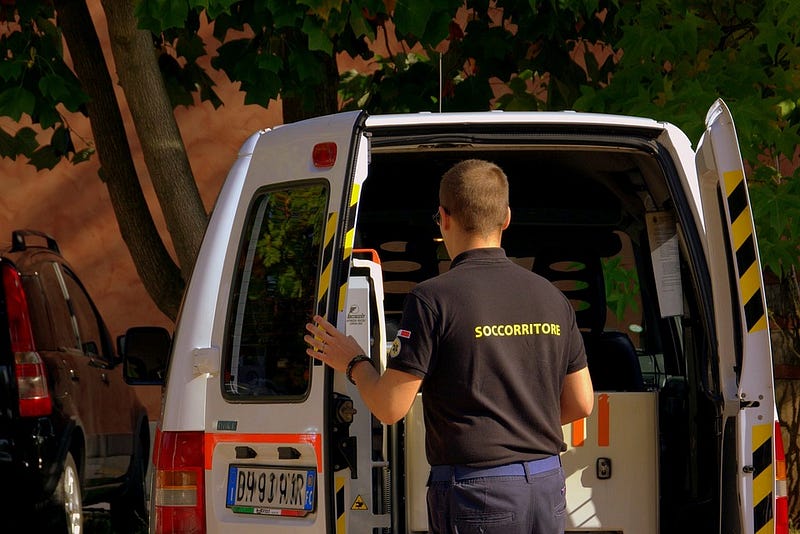
On December 26, 2019, my husband arrived by ambulance at the local hospital. Although not a typical way to spend Boxing Day, it seemed many others had the same idea. It was a hectic night. The hallways were hustling and bustling as paramedics, nurses, and doctors darted from room to room. If pain were the precursor to being seen first, Ed’s suffering, a ten out of ten, would have put him ahead of the pack.
But Ed had a high pain threshold, and to his detriment, he didn’t wince. He didn’t even look very sick, but his symptoms said otherwise. So with only weeks after his transplant and being highly immunocompromised, intake gave him a room out of the hallway while waiting to be seen.
Pre-Covid, the large room, held three patients and their visitors. Ed’s bed was in the middle and we could hear everyone’s conversations. The patient to the left of us had been waiting for hours. They were next in line but told there could still be another hour to go.
I worried about what that meant for us as doctors appeared to attend to patients in order of their arrival.
Then again, I can’t complain about Ed’s healthcare from a nursing perspective. From the moment Ed got a cot, a nurse checked his vitals. He asked him questions about his current state and inquired about his pain. He immediately returned with medication to combat it. Then he checked on him periodically to ensure Ed had found relief.
It surprised and relieved me to see that the doctors allowed medication before being seen by one of them. I thought they would like to assess him before masking any symptoms, but either I was wrong, or it spoke to how busy they were and how inhumane it would be to hold patients in crisis for so long.
We waited for a doctor. And waited. And waited, but no one came to evaluate Ed. I was thankful to the nurse, who came often to ensure his pain remained manageable and that no other symptoms had appeared. Ed was relatively stable — the nurse kept a watchful eye.
Being in the hospital was an extremely stressful time. Watching a loved one struggle isn’t easy. Unfortunately, I didn’t have the means or experience to help my husband feel better. But our friendly nurse did. I was grateful to see his familiar face whenever he had the time to visit.
When a doctor poked his head in, he explained he hadn’t seen the Emergency room this busy in over nine years. He said they were trying to get to Ed, but it would still be quite a wait. Still, despite his welcomed update, he didn’t take a moment to examine him.
Ed arrived at the hospital at 5:30 pm. I hadn’t eaten dinner because calling the ambulance happened quickly. After seven hours of being in Emergency and still not seeing a doctor, I politely asked the nurse if there was anything I could eat? I was extremely grateful when he brought me a tuna sandwich without hesitation or a glare.
Since Ed’s transplant, I’ve learned that nurses faced caring for patients and their loved ones. I wonder if this was part of their mandate when they went to school or an added burden with the job?
After being in the emergency department for approximately eight hours, Ed finally saw a doctor. First, he listened to my husband’s symptoms and noted his pain. Then, he sent Ed for a CT scan to rule out anything life-threatening.
I wondered how someone with a potentially life-threatening illness could be in the emergency department for so long without a quick assessment when he first arrived. While Ed waited for a technician to pick him up and take him for the test, we saw the nurse twice reassuring us someone would take him soon.
It turned out that Ed’s CT scan revealed an incarcerated hernia, so the hospital scheduled him for emergency surgery.
During his wait, Boxing Day had come and gone and the Emergency department had cleared out considerably. The problem was now it was 2:30 in the morning and all the transplant surgeons had gone home.
I was frantic. Now knowing the state of Ed’s hernia was indeed serious, I felt helpless and alone. We had been at the hospital for nearly ten hours — and so had our nurse. He was the only person at the hospital who showed us any consistent care.
I don’t know if this was an extraordinarily long shift for him because of the holiday season or the mayhem, or if it was his regular shift, but I, for one, was glad he was there. His constant positive reinforcement helped keep my nerves as calm as was possible.
During Ed’s surgery, the surgeon found his hernia had strangulated. A dire situation. The doctor and nurses worked on his hernia and removed a piece of his intestine.
A kind and lovely nurse allowed me into the recovery room to witness that Ed was stable. Then, when an orderly wheeled him into the ward in the transplant unit, Ed met with a team of nurses whose sole job was to tend to the needs of their patients and to offer them the highest quality of care.
I learned the true value nurses bring to their patients throughout this ordeal. They witness a lot and put up with even more, especially in the direst of situations. It didn’t matter that it was during the holiday season. I felt their dedication.
We never saw the nurse again from that chaotic night in the emergency department. His care for Ed was exceptional under the circumstances, as I don’t doubt it was for his other patients. He took that busiest night of the year at the hospital in stride.
Perhaps, Nurseslabs says it best.
Nurse. Just another word to describe a person strong enough to tolerate everything and soft enough to understand everyone.
I couldn’t agree more.
The writing of this story was inspired by Barb Dalton’s call out for articles around the holiday season about our memorable experiences with nurses.
Since 2019, Ed has battled many hernias and struggles with another two today. It’s likely an effect from his transplant. Although facing more surgeries is never easy, at least we know we will meet kind and compassionate nurses who will be there by his side.
Thank you Barb for housing stories like these where we can share our appreciation.